17 Essential Environment and Conservation Stories for Eco Leaders


According to Press Monitor's tracking of Indian publications, this press review delivers 17 essential environment and conservation stories drawn from today's print media monitoring data. From waste-to-energy pollution in Hyderabad and Delhi to forest protection orders in Jharkhand, from snow leopard research in the Himalayas to water conservation in Karnataka, this news on environment and conservation roundup reflects the depth and diversity of India's print landscape. These stories, powered by media intelligence gathered from 25 articles across multiple Indian newspapers, reveal the urgent environmental challenges and conservation wins shaping the country's future.
1. 37 Die in Nigeria Oil Theft Fumes
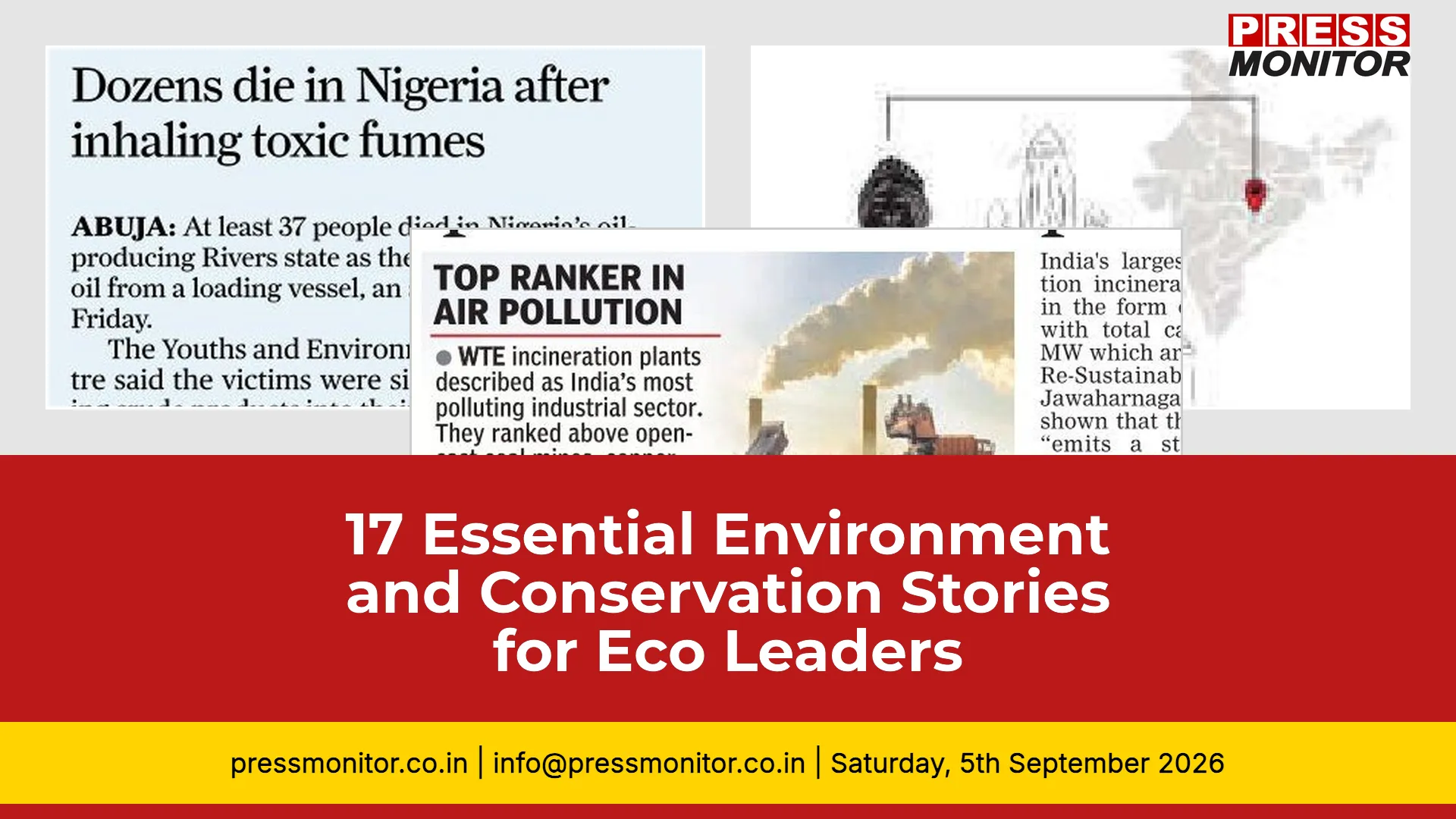
A front-page report in Millennium Post says that at least thirty-seven people died in Nigeria's oil-producing Rivers state after inhaling toxic fumes while trying to steal oil from a loading vessel. The Youths and Environmental Advocacy Centre said the victims were siphoning crude products into their boats from an illegal tapping point on Thursday, and many people are still missing.
Why it matters: Toxic fumes from illegal oil siphoning claim lives in Nigeria's Rivers State, highlighting the human cost of petroleum theft and environmental negligence.
Key detail: At least thirty-seven people died after inhaling toxic fumes while trying to steal oil from a loading vessel; many remain missing.
Source: Millennium Post, reported from Abuja.
Next step: International energy regulators and environmental advocacy groups must coordinate on maritime security and illegal oil tapping prevention.
2. Chhattisgarh Leads Rainwater Harvesting
A front-page report in New Indian Express says Chhattisgarh has emerged as the best performer in rainwater harvesting under the Ministry of Jal Shakti's flagship campaigns due to grassroots participation. The state's success stems from four measures including state-specific 'Catch the Rain' plans, State Water Awards, mapping of water structures, and quarterly reviews, with five districts ranking among the national Top 10. Additionally, the state launched the Tribal Incentives on Natural Resources Portal to empower indigenous miners in Bastar by tethering tin collector earnings directly to global market valuations via the London Metal Exchange.
Why it matters: Chhattisgarh's grassroots-driven rainwater harvesting model offers a replicable blueprint for water-stressed states across India.
Key detail: Five districts in Chhattisgarh rank among the national Top 10 under the Ministry of Jal Shakti's flagship campaigns, supported by state-specific Catch the Rain plans and State Water Awards.
Source: New Indian Express, reported from Chhattisgarh.
Next step: Other states should study Chhattisgarh's four-pronged approach and adapt it locally.
3. India's Largest Incinerator Emits Methane
A front-page report in Deccan Chronicle says that the 48‑megawatt incineration plant in Jawaharnagar, operated by Re‑Sustainability Ltd, is the country’s largest waste‑to‑energy facility and emits 5.9 tonnes of methane per hour, amounting to about 49,000 tonnes annually and 3.96 million tonnes of carbon‑dioxide equivalent, according to a study by NASA Jet Propulsion Laboratory and UCLA scientists using Carbon Mapper satellite data. The study highlights that high‑moisture waste is inefficient to burn, releasing large volumes of carbon dioxide and methane.
Why it matters: India's largest waste-to-energy facility at Jawaharnagar is emitting methane at levels that undermine climate goals and public health.
Key detail: The 48-megawatt plant operated by Re-Sustainability Ltd emits 5.9 tonnes of methane per hour, equating to roughly 49,000 tonnes annually and 3.96 million tonnes of CO2 equivalent, per NASA Jet Propulsion Laboratory and UCLA satellite data.
Source: Deccan Chronicle.
Next step: The Central Pollution Control Board must revisit the 2025 Blue category reclassification that allows these plants to bypass stricter red-tier monitoring.
4. High Court Stays Felling of 13,681 Trees
A front-page report in Morning Standard says the Jharkhand High Court has stayed the felling of 13,681 full-grown trees for the construction of a bypass around Chatra. Justice Ananda Sen directed that none of the identified trees be felled until further orders and left it to the concerned authorities to reconsider the proposed road alignment and explore alternative routes that could minimise tree loss. The court also impleaded the Union Ministry of Environment, Forest and Climate Change and the Union Ministry of Road Transport and Highways as respondents.
Why it matters: The Jharkhand High Court's intervention protects 13,681 full-grown trees from being felled for a bypass road, setting a precedent for environmental judicial activism.
Key detail: Justice Ananda Sen directed that none of the identified trees be felled until further orders and impleaded the Union Ministry of Environment, Forest and Climate Change and the Union Ministry of Road Transport and Highways as respondents.
Source: Morning Standard, reported from Ranchi.
Next step: Authorities must explore alternative road alignments that minimise tree loss while meeting infrastructure needs.
5. Vantara Announces New Governing Council
A front-page report in Free Press Journal says Vantara on Friday announced the full membership of its newly established Governing Council. The Council will oversee Vantara’s conservation, rescue and compliance work, take the final decision on any future applications to import wild animals, and help set Vantara’s vision for the next five years and beyond. The five-member Council includes John E. Scanlon AO, Hon. Justice Krishna Murari, Mr Craig Hoover, Subhash K. Malkhede, and Ms Greta F. lori, with Dr Kushal Konwar Sarma as an ex officio non-voting member.
Why it matters: Vantara's newly formed Governing Council signals a maturing governance framework for wildlife conservation and rescue operations in India.
Key detail: The five-member Council includes John E. Scanlon AO, Hon. Justice Krishna Murari, Craig Hoover, Subhash K. Malkhede, and Greta F. Lori, with Dr Kushal Konwar Sarma as ex officio non-voting member. The Council will oversee conservation, rescue, compliance, and future wild animal import applications.
Source: Free Press Journal.
Next step: The Council should prioritise transparency in its decision-making, especially regarding wild animal import applications that carry significant ecological risks.
6. 4,000 Tonnes WTE Plant Opposed
A front-page report in Deccan Chronicle says the Centre for Financial Accountability opposes the Telangana government's plan for a 4,000 tonnes per day waste-to-energy plant at Siddapur in Rangareddy district. The CFA says the proposed plant was reclassified under CPCB's 2025 Blue category, bypassing mandatory public hearings and environmental impact assessments. Villagers fear heavy metal contamination and air pollution similar to the Jawaharnagar incident.
Why it matters: A proposed 4,000 tonnes per day waste-to-energy plant at Siddapur in Telangana faces opposition over environmental bypasses and public health risks.
Key detail: The Centre for Financial Accountability says the plant was reclassified under CPCB's 2025 Blue category, bypassing mandatory public hearings and environmental impact assessments. Villagers fear heavy metal contamination and air pollution similar to the Jawaharnagar incident.
Source: Deccan Chronicle.
Next step: The Telangana government must conduct proper public consultations and environmental impact assessments before proceeding with the Siddapur plant.
7. Karnataka Minister Targets Lake Encroachments
A front-page report in Free Press Journal says Karnataka Minister Eshwar Khandre announced a crackdown on lake encroachments, pledging to remove encroachments covering 1,67l acres across 4,828 lakes and file criminal cases. The minister, speaking in Delhi at a Union Ministry of Jal Shakti summit, highlighted Karnataka’s drought‑prone status and urged the Centre to launch a national programme to protect lakes, reservoirs and rivers.
Why it matters: Karnataka's crackdown on lake encroachments addresses a critical water conservation crisis in a drought-prone state.
Key detail: Minister Eshwar Khandre pledged to remove encroachments covering 1,670 acres across 4,828 lakes and file criminal cases, speaking at a Union Ministry of Jal Shakti summit in Delhi.
Source: Free Press Journal.
Next step: The Centre should launch a national programme to protect lakes, reservoirs, and rivers, as urged by the Karnataka minister.
8. Rs 4.43 Crore For Alibaug Mangrove Eco Zone
A front-page report in Free Press Journal says the Alibaug Municipal Council has been sanctioned Rs 4.43 crore under the Centre's Amrit 2.0 scheme to develop a 2.3-acre green zone for ecotourism and environmental awareness. The project features an elevated boardwalk to protect local mangroves and an interactive learning site, with officials targeting work order issuance by next year. It aims to promote sustainable tourism while educating citizens about coastal ecosystem conservation.
Why it matters: Mangrove conservation in Alibaug receives significant funding, promoting sustainable tourism and coastal ecosystem protection.
Key detail: The Alibaug Municipal Council has been sanctioned Rs 4.43 crore under the Centre's Amrit 2.0 scheme to develop a 2.3-acre green zone featuring an elevated boardwalk and interactive learning site.
Source: Free Press Journal.
Next step: Work order issuance should be accelerated to meet the target timeline and protect the mangrove ecosystem.
9. Kulbhushansingh Suryawanshi Snow Leopard Conservation
A front-page report in Deccan Herald says award-winning scientist Kulbhushansingh Suryawanshi dedicated his life to snow leopard conservation after a childhood tiger story sparked his interest. He studied mountaineering and wildlife biology, leading to groundbreaking fieldwork in the Himalayas documenting elusive snow leopards.
Why it matters: Award-winning scientist Kulbhushansingh Suryawanshi's lifelong dedication to snow leopard conservation highlights the importance of individual commitment to endangered species protection.
Key detail: Suryawanshi's childhood tiger story sparked his interest in wildlife biology, leading to groundbreaking fieldwork in the Himalayas documenting elusive snow leopards.
Source: Deccan Herald.
Next step: Greater investment in snow leopard research and habitat protection is needed to secure the species' future in the face of climate change and habitat fragmentation.
10. 250 Square Kilometers Snow Leopard Territory
A front-page report in Deccan Herald says that Kulbhushansingh Suryawanshi has spent two decades tracking elusive snow leopards in India’s Himalayas, where the cat’s population is estimated at around 702 and faces threats from habitat fragmentation and climate change. His work with the Snow Leopard Trust has centred on women-led conservation initiatives in Spiti and Ladakh, while his new book, The Ghost of the Mountains, documents the species’ secrets and the complex relationship between local communities and the predator.
Why it matters: New research on snow leopard territory and community-based conservation offers hope for the species' survival in the Himalayas.
Key detail: Kulbhushansingh Suryawanshi has spent two decades tracking snow leopards across approximately 702 remaining in the wild, with women-led conservation initiatives in Spiti and Ladakh. His new book, The Ghost of the Mountains, documents the species' secrets.
Source: Deccan Herald.
Next step: The book launch should be leveraged to raise awareness and funding for community-based conservation programs in the Himalayan region.
11. Delhi Waste Plants Hit Maximum Pollution
A front-page report in The Pioneer says a Centre for Financial Accountability study found four major waste-to-energy plants in Delhi scored a perfect 100 on the Pollution Index, making them more polluting than coal facilities. The analysis criticises the Central Pollution Control Board’s January 2025 decision to reclassify these plants into a self-assessing blue category, bypassing stricter red-tier monitoring. Researchers warn that this regulatory shift effectively permits the continued operation of highly hazardous facilities while generating 68 per cent higher greenhouse gas emissions than traditional thermal power stations.
Why it matters: Four major Delhi waste-to-energy plants scoring a perfect 100 on the Pollution Index represent a severe environmental and public health crisis in the capital.
Key detail: The CFA study found these plants generate 68 percent higher greenhouse gas emissions than traditional thermal power stations, while the CPCB's 2025 Blue category reclassification allows them to bypass stricter red-tier monitoring.
Source: The Pioneer.
Next step: The Central Pollution Control Board must reverse the Blue category decision and reinstate mandatory emissions monitoring for all waste-to-energy facilities.
12. PMK Opposes Pallikaranai Wall Construction
A front-page report in New Indian Express says PMK president Dr Anbumani Ramadoss urged the state government to halt construction of a three-kilometre retaining wall and two-kilometre walkway in Pallikaranai marshland. The project, initiated by the previous DMK government at a cost of 2 lakh crore rupees, is being continued by the present TVK government despite fears it will obstruct water flow and increase flooding risk in Chennai.
Why it matters: The proposed retaining wall in Pallikaranai marshland threatens Chennai's flood resilience and wetland ecosystem.
Key detail: PMK president Dr Anbumani Ramadoss urged the state government to halt construction of a three-kilometre retaining wall and two-kilometre walkway, initiated by the previous DMK government at a cost of 2 lakh crore rupees.
Source: New Indian Express, reported from Chennai.
Next step: The Tamil Nadu government must conduct an environmental impact assessment before continuing the Pallikaranai project.
13. Delhi Air Pollution Carries Antibiotic-Resistant Bacteria
A front-page report in Deccan Herald says a study led by Professor Kasturi Mukhopadhyay at Jawaharlal Nehru University found high levels of antibiotic-resistant bacteria in Delhi's polluted air. The research suggests fine particulate matter may carry microbes deeper into lungs where biofilms help them evade antibiotics, worsening COPD and potentially linking to lung cancer. Experts note reducing pollution exposure and early diagnosis remain key priorities while microbiome-based treatments show promise.
Why it matters: New research reveals that Delhi's polluted air carries antibiotic-resistant bacteria, posing a novel public health threat that compounds existing respiratory disease risks.
Key detail: Professor Kasturi Mukhopadhyay's study at Jawaharlal Nehru University found that fine particulate matter may carry microbes deeper into lungs where biofilms help them evade antibiotics, potentially worsening COPD and linking to lung cancer.
Source: Deccan Herald.
Next step: Public health authorities must integrate air quality and antimicrobial resistance monitoring into a unified response strategy.
14. India Minister Urges Water Protection Plan
A front-page report in Free Press Journal says Karnataka minister Khandre warned excessive groundwater extraction has lowered the water table. He urged the Centre, in the presence of the prime minister, to formulate a national programme to protect lakes and rivers from pollution and encroachment. Khandre noted that 11,498 of 32,504 lakes under gram panchayat jurisdiction in Karnataka had been encroached upon.
Why it matters: A national water protection plan is urgently needed as groundwater extraction lowers water tables and lake encroachments multiply across India.
Key detail: Karnataka minister Khandre noted that 11,498 of 32,504 lakes under gram panchayat jurisdiction in Karnataka had been encroached upon, and urged the Centre to formulate a national programme to protect lakes and rivers.
Source: Free Press Journal.
Next step: The Centre should formulate a comprehensive national water protection programme that addresses both groundwater extraction and lake encroachment.
15. 105 Rural Lakes Rejuvenated for Rs 50 Crore
A front-page report in The Hans India says the state government is modernising and rejuvenating 105 rural lakes across Andhra Pradesh at an estimated cost of nearly Rs 50 crore under the Pradhan Mantri Krishi Sinchayee Yojana. Deputy Chief Minister Pawan Kalyan is spearheading the project, which includes installing open-air gyms, walking tracks, solar lighting, and parks to improve rural health and recreation. 26 lakes have already been completed and opened to the public, with the remaining works scheduled for completion by the end of September to enhance groundwater recharge, irrigation, and local drinking water resources.
Why it matters: Andhra Pradesh's initiative to rejuvenate 105 rural lakes demonstrates how targeted government investment can restore water resources and improve rural livelihoods.
Key detail: Under the Pradhan Mantri Krishi Sinchayee Yojana, Deputy Chief Minister Pawan Kalyan is spearheading the project at an estimated cost of nearly Rs 50 crore, with 26 lakes already completed and the remaining works scheduled for completion by end of September.
Source: The Hans India, reported from Amaravati.
Next step: The project's success should be evaluated and replicated in other water-stressed states.
16. Haryana Village Pond Toxic
A front-page report in The Hindu says a toxic pond at Kajalheri village in Haryana has turned a community reserve into a dangerous habitat for rare turtles, forcing them to flee due to untreated sewage. Local residents and a wildlife conservationist have accused officials of negligence, while authorities cite a shortage of funds as the reason for the delay in remedial measures.
Why it matters: A toxic pond in Haryana has turned a community reserve into a dangerous habitat for rare turtles, exposing gaps in local environmental enforcement.
Key detail: Untreated sewage at Kajalheri village in Haryana has forced rare turtles to flee the Shri Guru Gorakhnath Community Reserve, with local residents and a wildlife conservationist accusing officials of negligence.
Source: The Hindu, reported from Gurugram.
Next step: Authorities must allocate sufficient funds for remedial measures and establish a dedicated wastewater diversion channel as promised by the Forest Department.
17. FIR Sought for Turtle Habitat Pollution
A front-page report in Tribune says that wildlife conservationist Vaishali Rana has filed an FIR over untreated sewage polluting the Shri Guru Gorakhnath Community Reserve in Fatehabad’s Kajal Heri, threatening the 150‑200 Indian softshell turtles. The Forest Department has pledged to build a separate channel to divert wastewater away from the pond.
Why it matters: A wildlife conservationist's FIR over turtle habitat pollution in Fatehabad highlights the role of citizen activism in environmental enforcement.
Key detail: Conservationist Vaishali Rana filed an FIR over untreated sewage polluting the Shri Guru Gorakhnath Community Reserve in Fatehabad's Kajal Heri, threatening 150-200 Indian softshell turtles. The Forest Department has pledged to build a separate channel to divert wastewater.
Source: Tribune.
Next step: The Forest Department must expedite the wastewater channel construction and ensure the FIR leads to tangible remedial action.
Closing: What environmental story from today's print media surprised you the most? Share your thoughts in the comments. For the full press review and media monitoring digest, visit pressmonitor.co.in.