17 Essential Environment and Conservation Stories for Indian Policymakers


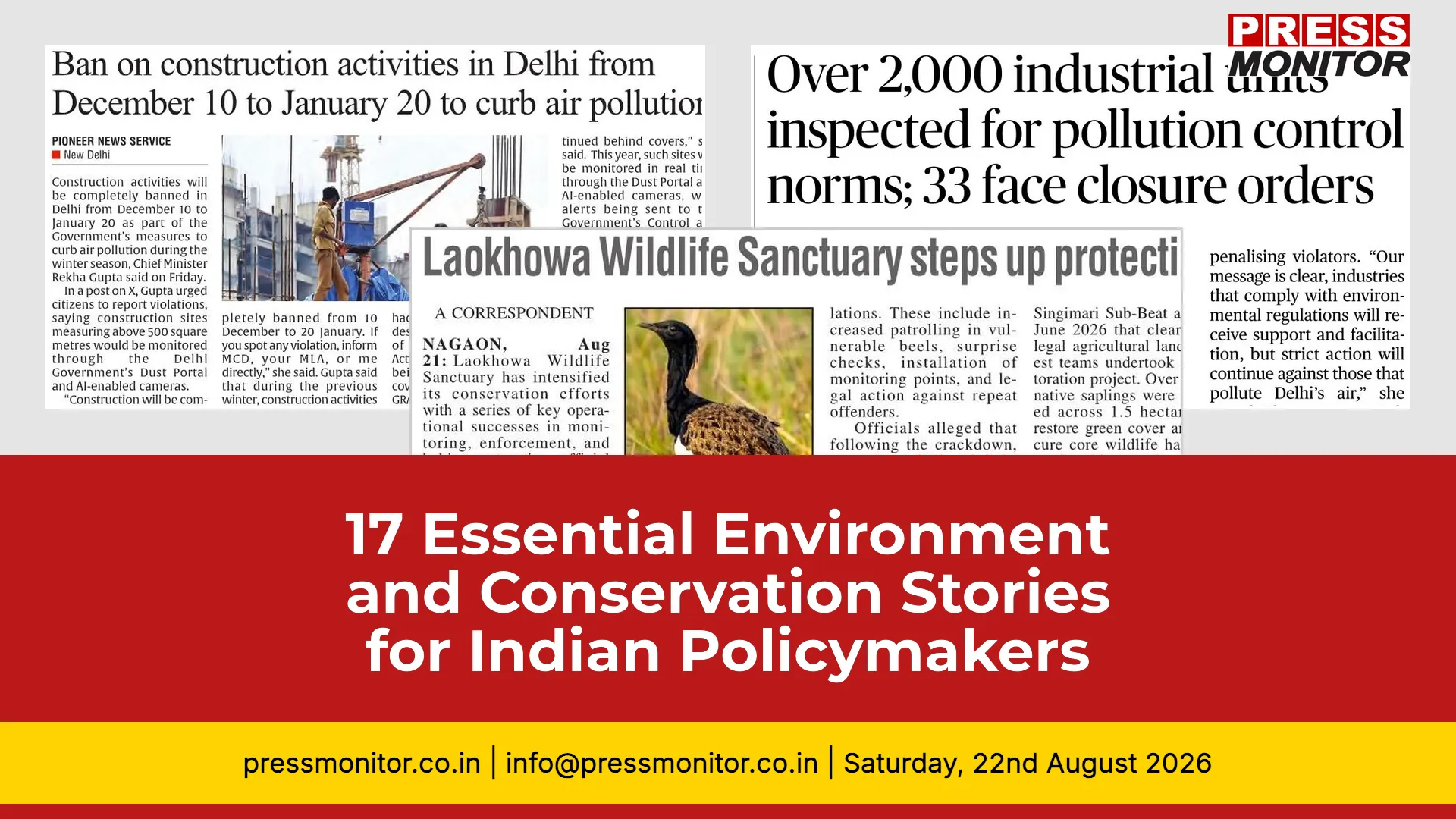
In today's press review powered by Press Monitor's comprehensive print media monitoring, we curate 17 critical stories shaping India's environment landscape. From air pollution crackdowns to biodiversity discoveries, here's what Indian newspapers are reporting.
1. Delhi Announces 42-Day Construction Ban to Curb Winter Pollution
A front-page report in The Pioneer says that construction activities will be completely banned in Delhi from December 10 to January 20 as part of the Government's measures to curb air pollution during the winter season. Chief Minister Rekha Gupta urged citizens to report violations, saying construction sites measuring above 500 square metres would be monitored through the Delhi Government's Dust Portal and AI-enabled cameras.
Why it matters: This is the most-covered story of the day, reflecting growing public concern over Delhi's air quality. The ban from December 10 to January 20 targets peak pollution months.
Key detail: Construction sites over 500 sq m will be monitored via AI-enabled cameras and the Dust Portal. Chief Minister Rekha Gupta urged citizens to report violations.
Source: The Pioneer (front page)
Next step: Citizens can report violations; real-time monitoring data available.
2. Delhi Government Inspects 2,000 Industrial Units for Pollution Compliance
A front-page report in The Hindu says that the Delhi government inspected 2,000 industrial units between January and July this year, imposing environmental compensation on 44 units and issuing closure orders against 33 for non-compliance. The inspections were part of a campaign led by Chief Minister Rekha Gupta to monitor industrial pollution and ensure compliance.
Why it matters: Industrial emissions are a major source of Delhi's pollution. The inspections signal stricter enforcement.
Key detail: Between January and July 2026, 2,000 units were inspected; environmental compensation imposed on 44, closure orders on 33.
Source: The Hindu (front page)
Next step: Expected to continue with AI-based monitoring.
3. Laokhowa Wildlife Sanctuary Steps Up Protection, Records Rare Bird Sighting
A front-page report in Sentinel says Laokhowa Wildlife Sanctuary has intensified its conservation efforts with a series of key operational successes in monitoring, enforcement, and habitat restoration. During the 7th Kaziranga Waterbird Count 2026, sanctuary staff recorded a high overall bird count and rich species diversity across major wetlands including Rowmari, Dondowa, and Muamari Beels. In a significant finding, the team documented the first-ever sighting of the rare migratory Smew Mergellus albellus as well as the Bengal florican in the sanctuary, highlighting Laokhowa’s growing importance as a wintering ground for waterbirds.
Why it matters: First-ever sighting of rare migratory Smew (Mergellus albellus) and Bengal florican highlights sanctuary's ecological importance.
Key detail: High bird count and species diversity recorded during 7th Kaziranga Waterbird Count.
Source: Sentinel (front page)
Next step: Continued habitat restoration and anti-poaching patrols.
4. CPCB Directs Action Against Shree Cement Plant for Violations
A front-page report in Tribune says the Central Pollution Control Board (CPCB) has directed the Haryana State Pollution Control Board (HSPCB) to take appropriate action against Shree Cement plant in Panipat for violations observed during inspections.
Why it matters: CPCB enforcement reinforces environmental compliance in industrial operations.
Key detail: Haryana State Pollution Control Board ordered to take action based on inspection violations at Shree Cement's Panipat plant.
Source: Tribune (front page)
Next step: HSPCB to submit action taken report.
5. Rajasthan Seeks Supreme Court to Consider Jojari River Pollution Panel Report
"A front-page report in First India says" the Rajasthan Government has urged the Supreme Court to take into account the recommendations of a high-level ecosystem oversight committee in the case concerning pollution of the Jojari River. Rajasthan’s Additional Advocate General Shiv Mangal Sharma indicated that the State requested the court to incorporate the findings of the committee’s report dated August 2O, 2O26, in its judgment. The State Government has sought consideration of the report prepared by the high-powered committee before the court pronounces its final decision. The case relates to concerns over pollution of the Jojari River and its impact on the surrounding ecosystem.
Why it matters: Pollution of Jojari River affects ecosystem and local communities. Supreme Court involvement could set precedent.
Key detail: State requests court to incorporate recommendations of high-level ecosystem oversight committee before final judgment.
Source: First India (front page)
Next step: Court to consider report and decide.
6. Illegal Power Lines Removed in Kawal Tiger Reserve
A front-page report in Deccan Chronicle says the state electricity department has agreed to remove all illegal power connections inside the Kawal tiger reserve and the tiger corridor areas.
Why it matters: Power lines in tiger corridor pose electrocution risk to wildlife. Removal is a conservation win.
Key detail: State electricity department agreed to remove all illegal connections inside Kawal tiger reserve and corridor areas.
Source: Deccan Chronicle (front page)
Next step: Restoration of habitat.
7. High Uranium Levels Found in Breast Milk in Bihar
A front-page report in Statesman says a study evaluated breast milk of randomly selected 40 lactating mothers living in regions of different districts along the Gangetic plain in Bihar where people use uranium contaminated groundwater. The study revealed significantly high uranium content in breast milk of lactating mothers. Exposure to uranium can pose significant health risks including kidney damage, bone damage and an increased risk of cancer.
Why it matters: Health risk to infants from groundwater contamination. Urgent need for water quality monitoring.
Key detail: Study of 40 lactating mothers along Gangetic plain in Bihar revealed significantly high uranium content.
Source: Statesman (front page)
Next step: Health advisories and groundwater treatment.
8. Solar Energy Expansion Poses Hidden Biodiversity Risks
A front-page report in Deccan Herald says that the global push to expand solar energy could carry hidden biodiversity costs. The research spanning more than 2,300 Chinese counties found that pro-solar policies reduced bird diversity as cropland and grassland were rapidly cleared for development.
Why it matters: Trade-off between clean energy and biodiversity. Policy needs to balance both.
Key detail: Research across 2,300 Chinese counties found solar policies reduced bird diversity due to land clearing.
Source: Deccan Herald (front page)
Next step: Integrate ecological impact assessments in solar projects.
9. Madras High Court Stays Tamil Nadu Law Allowing Felling of Rosewood Trees
A front-page report in New Indian Express says the Madras High Court has temporarily stayed a G.O issued by the state accepting the recommendations of the Principal Chief Conservator of Forests for repealing the Tamil Nadu Rosewood Trees (Conservation) Act, 1994.
Why it matters: Rosewood conservation critical for biodiversity. Court intervention protects endangered tree species.
Key detail: HC stayed government order to repeal Tamil Nadu Rosewood Trees (Conservation) Act, 1994.
Source: New Indian Express (front page)
Next step: Final hearing pending.
10. Nilgiri Wild Jamun Trees Fail to Flower, Raise Ecological Concerns
A front-page report in New Indian Express says the endangered Nilgiri wild jamun tree has failed to flower and bear fruit in its natural habitat, raising concerns about the ecological health of the area.
Why it matters: Indicator of climate change impact on endemic species.
Key detail: Endangered Nilgiri wild jamun has not flowered or fruited in its natural habitat.
Source: New Indian Express (front page)
Next step: Research on causes and restoration measures.
11. Rajasthan High Court Orders Compensatory Planting for Road Widening Project
A front-page report in Millennium Post says the Rajasthan High Court has intervened in a road widening project, ordering ten saplings be planted for every tree felled. The report highlights that compensatory planting cannot replace the ecological role of mature trees lost to infrastructure development and suggests environmental considerations should be integrated early in planning.
Why it matters: Balances development with environmental protection. Sets precedent for infrastructure projects.
Key detail: Court ordered 10 saplings for every tree felled, noting compensatory planting cannot replace mature trees.
Source: Millennium Post (front page)
Next step: Implement compensatory plantation plan.
12. Delhi Embraces Urban Farming for Greener Capital
A front-page report in The Pioneer says Delhi is encouraging urban farming, vegetable gardens, and rooftop farming to create a greener and more sustainable Capital.
Why it matters: Urban agriculture improves air quality, food security, and green cover.
Key detail: Government encouraging vegetable gardens, rooftop farming as part of sustainability push.
Source: The Pioneer (front page)
Next step: Expansion of urban farming initiatives.
13. Delhi's Comprehensive Pollution-Free Formula Unveiled
A front-page report in Navbharat Times says that a comprehensive plan to reduce pollution in Delhi has been prepared. The plan focuses on air and noise pollution by implementing noise barriers, green walls, and promoting IT and high-tech clean industries.
Why it matters: Multi-pronged strategy addressing air and noise pollution.
Key detail: Plan includes noise barriers, green walls, promotion of IT and clean industries.
Source: Navbharat Times (front page)
Next step: Implementation across departments.
14. Rs 3,722-Crore Delhi Master Plan Fails to Address Water Shortage
A front-page report in The Times of India says that Delhi's most recent Master Plan (MPD 2047) continues to ignore the persistent water shortages and infrastructure gaps that plague the city. High-rise buildings raise challenges unaddressed by a developing city's aging support systems, while previous plans contribute to unauthorised settlements and underdeveloped housing along peripheral projects. High-density living strains water supply, sewage, electricity, and waste management, leading to reliance on unplanned-behavenabled communities.
Why it matters: Urban planning gaps affecting millions. High-rises strain basic amenities.
Key detail: Master Plan 2047 criticized for ignoring persistent water shortages and infrastructure deficits.
Source: Times of India (front page)
Next step: Policy revisions needed.
15. Hilsa Fish Returns to Upper Ganga, Signals Conservation Success
A front-page report in Economic Times says successful conservation efforts have reportedly returned the hilsa to the upper Ganga after several decades this season. The development could break a vicious cycle of over-fishing and silting rivers that threatens population collapse for the fish.
Why it matters: Reversal of overfishing trend. Multinational cooperation needed for sustainable fishing.
Key detail: Successful conservation efforts brought hilsa back to upper Ganga after decades.
Source: Economic Times (front page)
Next step: Strengthen cooperation between states and countries.
16. KSPCB Initiates Inquiry Against 4 Officers in Plastic Recycling Scam
A front-page report in Deccan Herald says that an internal fact-finding committee has held four officials of the Karnataka State Pollution Control Board (KSPCB) responsible for the plastic recycling scam involving a company in Ramanagara that has been slapped with a penalty of Rs 174 crore for issuing fake recycling certificates.
Why it matters: Fraud in recycling undermines environmental governance. Accountability crucial.
Key detail: Internal committee held four officials responsible for scam involving fake recycling certificates worth Rs 174 crore.
Source: Deccan Herald (front page)
Next step: Departmental action and criminal investigation.
17. Uttarakhand High Court Reserves Verdict on Land for New High Court Complex
"Selon The Hans India, the Uttarakhand High Court has reserved its decision on a petition challenging the administrative approval given to the land identified for the new high court complex construction. The proposed relocation from Nainital to the Bel Baba area of Haldwani has sparked debate over land usage, specifically regarding forest land status. Advocate Raman Shah questioned the suitability of land near the Bel Baba Temple, citing its designation as reserved forest and potential conflict with Section 2 of the Forest (Conservation) Act, 1980, arguing that extensive plantation and the land's character as a forest cannot be altered without proper procedure. The petitioner also requested an inquiry into officials involved and sought appropriate action if violations are found, highlighting the site’s location within an elephant corridor and an environmentally sensitive area."
Why it matters: Conflict between development and forest conservation.
Key detail: Proposed relocation to Haldwani's Bel Baba area challenged as it involves reserved forest land in elephant corridor.
Source: The Hans India (front page)
Next step: Court decision awaited.
This press review is compiled by Press Monitor, India's leading media intelligence platform. Which story matters most to you? Drop your comments below.