17 Essential Food & Beverage Industry Stories for Decision Makers


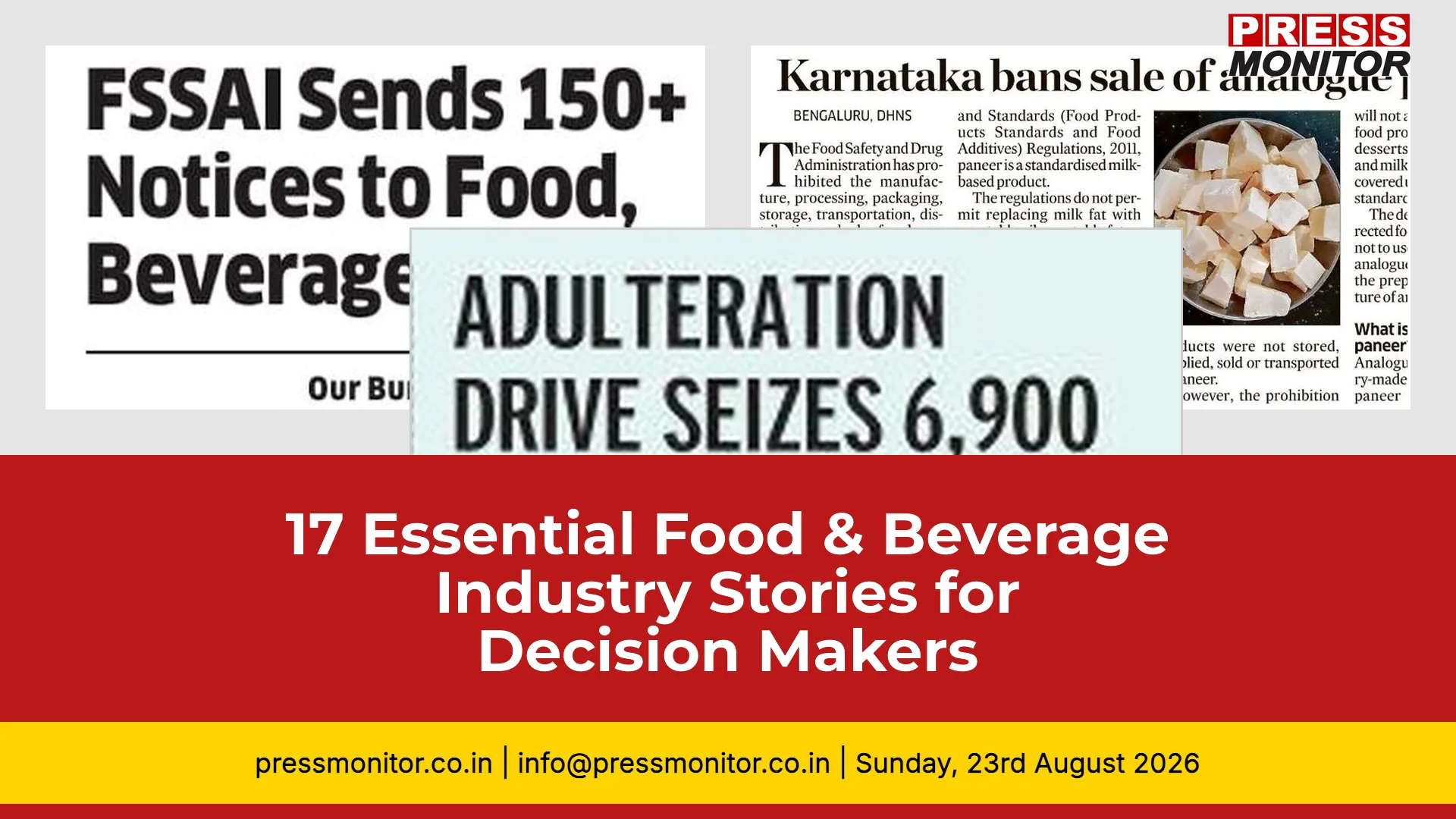
Welcome to today's curated press review from Press Monitor, your definitive source for print media intelligence on the Indian food and beverage industry. Over 150 food brands face FSSAI notices for misleading ads, Karnataka bans analogue paneer, and food safety crackdowns intensify nationwide. Here are the 17 stories you need to know.
1. Over 150 Food Brands Scrutinized for Advertising Violations
"Selon Economic Times, India’s food safety regulator has issued more than 150 notices to food and beverage companies for misleading advertisements, false claims and labelling violations, bringing some of the country’s biggest consumer brands under scrutiny. The Food Safety and Standards Authority of India has named companies including Nestle India, PepsiCo, Mondelez India, Coca-Cola India, Danone India, Ferrero India, Diageo, Pernod Ricard and energy-drink makers Red Bull, Monster and Hell Energy among those that received notices. The regulator also seized products for non-compliance with food-safety and standards regulations and issued 12 notices to quick-commerce platforms including Flipkart Minutes and Amazon Now. The license of a Amazon warehouse has also been cancelled, according to FSSAI data. Food-service operators have also come under the regulator’s lens. More than 30 notices were issued to establishments including KFC, Pizza Hut, Domino's, Costa Coffee and McDonalds, while more than 20 notices were sent to food-service establishments including top hotels and restaurants. The notices to hotels and restaurants included international chains such as Marriott, Hilton, Hyatt, Radisson Hotel Group, Four Seasons and Shangri- La, with violations relating to calorie disclosure and menu labelling."
Why it matters: India's food safety regulator is taking a hard line on misleading claims affecting consumer trust.
Key detail: FSSAI issued over 150 notices to Nestle India, PepsiCo, Mondelez, Coca-Cola, and others. Quick-commerce platforms like Flipkart Minutes and Amazon Now also received notices. An Amazon warehouse license was cancelled.
Source: Economic Times, with cross-reporting from Free Press Journal, Millennium Post, Business Line, and The Hindu.
Next step: Brands must review advertising claims and labelling compliance immediately.
2. Karnataka Bans Sale of Analogue Paneer
A front-page report in Deccan Herald says Karnataka has banned the sale of analogue paneer for one year. The prohibition, issued under the Food Safety and Standards Act, 2006, will remain in force until August 17, 2027, to ensure public health and that such products are not sold as paneer.
Why it matters: Protecting the authenticity of traditional dairy products.
Key detail: The one-year ban under the Food Safety and Standards Act, 2006, prohibits non-dairy paneer being sold as paneer, effective until August 2027.
Source: Deccan Herald, Deccan Chronicle.
Next step: Dairy processors should verify product labels and ingredient sourcing.
3. 6900L Suspect Oil Seized in Jaipur
A front-page report in First India says officials under Chief Minister Bhajan Lal Sharma's 'Shuddh Aahar—Milawat Par Vaar' campaign seized 6,900 litres of suspect groundnut oil in Jaipur and destroyed approximately 1150 litres of substandard products statewide during a comprehensive raid on 60 establishments. Under the supervision of Health Minister Gajendra Singh Khimsar and officials including Gayatri Rathore, Commissioner Dr T. Shubhamangala, and Joint Commissioner Dr Vijay Prakash Sharma, 110 samples were collected. Legal action will ensue upon lab findings.
Why it matters: Raids under the 'Shuddh Aahar—Milawat Par Vaar' campaign highlight state-level enforcement against adulteration.
Key detail: 6,900 litres of suspect groundnut oil seized, 1,150 litres of substandard products destroyed, 110 samples collected from 60 establishments.
Source: First India.
Next step: Food businesses should audit oil suppliers and ensure quality checks.
4. FDA Cracks Down on Adulteration in Bhopal
A front-page report in Free Press Journal says... the Food and Drug Administration (FDA) and Bhopal Municipal Corporation (BMC) conducted raids across luxury restaurants and hotels in Bhopal. The drive resulted in 90 cases under food safety regulations violations, with Rs 5.80 lakh in fines imposed on establishments like Bansal One and DB Mall. Officials noted a decline in Madhya Pradesh's adulteration percentage (11%) compared to the national average (16%), with sample failure rates improving from 29% in 2023-24 to 14.4% in 2024-25. Testing limitations persist due to insufficient laboratories in major cities.
Why it matters: Luxury restaurants and hotels are not exempt from food safety regulations.
Key detail: 90 cases filed, Rs 5.80 lakh in fines imposed. Madhya Pradesh's adulteration percentage (11%) is below the national average (16%).
Source: Free Press Journal.
Next step: Hospitality operators must ensure compliance with calorie disclosure and hygiene standards.
5. Misleading Food Ads Can Cost Up to Rs 10 Lakh
A front-page report in Financial Express says Manisha Kapoor, CEO and secretary general of the Advertising Standards Council of India (ASCI), informs that misleading or false claims in food advertisements can amount to a fine of up to 10 lakh rupees. Kapoor states that the ultimate responsibility lies with the brands, who must ensure their teams validate claims before reaching consumers. She notes that recurring concerns involve claims about weight management, immunity, gut health, and blood sugar regulation.
Why it matters: ASCI warns that false claims in food ads carry heavy penalties, putting marketing teams on notice.
Key detail: Manisha Kapoor, CEO of ASCI, states that brands must validate all claims before marketing, especially around weight management, immunity, and gut health.
Source: Financial Express.
Next step: Marketing departments should conduct pre-approval audits of all health claims.
6. 'Natural', 'Organic', 'Healthy' Claims Under Scrutiny
A front-page report in Financial Express says words like 'natural', 'organic', and 'healthy' on food labels are facing scrutiny for lacking substantiation under FSSAI regulations and consumer laws. Dieticians warn that such claims do not guarantee nutritional quality or safety, and advise consumers to read ingredient lists and nutrition panels carefully.
Why it matters: Unsubstantiated label claims are being targeted by regulators and consumer groups.
Key detail: Dieticians advise consumers to check ingredient lists and nutrition panels carefully, as terms like 'natural' lack legal definition.
Source: Financial Express.
Next step: Food manufacturers must substantiate all label claims with scientific evidence.
7. FDA Seizes Substandard Milk Products in Navi Mumbai
A front-page report in Free Press Journal says... The Administration (FDA) seized 1,309 kg/litres of suspected substandard milk and dairy products worth 712.23 lakh during inspections at three establishments in Mahape, Navi Mumbai, on August 19.
Why it matters: Enforcement actions are extending to dairy supply chains.
Key detail: 1,309 kg/litres of suspected substandard milk and dairy products worth Rs 712.23 lakh seized from three establishments in Mahape.
Source: Free Press Journal.
Next step: Dairy processors and retailers should tighten quality control protocols.
8. Schoolchildren Fall Ill After Lizard Found in Meal
A front-page report in Deccan Herald says that scores of children at the upgraded government school in Bidanala village in the taluk took ill on Saturday after they were served meals, during the preparation of which a lizard is said to have fallen into the food, rendering it unfit for consumption.
Why it matters: Food contamination in government schools raises serious public health concerns.
Key detail: Scores of children at a government school in Bidanala village fell ill after a lizard fell into the food during preparation.
Source: Deccan Herald.
Next step: School meal programs must implement stringent kitchen hygiene audits.
9. 38 Schoolchildren Hospitalized After Mid-Day Meal Illness
“A front-page report in the Free Press Journal says” Thirty-eight schoolchildren from a government middle school in Singhana village of Sanwer’s Dharampur area reportedly complained of stomach pain, dizziness, and headache after eating their mid-day meal on Saturday. The children were served ‘kadhi’-rice around 1.30 pm, after which several students reported feeling unwell. The school management immediately informed the parents and arranged medical assistance. Some children were taken to Arbindo Hospital in Indore for examination, while 19 were admitted for observation. They were kept under medical supervision for nearly seven hours and were discharged around 7 pm after doctors found their condition stable. The incident initially raised concerns of food poisoning as several children developed symptoms around the same time. However, the district administration later said that medical examinations did not reveal signs of food poisoning or any other illness in the children. Admin statement All children healthy: The district administration said medical examination found no signs of food poisoning or illness in any of the children. Following the information, collector Shivam Verma directed chief medical and health officer Dr Madhav Prasad Hasani to send a medical team to the village immediately. The team examined the children and reported that all of them were normal and healthy. Officials said the medical examinations were carried out as a precautionary measure. Dr Hasani said one girl had already been unwell and was undergoing treatment for the past three days. After receiving information about the incident, the health department arranged precautionary medical examinations of all the children. Meanwhile, the Food and Drug Administration team visited the school and col. collected samples of the prepared food and_ other necessary materials. The samples have been sent for examination, and officials said the exact reason behind the children’s complaints would be clear only after the test reports are received. The administration is also examining where the meal was prepared, how it was transported to the school and whether quality checks were conducted before it was served. Officials have clarified that no child is currently seriously ill and said the children’s health is being monitored as precaution. Mid-day meal cost Under the PM POSHAN scheme, the material cost for a mid-day meal is Rs 10.17 per child per day for Classes VI VIII and Rs 6.78 for Classes I V, effective from May 1, 2025 The cost covers ingredients and cooking fuel.
Why it matters: Another mid-day meal incident in Madhya Pradesh underscores food safety gaps in the PM POSHAN scheme.
Key detail: 38 children complained of stomach pain and dizziness after eating kadhi-rice. Samples sent for testing; officials later reported no signs of poisoning.
Source: Free Press Journal.
Next step: State education departments should enforce real-time monitoring of meal preparation.
10. Government to Establish Taluk-Level Food Safety Teams
A front-page report in Deccan Herald says government is establishing taluk-level monitoring teams to enhance food safety inspections. Retired officials will join these teams, potentially given powers to conduct inspections.
Why it matters: Decentralising food safety inspections aims to improve local compliance.
Key detail: Retired officials will be recruited to form taluk-level monitoring teams, with potential powers to conduct inspections.
Source: Deccan Herald.
Next step: Food businesses should prepare for increased local inspections.
11. FSSAI Urged to Mandate Nutri-Score
A front-page report in The Hans India says India requires a mandatory, standardised front-of-pack nutritional grading system to prevent food brands from using misleading health claims. The author highlights how the Food Safety and Standards Authority of India has seen slow progress due to powerful industry lobbying.
Why it matters: A standardised front-of-pack nutrition label could help consumers make informed choices amid misleading claims.
Key detail: Industry lobbying has slowed progress on mandatory Nutri-Score implementation.
Source: The Hans India.
Next step: Advocacy groups are pushing for quicker adoption; food companies should anticipate changes.
12. Paneer Nutritional Profiles and Health Risks
A front-page report in Deccan Herald says paneer is a protein and calcium-rich milk product, though commercial versions vary in nutritional value. Clinical nutritionists warn that analogue paneer containing saturated fats and refined carbohydrates may increase cardiometabolic risks.
Why it matters: Understanding the nutritional differences between real and analogue paneer is critical for consumer health.
Key detail: Clinical nutritionists warn that analogue paneer containing saturated fats and refined carbohydrates may increase cardiometabolic risks.
Source: Deccan Herald.
Next step: Consumers should read labels carefully; manufacturers should avoid misleading product names.
13. Food Waste Concerns Rise as Prices Surge
"Selon The Hans India, at a time when food prices continue to adversely impact many families, the amount of perfectly edible food thrown away is deeply troubling. From restaurants and celebrations to households, food is often wasted simply because more is prepared or ordered than is necessary. Food waste is not only an economic issue; it also wastes the water, energy, labour and resources used to produce it. Restaurants and event organizers could adopt better systems for estimating the required quantities and safely redistributing surplus food. Citizens can contribute by serving smaller portions and avoiding unnecessary purchases. We do not need grand solutions to begin with. Even a simple decision to take only what we can eat can make a difference. Respecting food means respecting the people and resources behind it."
Why it matters: At a time of high food inflation, wastage of edible food is an economic and ethical issue.
Key detail: Restaurants, events, and households are urged to estimate quantities accurately and redistribute surplus.
Source: The Hans India.
Next step: Food service operators should implement waste tracking and donation programs.
14. Vegetarian Dining Gains Creative Twists
A front-page report in Deccan Herald says a new generation of restaurants is redefining vegetarian cuisine with innovative dishes like betel leaf tartare and jhol dumplings. Chefs at Bengaluru establishments such as Sattvam, PHURR, Kalpaney, and Continuum are creating Instagram-worthy, experiential menus that appeal to diners seeking variety.
Why it matters: A new wave of vegetarian restaurants is attracting younger, Instagram-savvy diners.
Key detail: Bengaluru restaurants like Sattvam, PHURR, and Continuum are offering experiential menus with dishes like betel leaf tartare and jhol dumplings.
Source: Deccan Herald.
Next step: Restaurant chains can explore innovative vegetarian concepts to capture the growing demand.
15. PMFME Bazaar Celebrates India's Diversity
A front-page report in Times of India says that the PMFME Bazaar will showcase nationwide diversity with superfoods, wellness products, and geographical indications from 25 states. The event will feature packaged delicacies, artisanal oils, and heritage foods from various regions of India.
Why it matters: The event promotes micro-entrepreneurs and regional food heritage.
Key detail: Products from 25 states, including superfoods, heritage foods, and artisan flavours, will be showcased.
Source: Times of India.
Next step: Food processors should explore opportunities in regional and artisanal product lines.
16. Food Safety Critical for Millions on Roadside
A front-page report in Free Press Journal says roadside dhabas between Bengaluru and Ahmedabad present unhygienic conditions exposing food to dust and flies. The report calls for stricter government inspections and consumer awareness to ensure safe dining for travellers.
Why it matters: Unhygienic conditions at roadside dhabas between Bengaluru and Ahmedabad expose travellers to health risks.
Key detail: The report calls for stricter government inspections and consumer awareness.
Source: Free Press Journal.
Next step: Travel food outlets should adopt basic hygiene standards to avoid regulatory action.
17. Hyderabad Resident Pleads Against Food Waste Amid Rising Prices
A front-page report in The Hans India says Hyderabad resident M Nireekshita Pearl addresses the issue of edible food waste amidst rising food prices. She urges restaurants and event organizers to estimate food quantities accurately and redistribute surplus effectively, while calling on citizens to serve smaller portions and avoid unnecessary purchases.
Why it matters: Individual voices are raising awareness about food waste as prices climb.
Key detail: M Nireekshita Pearl urges restaurants and event organisers to estimate food quantities accurately and redistribute surplus.
Source: The Hans India.
Next step: Citizens and businesses can adopt simple measures to reduce waste and save money.
These 17 stories, tracked by Press Monitor's comprehensive media monitoring of Indian print publications, illustrate the current landscape of the food and beverage industry. From regulatory crackdowns to consumer trends, staying informed is key. Which of these stories impacts your business most? Let us know in the comments.