17 Essential Food & Beverage Industry Stories for Professionals


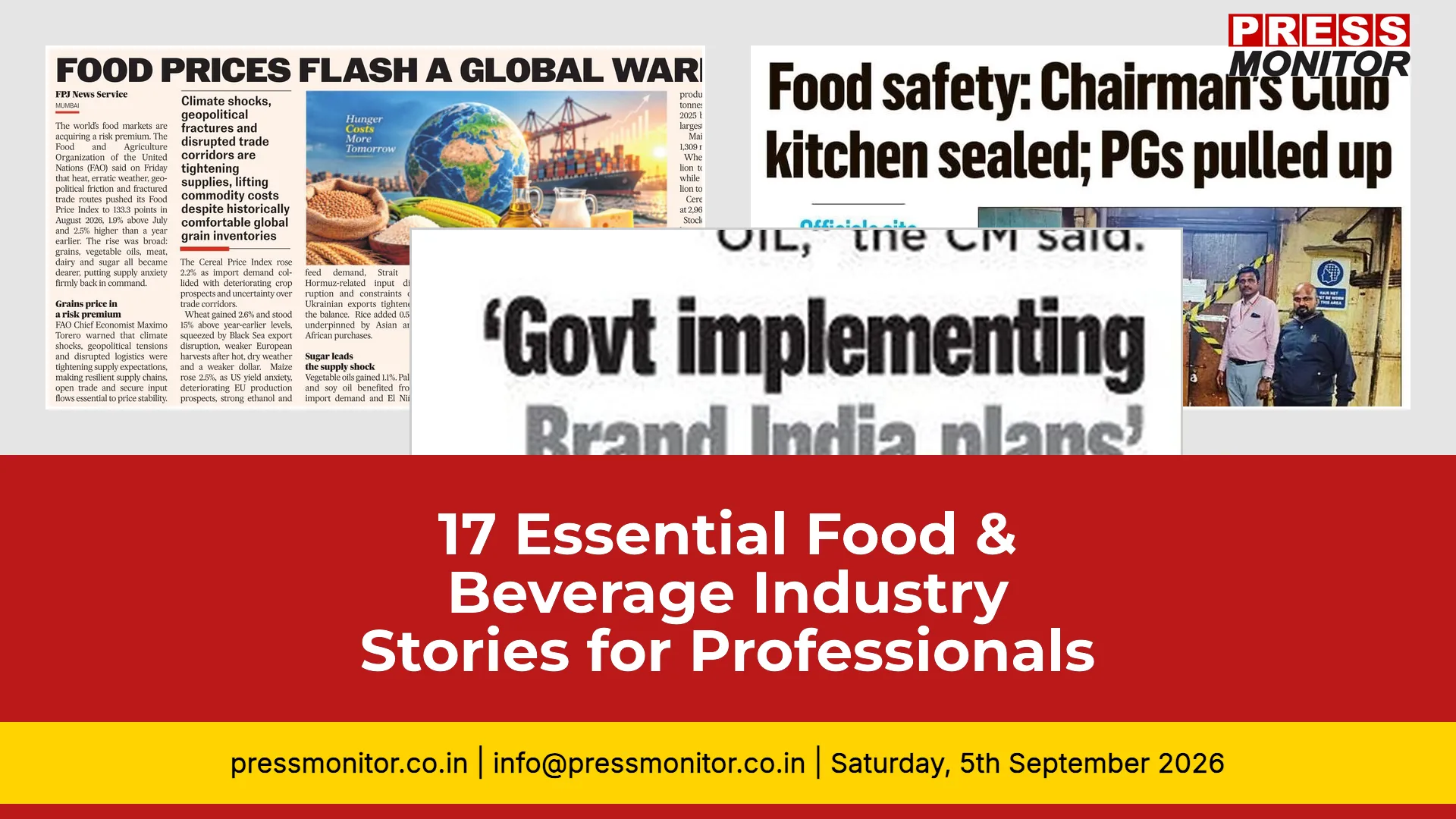
Media monitoring across Indian print publications reveals 17 essential stories shaping the food and beverage industry today. This press review draws on media intelligence and print media monitoring to deliver a comprehensive news on food and beverage briefing, covering regulatory crackdowns, global price shocks, and innovation across the sector.
1. FAO Food Prices Hit Three-Year High
A front-page report in Free Press Journal says the United Nations Food and Agriculture Organization Food Price Index rose to one hundred thirty-three point three points in August two thousand and twenty-six, driven by heat, erratic weather, geopolitical friction and fractured trade routes. The FAO Chief Economist Maximo Torero warned that climate shocks and disrupted logistics are tightening supply expectations, making resilient supply chains essential to price stability.
Why it matters: Global food inflation directly impacts input costs for Indian F&B companies, from restaurants to packaged goods manufacturers.
Key detail: The FAO Food Price Index averaged 133.3 points in August 2026, the highest since late 2022, driven by extreme heat, drought in Europe, and war disruption in the Black Sea region. FAO Chief Economist Maximo Torero warned that climate shocks and disrupted logistics are tightening supply expectations.
Source: Free Press Journal
Next step: Monitor commodity price trends and assess supply chain exposure for your product categories.
2. Bengaluru Food Safety Seals Chairman's Club Kitchen
A front-page report in Deccan Herald says the Food Safety Wing of the Department of Food Safety and Drug Administration recently carried out special inspections across clubs, paying guest accommodations, and government offices in Bengaluru. Violations including poorly maintained kitchens, expired food products, and improper storage practices were unearthed, leading to closures, seals, and legal action under the Food Safety and Standards Act, 2006, and Rules, 2011. A special drive inspected 64 paying guest accommodations across Bengaluru City, Bengaluru Rural, and Greater Bengaluru Authority areas on Friday, finding violations in 23 PGs and issuing notices.
Why it matters: Regulatory enforcement is intensifying across India's restaurant and hospitality sector, raising compliance costs and reputational risks.
Key detail: The Food Safety Wing inspected 64 paying guest accommodations and clubs in Bengaluru, finding violations in 23 PGs and issuing notices under the Food Safety and Standards Act, 2006. The drive covered Bengaluru City, Bengaluru Rural, and Greater Bengaluru Authority areas.
Source: Deccan Herald
Next step: Audit your own food safety compliance and prepare for potential inspections.
3. India to Establish Brand India Globally
A front-page report in Asian Age says Dr J.P. Dongre, director in the Union ministry of food processing industries, stressed the importance of establishing Indian food products in the global market. Speaking at a precursor event in New Delhi for Anuga Select India and Anuga FoodTec India, which will bring the global food and beverage community together in Mumbai from September 29 to October 1, Dr Dongre said the ministry is implementing many schemes and supporting events like Anuga to build Brand India.
Why it matters: Government backing for food exports could open new markets for Indian F&B companies and ingredient suppliers.
Key detail: Dr J.P. Dongre, director in the Union ministry of food processing industries, highlighted schemes and events like Anuga Select India and Anuga FoodTec India (Mumbai, September 29 to October 1) to build Brand India on the global stage.
Source: Asian Age
Next step: Explore export opportunities through upcoming trade events and government schemes.
4. Chopra Moves to Taco Bell
A front-page report in Business Line says that General Manager of K F C India and Partner Countries, Chopra, will transition to a new role as Market Lead for the Indian Subcontinent at Taco Bell International, effective September seventh. The move places him in charge of strategy and business growth for Taco Bell in India, Sri Lanka and Kuwait.
Why it matters: Leadership changes at major QSR brands signal strategic shifts in the Indian quick-service restaurant landscape.
Key detail: Chopra, General Manager of KFC India and Partner Countries, transitions to Market Lead for the Indian Subcontinent at Taco Bell International effective September 7, covering India, Sri Lanka, and Kuwait.
Source: Business Line
Next step: Track competitive positioning moves by Yum Brands and other global QSR operators in India.
5. Swiggy's Inventory Model Shift
A front-page report in Financial Express says Swiggy has shifted its Instamart service to an inventory‑led model after shareholders approved a forty‑nine point five percent cap on foreign ownership. The change means the platform will now record the full value of goods sold rather than just commission, boosting reported revenue and making it more like a conventional retailer. FMCG companies are expected to benefit from a new profitable route to consumers and higher margins for quick‑commerce operators.
Why it matters: The shift to an inventory-led model changes how quick-commerce platforms report revenue, affecting investor perceptions and FMCG partnerships.
Key detail: Swiggy moved Instamart to an inventory-led model after shareholders approved a 49.5% cap on foreign ownership, recording full value of goods sold rather than just commission, boosting reported revenue.
Source: Financial Express
Next step: Reassess partnerships with quick-commerce platforms under the new financial reporting model.
6. FSSAI Warned Dabur Repeatedly Over 100% Claims
A front-page report in Hindustan Times says the Food Safety and Standards Authority of India told the Delhi high court that its order restraining Dabur from selling food products bearing claims such as "100% Pure" and "100% Natural" followed repeated regulatory communications and five improvement notices issued between 2024 and 2026, and was not issued without prior regulatory action. In its affidavit filed on August 25, FSSAI stated Dabur was given multiple opportunities to explain its position and take corrective measures. The Delhi high court stayed FSSAI's order until August 24, calling it too general and vague, and fixed December 16 as the next date of hearing.
Why it matters: Regulatory action against major FMCG brands signals stricter enforcement of food labelling rules, affecting the entire consumer goods sector.
Key detail: FSSAI told the Delhi high court it issued five improvement notices to Dabur between 2024 and 2026 before restraining sales of products bearing 100% Pure and 100% Natural claims. The court stayed the order until August 24 and fixed December 16 as the next hearing date.
Source: Hindustan Times
Next step: Review your own product labelling for compliance with FSSAI guidelines.
7. India's Organic Export Hits 665.97 Million Dollars
A front-page report in Deshbandhu says that India's organic export reached 665.97 million dollars in fiscal year 2024-25. The article highlights that the food and beverage sector has immense potential for export and growth, driven by value addition, modern technology, and global partnerships. Industry and government representatives gathered at a pre-event programme in New Delhi to discuss these opportunities.
Why it matters: India's organic sector is gaining global traction, creating opportunities for exporters and organic food retailers.
Key detail: India's organic export reached 665.97 million dollars in fiscal year 2024-25, driven by value addition, modern technology, and global partnerships discussed at a pre-event programme in New Delhi.
Source: Deshbandhu
Next step: Evaluate organic certification and export readiness for your product lines.
8. Gaggan Anand Opens Raga in Delhi
A front-page report in Mint says Gaggan Anand has launched his new restaurant Raga on Delhi's Janpath Road, marking his return to India after twenty years with a twenty-two-course tasting menu priced at 31,000 rupees per person. The opening signals a renewed ambition in Delhi's fine-dining landscape, alongside plans for Bangkok's Michelin-starred Jhol to open in November, while chef Gaggan Anand and his team aim to cater to Delhi's evolving palate for experimental cuisine.
Why it matters: High-profile restaurant openings signal renewed confidence in Delhi's fine-dining market and evolving consumer tastes.
Key detail: Chef Gaggan Anand launched Raga on Delhi's Janpath Road with a 22-course tasting menu priced at 31,000 rupees per person, marking his return after twenty years. Plans for Bangkok's Michelin-starred Jhol in November.
Source: Mint
Next step: Monitor premium dining trends and consumer spending in the hospitality sector.
9. FDA Intensifies Nashik Food Safety Drive
A front-page report in Free Press Journal says the FDA has intensified inspections and enforcement against food businesses across Nashik district. Hotels, sweet shops, storage facilities and online delivery centres have been targeted for alleged violations, resulting in suspended licences for nine hotels and fines totalling around Rs 3.10 lakh. The department also seized ghee stock worth around Rs 2.75 lakh on suspicion of adulteration and took action against a Zepto centre for hygiene violations.
Why it matters: Localized enforcement drives highlight the growing regulatory scrutiny of food businesses across India's secondary cities.
Key detail: FDA inspections targeted hotels, sweet shops, storage facilities, and online delivery centres in Nashik, suspending licences for nine hotels and imposing fines totalling Rs 3.10 lakh, plus seizing ghee stock worth Rs 2.75 lakh on suspicion of adulteration.
Source: Free Press Journal
Next step: Ensure compliance in all operational locations, including smaller cities and towns.
10. Quick Commerce Firms Hire Quality Checkers
A front-page report in Mint says quick commerce firms are actively hiring quality checkers following recent regulatory enforcement. Regulators have inspected dark stores across Maharashtra and Karnataka, leading to license suspensions for Blinkit, Zepto, and Swiggy Instamart over hygiene and labelling violations. These companies operate thousands of dark stores and are responding to scrutiny by adding dedicated store-level compliance roles.
Why it matters: The quick-commerce sector is responding to regulatory pressure by building dedicated compliance teams, changing operational costs and standards.
Key detail: Following license suspensions for Blinkit, Zepto, and Swiggy Instamart over hygiene and labelling violations, quick-commerce firms are actively hiring quality checkers for store-level compliance across thousands of dark stores.
Source: Mint
Next step: Prepare for increased compliance costs and potential service disruptions in the quick-commerce channel.
11. India Pushes Red Food Labels
A front-page report in Deccan Herald says that India is proposing to mandate prominent red warning labels on unhealthy packaged foods to tackle the country’s severe public health crisis. The proposal aims to shift the burden from consumers to the industry and calls for strict, time-bound rules covering all harmful ingredients, while also highlighting the need for public education campaigns.
Why it matters: Mandatory red warning labels on unhealthy packaged foods could reshape product formulations and marketing strategies across the FMCG sector.
Key detail: India is proposing to mandate prominent red warning labels on unhealthy packaged foods, with strict, time-bound rules covering all harmful ingredients and public education campaigns to shift the burden from consumers to the industry.
Source: Deccan Herald
Next step: Assess the impact of proposed labelling rules on your product portfolio and reformulation timelines.
12. 4.45% CPI, 9.78% WPI Base Revised
A front-page report in Business Line says that the Reserve Bank of India has revised the base years for the Consumer Price Index to 2024 and for the Wholesale Price Index to 2022‑23, and updated their weightings. The revisions show CPI in July 2026 rose to 4.45 percent and WPI to 9.78 percent, with food inflation at 5.79 percent in rural areas and 5.05 percent in urban areas. The changes raise doubts that both inflation and GDP may be understated due to the exclusion of online purchases in current surveys.
Why it matters: Revised inflation indices with updated base years affect monetary policy expectations and food price benchmarking for the industry.
Key detail: The RBI revised CPI base year to 2024 and WPI base year to 2022-23. CPI in July 2026 rose to 4.45% and WPI to 9.78%, with food inflation at 5.79% in rural areas and 5.05% in urban areas.
Source: Business Line
Next step: Factor revised inflation data into pricing strategies and cost projections.
13. FlavorDB Database Helps Chefs Discover New Pairings
A front-page report in Indian Express says chef-mixologist Grigorii uses the FlavorDB database to discover non-obvious flavour pairings such as capsicum and chocolate. Developed by Dr Ganesh Bagler at the Indraprastha Institute of Information Technology, the database maps food ingredients by shared flavour molecules and supports applications in personalised nutrition and sustainable food. Food entrepreneur Shantanu Patil in Maharashtra also uses the database to recreate childhood flavours in millet-based products while reducing carbon footprint.
Why it matters: AI-driven food science tools are enabling innovation in product development and sustainable ingredient use.
Key detail: Developed by Dr Ganesh Bagler at Indraprastha Institute of Information Technology, FlavorDB maps food ingredients by shared flavour molecules. Food entrepreneur Shantanu Patil uses it to recreate childhood flavours in millet-based products while reducing carbon footprint.
Source: Indian Express
Next step: Explore computational gastronomy tools for product innovation and sustainability goals.
14. Tata Motors Iveco Bid Approved
A front-page report in Business Line says Yum Brands executive Chopra will transition from KFC India to Taco Bell International as Market Lead for the Indian Subcontinent effective September 7. Meanwhile, Tata Motors announced that Italy's market regulator Consob has approved its voluntary tender offer to acquire all common shares of Iveco Group NV, with the acceptance period running from September 7 to October 26 at 14.10 euros per share.
Why it matters: Major M&A activity in the automotive sector affects supply chain logistics for food and beverage distribution.
Key detail: Italy's market regulator Consob approved Tata Motors' voluntary tender offer to acquire all common shares of Iveco Group NV, with the acceptance period running from September 7 to October 26 at 14.10 euros per share.
Source: Business Line
Next step: Monitor automotive supply chain implications for food logistics and cold chain transportation.
15. Eazy Business Solutions Urges AI Adoption
A front-page report in Business Line says Kunal Singhal, managing director of Eazy Business Solutions, urged farmers, manufacturers, distributors and middlemen in India to adopt artificial intelligence during a Business Line interaction. He said artificial intelligence can analyse existing data, send early alerts and suggest actions to reduce wastage and improve crop and supply chain decisions. Singhal also pointed to digital agriculture tools that improve visibility on soil conditions, crop suitability, water availability and inventory placement for food products with limited shelf life.
Why it matters: AI tools for agriculture and supply chain can reduce food waste and improve decision-making across the F&B value chain.
Key detail: Kunal Singhal, managing director of Eazy Business Solutions, highlighted AI's ability to analyse existing data, send early alerts, and suggest actions to reduce wastage, alongside digital agriculture tools for soil conditions, crop suitability, and inventory placement.
Source: Business Line
Next step: Evaluate AI-driven tools for your agricultural sourcing and supply chain operations.
16. Varanasi Flavours Global Platform Trade Show
A front-page report in Free Press Journal says Varanasi's traditional flavours will get a global platform at the Uttar Pradesh International Trade Show in Greater Noida from September twenty-fifth to twenty-ninth, two thousand and twenty-six. Four local entrepreneurs have been selected under the One District One Cuisine initiative and will receive free stalls to display and sell their products, including Banarasi paan, launglata, and tiranga barfi. The move aims to connect traditional food businesses with domestic and international buyers, opening opportunities for new markets and larger orders.
Why it matters: Government initiatives to showcase traditional Indian food on global platforms create export and branding opportunities for regional food businesses.
Key detail: Four entrepreneurs from Varanasi selected under the One District One Cuisine initiative will display Banarasi paan, launglata, and tiranga barfi at the Uttar Pradesh International Trade Show in Greater Noida from September 25 to 29, 2026.
Source: Free Press Journal
Next step: Consider participating in government-backed trade shows to expand domestic and international market reach.
17. FSSAI CEO Rajit Punhani Urges Food Literacy
A front-page report in Focus News says FSSAI Chief Executive Officer Rajit Punhani on Thursday stressed the importance of providing consumers with accurate information to help them make better food choices. Speaking at a health summit organised by the Sunness to Wellness Foundation in New Delhi, Punhani highlighted efforts to link food safety laws with consumer education and behavioural change, emphasising that food safety and nutrition are central to preventive public health. Former Health Ministry Secretary Rajesh Bhushan and National Health Mission Director Joysh Ali Rivzi also spoke on lifecycle nutrition approaches and the role of community workers like ASHA and anganwadi staff in driving meaningful awareness.
Why it matters: Consumer education initiatives linked to food safety laws signal a shift toward preventive public health, affecting how F&B companies communicate about their products.
Key detail: FSSAI CEO Rajit Punhani stressed providing consumers with accurate information for better food choices, linking food safety laws with consumer education and behavioural change at a health summit in New Delhi.
Source: Focus News
Next step: Align your brand communication with evolving food literacy and consumer education trends.
Closing: These 17 stories, tracked through print media monitoring, illustrate the dynamic forces reshaping India's food and beverage landscape. What developments will you be watching most closely in the weeks ahead?