17 Essential Green Energy & Renewables Stories for Energy Professionals


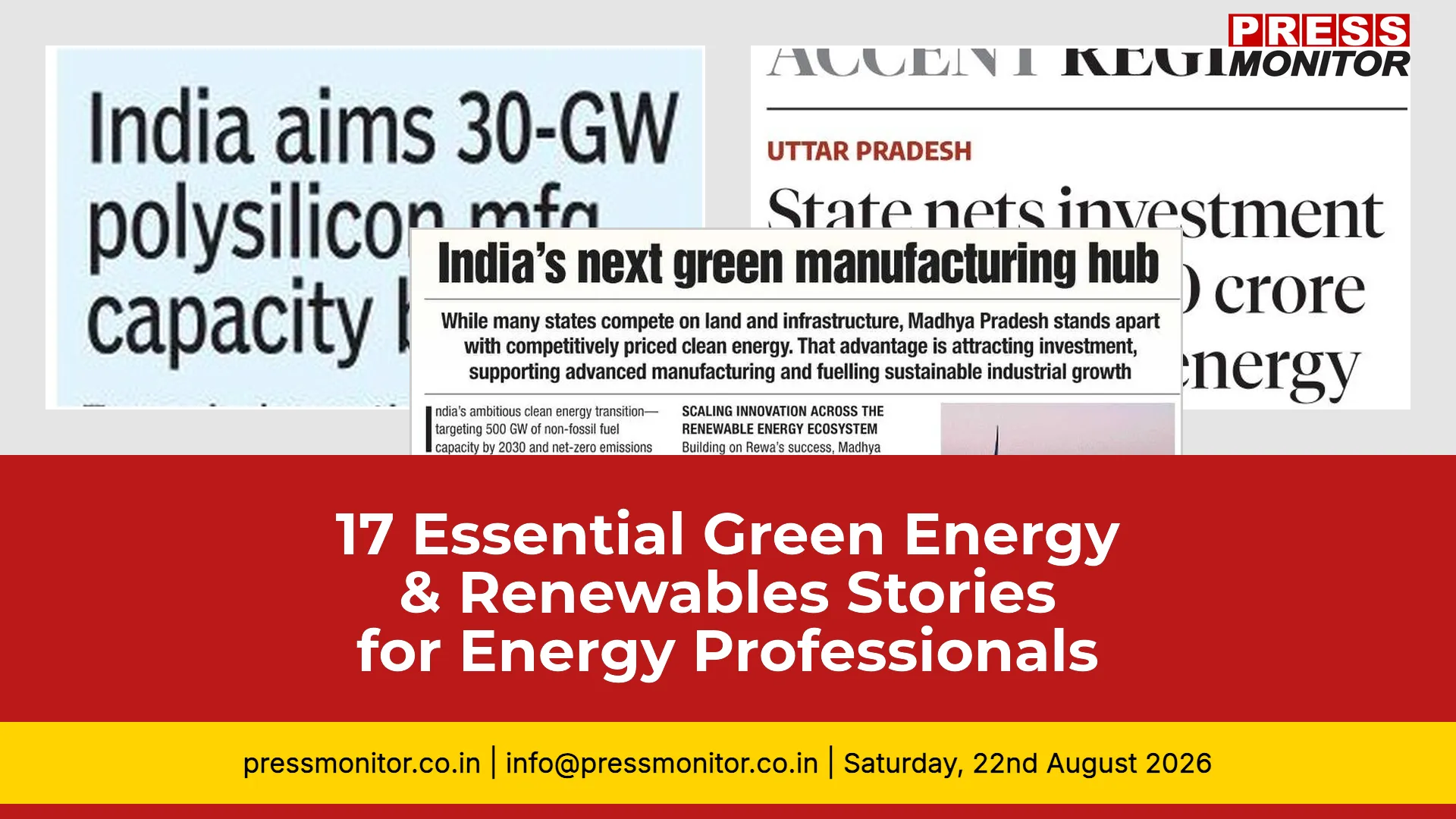
India's renewable energy landscape is evolving rapidly. From polysilicon manufacturing to state-level storage mandates, here are 17 must-read stories from today's Indian print media, curated by Press Monitor's media monitoring.
1. 30 GW Polysilicon Capacity Boost
A front-page report in Asian Age says the government plans to add 30 GW of polysilicon manufacturing capacity by 2030, which could attract 225,000 crore in investment. An estimated 2,850 crore rupees is needed to set up 1 GW of a polysilicon plant along with metallurgical-grade silicon, according to Santosh Kumar, secretary at the Union ministry of new and renewable energy.
Why it matters: India aims to reduce import dependence for solar manufacturing.
Key detail: The government plans to add 30 GW polysilicon capacity by 2030, attracting ₹225,000 crore investment, as per MNRE Secretary Santosh Kumar.
Source: Asian Age
Next step: Watch for dedicated support scheme details.
2. UP Secures ₹35,000 Crore RE Investments
A front-page report in Business Standard says Uttar Pradesh has received fresh investment proposals worth 35,000 crore from leading renewable energy companies. Five projects spanning solar and renewable energy are proposed to be developed in Gautam Buddha Nagar district.
Why it matters: Uttar Pradesh becomes a renewable energy investment hotspot.
Key detail: Five solar and renewable projects proposed in Gautam Buddha Nagar.
Source: Business Standard
Next step: Monitor project implementation timelines.
3. Madhya Pradesh: India's Green Manufacturing Hub
India’s next green manufacturing hub, Madhya Pradesh, stands apart with competitively priced clean energy, attracting investment and supporting sustainable industrial growth. ‘Targeting 500 GW of non-fossil fuel capacity by 2030 and net-zero emissions by 2070’ is creating new opportunities in renewable energy, storage, and green manufacturing. Backed by progressive policies, the state is leveraging its renewable energy leadership to become a preferred destination for green investment, shaping India’s next phase of industrial transformation.
Why it matters: MP leverages low-cost clean energy to attract industry.
Key detail: Targeting 500 GW non-fossil fuel capacity by 2030.
Source: Times of India
Next step: Explore investment opportunities in the state.
4. India-Canada Pact for Arunachal RE Projects
A front-page report in The Indian Express says India and Canada have finalized a landmark infrastructure pact to develop renewable energy projects in Arunachal Pradesh, projecting investments above ₹50,000 crore over the next decade, with technology exchanges fostering clean energy advancements.
Why it matters: International cooperation for remote area development.
Key detail: Investments above ₹50,000 crore over a decade in renewable energy and technology exchange.
Source: Indian Express
Next step: Track project announcements.
5. Tamil Nadu to Store 4% Green Energy
A front-page report in New Indian Express says the Tamil Nadu government aims to store 4% of total renewable energy generated by 2029-30. The state plans to achieve a total energy storage capacity of 2,500 MWh by the end of 2027 to improve grid stability.
Why it matters: Grid stability through energy storage mandate.
Key detail: Target of 2,500 MWh storage capacity by 2027.
Source: New Indian Express
Next step: Assess storage technology partnerships.
6. India Ranks Top 3 in Renewables Globally
A front-page report in Financial Express says Minister of State for External Affairs and Textiles Pabitra Margherita stated that renewable energy capacity is now essential for energy security. He noted that India has become one of the fastest-growing clean energy economies and ranks among the top three countries globally in renewable capacity.
Why it matters: India's clean energy leadership recognized internationally.
Key detail: Minister Pabitra Margherita highlighted renewable capacity for energy security.
Source: Financial Express
Next step: Leverage global ranking for investment.
7. Delhi Master Plan 2047: Solar & Gas Expansion
According to a front-page report in Millennium Post, Delhi Chief Minister Ashish Sood announced plans under the Master Plan 2047 to significantly expand renewable energy sources like solar farms, rooftop solar installations on government buildings, and water-integrated projects. The government also intends to boost access to affordable gas, including expanded piped natural gas networks, and increase energy generation through local turbines to reduce electricity costs. The key priorities include sustainable development, issuing Renewable Energy Plans to meet rising power demand (estimated at 25,500 MW by 2047), and critically soliciting public participation for policy implementation.
Why it matters: Comprehensive urban energy planning.
Key detail: Rooftop solar on government buildings, expanded PNG network, target 25,500 MW by 2047.
Source: Millennium Post
Next step: Engage in public consultation process.
8. Nagaland Signs 20 MW Solar PPA
A front-page report in {source_name} says the Department of Power Nagaland has signed a Power Purchase Agreement (PPA) with M/s. Tvaksas Renewable Pvt. Ltd. to develop a 20 MW solar power plant at Lapa Lampong Village in Tizit, Mon district.
Why it matters: Renewable energy reaches northeast India.
Key detail: PPA with Tvaksas Renewable Pvt Ltd for plant in Mon district.
Source: Sentinel
Next step: Watch for construction milestones.
9. Srinivas Drives Rajasthan Solar Transformation
A front-page report in First India says Srinivas has played an active role in accelerating Rajasthan’s solar transformation and innovation in governance.
Why it matters: Administrative leadership accelerating solar adoption.
Key detail: Chief Secretary V. Srinivas driving solar and infrastructure advancements.
Source: First India
Next step: Follow policy announcements from Rajasthan.
10. Ethanol Ambitions Face Sugar Reality
A front-page report in Tribune says India’s decision to allow the duty-free import of 10 lakh tonnes of raw sugar is more than a response to soaring prices; it is a reality check for its ambitious ethanol policy.
Why it matters: Duty-free sugar import impacts ethanol blending targets.
Key detail: India allows import of 10 lakh tonnes raw sugar as ethanol policy faces constraints.
Source: Tribune
Next step: Monitor sugar-ethanol price dynamics.
11. UPNEDA Invites Bids for Solar Plants
A front-page report in New Indian Express says that Uttar Pradesh New and Renewable Energy Development Agency (UPNEDA) is inviting online bids from prospective bidders for the supply, erection, testing, and commissioning of solar power plants at various government buildings across the state. The project involves three different capacity levels – grid-on solar rooftop (1kW to 10kW), grid-off solar power (8kW to 50kW), and a combination of both. The bid documents are available for download from June 22, 2026, with the bid submission deadline set for September 15, 2026.
Why it matters: Government buildings to go solar across UP.
Key detail: Three capacity categories, bid deadline September 15, 2026.
Source: New Indian Express (cross-sourced with Indian Express)
Next step: Bid submission for interested developers.
12. MP Strengthens Market Access & Investments
A front-page report in Times of India says Madhya Pradesh is strengthening market access through India's expanding Free Trade Agreements, advancing renewable energy leadership, and simplifying investments via its Simplifying a Single Window system. The state's strategic location, industrial infrastructure, and policy framework position it as a global investment destination complementing 'Samriddh Madhya Pradesh 2047' and 'Viksit Bharat 2047' objectives.
Why it matters: Single window system and FTAs boost manufacturing.
Key detail: Simplified investment process aligning with 'Viksit Bharat 2047'.
Source: Times of India
Next step: Explore MP as investment destination.
13. 42 GW RE Projects Lack Buyers
A front-page report in Indian Express says hybrid renewable energy projects with high tariffs and vanilla solar projects are struggling to secure buyers from power distribution companies. Around 42 gigawatts of renewable energy capacity currently lacks power purchase agreements.
Why it matters: Power purchase agreement shortage threatens renewable growth.
Key detail: Hybrid projects with high tariffs struggling to find offtake.
Source: Indian Express (cross-sourced with Business Standard)
Next step: Policy intervention needed to address PPA gap.
14. Solar Expansion Poses Biodiversity Risks
A front-page report in Deccan Herald says that the global push to expand solar energy could carry hidden biodiversity costs. The research spanning more than 2,300 Chinese counties found that pro-solar policies reduced bird diversity as cropland and grassland were rapidly cleared for development.
Why it matters: Environmental trade-offs of renewable energy.
Key detail: Chinese study shows solar policies reduced bird diversity due to land clearing.
Source: Deccan Herald
Next step: Integrate ecological assessments in project planning.
15. India's Path to Energy Self-Reliance
A front-page report in State Times says India is rapidly moving towards energy self-reliance by focusing on renewable energy sources to address environmental concerns and meet growing energy demands.
Why it matters: Reducing fossil fuel dependence through renewables.
Key detail: Focus on renewable sources to meet growing demand and environmental goals.
Source: State Times
Next step: Support domestic manufacturing and R&D.
16. MP Investment Boom: ₹2.7 Crore & Reforms
A front-page report in Times of India says Madhya Pradesh under leadership of minister Dr Mohan Yadav declared 2025 as Udyog Evam Rojgar Varsh. The state launched 18 sector-specific investment policies across industries including semiconductors, logistics, renewable energy, and GCCs, ushering in an holistic framework supporting investments from proposal to production. Faster approvals via the Invest MP Single Window System cut timelines for GIS-based land allotment significantly, and deregulation rationalizing compliances, repealing outdated Acts, and implementing Jan Vishwas accelerated ease of investments
Why it matters: 2025 declared 'Udyog Evam Rojgar Varsh' with sector-specific policies.
Key detail: 18 new policies covering semiconductors, logistics, renewable energy.
Source: Times of India
Next step: Leverage single window system for fast approvals.
17. V. Srinivas' Extended Tenure in Rajasthan
A front-page report in First India says, The tenure of V. Srinivas as Chief Secretary of Rajasthan, viewed alongside his broader career, represents a distinctive combination of administrative stability, institutional reform, digital governance, clean-energy transition, public-health intervention and Centre-State coordination.
Why it matters: Administrative continuity for clean-energy transition.
Key detail: Combined focus on digital governance, public health, and renewable energy.
Source: First India
Next step: Observe policy stability under extended leadership.
Which of these stories impacts your strategy most? According to Press Monitor's tracking of Indian publications, staying ahead requires real-time press review. Our media intelligence platform delivers curated green energy news daily. For deeper analysis, visit pressmonitor.co.in.
This press review is powered by Press Monitor – print media monitoring for India's energy transition.