17 Essential Green Energy Stories for Industry Leaders


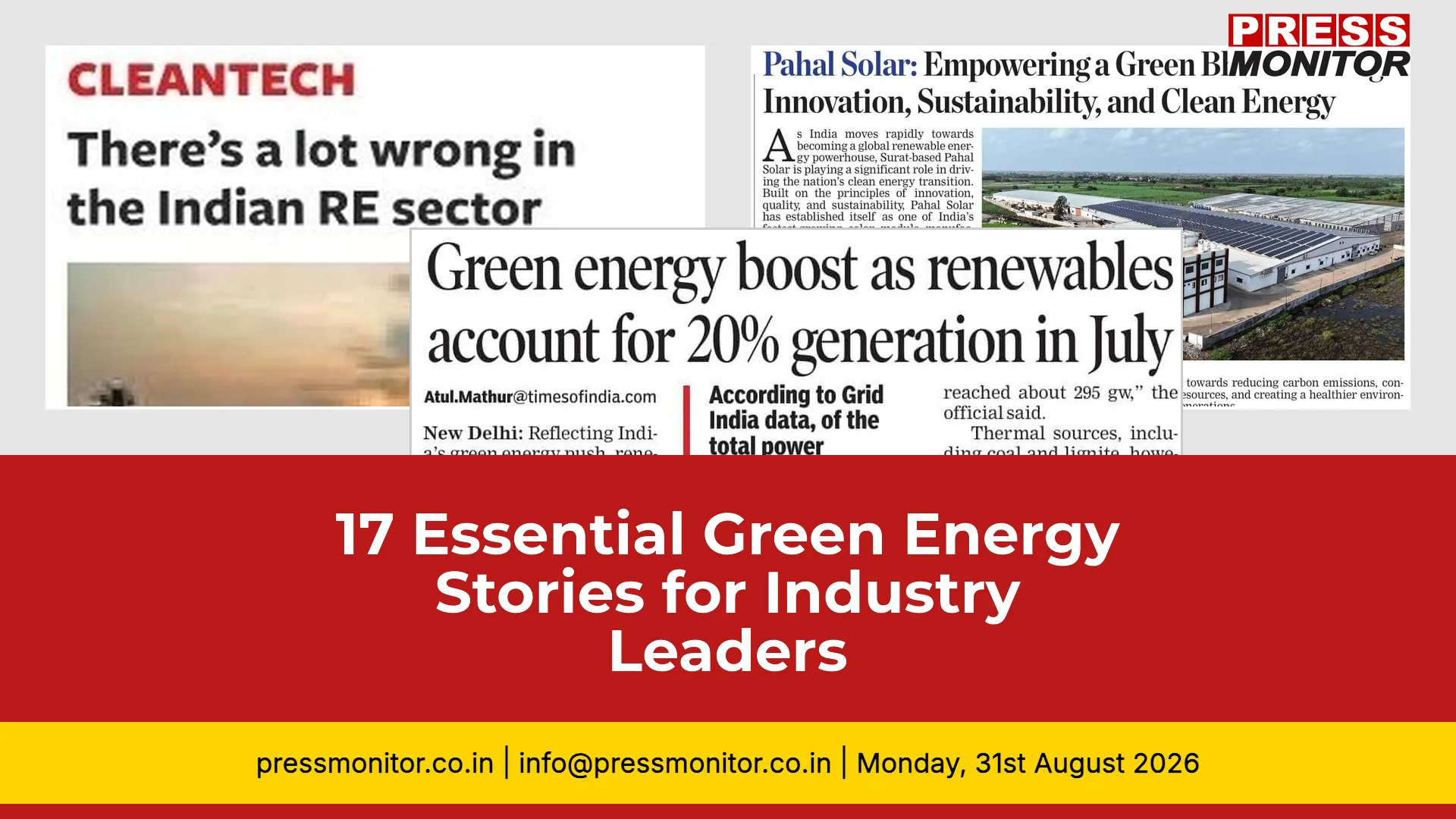
India's renewable energy sector is at a pivotal moment, with record installations, policy shifts, and emerging challenges. According to Press Monitor's tracking of Indian publications, here are the 17 most impactful stories from today's print media that every industry leader needs to know. This media monitoring roundup covers solar manufacturing, storage, policy innovations, and more.
1. Solar Manufacturing Investment Surge
"Selon Business Line, le ministre Pralhad Joshi a insisté sur le succès de l’industrie renouvelable, malgré des statistiques mitigées. Avec des investissements annoncés d’environ 3l lakh de crore, l’expansion de la capacité de fabrication solaire semble rapide. Cependant, une analyse plus approfondie révèle une situation plus complexe, avec un conflit croissant entre le Birla et l’Adani Group, se poursuivant maintenant dans le domaine de l’aluminium."
Why it matters: Minister Pralhad Joshi announced a staggering 3 lakh crore investment in solar manufacturing capacity, signaling government confidence in domestic production. However, the report also highlights a growing rivalry between Birla and Adani groups in the aluminium sector.
Key detail: The investment target is 31 lakh crore for solar manufacturing expansion.
Source: Business Line (front-page)
Next step: Track how this investment translates into actual capacity additions over the next year.
2. Pahal Solar's AI-Driven Growth
A front-page report in Economic Times says... Surat-based Pahal Solar is driving India’s clean energy transition through innovative solar module manufacturing and EPC solutions, expanding from 30 MW in 2016 to multi-gigawatt capacity with AI-driven production.
Why it matters: Surat-based Pahal Solar exemplifies how innovation drives India's clean energy transition, expanding from 30 MW to multi-gigawatt capacity using AI.
Key detail: The company has integrated AI into its module manufacturing and EPC solutions.
Source: Economic Times (front-page)
Next step: Monitor similar mid-sized solar firms adopting AI for competitive advantage.
3. Renewable Energy Hits 20% of Power Generation
A front-page report in Times of India says that renewable energy contributed nearly 20% of India’s power generation in July, marking a year-on-year growth of over 30%.
Why it matters: In July, renewables contributed nearly 20% of India's power generation, a 30% year-on-year increase, confirming the energy transition's acceleration.
Key detail: This is a record share for renewable energy in India's power mix.
Source: Times of India (front-page, by Atul Mathur)
Next step: Use this data to benchmark your organization's renewable energy procurement targets.
4. Indosol's Ingot Plant Nears Commissioning
A front-page report in Business Line says Indosol Solar Pvt Ltd, a subsidiary of Shirdi Sai Electricals Ltd, is set to inaugurate its ingot-cum-wafer plant in Ramayapatnam, Andhra Pradesh. When the 3,000-crore facility starts production next month, it will be the country’s sole operational ingot plant.
Why it matters: Indosol Solar's 3,000 crore ingot-cum-wafer plant in Andhra Pradesh will be India's only operational ingot facility, reducing import dependence.
Key detail: Commissioning is scheduled for next month.
Source: Business Line (front-page, by M Ramesh)
Next step: Evaluate supply chain opportunities for ingot and wafer sourcing.
5. RE Sector Faces Infrastructure Bottlenecks
A front-page report in Business Line says... India's renewable energy sector, despite record solar (164 GW) and wind (58 GW) capacity installations, faces critical mismatches between generation and infrastructure. Tender volumes for solar plummeted from 79.5 GW in 2024 to 44 GW in 2025, with transmission bottlenecks affecting 11 GW in Rajasthan/Gujarat. Module manufacturing capacity (220 GW) shows overcapacity, while cell shortages and rooftop electricity auction delays threaten future growth.
Why it matters: Despite record solar (164 GW) and wind (58 GW) capacity, transmission bottlenecks and tender volume drops pose risks to future growth.
Key detail: Solar tender volumes fell from 79.5 GW in 2024 to 44 GW in 2025, and module manufacturing overcapacity of 220 GW exists.
Source: Business Line (front-page, by M Ramesh)
Next step: Advocate for grid infrastructure investments to unlock stalled projects.
6. NCRTC Signs Solar PPA for Namo Bharat Corridor
“Selon le Statesman News Service, le NCRTC a signé un accord de vente d’électricité avec NIRLNCRTC Renewables Limited (NNRL) pour une centrale solaire de 110 MW à construire par NNRL. L’accord a été signé en présence du PDG du NCRTC, Shalabh Goel; du Directeur Finances et Commissaire Exécutif Désigné du NIRL, Dr Prasanna Kumar Acharya; du Directeur Finances du NCRTC, Namita Mehrotra; du Directeur des Électriques et de la Production de Wagon du NCRTC, Mahendra Kumar; et de hauts fonctionnaires du NCRTC et du NIRL,” a déclaré un porte-parole du NCRTC. Le projet, de première de son genre pour les systèmes de transport RRTS et métropolitains du pays, est destiné à alimenter près de 60 % de l’électricité requise par le corridor Delhi-Meerut Namo Bharat. Il renforcera l’efficacité opérationnelle à long terme du corridor grâce à une énergie propre et fiable. Le coût estimé de la centrale solaire est d’environ 450 crore roupies et sera développé dans la ville de Jaulan, dans l’Uttar Pradesh, grâce à un modèle de financement dette-capital de 80:20. La production d’électricité sera acheminée via le réseau électrique de l’Uttar Pradesh vers les postes de transformation (RSS) du NCRTC situés dans l’Uttar Pradesh et Delhi, puis distribuée dans tout le corridor Namo Bharat. Le projet tire parti de la politique énergétique solaire de l’Uttar Pradesh pour promouvoir l’utilisation des énergies renouvelables. La mise en service est prévue dans les 24 prochains mois. L’électricité représente environ 30-35 % du coût d’exploitation du corridor Namo Bharat, ce qui en fait l’une des plus importantes dépenses récurrentes. Le projet de centrale solaire en captif ne devrait réduire les dépenses énergétiques annuelles d’environ 25 % tout en contribuant à un avenir plus propre et plus durable.
Why it matters: NCRTC has signed a 450 crore PPA for a 110 MW captive solar plant, powering 60% of the Delhi-Meerut RRTS corridor's electricity needs.
Key detail: The plant will reduce annual energy costs by 25% and is a first for Indian RRTS systems.
Source: Statesman (front-page)
Next step: Explore similar captive solar models for large infrastructure projects.
7. Delhi's New Solar Policy to Cut Rooftop Costs
A front-page report in Hindustan Times says that the Delhi government is working on a new solar policy aimed at slashing the upfront cost of rooftop installations for households. The draft policy, which was finalised earlier this month, is expected to be placed before the Cabinet this week.
Why it matters: The Delhi government's draft solar policy aims to slash upfront costs for rooftop installations, boosting residential adoption.
Key detail: The draft is expected before the Cabinet this week.
Source: Hindustan Times (front-page, by Saloni Bhatia)
Next step: Prepare for potential demand surge in Delhi's rooftop solar market.
8. Battery Storage Capacity Expands
A front-page report in Business Line says that the year-wise capacity addition of battery energy storage system (BESS) projects has seen significant growth over the years. The data highlights the commissioned, under construction, awarded, and under tendering capacities in MW and MWh.
Why it matters: BESS capacity additions are accelerating, with data showing growth in commissioned, under construction, and awarded projects.
Key detail: The article provides year-wise capacity in MW and MWh.
Source: Business Line (front-page)
Next step: Integrate battery storage into your renewable energy strategy.
9. Rajasthan to Pilot 172 BESS Units
A front-page report in Business Line says Rajasthan is the State with the highest capacity for solar plants under construction. The Rajasthan government now intends to set up 1 MW/4 MWhr battery energy storage system (BESS) units at 172 locations across the State on a pilot basis.
Why it matters: Rajasthan, a solar-rich state, will set up 1 MW/4 MWh BESS units at 172 locations, setting a model for grid-scale storage.
Key detail: This is a pilot project to address solar intermittency.
Source: Business Line (front-page)
Next step: Monitor the pilot results for replication in other states.
10. MSEZL Invites Bids for Renewable Power
"Selon Mangalore SEZ Limited, Mangaluru, invites tenders from eligible bidders for the procurement of renewable power on a short-term basis under a wheeling and banking through a competitive bidding process. The tender is open for proposals until September 7, 2026, and is to be submitted electronically through the MSTC e-tendering portal and the Mangalore SEZ website."
Why it matters: Mangalore SEZ is procuring renewable power on a short-term basis via wheeling and banking, signaling demand from industrial zones.
Key detail: Bids are due by September 7, 2026.
Source: Indian Express (front-page)
Next step: Assess similar opportunities for renewable power procurement in SEZs.
11. Uttarakhand's Pumped Storage Policy Unveiled
A front-page report in Financial Express says the Uttarakhand government has introduced a policy to encourage the development of Pumped Storage Projects (PSPs) to support the state's growing energy demand in a sustainable manner. The policy includes exemptions from intra-state transmission charges, Local Area Development Fund, and free royalty power for PSPs.
Why it matters: The policy promotes PSPs with exemptions from intra-state transmission charges and royalty, attracting private investment.
Key detail: Includes free royalty power for PSPs, a significant incentive.
Source: Financial Express (front-page, also covered by Indian Express and The Hindu)
Next step: Evaluate PSP project opportunities in Uttarakhand.
12. FDRE Tariffs Fall Despite Cost Pressure
A front-page report in Business Line says that Firm and Despatchable Renewable Energy (FDRE) tariffs have fallen despite rising costs, possibly reflecting intensifying competition among developers.
Why it matters: Firm and Dispatchable Renewable Energy tariffs are declining, indicating intense competition among developers.
Key detail: This is happening despite rising costs, which may squeeze margins.
Source: Business Line (front-page)
Next step: Reassess power purchase agreement strategies in light of tariff trends.
13. OIL Green Energy Expands into CBG and Waste-to-Energy
A front-page report in Millennium Post says Oil India Limited’s wholly owned subsidiary OIL Green Energy Ltd (OGEL) signed MoUs with four municipalities in Haryana to develop integrated Compressed Biogas & Waste-to-Energy projects, marking a significant expansion of the company’s low-carbon energy portfolio.
Why it matters: Oil India's subsidiary signed MoUs with four Haryana municipalities, expanding its low-carbon portfolio.
Key detail: The projects will produce compressed biogas and energy from waste.
Source: Millennium Post (front-page)
Next step: Watch for similar oil PSU diversification into green energy.
14. Japan Opens Carbon Credit Market for Indian Projects
India has concluded bilateral arrangements with Japan and South Korea, while talks are on with Singapore, Switzerland and Sweden, according to Yashodhan Ramteke, CEO of EcoGuard Global. This potentially lucrative market is opening up under Article 6.2 of the Paris Agreement, which provides a framework for countries to cooperate and transfer emission reductions inter-nationally, while ensuring that the same emission reduction is not counted twice. Japan operates its own Joint Credit-ing Mechanism (JCM) — with methodologies, procedures and registry arrangements for tracking projects and credits — rather than functioning as a project under a voluntary carbon credit programme such as Verra or Gold Standard. The country aims to secure cumulative emission reductions and removal of around 100 million tonnes of carbon dioxide by 2030.
Why it matters: India's bilateral arrangement with Japan under Article 6.2 allows Indian green projects to earn carbon credits. Yashodhan Ramteke, CEO of EcoGuard Global, confirmed the development.
Key detail: Japan aims to secure 100 million tonnes of CO2 reduction by 2030 via its Joint Crediting Mechanism.
Source: Business Line (front-page)
Next step: Explore carbon credit monetization for your green projects.
15. MP Sandipan Bhumre Reviews Solar Progress
A front-page report in Free Press Journal says MP Sandipan Bhumre has directed officials to accelerate the Revamped Distribution Sector Scheme and other initiatives to reduce electricity losses. During a District Electricity Committee meeting, officials detailed the installation of rooftop solar systems and upgrades to agricultural power infrastructure across the district.
Why it matters: In Chhatrapati Sambhajinagar, the MP directed officials to accelerate rooftop solar and agricultural power infrastructure upgrades.
Key detail: The Revamped Distribution Sector Scheme is being fast-tracked.
Source: Free Press Journal (front-page)
Next step: Engage with local distribution companies for rooftop solar partnership opportunities.
16. Fr. Rodrigues College Sets Sustainability Benchmark
A front-page report in Economic Times says Fr. Conceicao Rodrigues College of Engineering in Bandra, Mumbai, is a model of sustainability in the Green Bharat movement. The college employs renewable energy, rain harvesting, and efficient waste disposal systems to promote environmental stewardship.
Why it matters: An engineering college in Mumbai is a model of Green Bharat, using renewable energy, rain harvesting, and waste management.
Key detail: The college demonstrates how institutions can lead in sustainability.
Source: Economic Times (front-page)
Next step: Use this case study to advocate for campus sustainability programs.
17. International Climate Summit to Showcase 'Agnikawach'
A front-page report in Statesman says the 6th International Climate Summit (ICS 2O26), being organised by PHDCCL, will be held in New Delhi on September 2. Focused on bioethanol, coal gasification, Small Modular Reactors (SMRs), biorefineries, bioplastics, and process safety, the Summit will foster meaningful dialogue, innovation, and strategic collaborations to accelerate India’s sustainable energy transition.
Why it matters: The 6th International Climate Summit in New Delhi on September 2 will focus on bioethanol, coal gasification, SMRs, and more, with AI-driven 'Agnikawach' as a highlight.
Key detail: The summit is organized by PHDCCL.
Source: Statesman (front-page, by Nikhil Vyas)
Next step: Attend or follow the summit for emerging technology insights.
These stories, powered by print media intelligence, offer a comprehensive view of India's green energy landscape. Which of these developments will impact your strategy? Let us know in the comments below.
