17 Essential Health Stories for Healthcare Leaders


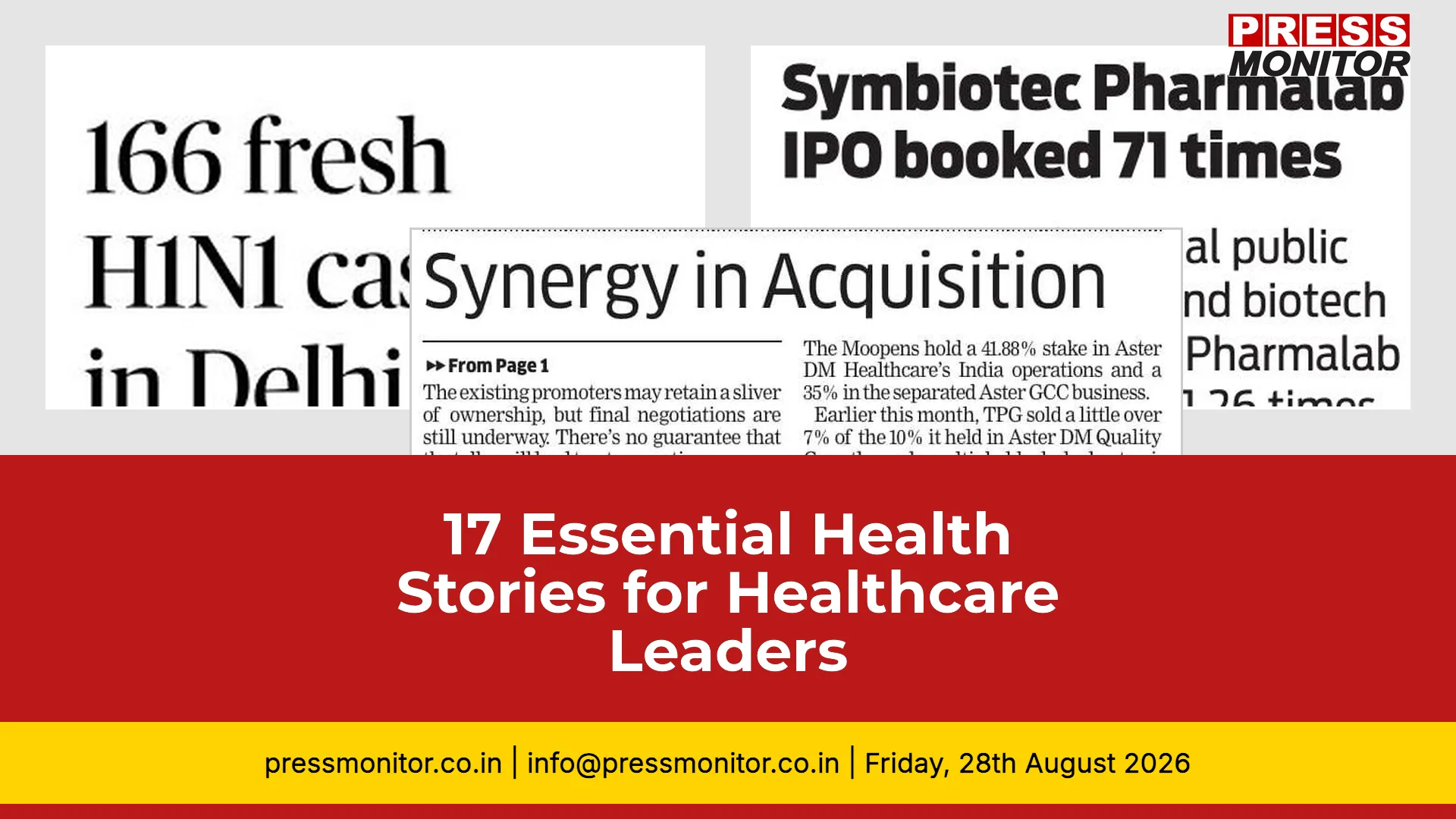
In today's health landscape, staying ahead requires more than just headlines — it demands real-time, verified intelligence from India's largest print ecosystem. Here are 17 essential health stories you need to know today, sourced through Press Monitor's comprehensive media monitoring of Indian publications.
1. Delhi H1N1 Surge: Minister Inspects Hospital
"Selon The Hindu, Singh inspected Indira Gandhi Hospital at Dwarka in view of the rising number of HINI cases in the national capital and reviewed the preparedness of the hospital and the Health Department. The total number of HINI cases in Delhi stood at 2,6l2, and cumulative Influenza-A cases around 3,3OO, as per an official statement. The Minister said he has been closely monitoring preparedness across hospitals. Meanwhile, Delhi Aam Aadmi Party (AAP) president Saurabh Bharadwaj alleged that Delhi government-run Guru Teg Bahadur Hospital is in a state of utter neglect. "Patients are not receiving all prescribed medications. Essential tests and scans are also unavailable at the hospital," he said. AAP MLAs Sanjeev Jha and Kuldeep Kumar visited the hospital to assess the situation."
Why it matters: Delhi's cumulative H1N1 cases have reached 2,612 amid a sudden spike, prompting a high-level review of hospital preparedness. This directly impacts urban healthcare capacity and public health messaging.
Key detail: Health Minister Pankaj Kumar Singh reviewed Indira Gandhi Hospital's H1N1 isolation ward, bed availability, and testing facilities. Simultaneously, AAP alleged neglect at Guru Teg Bahadur Hospital, raising political stakes.
Source: The Hindu
Next step: Monitor bed occupancy rates and any escalation of political oversight.
2. Symbiotec Pharmalab IPO Subscribed 71.26 Times
A front-page report in New Indian Express says, the initial public offering of Symbiotec Pharmalab Ltd was subscribed 71.26 times on the last day of bidding on Thursday. The IPO received bids for 93,52,49,700 shares against 13,124,929 shares on offer, according to data available with the NSE.
Why it matters: The massive over-subscription signals strong investor confidence in the pharma sector, especially in biotech and generic drug manufacturing.
Key detail: The IPO received 93,52,49,700 bids against 13,124,929 shares on offer, reflecting 71.26 times subscription across categories.
Source: New Indian Express
Next step: Track listing day performance and sector-wide sentiment.
3. Yatharth Hospitals Acquisition Talks
A front-page report in Economic Times says Yatharth, a hospital chain headquartered in Noida, is exploring a potential acquisition. Current promoters may retain a sliver of ownership, but negotiations are still in progress. Blackstone and Aster DM Healthcare have denied any involvement in the deal.
Why it matters: Private equity interest in hospital chains is reshaping India's healthcare delivery landscape. This deal could set valuation benchmarks for mid-sized hospitals.
Key detail: Advent International and Blackstone-backed Aster DM are negotiating for a majority stake, though some parties deny involvement. Promoters may retain a minority.
Source: Economic Times
Next step: Watch for official bid confirmations or regulatory filings.
4. Nationwide Vector-Borne Disease Initiative
A front-page report in Millennium Post says the Ministry of Health has initiated a nationwide public health program targeting vector-borne diseases, announced today. Officials revealed that the initiative includes distribution of preventive kits and awareness campaigns across 10 states starting next month, aiming to reduce disease incidence by 40% in two years. The program will prioritize rural areas with limited healthcare access. Health Minister Rajesh Gupta emphasized collaboration with NGOs for implementation.
Why it matters: With monsoon season, vector-borne diseases like dengue and malaria spike. This preventive programme aims to reduce incidence by 40% in two years.
Key detail: Health Ministry launched a programme distributing preventive kits and running awareness campaigns across 10 rural states, in collaboration with NGOs.
Source: Millennium Post
Next step: Check if your state is included in the first phase.
5. New Oral PCSK9 Inhibitor Launched in India
A front-page report in Hindustan Times says that icitide, a once-daily tablet approved by the US Food and Drug Administration in July 2026, is the fourth newcomer in the realm of PCSK9 drugs. Unlike traditional PCSK9 drugs which needed needles as proteins do not survive stomach; icitide is built as a macrocyclic peptide chemistries that the peptide folded into a form that reaches the bloodstream intact. Its main trial cut LDL by 56 per cent against placebo. The outcomes trial is still running. In India, CDSCO has approved a Phase 3 trial.
Why it matters: Icitide offers a needle-free alternative to traditional cholesterol-lowering injections, potentially improving patient compliance.
Key detail: FDA-approved in July 2026, it lowers LDL by 56% vs placebo. CDSCO has approved a Phase 3 trial in India.
Source: Hindustan Times
Next step: Monitor trial outcomes for possible formulary inclusion.
6. Flu Vaccine Demand Surges
A front-page report in Economic Times says that demand for flu vaccines has shot up significantly, with people increasingly turning to digital health platforms for at-home vaccinations and rapid testing as H1N1 and other types of influenza spread across the country.
Why it matters: Rising H1N1 cases are driving unprecedented demand for vaccines, stressing supply chains and boosting digital health platforms.
Key detail: Digital platforms report increased orders for at-home vaccinations and rapid testing kits. Economic Times calls it a 'surge'.
Source: Economic Times
Next step: Evaluate vaccine stock availability through public health portals.
7. PH Kurian: Public Health Champion Passes Away
A front-page report in Business Line says that PH Kurian, a civil servant who issued India’s first and only compulsory license on a kidney cancer drug, has passed away in Kerala. Colleagues and pro-health groups remember the low-profile man, whose judgment under India’s amended Patents Act was not just high-profile, but also stood the test of intense legal scrutiny in the country and abroad. The judgment allowed Hyderabad’s Natco Pharma to make the medicine at a price that was about 97 per cent less, but with a royalty payment to the innovator, reducing the monthly treatment cost for kidney and liver cancer patients "from over ₹2.8 lakh to just ₹8,800", making life-saving medication accessible.
Why it matters: PH Kurian's compulsory license on a kidney cancer drug reduced monthly treatment cost from ₹2.8 lakh to ₹8,800 — a landmark for drug access.
Key detail: The 2012 order under India's Patents Act allowed Natco Pharma to produce the drug at 97% lower cost, withstanding legal challenges.
Source: Business Line
Next step: Reflect on the legacy of IP reform in healthcare access.
8. India Plans Trauma Care Strengthening at District Hospitals
"A front-page report in Millennium Post says that Union Health Minister J P Nadda reviewed progress on budget projects aimed at increasing emergency and trauma-care capacity in district hospitals by 50 per cent. The ministry is implementing a phased approach, categorizing 613 hospitals, and targeting 160 for initial strengthening by March 2027. Additionally, the Minister reviewed the strengthening of the Allied Health Professionals (AHPs) ecosystem, with the objective of adding one lakh AHPs over the next five years."
Why it matters: District hospitals are the first line of emergency care. A 50% capacity increase could save thousands of trauma patients annually.
Key detail: Union Health Minister JP Nadda reviewed a phased plan to strengthen 160 hospitals by March 2027, plus add 1 lakh allied health professionals.
Source: Millennium Post
Next step: Identify which district hospitals are in the initial batch.
9. Omar Abdullah Advocates Integrated Healthcare in J&K
According to a State Times report, Chief Minister Omar Abdullah addressed a gathering at SKICC on Thursday, advocating for a balanced and integrated healthcare strategy. He emphasized the need to combine advanced quaternary care with strengthening primary and secondary healthcare services across Jammu and Kashmir. Abdullah highlighted the importance of focusing on grassroots delivery while acknowledging the role of tertiary care in providing specialized treatment, cautioning against solely increasing the tier of care.
Why it matters: Balancing quaternary care with primary services is critical for regions with diverse geography and limited access.
Key detail: Speaking at SKICC, the CM stressed grassroots delivery over merely higher-tier care, calling for a balanced health strategy.
Source: State Times
Next step: Watch for policy shifts in J&K's health budget allocations.
10. India's Doctor Shortage: Foreign Graduates Face Tough Test
A front-page report in Business Standard says India faces an acute shortage of doctors, particularly specialists in rural areas, yet thousands of foreign-trained medical graduates remain unable to enter its healthcare workforce.
Why it matters: India needs doctors, especially in rural areas, yet thousands of foreign-trained graduates cannot join the workforce due to exam barriers.
Key detail: Business Standard reports an acute shortage of specialists, while licensing exams remain a bottleneck.
Source: Business Standard
Next step: Advocate for streamlined licensing pathways.
11. Six Indian HealthTech Startups Selected for UK-India Accelerator
"Selon Deccan Herald, six Indian HealthTech startups have been selected for the UK-India HealthTech Accelerator Programme. Harjinder Kang, Trade Commissioner for South Asia, announced the selection with Chandru Iyer, British Deputy High Commissioner for Karnataka. The program supports high-potential Indian HealthTech and MedTech companies to explore collaborations, investment, research, and commercialization opportunities in the UK. Launched in 2023, it's organized by the UK Government and aims to strengthen UK-India collaboration in health innovation, supporting Indian companies to establish and scale operations in the UK. The initiative is projected to generate 32 million pounds of investment and support 100 jobs, with seven companies already establishing a UK presence and more than 10-15 collaborating with UK universities, NHS organizations, and innovation partners."
Why it matters: This programme supports Indian healthtech companies to scale in the UK, potentially attracting £32 million investment and creating 100 jobs.
Key detail: Selected startups will explore collaboration, investment, and commercialization opportunities with NHS and UK universities.
Source: Deccan Herald
Next step: Check if your portfolio company is among the six selected.
12. Health Ministry Reviews Budget Allocations
A front-page report in Millennium Post says Indian Health Minister Harsh Vardhan Nadda reviewed post-budget initiatives, including committee formations for infrastructure, drugs, diagnostics, academic expansion, and digital architecture. Nadda stressed timelines for healthcare improvements, mentioning 1,60 hospital district enhancement. The Health Ministry conducted a comprehensive gap analysis against Indian Public Health Standards, proposing phased hospital upgrades with financial allocations detailed in budget plans.
Why it matters: Post-budget implementation plans determine actual improvements in healthcare infrastructure, drugs, and digital health.
Key detail: Nadda reviewed committees for infrastructure, drugs, diagnostics, academic expansion, and digital architecture, with a gap analysis against Indian Public Health Standards.
Source: Millennium Post
Next step: Align your organization's plans with the ministry's timeline.
13. Sanjay Gandhi Hospital Under Scrutiny After Mother-Child Deaths
A front-page report in Free Press Journal says medical college dean Dr Sunil Agrawal suspended two nurses following the deaths of a newborn and mother during surgical delivery at Sanjay Gandhi Memorial Hospital. Investigators are examining potential negligence, including use of external blood supplies and alleged anesthesia overdose. The incident occurred during Kalpana Mishra's delivery on 26 August 2026.
Why it matters: Medical negligence allegations in Rewa highlight systemic issues in maternal care at public hospitals.
Key detail: Two nurses were suspended after a newborn and mother died during surgical delivery. Investigations include possible anesthesia overdose and external blood supply use.
Source: Free Press Journal
Next step: Push for transparent investigation and safety audits.
14. SEBI Stands Firm on Closing Auction Session
A front-page report in New Indian Express says that Sebi Chairman Tuhin Kanta Pandey has confirmed that the capital market regulator will not make any changes to the newly-introduced closing auction session (CAS). The Sebi is also close to approving the NSE Draft Red Herring Prospectus (DRHP), which will facilitate the IPO of the largest equity bourse. Symbiotec Pharmalab IPO was subscribed 7l.26 times on the last day of bidding.
Why it matters: The decision impacts market liquidity and IPO pricing mechanisms, especially for pharma stocks.
Key detail: SEBI Chairman Tuhin Kanta Pandey confirmed no changes to the newly introduced CAS, which affects how IPOs close trading.
Source: New Indian Express
Next step: Monitor market participants' reactions for feedback loops.
15. China Accepts Novo Nordisk's Wegovy Oral Application
A front-page report in Business Standard says that China’s drug regulator has accepted Novo Nordisk’s application to sell the oral version of its GLP-1 weightloss drug Wegovy, as the Danish drugmaker seeks to catch up with rival Eli Lilly in the world’s second-largest pharmaceutical market.
Why it matters: The Chinese market approval would expand weight-loss drug access globally, intensifying competition between Novo Nordisk and Eli Lilly.
Key detail: China's drug regulator has accepted the oral version of Wegovy, as Novo seeks to catch up in the world's second-largest pharma market.
Source: Business Standard
Next step: Track regulatory decisions in other key markets.
16. Uttarakhand Gets First Super Speciality Hospital
A front-page report in Asian Age says Union Health Minister JP Nadda has directed officials to evaluate proposals for Uttarakhand’s first super speciality hospital and paramedical college under the Hemvati Nandan Bahuguna Uttarakhand Medical Education University.
Why it matters: The state has lacked advanced care, forcing patients to travel. This hospital and paramedical college will improve outcomes and train local professionals.
Key detail: JP Nadda directed evaluation of proposals under the Hemvati Nandan Bahuguna Uttarakhand Medical Education University.
Source: Asian Age
Next step: Follow EOI timelines for construction and staffing.
17. New Drugs Reshaping Cholesterol Control
A front-page report in Hindustan Times says new drugs are reshaping the cholesterol control battle. Despite statins being the standard treatment for three decades, new therapies targeting PCSK9 protein show promise in further reducing LDL cholesterol levels, potentially preventing heart attacks and strokes.
Why it matters: Beyond statins, new PCSK9 therapies promise additional LDL reduction, potentially preventing heart attacks and strokes.
Key detail: Despite statins being standard for three decades, novel agents targeting PCSK9 protein are emerging, reshaping treatment guidelines.
Source: Hindustan Times
Next step: Review your cholesterol management protocols for breakthrough therapies.
Stay informed with real-time print media monitoring — Press Monitor brings you the stories that shape Indian healthcare. Which of these developments will impact your organization most? Share your thoughts.