17 Essential Human Resources Stories for HR Leaders


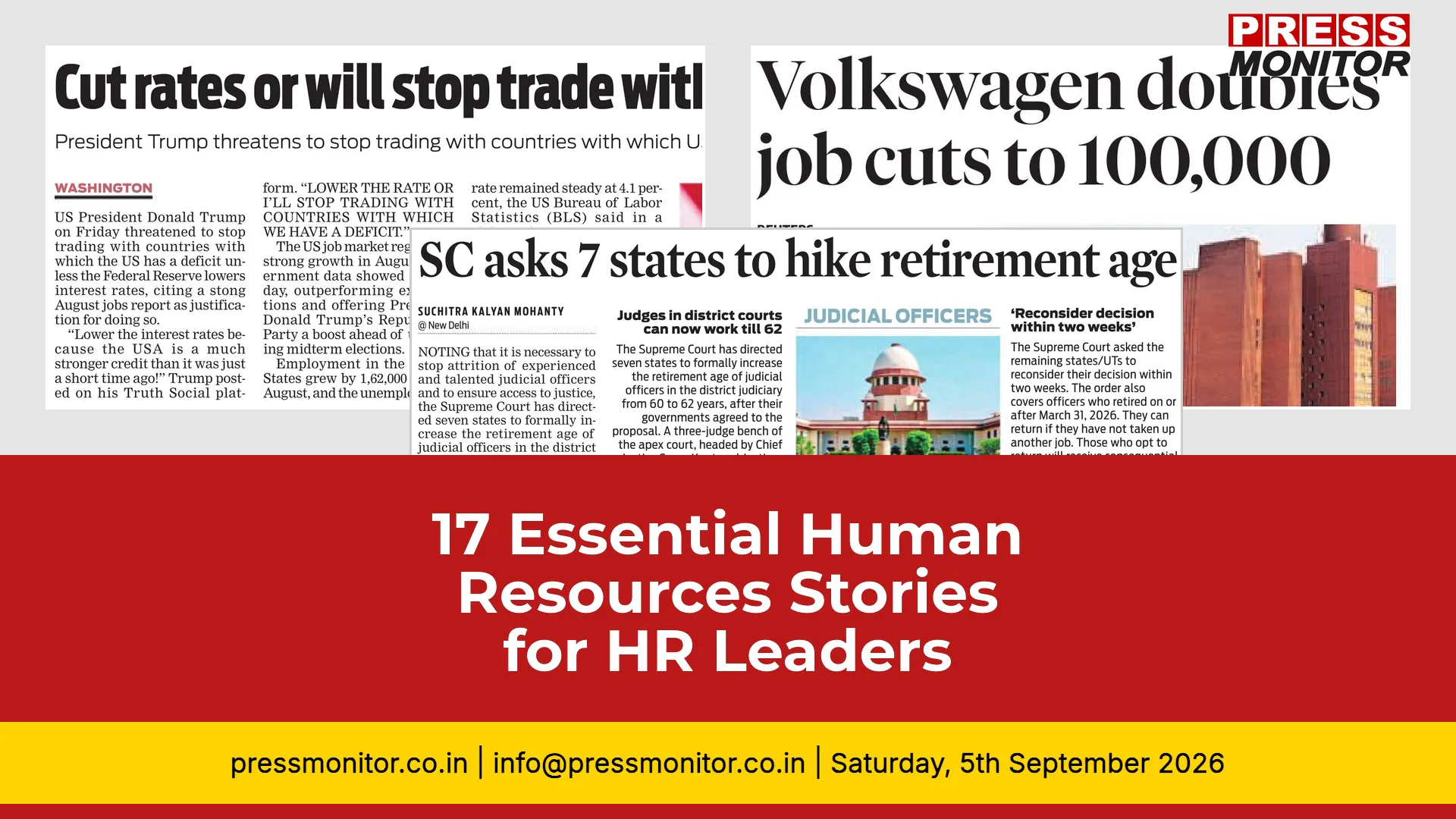
According to Press Monitor's tracking of Indian publications, this press review delivers 17 essential stories on human resources — covering labour market shifts, workforce restructuring, skills development, and employee wellbeing. As media monitoring and media intelligence reveal, today's print data offers the editorial depth that digital platforms often miss. These stories on news on human resources matter for every HR leader, and print media monitoring ensures you stay ahead of developments before they break elsewhere.
1. Trump Threatens Trade Halt Over Fed Rates
A front-page report in Morning Standard says US President Donald Trump threatened to halt trade with nations running deficits against the United States unless the Federal Reserve lowers interest rates. Citing a robust August labour report that added one hundred sixty-two thousand jobs while holding unemployment steady at four point one percent, Trump issued the warning via Truth Social. Vice President JD Vance and other administration figures have also pushed for rate cuts before the central bank’s September fifteenth to sixteenth gathering, even as economists anticipate a potential hike to curb inflation.
Why it matters: A direct threat from the US President to halt trade with deficit-running nations unless the Federal Reserve cuts rates could reshape global labour markets and cross-border hiring. Key detail: The threat followed a strong August jobs report adding 162,000 jobs while unemployment held at 4.1%. Source: Morning Standard, front page. Next step: Monitor the Fed's September 15-16 meeting for rate decision implications. How will this affect your international workforce strategy?
2. Volkswagen Shares Hit Long-Week High After 100,000-Job Cut Plan
A front‑page report in Business Standard says Volkswagen shares hit a long‑week high after the supervisory board struck a turnaround agreement that focuses on cutting one hundred thousand jobs. It also notes that United States tariffs, falling sales in China and competition from Asian rivals are squeezing the automaker, and that Volkswagen India plans to cut twelve percent of its workforce by 2027.
Why it matters: Volkswagen's supervisory board approved a turnaround plan cutting 100,000 jobs globally, with India planning a 12% workforce reduction by 2027. Key detail: The restructuring targets tariffs, overcapacity, and Chinese rivals. Source: Business Standard, front page. Next step: Track how automotive HR teams are managing the transition. What does this mean for manufacturing talent pipelines in India?
3. Supreme Court Extends Judicial Retirement Age to 62
A front-page report in New Indian Express says the Supreme Court has directed seven states to formally increase the retirement age of judicial officers in the district judiciary from 60 to 62 years. A three-judge bench headed by Chief Justice Surya Kant passed the order in the All India Judges Association versus Union of India case, noting that Chhattisgarh, Karnataka, Madhya Pradesh, Maharashtra, Sikkim, Tamil Nadu, and West Bengal consented to the proposal. The court directed these states to amend service rules within two months and asked the remaining 23 states and union territories to reconsider their decision within two weeks.
Why it matters: The Supreme Court directed seven states to raise the retirement age of district judicial officers from 60 to 62, a reform with significant implications for public-sector HR planning. Key detail: Chhattisgarh, Karnataka, Madhya Pradesh, Maharashtra, Sikkim, Tamil Nadu, and West Bengal consented; 23 states and UTs must reconsider within two weeks. Source: New Indian Express, front page. Next step: Assess how this affects recruitment and succession planning in the judicial services. What does this mean for your public-sector HR forecasting?
4. Rs 60,000 Crore PM-SETU Skilling Push with 51% Industry Stake
A front-page report in Indian Express says the government has urged industry to take a leading role in transforming India's skilling landscape through the Rs 60,000 crore PM-SETU initiative. Debashree Mukherjee, Secretary of the Ministry of Skill Development and Entrepreneurship, outlined the vision at Bharat Electricity 2026, noting that industry partners will hold a 51% stake in Section 8 companies managing ITI clusters. The event, organised by The Energy & Climate Initiatives Society, brought together over 15,000 professionals and highlighted the critical importance of workforce development for India's energy transition.
Why it matters: The government is urging industry to lead India's skilling transformation through the PM-SETU initiative, with industry partners holding a 51% stake in ITI cluster companies. Key detail: Debashree Mukherjee, Secretary of Ministry of Skill Development and Entrepreneurship, outlined the vision at Bharat Electricity 2026. Source: Indian Express, front page. Next step: Evaluate how your organisation can participate in ITI partnerships. Is your workforce ready for the energy transition?
5. US Job Growth Surges in August
A front-page report in Business Standard says US job growth accelerated sharply in August while the unemployment rate held steady at 4.1 percent, suggesting improvement in the labour market and keeping an interest rate hike from the Federal Reserve on the table. The larger-than-expected increase in non-farm payrolls reflected a rebound in leisure and hospitality employment and a reversal of the drag from local government education. The unemployment rate remained unchanged despite the labour force increasing by 683,000.
Why it matters: US job growth accelerated sharply in August with non-farm payrolls exceeding expectations, while the unemployment rate held steady at 4.1%. Key detail: The labour force increased by 683,000, and the rebound in leisure and hospitality employment suggests broader economic recovery. Source: Business Standard, front page. Next step: Consider how US labour market strength affects global talent competition and relocation patterns. Are you prepared for increased cross-border talent mobility?
6. 3,800 Children Rescued From Child Labour
A front-page report in Tribune says the National Commission for Protection of Child Rights rescued more than 3,800 children from child labour during a pan-India campaign. The Ministry of Women and Child Development said 575 FIRs were registered between June 12 and August 31. The NCPCR coordinated with state governments, district magistrates, labour departments, and police to identify, rescue, and rehabilitate children vulnerable to trafficking and exploitation.
Why it matters: The NCPCR rescued more than 3,800 children from child labour during a pan-India campaign, with 575 FIRs registered between June 12 and August 31. Key detail: The Ministry of Women and Child Development coordinated with state governments, district magistrates, labour departments, and police. Source: Tribune, front page. Next step: Review your supply chain for child labour risks. Is your organisation's CSR strategy aligned with these rehabilitation efforts?
7. India Tops Global Unpaid Work Rankings
A front-page report in Tribune says India has the highest percentage of workers reporting sixteen or more unpaid working hours per week, according to a study by ADP's People at Work 2026. About twenty-four percent of Indian labourers work more than sixteen unpaid hours per week, and an additional forty percent put in six to fifteen hours of unpaid labour each week. The study notes that employees who put in more than sixteen unpaid hours are more likely to report being totally involved in their work, but this is accompanied by lower levels of thriving, perceived productivity, and intent to find another employment.
Why it matters: India has the highest percentage of workers reporting 16 or more unpaid working hours per week, according to ADP's People at Work 2026 study. Key detail: 24% of Indian labourers work more than 16 unpaid hours weekly, and 40% put in 6-15 hours of unpaid labour. Source: Tribune, front page. Next step: Audit your organisation's unpaid work culture. How does this impact employee retention and wellbeing?
8. Volkswagen India Cuts 12% of Workforce by 2027
A front-page report in Business Standard says Volkswagen's India unit is accelerating a three-year restructuring plan that will cut about 12 percent of its workforce, as it looks to lower costs before its next investment cycle in the country. The overhaul which began in 2025 was accelerated to compress the timetable, forcing quicker cuts through 2027.
Why it matters: Volkswagen's India unit is accelerating a three-year restructuring plan that will cut about 12% of its workforce, compressing the timeline from the original investment cycle. Key detail: The overhaul began in 2025 and was accelerated to force quicker cuts through 2027. Source: Business Standard, front page. Next step: Assess the impact on your automotive supply chain talent pool. How are you planning for workforce transitions in the Indian auto sector?
9. Sanitary Workers Suspend Protest After Deal
A front-page report in New Indian Express says sanitary workers in Chennai suspended their 16-day protest after the Tamil Nadu government agreed to provide a daily food allowance of Rs 50 and withdraw cases registered against them. Ministers promised toilets and rest areas in all 200 wards by September 30 and 300 new battery-operated vehicles for zones 4, 7 and 8. However, the workers' main demand for job regularisation remains unresolved.
Why it matters: Sanitary workers in Chennai suspended their 16-day protest after the Tamil Nadu government agreed to provide a daily food allowance of Rs 50 and withdraw cases. Key detail: Ministers promised toilets and rest areas in all 200 wards by September 30 and 300 new battery-operated vehicles, but job regularisation remains unresolved. Source: New Indian Express, front page. Next step: Review your municipal and public-sector contracts for labour compliance. Is your organisation's vendor management addressing worker rights?
10. Over 400 Tasmac Shops Remain Shut
A front-page report in New Indian Express says over 400 Tasmac shops remained shut in six districts on Friday as employees protested the bottle buy-back scheme and suspensions. Staff demanded additional workers or privatisation, noting they incur expenses to rent space and pay wages out of pocket. Officials claimed shops were not completely closed and said interventions and talks are underway.
Why it matters: Over 400 Tasmac shops remained shut in six districts as employees protested the bottle buy-back scheme and suspensions, highlighting public-sector labour relations challenges. Key detail: Staff demanded additional workers or privatisation, noting they incur expenses to rent space and pay wages out of pocket. Source: New Indian Express, front page. Next step: Evaluate the implications of government staffing models on public-sector employment. How does this affect your public-sector client relationships?
11. ALPA Calls for Review of Pilot Training After Tailstrike Incidents
A front-page report in Deccan Herald says that the Airline Pilots’ Association of India has raised concerns over repeated tailstrike incidents involving Airbus A321neo and A321XLR aircraft, citing an Air India flight AI2651 incident on May twenty-first, two thousand twenty-six and a September two thousand twenty-four IndiGo incident. The association calls for independent review of pilot training, simulator use, safety systems and fatigue management, and urges stronger tail‑skid protection and non‑overridable tailstrike protection.
Why it matters: The Airline Pilots' Association of India raised concerns over repeated tailstrike incidents involving Airbus A321neo and A321XLR aircraft, calling for independent review of pilot training and safety systems. Key detail: The association cited an Air India flight AI2651 incident and a September 2024 IndiGo incident. Source: Deccan Herald, front page. Next step: Review your aviation sector clients' HR and safety training protocols. Is your organisation's talent management aligned with aviation safety standards?
12. India Labour Policy Letters Call for Faster IRC Clarification
A front-page report in Business Line says letters published in the newspaper's editorials section on September 4 called for faster clarification of India's Industrial Relations Code, deeper India-Belgium cooperation, and stronger women-focused policies across high-income Indian states. The letters were from AMyilsami in Coimbatore, AC Vineeth Kumar in Thrissur, Kerala, and Kosaraju Chandramouli in Hyderabad.
Why it matters: Editorials published in Business Line called for faster clarification of India's Industrial Relations Code, deeper India-Belgium cooperation, and stronger women-focused policies. Key detail: Letters were from AMyilsami in Coimbatore, AC Vineeth Kumar in Thrissur, Kerala, and Kosaraju Chandramouli in Hyderabad. Source: Business Line, front page. Next step: Monitor how the Industrial Relations Code evolves and its impact on your labour compliance strategy. Is your organisation prepared for the regulatory changes?
13. 7% Placement Rate in PMKVY Training
A front-page report in Business Standard says the government's PMKVY scheme has recorded placements of just 7 per cent of the 2.85 million candidates it has trained, with 200,224 placements as of August 28. The dashboard data reveals sharp sector-wise variation, with telecom recording the highest placement rate at 17.5 percent and management the lowest at 1.1 percent. The scheme, part of the Skill India Programme, has an approved outlay of 8,800 crore for 2022-23 to 2025-26, with 6,000 crore allocated to PMKVY 4.0.
Why it matters: The government's PMKVY scheme has recorded placements of just 7% of the 2.85 million candidates trained, with sharp sector-wise variation — telecom at 17.5% and management at 1.1%. Key detail: The scheme has an approved outlay of 8,800 crore for 2022-23 to 2025-26. Source: Business Standard, front page. Next step: Evaluate how your organisation can improve vocational training outcomes. What role can your HR team play in bridging the skills-placement gap?
14. 8.7% Women Enter Indian Auto Jobs
A front-page report in Business Line says that women constitute just 8.7 percent of India’s automotive manufacturing workforce, facing substantial pay disparities and shift limitations. Major manufacturers including Tata Motors and Hero MotoCorp are expanding female recruitment and launching large-scale training initiatives, though smaller suppliers continue to struggle with infrastructure costs and hiring biases.
Why it matters: Women constitute just 8.7% of India's automotive manufacturing workforce, facing substantial pay disparities and shift limitations, though major manufacturers are expanding female recruitment. Key detail: Tata Motors and Hero MotoCorp are launching large-scale training initiatives, but smaller suppliers struggle with infrastructure costs and hiring biases. Source: Business Line, front page. Next step: Review your organisation's DEI strategy for manufacturing roles. How are you addressing gender parity in traditionally male-dominated sectors?
15. AI Will Threaten White-Collar and Creative Jobs
A front-page report in Business Standard says AI will likely have a different impact on the labour force than previous technologies, threatening white-collar and creative workers. It is surprising that there is remarkable complacency about AI's effects despite creators expressing concern. The article notes manufacturing employment rose globally but white-collar workers face greater risk.
Why it matters: AI will likely have a different impact on the labour force than previous technologies, threatening white-collar and creative workers with remarkable complacency from the industry. Key detail: Manufacturing employment rose globally but white-collar workers face greater risk than from previous automation waves. Source: Business Standard, front page. Next step: Assess how AI adoption in your organisation affects creative and knowledge-worker roles. Is your reskilling strategy keeping pace?
16. Manufacturing Sector Needs 13.1% CAGR to Hit $7.5 Trillion by 2047
A front-page report in Millennium Post says India’s manufacturing sector must grow at a 13.1 percent compound annual growth rate to reach $7.5 trillion by 2047, according to a KPMG report. The current 7.9 percent growth would only bring it to $2.7 trillion, leaving a $4.8 trillion gap. The report highlights productivity as the key lever, noting that firms with higher productivity enjoy 50 percent higher profitability growth and nearly double market capitalisation growth, and recommends a three‑pillar approach of reimagining work, redesigning organisations and remodelling the workforce.
Why it matters: India's manufacturing sector must grow at a 13.1% compound annual growth rate to reach $7.5 trillion by 2047, according to a KPMG report — far above the current 7.9% growth. Key detail: Firms with higher productivity enjoy 50% higher profitability growth and nearly double market capitalisation growth. Source: Millennium Post, front page. Next step: Align your workforce planning with the productivity levers identified in the report. Is your organisation's talent strategy supporting the three-pillar approach of reimagining work, redesigning organisations, and remodelling the workforce?
17. 23-Year-Old IT Employee Dies By Suicide in Chennai
A front-page report in New Indian Express says that 23-year-old IT employee Santhosh died by suicide at a Tamil Nadu Slum Clearance Board tenement on Ambattur-Athipattu Main Road in Chennai on Thursday night. He had left work approximately two hours before his shift ended and was found dead on the ground floor. Police registered a case and preliminary inquiries suggest he took the extreme step after a woman rejected his marriage proposal.
Why it matters: A 23-year-old IT employee died by suicide at a Tamil Nadu Slum Clearance Board tenement, highlighting the urgent need for employee wellbeing and mental health support in the IT sector. Key detail: Police registered a case and preliminary inquiries suggest the extreme step followed a personal rejection. Source: New Indian Express, front page. Next step: Review your organisation's employee assistance programmes and mental health policies. Is your workplace culture adequately supporting employee wellbeing?
Closing question: Which of these 17 stories on news on human resources will have the biggest impact on your organisation's workforce strategy in the coming quarter?
