17 Essential Jobs and Employment Stories for HR Leaders


According to Press Monitor's tracking of Indian publications, today's news on jobs and employment spans hiring slowdowns in the US, AI salary surges in India, major layoffs at Uber and PayPal, and new workforce initiatives from state governments to corporate India. This media monitoring roundup delivers 17 stories every HR and talent leader needs to know, combining media intelligence from India's diverse print landscape.
1. Uber's Largest Restructuring Since 2020
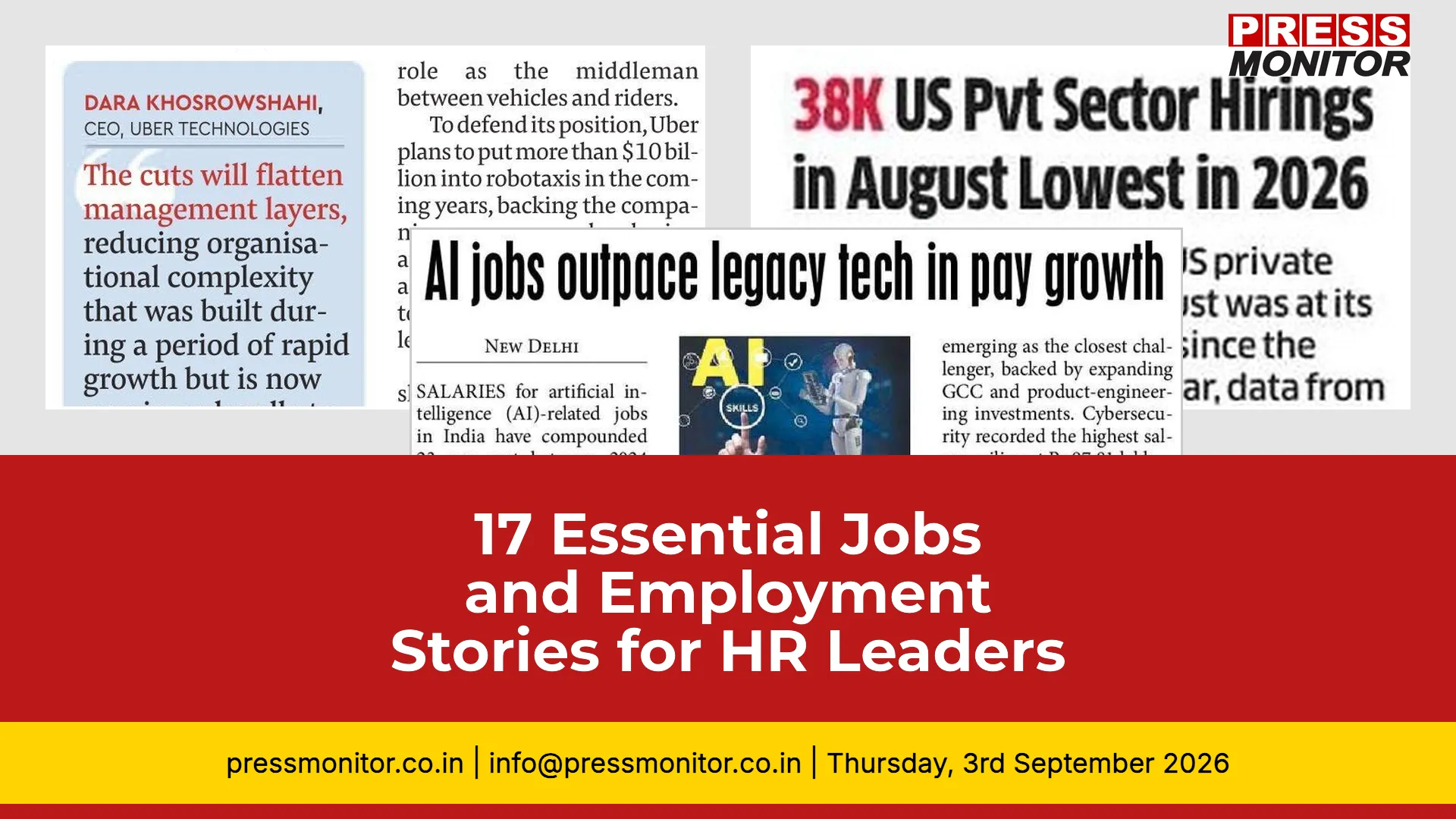
A front-page report in Financial Express says Uber Technologies is carrying out its biggest restructuring since 2020, cutting employees positioned seven or more reporting layers below the chief executive by 20% and nearly halving teams with only one or two direct reports. The overhaul comes amid growing robotaxi competition from Waymo and Tesla, prompting Uber to pledge more than $10 billion for autonomous vehicle investment. Uber had about 34,000 employees globally at the end of last year.
Why it matters: Uber Technologies is cutting 3,300 roles, or 10% of its global workforce, in its biggest restructuring since the pandemic, reshaping the gig economy's largest employer.
Key detail: The overhaul removes seven or more reporting layers below the CEO and nearly halves teams with only one or two direct reports, while pledging over $10 billion for autonomous vehicle investment amid robotaxi competition from Waymo and Tesla.
Source: Financial Express, Business Standard, Free Press Journal
Next step: Monitor how the restructuring affects driver-partner economics and delivery timelines in India. Closing: Will Uber's pivot to robotaxis redefine the future of ride-hiring jobs globally?
2. US Private Sector Hiring Slows in August
A front-page report in Economic Times says hiring in the US private sector in August was at its slowest pace since the start of the year, according to payroll firm ADP.
Why it matters: The slowest US private sector hiring since the start of the year signals a cooling global labor market that could affect Indian IT and BPO export demand.
Key detail: Payroll firm ADP reported August hiring at its slowest pace since January, raising concerns about a broader economic slowdown.
Source: Economic Times
Next step: Track whether Indian IT services firms adjust their hiring forecasts for US-facing roles. Closing: How will slower US hiring impact the next wave of Indian tech job creation?
3. AI Salaries Jump 23 Per Cent
A front-page report in The Hans India says salaries for artificial intelligence jobs in India have compounded 23 per cent between 2024 and 2026, while pay in some legacy technology roles has declined. AI recorded 12 per cent year-on-year salary growth, the highest among tracked categories, with entry-level AI professionals earning Rs 8.87-15.41 lakh per annum and Bengaluru remaining the country's highest-paying AI market. Foundit chief executive Tarun Sinha said experience alone no longer commands the strongest raises, as what matters is whether a skill fills a capability gap the business needs.
Why it matters: AI roles in India are seeing the highest salary growth among tracked categories, reshaping talent acquisition strategies across the tech sector.
Key detail: AI salaries compounded 23% between 2024 and 2026, with entry-level professionals earning Rs 8.87-15.41 lakh per annum; Bengaluru remains the highest-paying AI market.
Source: The Hans India, Foundit CEO Tarun Sinha
Next step: Evaluate whether your organization's AI compensation bands are competitive. Closing: Is your company prepared to match the 23% AI salary surge for critical talent?
4. Job Engine Stalls at State Borders
A front-page report in New Indian Express says the macroeconomic figures depict a picture of reassuring stability. However, these headlines mask a more urgent structural narrative. There is a persistent spatial and institutional disconnect in India’s economy.
Why it matters: A structural disconnect between macroeconomic stability and ground-level employment realities demands attention from policymakers and industry leaders.
Key detail: Tulsi Jayakumar reports that reassuring national figures mask persistent spatial and institutional gaps in India's labor market.
Source: New Indian Express
Next step: Assess which states are most affected by the spatial employment disconnect. Closing: Can state-level reforms bridge the gap between national growth and local job creation?
5. Private Employment Rises in August
A front-page report in Financial Express says private employment rose by 38,OOO jobs last month after an upwardly revised 46,OOO in July.
Why it matters: After a revised 46,000 jobs in July, private employment added 38,000 positions in August, offering early signs of a hiring recovery.
Key detail: The upward revision suggests data normalizations are occurring, but the pace remains modest.
Source: Financial Express
Next step: Compare this with the foundit hiring index to gauge sectoral balance. Closing: Is August's 38,000-job gain enough to sustain momentum through the festival season?
6. Amazon Expands Workforce for Festival Season
A front-page report in Business Standard says Amazon India is expanding its workforce to strengthen fulfilment and logistics capabilities for the festival season. Opportunities in Tier-II and Tier-III cities now account for nearly 55 per cent of gig jobs on the platform.
Why it matters: Amazon India is scaling fulfillment and logistics hiring, with Tier-II and Tier-III cities now accounting for nearly 55% of gig jobs on the platform.
Key detail: Festival season demand is driving a shift in where jobs are created, moving beyond metro centers.
Source: Business Standard
Next step: Consider how this geographic shift affects your logistics and supply chain workforce planning. Closing: Will the festival hiring boom create lasting employment in India's smaller cities?
7. Festival Demand Boosts Hiring in Ecom and Logistics
A front-page report in Business Standard says that with the festival season around the corner, ecommerce, quick-commerce, and logistics firms are ramping up hiring to meet a longer demand period.
Why it matters: Ecommerce, quick-commerce, and logistics firms are ramping up hiring ahead of the festival season, extending the demand window for seasonal workers.
Key detail: The longer demand period is creating more sustained employment opportunities beyond traditional peak seasons.
Source: Business Standard
Next step: Plan temporary workforce deployments now to capture festival-season logistics roles. Closing: How should your organization prepare for the extended festival hiring cycle?
8. Adani Group's Workforce Shrinks as Outsourcing Increases
A front-page report in Mint says the number of people directly employed by Adani's listed firms fell as jobs increasingly moved to vendors and unlisted entities. The decision to outsource work to large vendors stems from a strategic rethink at Shantigram where the Adani headquarters are situated in Ahmedabad.
Why it matters: Adani's listed firms are reducing direct headcount as jobs move to vendors and unlisted entities, signaling a broader corporate outsourcing trend.
Key detail: The strategic rethink at Shantigram, where Adani headquarters are situated in Ahmedabad, reflects a fundamental shift in how large Indian conglomerates manage their workforce.
Source: Mint
Next step: Evaluate whether outsourcing trends in your sector could affect direct employment numbers. Closing: Is the shift from direct employment to vendor-based staffing the future of corporate workforce management?
9. PayPal Layoffs Affect Nearly a Quarter of Indian Workforce
A front-page report in Business Line says that nearly a quarter of PayPal’s approximately 6,700 employees in India have either been laid off or are in the process of being done so. The recent staffing changes are part of the firm’s multi-year transformation to simplify global operations and position the firm for long-term growth.
Why it matters: Nearly a quarter of PayPal's approximately 6,700 employees in India have been laid off or are in the process, marking a significant impact on India's tech workforce.
Key detail: The staffing changes are part of PayPal's multi-year transformation to simplify global operations and position the firm for long-term growth.
Source: Business Line
Next step: Assess the impact on PayPal's India tech hubs and the broader fintech job market. Closing: What does PayPal's restructuring mean for India's position as a global fintech talent hub?
10. Claims Double-Digit Growth in Auto Industry
A front-page report in Times of India says Commerce and industry minister Piyush Goyal rejected criticism of the GDP data and said demand across sectors showed that the expansion was 'for real'. He said critics were drawing misleading comparisons between growth rates calculated under different GDP series and base years.
Why it matters: Commerce and industry minister Piyush Goyal defended GDP data and called sector-wide demand expansion 'for real,' which could translate into sustained auto sector hiring.
Key detail: Goyal rejected criticism of GDP data, saying critics were drawing misleading comparisons between growth rates calculated under different GDP series and base years.
Source: Times of India
Next step: Monitor whether auto industry growth translates into blue-collar and engineering job creation. Closing: Will double-digit auto growth deliver on its promise of mass employment?
11. RFP Notification for ITI Cluster Upgradation
A front-page report in Times of India says that the Directorate of Training & Employment, Uttarakhand, invites Request for Proposal (RFP) for the selection of an Anchor Industry Partner (AIP) for upgradation of ITI Cluster under PM-SETU in the state of Uttarakhand.
Why it matters: Uttarakhand's Directorate of Training & Employment is seeking an Anchor Industry Partner for ITI Cluster upgradation under PM-SETU, creating new vocational training infrastructure.
Key detail: The initiative aims to upgrade industrial training institutes to meet modern manufacturing and technology skill demands.
Source: Times of India
Next step: ITI partners and vocational training providers should prepare responses to this RFP. Closing: Could this RFP be a catalyst for transforming India's vocational training landscape?
12. IT Services Hiring Reaches 8-Month High in September
A front-page report in Deccan Herald says India’s IT hiring is staging a recovery, with active tech openings hitting an 8-month high of 117,000 in September, up 7% month-on-month and 15% year-on-year. Tech jobs accounted for over 51% of all active openings, crossing the 50% mark for the first time this fiscal.
Why it matters: India's IT hiring is staging a recovery, with active tech openings hitting an 8-month high of 117,000 in September, crossing the 50% mark of all active openings for the first time this fiscal.
Key detail: Tech jobs accounted for over 51% of all active openings, up 7% month-on-month and 15% year-on-year.
Source: Deccan Herald, Uma Kannan
Next step: IT services firms and job seekers should capitalize on this recovery momentum. Closing: Is this the beginning of a sustained IT hiring revival in India?
13. Hiring Up 5%, IT Stays Weak
A front-page report in Financial Express says the foundit hiring index rose 5% month-on-month in August after five consecutive months of decline, offering early signs of revival in India's job market. The index, however, stayed 18% below its February peak of 404, with travel and tourism hiring growing 22% while IT hiring kept losing momentum. Only five of the 27 industries tracked by foundit recorded annual growth, with demand strongest for professionals with 7-10 years of experience.
Why it matters: The foundit hiring index rose 5% month-on-month in August after five consecutive months of decline, but IT hiring continues to lose momentum even as travel and tourism hiring grows 22%.
Key detail: Only five of the 27 industries tracked by foundit recorded annual growth, with demand strongest for professionals with 7-10 years of experience.
Source: Financial Express, Manu Kaushik
Next step: Mid-career professionals in non-IT sectors should leverage the current demand surge. Closing: Why is IT still weak while other sectors show revival, and what does this mean for job seekers?
14. 19 MSME Parks Inaugurated in Andhra Pradesh
A front-page report in The Hans India says Andhra Pradesh MSME minister Kondapalli Srinivas has said the state government is working to create an entrepreneur in every household, in line with Chief Minister N Chandrababu Naidu's "One Family, One Entrepreneur" vision. Addressing an MSME growth workshop in Vijayawada on Wednesday, he said 19 MSME parks have been inaugurated and 138 more are under way, expected to host 2,876 industrial units, attract investments of about Rs 8,000 crore and generate 1.03 lakh jobs. The state has also allocated Rs 300 crore under the CMEP scheme and reduced rural bank loan interest rates to support DWCRA women and aspiring entrepreneurs.
Why it matters: Andhra Pradesh has inaugurated 19 MSME parks with 138 more under way, expected to host 2,876 industrial units and generate 1.03 lakh jobs under the 'One Family, One Entrepreneur' vision.
Key detail: The state has allocated Rs 300 crore under the CMEP scheme and reduced rural bank loan interest rates to support DWCRA women and aspiring entrepreneurs.
Source: The Hans India, Kondapalli Srinivas
Next step: MSME entrepreneurs and women entrepreneurs in Andhra should explore these new park opportunities. Closing: Can MSME parks become the engine of rural employment growth in India?
15. VTU Partners with TCSF to Enhance Student Employability
A front-page report in Deccan Herald says, Visvesvaraya Technological University (VTU) has collaborated with Tata Consultancy Services Foundation (TCSF) to train its students in skills in demand. The initiative, 'Youth Employment Skill Education', aims to bridge the gap between classroom and industry.
Why it matters: Visvesvaraya Technological University's collaboration with Tata Consultancy Services Foundation bridges the gap between classroom learning and industry needs, directly improving graduate employability.
Key detail: The 'Youth Employment Skill Education' initiative targets skills in demand in the current job market.
Source: Deccan Herald
Next step: Other universities should explore similar industry-academia partnerships to boost placement rates. Closing: Could this VTU-TCSF model become a national template for employability training?
16. 179-Year Wait for US Green Cards
A front-page report in Free Press Journal says Indian professionals applying for US employment-based green cards could face a wait of up to 179 years in the EB-2 category, according to an analysis by the National Foundation for American Policy. The study of US Citizenship and Immigration Services data found nearly 10 lakh Indians stuck in the green card backlog as of December 2025, with the backlog across the EB-1, EB-2 and EB-3 categories rising 20.6% over five years to an estimated 12.6 lakh people. New Indian applicants could wait 179 years in EB-2, 38 years in EB-3 and four to five years in EB-1, as US law caps employment-based green cards at 140,000 annually with no more than 7% for any single country.
Why it matters: Indian professionals applying for US employment-based green cards could face a wait of up to 179 years in the EB-2 category, with nearly 10 lakh Indians stuck in the backlog.
Key detail: The backlog across EB-1, EB-2, and EB-3 categories has risen 20.6% over five years to an estimated 12.6 lakh people, as US law caps employment-based green cards at 140,000 annually with no more than 7% for any single country.
Source: Free Press Journal, National Foundation for American Policy
Next step: Indian tech professionals and HR teams managing global mobility should factor this backlog into retention and relocation strategies. Closing: How will the 179-year green card wait reshape global talent flows for Indian professionals?
17. UP Launches UPCOS to Protect Outsourced Workers' Rights
A front-page report in Business Line says Uttar Pradesh has launched the Uttar Pradesh Corporation for Outsource Services (UP-COS) to streamline recruitment, guarantee fixed salaries, and safeguard the statutory rights of outsourced or contractual workers.
Why it matters: Uttar Pradesh has launched the Uttar Pradesh Corporation for Outsource Services (UP-COS) to streamline recruitment, guarantee fixed salaries, and safeguard statutory rights of outsourced workers.
Key detail: The initiative addresses growing concerns about worker classification and labor rights in the gig and contract economy.
Source: Business Line, Yogi Adityanath government
Next step: Companies using outsourced labor in UP should review compliance with the new UP-COS framework. Closing: Will UP-COS set a precedent for other states to protect outsourced and contractual workers?