17 Essential Water & Wastewater Stories for Infrastructure Leaders


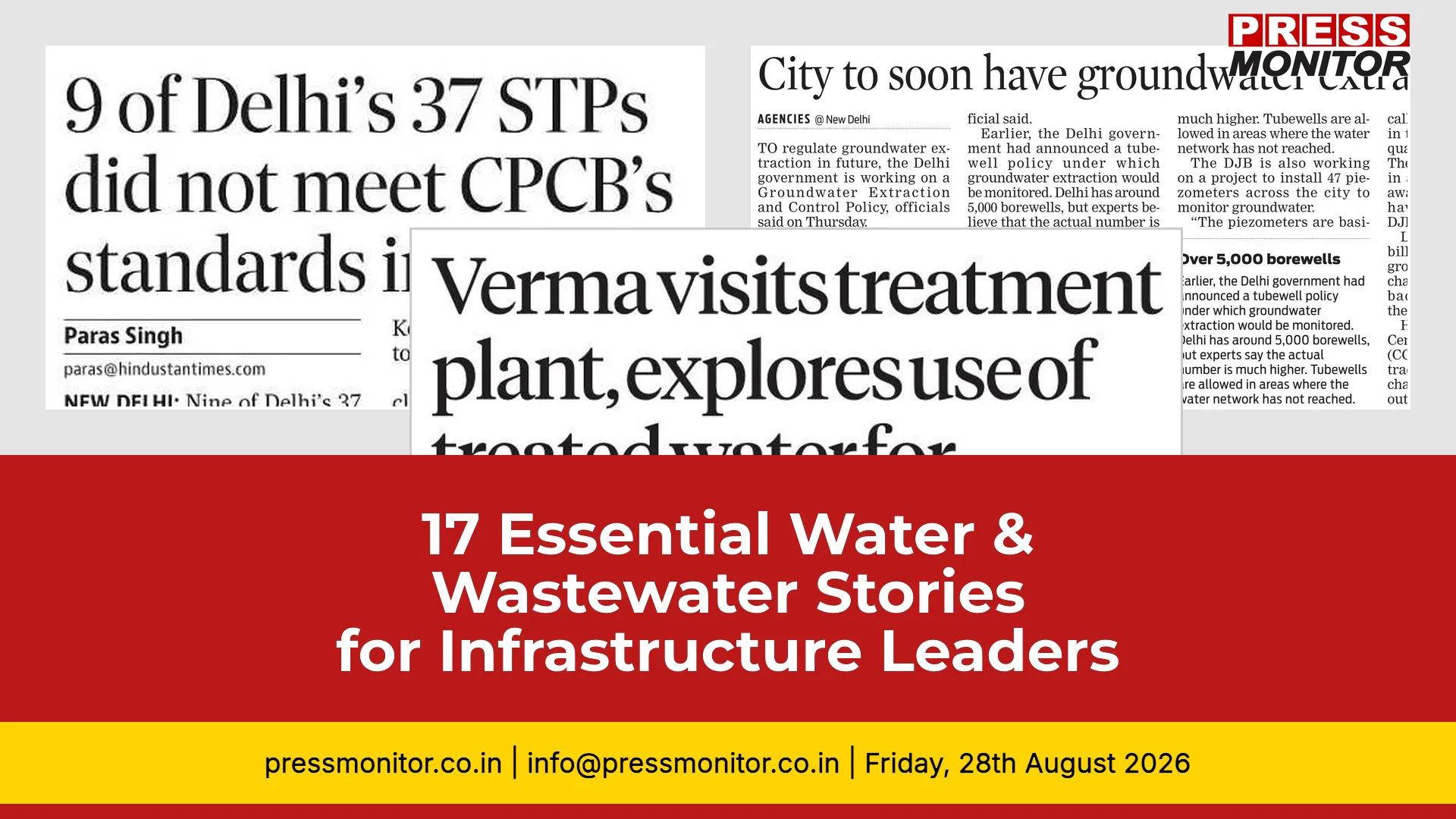
Water security is the silent backbone of India's growth story. Today's print media monitoring reveals a landscape in flux — from Delhi's failing sewage plants to Gujarat's drought-proofing, and from Central Water Commission interventions to tech-driven transparency in rural water assets. According to Press Monitor's tracking of Indian publications, these 17 stories demand your attention. They span policy, infrastructure, environment, and governance — essential reading for anyone in water and wastewater. Here is your press review for August 28, 2026.
1. Delhi's Sewage Treatment Plants Fail to Meet Standards
A front-page report in Hindustan Times says that nine out of Delhi's 37 sewage treatment plants are either non-operational or fail to meet water treatment parameters set by the Central Pollution Control Board (CPCB). The report highlighted that faecal coliform levels peaked at l8,OOO most probable number units per lOOml at the Ghitorni STP and l7,OOO MPN/lOOml at Mehrauli, exceeding the CPCB standard of less than 23O MPN/lOOml.
Why it matters: Nine of Delhi's 37 STPs are non-operational or failing CPCB parameters. Faecal coliform levels at Ghitorni hit 18,000 MPN/100ml — far above the 230 MPN/100ml standard. The city's water bodies are at risk. Key detail: The Ghitorni plant recorded the highest violation.
Source: Hindustan Times (front page). Next step: Municipal authorities must expedite STP upgrades under NGT directives.
2. Delhi to Implement Groundwater Extraction Policy
"A front-page report in Morning Standard says that the Delhi government is working on a Groundwater Extraction and Control Policy to regulate future groundwater usage. Besides previous years, Delhi has extracted more groundwater than it recharges, leading to resource depletion. The policy will monitor water quality and contamination, with the DJB and environment department leading the initiative, including the installation of 47 piezometers to monitor groundwater levels."
Why it matters: Delhi extracts more groundwater than it recharges, depleting reserves. The Delhi Jal Board and environment department will finalise a policy soon. Key detail: 47 piezometers will monitor groundwater levels and contamination.
Source: Morning Standard (front page). Next step: Real estate and construction companies must prepare for stricter extraction norms.
3. Water Minister Verma Visits Treatment Plant to Explore Treated Water Use
A front-page report in Statesman says Delhi's Water Minister Parvesh Verma visited one of the city's treatment plants to explore the possibility of using treated water for construction activities. Verma emphasized that using the precious natural resource sensibly is the need of the hour and that the national capital needs practical, sustainable solutions such as reusing treated water for suitable purposes.
Why it matters: Delhi's Water Minister Parvesh Verma wants treated wastewater used for construction — a practical, sustainable solution. Key detail: Verma stressed sensible use of natural resources.
Source: Statesman (front page). Next step: Construction industry associations should engage with DJB on treated water supply.
4. PM Modi Announces New Industrial Policy, Focus on Gurugram Water Crisis Action
A front-page report in Haribhoomi says that Prime Minister Narendra Modi met with Haryana Chief Minister Nayab Singh Saini in Delhi to discuss the state’s development. The discussion included a new industrial policy, investment plans, and strategies to address the ongoing water crisis in Gurugram. Saini announced a comprehensive action plan encompassing check dams, water harvesting wells, and camera-based de-silting of drainage systems, alongside a new industrial policy with a target of five lakh crore rupees in investment over five years. The government has already seen around 25,000 crore of investment materialize from the launch of the policy.
Why it matters: The Prime Minister met Haryana CM Nayab Singh Saini to discuss investment and water solutions for Gurugram. Key detail: Action plan includes check dams, water harvesting wells, and camera-based de-silting.
Source: Haribhoomi (front page). Next step: Real estate developers in Gurugram should align with the new water action plan.
5. Centre Urges States to Tap VB-G RAM G Funds for Drinking Water Sustainability
A front-page report in Indian Express says the Centre has asked states to use VB-G RAM G funds for drinking water source sustainability under the Jal Jeevan Mission 2.0. Secretaries Ashok K K Meena and Rohit Kansal called for integrated planning to merge water security and waste management into Viksit Gram Panchayat Plans.
Why it matters: Jal Jeevan Mission 2.0 integrates water security with waste management at the gram panchayat level. Key detail: Secretaries Ashok K K Meena and Rohit Kansal called for integrated planning.
Source: Indian Express (front page). Next step: State water departments should expedite utilisation of VB-G RAM G funds.
6. Amit Shah Inaugurates Gujarat Gaurav Sarovar, Hails 25-Year Drought-Free Run
A front-page report in The Hindu says Union Minister Amit Shah claimed Gujarat has not faced a drought-like situation in 25 years due to water management reforms initiated by Narendra Modi. Speaking in Amreli on Thursday, Mr. Shah inaugurated a 21-acre lake and highlighted the construction of 1.5 lakh check dams in 2003.
Why it matters: Gujarat has not faced a drought since 2001, says Amit Shah, crediting check dams and Narmada water. Key detail: 1.5 lakh check dams built in 2003; a 21-acre lake inaugurated.
Source: The Hindu (front page); also covered by Morning Standard, New Indian Express, The Pioneer. Next step: Other states can study Gujarat's water management model.
7. Infrastructure Priorities Shift to Green Tech: Clean Water Tops India's List
A front-page report in Mint says Indians prioritise essential services such as clean water, solar energy and local road networks over airports and housing supply. The Global Infrastructure Index 2026 survey in April-May 2026 ranks 'water supply & sewerage', 'solar energy infrastructure' and 'local road network' as India's top infrastructure priorities, with global average scores much lower for 'cycle routes/lanes' and 'new housing supply'.
Why it matters: The Global Infrastructure Index 2026 ranks water supply & sewerage as India's top infrastructure priority. Key detail: Solar energy and local roads follow.
Source: Mint (front page). Next step: Investors and policymakers should double down on water infrastructure PPPs.
8. Karnataka Launches GIS-Based Water Asset Management App to Curb Fake Bills
A front-page report in Deccan Herald says Karnataka Rural Development and Panchayat Raj Minister Eshwar B Khandre launched a mobile and web application based on Geographic Information System to manage rural water assets and prevent fake bills. All rural properties are being geotagged to bring in transparency. Over 3,53,000 water assets have been digitised and the remaining will be digitalised by September-end.
Why it matters: Minister Eshwar B Khandre launched a GIS app to manage rural water assets transparently. Key detail: Over 3,53,000 water assets digitised; three-tier verification.
Source: Deccan Herald (front page); also covered by Free Press Journal. Next step: Other states can replicate Karnataka's digital transparency model.
9. Cauvery Valley Authority Announced by Minister Jagjivan Ram
A front-page report in Deccan Herald says Jagjivan Ram announced the constitution of a Cauvery Valley Authority in the Lok Sabha today. The authority will comprise three irrigation engineers, one each to be nominated by Tamil Nadu, Karnataka and Kerala, and its Chairman will be an irrigation engineer to be named by the Centre.
Why it matters: A new authority with engineers from TN, Karnataka, Kerala will manage Cauvery water disputes. Key detail: Chairman to be named by Centre.
Source: Deccan Herald (front page). Next step: Stakeholders should monitor composition of the authority.
10. CWC Calls Meeting on Telangana-Andhra Pradesh Water Issues on September 7
A front-page report in Deccan Chronicle says the Central Water Commission (CWC) has called for a meeting between Telangana and Andhra Pradesh on September 7 to deliberate on key issues concerning water management between the two states.
Why it matters: Interstate water management remains contentious. The Central Water Commission will mediate. Key detail: Meeting to deliberate on key water-sharing issues.
Source: Deccan Chronicle (front page). Next step: Both state governments should prepare technical submissions.
11. CWC in September 7 Talks for Wardha Barrage Project
The Central Water Commission (CWC) will hold a meeting on September 1 between Telangana and Maharashtra irrigation officials to discuss the proposed 152-metre-high Tummidihatti barrage on the Wardha River. Telangana Chief Minister Revanth Reddy initiated talks via letters to Maharashtra Chief Minister Devendra Fadnavis and water minister C.R. Patil, citing mutual agreement needs. Submergence concerns remain, with projections indicating 4,210 acres on the riverbed and 920 acres in the Chapral wildlife sanctuary.
Why it matters: Telangana and Maharashtra discuss the 152-metre-high Tummidihatti barrage. Key detail: Submergence concerns: 4,210 acres riverbed, 920 acres in Chapral wildlife sanctuary.
Source: Deccan Chronicle (front page). Next step: Environmental impact assessment must be prioritised.
12. Key Dams Below 2025 Levels as Monsoon Nears End
A front-page report in Tribune says that major reservoirs, including Pong, Pandoh, and Ranjit Sagar, have recorded significantly lower water levels and inflows compared to the previous year as the monsoon nears its end. Authorities are now hoping for stronger rainfall and catchment inflows before September 15 to improve the water position.
Why it matters: Pong, Pandoh, Ranjit Sagar reservoirs have lower storage than last year. Key detail: Authorities hoping for rainfall before September 15.
Source: Tribune (front page). Next step: Irrigation departments should plan for water rationing.
13. Punjab Dams Below 2025 Levels: Bhakra Only 64% Full
A front-page report in Tribune says water storage in Punjab's major reservoirs, including Bhakra, Pong, and Ranjit Sagar, remains below last year's levels as the monsoon season ends. The Bhakra reservoir is currently 64 per cent full, significantly lower than the 93 per cent recorded on the same date in 2025.
Why it matters: Bhakra reservoir is 64% full versus 93% on same date in 2025. Key detail: Pong and Ranjit Sagar also low.
Source: Tribune (front page). Next step: Farmers in Punjab and Haryana should expect reduced canal water allocation.
14. Sirsa River Pollution Reaches Sutlej; PCB Flags Industrial Waste
A front-page report in Tribune says the Punjab Pollution Control Board wrote to its counterparts in Himachal Pradesh and Haryana, flagging widespread pollution of the Sirsa river due to industrial and toxic waste, which eventually reaches the Sutlej in Punjab. Officials inspected the Ropar headworks and visited areas in Himachal Pradesh and Haryana, finding huge quantities of solid and industrial waste accumulating along the riverbanks.
Why it matters: Punjab Pollution Control Board found huge quantities of solid and industrial waste along Sirsa river banks, affecting Sutlej. Key detail: PCB wrote to HP and Haryana counterparts.
Source: Tribune (front page). Next step: Industrial units in Baddi area must treat effluents.
15. Telangana Water Board Issues Tender Correction for Hyderabad Metro Project
A corrigendum has been issued by the Telangana Government’s Water Supply & Sewerage Board, Khalratabad, to revise the bid start date for an e-tender notice (EP.No.7O/CGM(E)TG/Tl/TD-I/2O26-27) related to a project in Hyderabad. The initial bid deadline was August 28, 2026, but it has been extended to September 10, 2026, at 4:00 PM. Mahatma Phule Renewable Energy and Infrastructure Technology Limited (MAHAPREIT) has released an Expression of Interest (Eol) for technology suppliers specializing in SAF, green hydrogen, and related solutions, covering government policy and regulatory aspects.
Why it matters: The tender for water supply project has revised bid start date. Key detail: Initial deadline August 28 extended to September 10.
Source: Indian Express (front page). Next step: Contractors should note new submission date.
16. Tiruvallur Sewage Stagnation Unresolved for Three Months
A front-page report in New Indian Express says that untreated sewage has been stagnating near platform 6 of Tiruvallur railway station in Chennai for over three months after the municipality diverted discharge from the Periyakuppam sewage treatment plant (STP) to prevent it from entering Putlur Lake. Authorities are to conduct a joint inspection with Railways shortly.
Why it matters: Untreated sewage near platform 6 of Tiruvallur railway station due to municipality diversion. Key detail: Joint inspection with Railways pending.
Source: New Indian Express (front page). Next step: Public health authorities must intervene.
17. Tamil Nadu Urban Habitat Development Board Invites Tenders for Wastewater Recycling Plant
A front-page report in New Indian Express says the Tamil Nadu Urban Habitat Development Board invites e-tenders for providing a waste water recycling treatment plant at Kailavanampettal scheme in Vedaranyam Municipality in Nagapattinam District.
Why it matters: A wastewater recycling treatment plant at Kailavanampettal in Nagapattinam district. Key detail: E-tender by TN Urban Habitat Development Board.
Source: New Indian Express (front page). Next step: Waste management firms should bid.
This media intelligence package is powered by Press Monitor's print media monitoring. Which of these developments impacts your organisation most? Let us know.