17 Key Geopolitics Stories for Foreign Policy Analysts


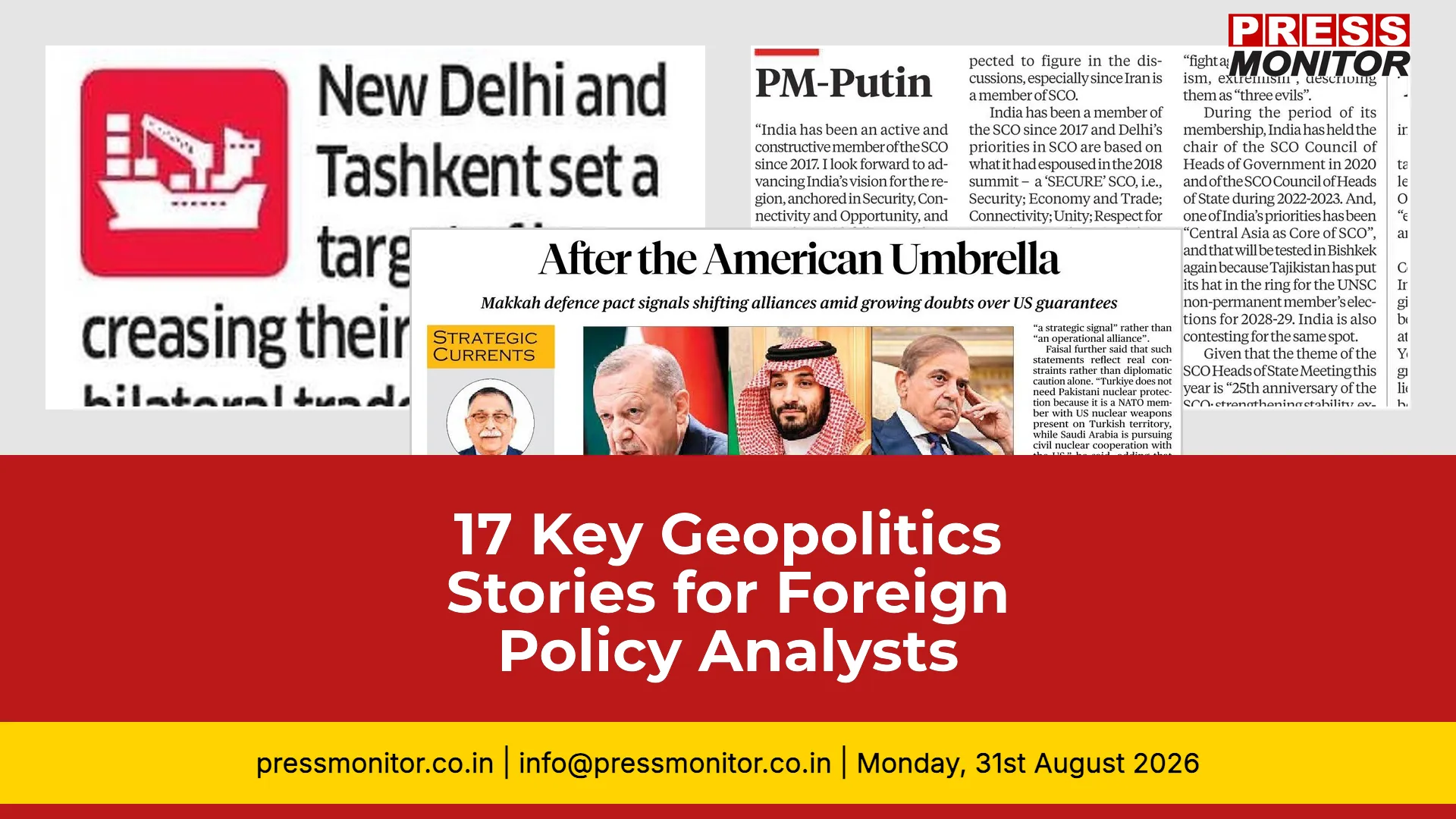
Stay ahead of global shifts with this press review of 17 essential geopolitics stories from Indian print media, powered by Press Monitor's media monitoring. From the SCO summit to Iran's war, here's your news on geopolitics for August 31, 2026.
1. India-Uzbekistan Trade Deal Targets $5 Billion by 2030
A front-page report in Economic Times says Delhi and Tashkent have set a target of increasing annual bilateral trade to $5 billion by 2030. They also decided to create a Joint Working Group to address non-tariff issues and investment barriers, focusing on key sectors of bilateral trade. India and Uzbekistan will jointly organize a business summit involving business leaders from both countries, Modi said.
Why it matters: India and Uzbekistan have agreed to a comprehensive strategic partnership, setting an ambitious trade target. This signals deepening Central Asian ties. Key detail: 11 agreements signed, including a Joint Working Group on non-tariff barriers.
Source: Economic Times, with cross-references from Business Standard, Asian Age, and Statesman. Next step: Monitor progress on the business summit and uranium supply agreement.
2. Modi-Putin Bilateral at SCO Summit
A front-page report in Indian Express says Narendra Modi will meet Russian President Vladimir Putin and Chinese President Xi Jinping in Bishkek, Kyrgyzstan, Monday for a two-day Shanghai Cooperation Organization (SCO) summit, marking the 25th anniversary of the alliance. He is expected to engage in bilateral meetings, including with Putin, while also interacting with Xi. Modi emphasized the SCO’s importance as a platform for advancing ‘SECURE’ principles—security, economy, trade, connectivity, unity, sovereignty, and territorial integrity—as discussions may include geopolitical conflicts in Ukraine and West Asia, centering on Iran’s participation. This summit is a precursor to the BRICS summit in New Delhi next month.
Why it matters: The meeting in Bishkek reinforces India-Russia ties amid geopolitical flux. Key detail: Both leaders met on the sidelines of the SCO 25th anniversary summit, with discussions expected on Ukraine and West Asia.
Source: Indian Express, cross-referenced by Tribune. Next step: Watch for joint statements on energy and defence.
3. Makkah Pact Alters Middle East Alliances
A front-page report in Millennium Post says Saudi Arabia, Turkey, and Pakistan signed the Makkah Joint Defence Agreement on August 7, 2026, in Makkah. The pact establishes collective deterrence against aggression and reflects growing doubts about US security guarantees in the Gulf, particularly after the US-Iran war. Analysts emphasize the agreement's symbolic nature, contrasting it with existing US alliances and highlighting regional power dynamics.
Why it matters: Saudi Arabia, Turkey, and Pakistan signed a joint defence agreement, reflecting doubts about US security guarantees. Key detail: The pact was signed in Makkah on August 7, against the backdrop of the US-Iran war.
Source: Millennium Post, cross-referenced by Economic Times. Next step: Assess impact on Gulf security dynamics.
4. Khamenei Calls for Muslim Unity Against US, Israel
“According to his official website,” Iran’s Supreme Leader Mojtaba Khamenei called on Muslim countries in the region to unite against the United States and Israel, stating ‘the solution to the problems of the Islamic nations is unity of words, friendship, and cooperation on the path of goodness.’ He urged regional rulers to recognize their ‘real enemy’ and confront it, and called on Iranian officials and citizens to set aside differences and unite against Israel and the U.S., echoing previous statements.
Why it matters: Iran's supreme leader is rallying regional support amid the ongoing war. Key detail: He urged Iranian officials to unite and called on Muslim countries to recognize their 'real enemy'.
Source: The Hindu, cross-referenced by Deccan Herald. Next step: Monitor potential diplomatic realignments.
5. Xi Jinping Arrives in Kyrgyzstan for SCO Summit
Chinese President Xi Jinping arrived in Kyrgyzstan on Sunday to attend the 26th Shanghai Cooperation Organisation (SCO) summit, scheduled for August 3l-September l. Prime Minister Narendra Modi and other leaders from the 10-member grouping are expected to participate. Xi is likely to hold bilateral meetings on the sidelines. The visit comes ahead of the BRICS summit in New Delhi on September 12-13, which Xi is also expected to attend.
Why it matters: China's president is attending the SCO summit ahead of the BRICS summit in New Delhi. Key detail: He is expected to hold bilateral meetings with Modi and other leaders.
Source: Millennium Post, cross-referenced by First India. Next step: Track any India-China boundary discussions.
6. Diplomatic Efforts to End War
A front-page report in Economic Times says that President Trump and Ukrainian President Zelenskyy said on Sunday that there will be more details tomorrow. They will do everything they can so that war does not remain the only option for how events unfold further. It is important that US shares many of our views on the situation.
Why it matters: Trump and Zelenskyy are pushing for a diplomatic resolution. Key detail: They indicated more details will be shared tomorrow, emphasizing shared views.
Source: Economic Times. Next step: Watch for concrete peace proposals.
7. Iran Vows to Withstand Pressure and Pursue Diplomacy
A front-page report in Deccan Chronicle says that Tranian leaders are acknowledging the economic toll of war with the US. The supreme leader urged the government to address the hardship and the president said foreign trade has shrunk by a third due to the American sanctions and blockade. Tehran signalled no retreat on Saturday, vowing to withstand US pressure, pursue diplomacy and maintain what it said was control over the Strait of Hormuz.
Why it matters: Iran acknowledges economic hardship but maintains control over the Strait of Hormuz. Key detail: Foreign trade has shrunk by a third due to American sanctions.
Source: Deccan Chronicle. Next step: Assess impact on global oil prices.
8. Israel's Strike on Syrian Base
A front-page report in Deccan Herald says Israel bombed a Syrian air base to pre-empt the deployment of Turkish forces, escalating tensions between Turkey and Israel.
Why it matters: Israel bombed a Syrian air base to pre-empt Turkish forces, escalating Turkey-Israel tensions. Key detail: The strike was reported by Ben Hubbard.
Source: Deccan Herald. Next step: Monitor for retaliatory actions.
9. Iran War: 6 Months On, No Off-Ramp
A front-page report in Hindustan Times says the US and Israel launched strikes on Iran on February 28. The conflict has now turned into a costly stalemate as global economic faultlines widen and there is still no clear path to ending the war.
Why it matters: The US-Israel strikes on Iran have led to a costly stalemate with widening economic faultlines. Key detail: No clear path to ending the war.
Source: Hindustan Times. Next step: Track global economic repercussions.
10. Drone Attacks Hit Russian Oil Refinery
According to Economic Times, Ukrainian drones struck and damaged a key Russian refinery that had undergone extensive repairs, a move Russia has linked to plans for reciprocal attacks on Ukrainian energy infrastructure. As Moscow warned of massive strikes, Russian air defences intercepted sixty-two drones in the Leningrad region, with one initiating a fire at the Kirishi facility that was later extinguished.
Why it matters: Ukrainian drones struck a key Russian refinery, risking retaliation on energy infrastructure. Key detail: 62 drones intercepted, one caused a fire at Kirishi facility.
Source: Economic Times. Next step: Monitor energy security in Europe.
11. India Bridges Iran-UAE Rift for BRICS
A front-page report in Business Line says India is intensifying efforts to reconcile differences between Iran and the UAE ahead of the BRICS Summit in New Delhi on September 12-13. The two nations are currently locked in a dispute following a UAE trade embargo on Iran linked to the West Asia conflict.
Why it matters: India is mediating between Iran and UAE ahead of the BRICS summit, addressing a trade embargo linked to the West Asia conflict. Key detail: The summit is scheduled for September 12-13 in New Delhi.
Source: Business Line. Next step: Watch for BRICS joint statements.
12. Empire's Legacy: Unsettling Frontiers
A front-page report in Tribune says Empire left the Himalayan frontier unsettled. The eight-point consensus between India’s National Security Adviser Ajit Doval and China’s Foreign Minister Wang Yi marks a significant step towards boundary delimitation.
Why it matters: India and China have reached an eight-point consensus on boundary delimitation. Key detail: National Security Adviser Ajit Doval and Foreign Minister Wang Yi led the talks.
Source: Tribune. Next step: Monitor implementation of the consensus.
13. Modi to Meet Iranian President Pezeshkian in Bishkek
A front-page report in Times of India says Prime Minister Narendra Modi has arrived in Bishkek, Kyrgyzstan, where he is scheduled to meet Iranian President Masoud Pezeshkian on Monday. This is the first in-person meeting between the two leaders since the start of the war between the United States and Israel and Iran in February.
Why it matters: This is the first in-person meeting since the US-Iran war began. Key detail: The meeting is scheduled on the sidelines of the SCO summit.
Source: Times of India. Next step: Look for outcomes on energy and regional stability.
14. Niger Mutiny: Soldiers Killed or Arrested
A front-page report in The Pioneer says that dozens of soldiers were killed or arrested after a group of young troops attempted a mutiny in Niger’s capital. It was the culmination of nearly 24 hours of unrest that appeared to be staged by young soldiers aggrieved over the worsening militant violence under the country’s ruling junta. Russia’s Africa Corps provided aerial and ground support to local forces to resist the rebellion.
Why it matters: A mutiny attempt by young soldiers was suppressed with Russian Africa Corps support. Key detail: Dozens killed or arrested; unrest lasted 24 hours.
Source: The Pioneer. Next step: Assess impact on Sahel security.
15. Russia Launches 'Gray Zone' Attacks in Europe
A front-page report in Mint says Russia has intensified 'gray zone' activities, including drone incursions and cyberattacks, across Europe to sow fear and reduce support for Ukraine. Western officials warn that Moscow may be testing NATO's resolve through sabotage and espionage to create divisions among allies.
Why it matters: Russia is using drone incursions and cyberattacks to test NATO resolve. Key detail: Western officials warn Moscow may be trying to create divisions among allies.
Source: Mint. Next step: Monitor NATO response.
16. India-Russia Energy Trade Goes Two-Way
A front-page report in Statesman says, With Ukrainian drone attacks on its oil refineries creating major supply chain disruptions in its energy sector, Russia, looking to keep its energy trade running, has turned to India as a partner with both the demand and the industrial capacity to help absorb the shock.
Why it matters: Russia is turning to India to help absorb the shock of Ukrainian drone attacks on its refineries. Key detail: Energy trade disruption is creating supply chain issues.
Source: Statesman. Next step: Track energy flow between the two countries.
17. US Takes 35% Stake in Blue Energy Partners
A front-page report in Financial Express says the United States government plans to acquire a thirty-five percent passive stake in Venezuelan businessman Alejandro Betancourt's North American Blue Energy Partners. The deal also includes options for the US to purchase twenty percent of the company's production at a cost price to help secure a source of crude oil and lower fuel prices.
Why it matters: The US government is securing a crude oil source to lower fuel prices. Key detail: The deal includes an option to purchase 20% of production at cost.
Source: Financial Express. Next step: Assess impact on US-Venezuela relations.
Which of these stories will shape your strategy? Let us know in the comments.