17 Key Water & Wastewater Stories for Infrastructure Leaders


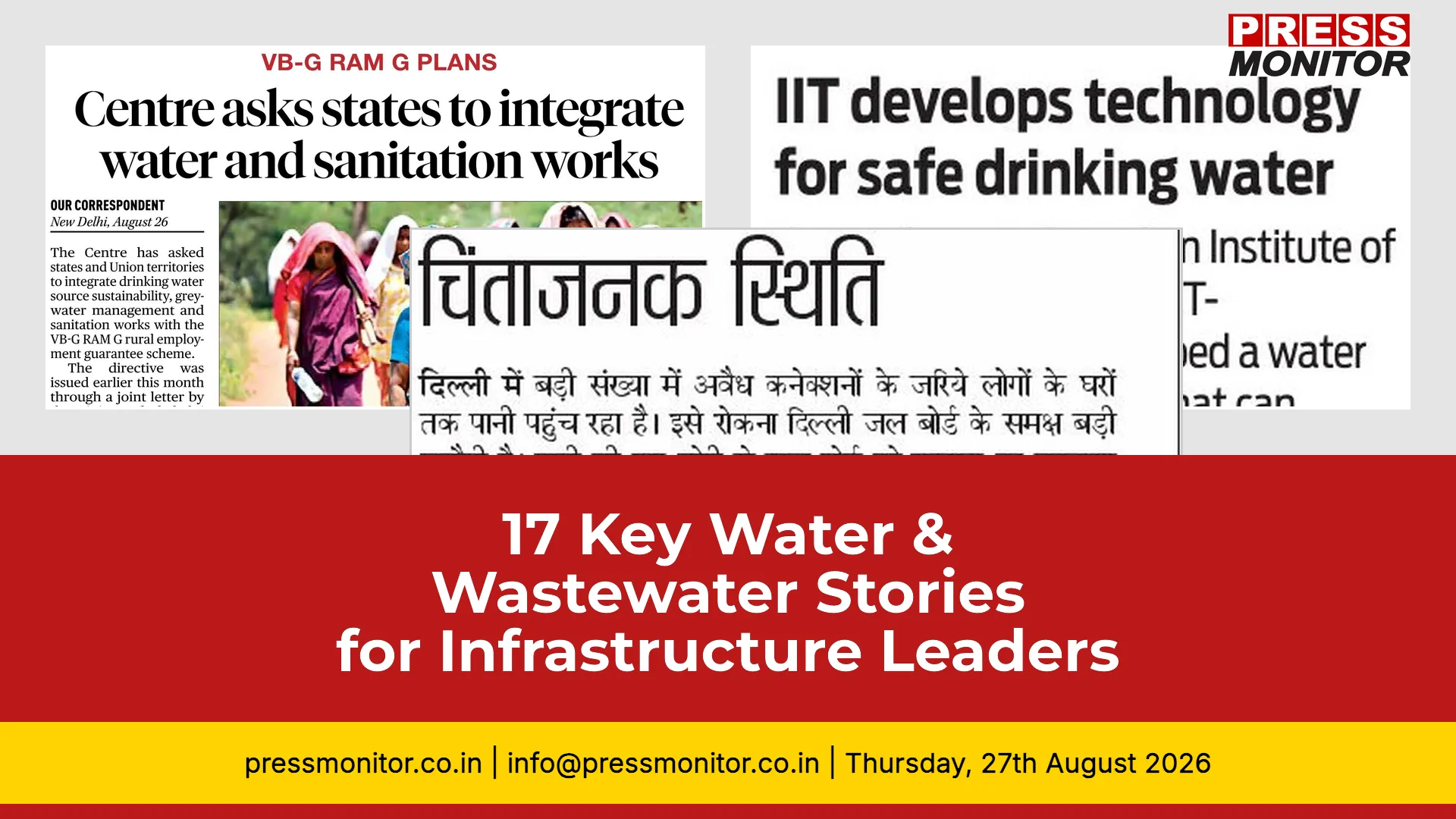
India’s water landscape is shifting fast. From policy convergence in rural employment schemes to cutting-edge treatment tech and simmering inter-state disputes, here are the top news on water and wastewater tracked by Press Monitor’s print media monitoring across 15 Indian newspapers.
1. Centre Integrates Water & Sanitation with VB-GRAM G
«The Centre has asked states and Union territories to integrate drinking water source sustainability, greywater management and sanitation works with the VB-G RAM Grural employment guarantee scheme. The directive was issued earlier this month through a joint letter by the Ministry of Jal Shakti and the Ministry of Rural Development, which asked states and UTs to ensure convergence of resources for water security and sanitation and outlined measures for integrated planning, implementation and monitoring of such works. The letter said water security has been identified as one of the four thematic focus areas under the Viksit Bharat-Guaran-tee for Rozgar and Ajeevika Mission (Gramin) (VB-G RAM G) Act, 2O25. The ministries directed that drinking water source sustainability works under Jal Jeevan Mission (JJM) 2.O, greywater management interventions and sanitation and solid and liquid waste management (SLWM) works under Swachh Bharat Mission (Grameen) 2.O be integrated into Viksit Gram Panchayat Plans (VGPPs) under the appropriate thematic categories of the Act. The implementation must be guided by water budgeting, local resource assessment and water security plans. The states were asked to give due priority to groundwater recharge, rainwater harvesting, rejuvenation of water bodies, watershed development, check dams, recharge structures, spring-shed management and other decentralized water conservation measures, particularly in water-stressed areas. The letter recommended that the additional chief secretary, principal secretary or secretary in charge of the rural water supply/public health engineering department should be included in the state-level steering committee constituted under the Act. States and UTs may also nominate dedicated nodal officers from the state water and sanitation mission and the rural development department, with corresponding district-level nodal officers, to facilitate coordinated planning, technical scrutiny, implementation and monitoring of convergent activities. The ministries further asked states to technically align village action plans prepared under JJN 2.O and SBM (G) 2.O witt VGPPs before approval by the gram sabha, ensuring optimal utilisation o resources and avoiding duplication. They directed tha drinking water source sustainability works, sanitation assets, greywater management structure: and other convergent assets be registered anc geo-tagged on the Viksi Bharat National Rural Infrastructure Stack to facilitate integrated monitoring, transpar ency and evidence-based decision-making.»
Why it matters: The Ministry of Jal Shakti and Rural Development have directed states to link drinking water sustainability and sanitation with the employment guarantee scheme, ensuring convergence of resources for water security.
Key detail: The directive mandates geo-tagging of assets and integration of village action plans with Viksit Gram Panchayat Plans.
Source: Millennium Post, Business Standard, Deccan Herald, State Times
Next step: State governments are expected to set up nodal officers and integrate water budgeting.
2. IIT Guwahati Develops Low-Cost Arsenic & Fluoride Removal Tech
A front-page report in New Indian Express says researchers at the Indian Institute of Technology Guwahati (IIT Guwahati) have created a groundbreaking water treatment technology capable of simultaneously purifying groundwater contaminated with arsenic and fluoride. This innovation could provide cost-effective solutions, with expected operating costs ranging from Rs 2,18 to Rs 5,8 per lakh liters of treated water, making it highly viable for areas facing severe water pollution challenges. The development marks a significant contribution toward safer drinking water access globally.
Why it matters: This breakthrough can provide safe drinking water at just Rs 2-5.8 per lakh litres, addressing a major public health crisis in groundwater-contaminated regions.
Key detail: The technology simultaneously removes arsenic and fluoride.
Source: New Indian Express, Morning Standard, Millennium Post
Next step: Field trials and scaling up for community-level deployment.
3. Delhi’s 3 Lakh Illegal Water Connections Deepen Scarcity
A front-page report in Dainik Jagran says thousands of illegal water connections are illegally supplying water across Delhi households, straining the DJB's capacity and worsening shortages—especially in scorching summers. Though efforts to formalize connections (via 'E-KYC') with minor (₹1000) charges have halted theft, most unauthorized users remain untracked. Valued conservators emphasize mismanagement, ballooning revenue losses, and operational constraints amid rising disputes between openly paying citizens and those denied major water supplies.
Why it matters: Undeclared pipes are draining DJB’s capacity and causing revenue loss, worsening summer shortages.
Key detail: An estimated 300,000 unauthorised connections exist, with e-KYC formalisation only partly successful.
Source: Dainik Jagran front-page
Next step: Enhanced enforcement and incentives for legalisation.
4. Delhi Jal Board Plans Treated Wastewater Reuse in Housing
A front-page report in Hindustan Times says that the Delhi Jal Board (DJB) is planning to expand the reuse of treated wastewater in upcoming residential projects. The move is expected to be a key part of the water strategy under Delhi's new Master Plan.
Why it matters: Expanding reuse in upcoming projects under the Master Plan will reduce groundwater stress.
Key detail: DJB’s initiative aligns with Delhi’s water strategy.
Source: Hindustan Times front-page
Next step: Implementation in new residential layouts.
5. Satara Tehsils Face Severe Water Crisis Despite Monsoon
A front-page report in Free Press Journal says Maan and Khatav tehsils in Satara district are facing severe water shortages despite the peak monsoon. Residents are relying on water tankers for drinking water and livestock, while crops like pearl millet and sugarcane dry up due to inadequate rainfall.
Why it matters: Maan and Khatav tehsils are dependent on tankers as crops wilt — a chronic failure of water infrastructure.
Key detail: Inadequate rainfall despite peak monsoon season.
Source: Free Press Journal front-page
Next step: Emergency relief and long-term supply planning.
6. Punjab & Himachal Pradesh Invite Water Infrastructure Tenders
A front-page report in Tribune says the Punjab Water Supply & Sewerage Division Moga and Shimla Jal Prabhandhan Nigam Limited have invited bids on August 25, 2026, for water supply and sewerage projects worth over four crore rupees and twenty-two crore rupees, respectively. The tender for Punjab (Moga) includes fixing OCEMS and desilting sewers, while the Himachal Pradesh tender seeks WR&M work for Bekhalti Ukhaldhar Road and U.V. disinfection systems.
Why it matters: Over ₹26 crore in projects for sewerage, disinfection, and water supply systems.
Key detail: Tenders include OCEMS fixing in Moga and UV disinfection in Shimla.
Source: Tribune front-page
Next step: Bids close in September 2026.
7. Shimla Municipal Corporation E-Tenders for Water Supply
“A front-page report in the Tribune says that the Additional General Manager of BWS SJPNL, Shimla, is inviting electronic tenders online for three projects including road repairs, water supply system improvements, and operation & maintenance of existing systems. The tender requests cover work at Bekhalti and Shimla Town, as well as maintaining the Giri water supply scheme. Bids are open until September 3, 2026, with cover-1 eligibility criteria to be reviewed on September 3rd, at 11:30 am.
Why it matters: Operation and maintenance of Giri water supply scheme and road repairs.
Key detail: Electronic tenders open until September 3.
Source: Tribune front-page
Next step: Eligibility review on September 3.
8. Urban Lakes Disappearing in Hyderabad, Bengaluru, Mumbai
A front-page report in The Hindu says that rapid urbanisation and encroachment have led to the systemic disappearance of urban lakes in cities like Hyderabad, Bengaluru, and Mumbai. While agencies like HYDRAA in Telangana are reclaiming lakebeds, experts argue that sustainable recovery requires integrating water bodies into city planning and ensuring legal protection.
Why it matters: Encroachment and poor planning are wiping out natural water bodies, reducing flood resilience.
Key detail: HYDRAA in Telangana is reclaiming lakebeds, but legal protections remain weak.
Source: The Hindu front-page
Next step: Integrate lakes into city development plans.
9. West Bengal Invites O&M Tender for Water Supply
A front-page report in Times of India says that the West Bengal e-Tender inviting Operation and Maintenance of different water supply schemes has been issued, with the last date for submission set for September 15, 2026, until 18:00 Hours.
Why it matters: Ensures maintenance of existing drinking water schemes.
Key detail: Last date for submission September 15, 2026.
Source: Times of India front-page
Next step: Bidding process underway.
10. BWSSB Invites Water Supply Tenders in Bengaluru
A front-page report in The Hindu says that the Bangalore Water Supply and Sewerage Board (BWSSB) invites tenders for various water supply works in Bengaluru.
Why it matters: Bangalore Water Supply and Sewerage Board is expanding network.
Key detail: Multiple works across the city.
Source: The Hindu front-page
Next step: Tender evaluation.
11. NDMC Chairman Apologises for Delhi Waterlogging Delay
“Selon {source_name}, at least 3-4 areas in central Delhi experienced waterlogging lasting over an hour, significantly longer than the usual 15-20 minutes. NDMC Chairman Manoj Kumar Dwivedi apologized for the inadequate response, citing heavy rainfall (72mm in less than 2 hours) as the cause. He promised immediate and long-term measures, including round-the-clock desilting and increased pumping capacity, to ensure a water-logging-free area for citizens, and highlighted the need to strengthen the drainage system to prevent future issues.”
Why it matters: 72mm rain caused hours-long waterlogging; NDMC promises round-the-clock desilting.
Key detail: 3-4 areas took over an hour to drain, far exceeding normal 15-20 minutes.
Source: Indian Express front-page
Next step: Increased pumping capacity.
12. PWD-NDMC Blame Game Over Delhi Waterlogging
A front-page report in Millennium Post says heavy rainfall in New Delhi triggered a dispute between the Public Works Department (PWD) and the New Delhi Municipal Council (NDMC), with officials blaming each other for lapses in waterlogging management. The PWD Minister defended progress, noting waterlogging spots reduced from 308 to 115. While immediate interventions (for 60 spots) and permanent solutions (for 21) are underway, officials highlight persistent shortcomings in the outdated drainage infrastructure and delayed desilting efforts.
Why it matters: Institutional finger-pointing delays fixes. Waterlogging spots reduced from 308 to 115 but gaps remain.
Key detail: PWD minister cited progress, NDMC blamed outdated drainage.
Source: Millennium Post front-page
Next step: Permanent solutions for 21 hotspots.
13. Karnataka Drought Assessment Underway
A front-page report in Free Press Journal says that Karnataka is facing deficient rainfall and emerging drought-like conditions. The state government is preparing to take a decision on declaring drought in affected areas after receiving ground-truthing reports from 102 taluks.
Why it matters: Deficient rainfall is threatening agriculture in 102 taluks.
Key detail: Ground-truthing reports being compiled before drought declaration.
Source: Free Press Journal front-page
Next step: State government decision soon.
14. Andhra Pradesh Diverts Nagarjunasagar Water, Triggers Row
A front-page report in Deccan Chronicle says... Former irrigation minister T. Harish Rao demanded Andhra Pradesh immediately stop drawing water from Nagarjunasagar. AP officials began diverting water through the Nagarjunasagar Right Canal on Wednesday, prompting Harish Rao to accuse Chief Minister Revanth Reddy of failing to protect Telangana's water rights. AP is also diverting 100 thousand cubic feet from Srisailam reservoir via Veligonda tunnel amidst El Nino drought conditions.
Why it matters: Former Telangana minister Harish Rao demands halt, accusing AP of violating rights amid El Nino drought.
Key detail: AP using Nagarjunasagar Right Canal and Veligonda tunnel.
Source: Deccan Chronicle front-page
Next step: Potential legal escalation.
15. Telangana & AP Officials Clash at Nagarjunasagar
A front-page report in Deccan Chronicle says a dispute between irrigation officials of Telangana and Andhra Pradesh resurfaced at the Nagarjunasagar Project (NSP) after AP officials released water into the right canal and Telangana subsequently released water into the left canal.
Why it matters: Both states released water into respective canals, escalating tension.
Key detail: Dispute resurfaced at NSP over water sharing.
Source: Deccan Chronicle front-page
Next step: Central intervention possible.
16. Delhi Government Plans Reclaimed Water Policy
A front-page report in The Pioneer says the Delhi government is planning a ‘Reclaimed Water Policy’ to enhance usage of treated water and reduce groundwater extraction.
Why it matters: Aims to boost treated water usage and cut groundwater extraction.
Key detail: Policy expected to cover new developments.
Source: The Pioneer front-page
Next step: Draft policy release.
17. Amit Shah Speaks to CMs on Nepal Flood Risk
A front-page report in Deccan Herald says Union Home Minister Amit Shah spoke to Bihar Chief Minister Samrat Choudhary and Uttar Pradesh Chief Minister Yogi Adityanath on the situation and the possible rise in river water levels. The National Disaster Response Force has been placed on high alert along with the local administrations and relief-rescue teams in the border areas where its impact may be felt.
Why it matters: Rising river levels after Nepal flash floods prompted central alert.
Key detail: NDRF on high alert, danger to downstream areas in UP and Bihar.
Source: Deccan Herald, Free Press Journal
Next step: Continuous monitoring by Central Water Commission.
Which of these stories affects your operations the most? Let us know via Press Monitor — the definitive media intelligence source for India’s water sector.