17 Pivotal Environment Stories for Policy Makers


Welcome to today’s essential briefing on news on environment & conservation. According to Press Monitor's tracking of Indian publications, this week’s print landscape reveals critical shifts in regulatory enforcement, ecological preservation, and sustainable development. This press review synthesizes high-impact developments across national and regional dailies, delivering actionable media intelligence for stakeholders navigating India’s environmental policy framework. Our print media monitoring ensures you capture editorial-vetted insights before they trend elsewhere.
1. NGT Seeks Govt’s Response on Plea Against New Sales Rules
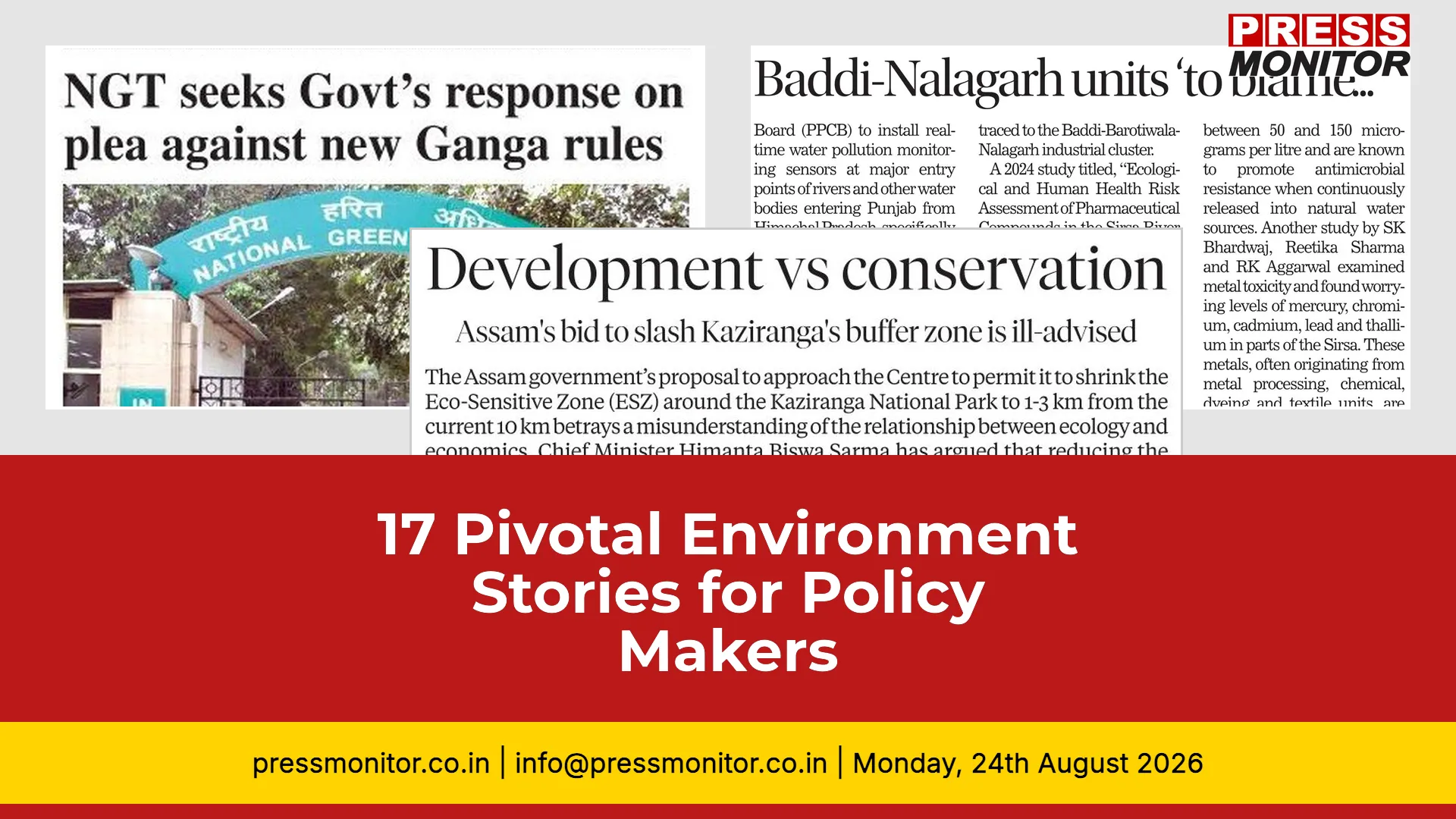
A front-page report in The Pioneer says the National Green Tribunal (NGT) has sought a response from the Centre on a petition challenging recent changes to the rules governing the protection of the Ganga. The National Mission for Clean Ganga and the Union Ministry of Environment, Forest and Climate Change are also among the respondents. The green tribunal was hearing a plea alleging that a government notification issued in August 2026 removed the crucial “no construction zone” along the river and its tributaries, which was contrary to the environmental rules.
Why it matters: Regulatory rollback on river protection zones triggers legal scrutiny.
Key detail: A government notification issued in August 2026 removed the crucial “no construction zone” along the Ganga and its tributaries, prompting the National Green Tribunal to seek responses from the Centre, NMCG, and MoEFCC.
Source: The Pioneer
Next step: Track tribunal hearings for potential injunctions affecting infrastructure projects.
2. Industrial Cluster Blamed for Sirsa River Pollution
A front-page report in Tribune says the Punjab Pollution Control Board will install real-time water pollution monitoring sensors at major entry points of rivers from Himachal Pradesh, specifically at Ghanauli in Ropar district, where the Sirsa River enters Punjab. The Sirsa, a major tributary of the Sutlej, is emerging as one of North India’s critically polluted water bodies, with pharmaceutical compounds, toxic heavy metals, volatile chemicals, and industrial waste traced to the Baddi-Barotiwala-Nalagarh industrial cluster.
Why it matters: Real-time monitoring expansion signals stricter accountability for industrial hubs.
Key detail: Punjab Pollution Control Board will install real-time water pollution sensors at Ghanauli entry points, tracing toxic heavy metals and pharmaceutical compounds to the Baddi-Barotiwala-Nalagarh belt.
Source: Tribune
Next step: Monitor sensor deployment timelines and compliance deadlines for listed units.
3. Development vs Conservation
A front-page report in Business Standard says the Assam government’s proposal to reduce the Eco-Sensitive Zone around the Kaziranga National Park is ill-advised. The proposal to shrink the buffer zone from 10 km to 3 km is argued to promote urban growth but threatens the fragile ecosystem of the park.
Why it matters: Buffer zone reductions spark debate over urban growth versus ecosystem integrity.
Key detail: Assam’s proposal to shrink Kaziranga’s Eco-Sensitive Zone from 10 km to 3 km faces criticism for threatening fragile habitats while promoting municipal expansion.
Source: Business Standard
Next step: Engage with state forestry departments on revised zoning drafts.
4. Baddi-Nalagarh Units Blamed for Toxic Sutlej
A front-page report in Tribune says an FIR has been registered against unidentified industrial units in the Baddi-Nalagarh belt for allegedly dumping chemical waste into the Sutlej river. The complaint, filed by AAP MLA Dinesh Chadha, highlights threats to public health and aquatic life in Ropar.
Why it matters: FIR registration marks escalation from advisory warnings to criminal liability.
Key detail: AAP MLA Dinesh Chadha filed a complaint alleging chemical dumping into the Sutlej, citing direct threats to public health and aquatic ecosystems in Ropar.
Source: Tribune
Next step: Watch for court-appointed expert committee formations.
5. NGT Directs Serious Implementation of Pollution Control Certificates in Delhi Govt Vehicles
A front-page report in Times of India says that the National Green Tribunal has directed that the enforcement mechanism for Pollution Under Control (PUC) certificates for government and government-hired vehicles in Delhi be implemented with 'full seriousness' at the ground level. The directions came after it was found that several government vehicles lacked PUC certificates.
Why it matters: Government fleet compliance sets precedent for public sector accountability.
Key detail: The tribunal mandated full seriousness in enforcing Pollution Under Control certificates for Delhi government and hired vehicles after audits revealed widespread non-compliance.
Source: Times of India
Next step: Audit internal transport fleets for certification gaps.
6. NGT Notices Biomedical Waste Plant Violations
A front-page report in Times of India says the National Green Tribunal has issued notices to the Delhi Pollution Control Committee and the Directorate General of Health Services over environmental violations at a biomedical waste plant in north Delhi. The facility is accused of emitting black smoke, improper ash disposal, and operating more incinerators than permitted.
Why it matters: Facility-level breaches highlight systemic gaps in hazardous waste handling.
Key detail: North Delhi plant accused of emitting black smoke, improper ash disposal, and operating excess incinerators beyond permitted capacity.
Source: Times of India
Next step: Review vendor contracts against CPCB operational standards.
7. Supreme Court Directs Disconnection of Services for Waste Generators
A front-page report in Tribune says that the Supreme Court has directed local bodies to disconnect water and electricity supply to bulk waste generators for violating the Solid Waste Management (SWM) Rules.
Why it matters: Utility disconnection introduces tangible penalties for Solid Waste Management Rule violations.
Key detail: Local bodies ordered to cut water and electricity to bulk waste generators failing to comply with SWM protocols.
Source: Tribune
Next step: Implement internal waste segregation audits immediately.
8. Ken-Betwa Link: Development or More Mindless Discrimination?
A front-page report in Asian Age says that the Ken-Betwa river-linking project is promoted as a solution to Bundelkhand’s water crisis, but it threatens to destroy forests, dent the ecology, and displace thousands of people, mirroring India’s poor track record on rehabilitating displaced persons.
Why it matters: Large-scale water projects face renewed scrutiny over ecological displacement.
Key detail: Critics warn the project threatens forests, disrupts ecology, and repeats historical failures in rehabilitating displaced communities.
Source: Asian Age
Next step: Assess ESG implications for downstream agricultural investments.
9. Hazardous Pesticides Threatening Health and Environment in J&K
A front-page report in State Times says that agriculture and allied activities engage about 45.7% of the labour force in J&K UT, with horticulture supporting around 7 lakh families. However, the use of hazardous pesticides is poisoning soil, water, food, and children, leading to rising cancer, brain tumors, and neurological disorders.
Why it matters: Agricultural chemical misuse links directly to rising chronic diseases.
Key detail: Heavy pesticide application in Jammu & Kashmir’s horticulture sector contaminates soil and water, correlating with increased cancer and neurological disorder cases.
Source: State Times
Next step: Advocate for integrated pest management training programs.
10. Jayakwadi Bird Sanctuary Gains International Significance
A front-page report in Free Press Journal says the Union Ministry of Environment has designated the Jayakwadi Bird Sanctuary as a Wetland of International Significance. The sanctuary, located in Paithan, is rich in biodiversity and is now being proposed for international Ramsar status.
Why it matters: Ramsar designation elevates regional biodiversity to global conservation priority.
Key detail: Union Ministry of Environment designated the Paithan sanctuary as a Wetland of International Significance, recognizing its rich avian diversity.
Source: Free Press Journal
Next step: Align tourism and research grants with Ramsar compliance frameworks.
11. Glyphosate Restrictions by Board and Registration Committee
A front-page report in Deccan Herald says that the Board and Registration Committee has decided to restrict the use of glyphosate, a herbicide. Public policy expert Narasimha Reddy Don has said the committee's application of the precautionary principle is especially significant given the continuing concerns regarding the potential health and environmental impacts of the glyphosate.
Why it matters: Precautionary principle adoption signals tightening herbicide regulations.
Key detail: Committee restricted glyphosate usage, emphasizing ongoing health and environmental risk assessments despite industry pushback.
Source: Deccan Herald
Next step: Reformulate crop protection strategies to meet new safety thresholds.
12. India Water Crisis: 12% Deficit
A front-page report in Tribune says India has a rainfall problem while also facing water scarcity in some regions, as the country reels from a twelve percent deficit and inconsistent monsoon patterns. The country faces a paradox of floods and water scarcity, with agriculture consuming eighty-seven percent of groundwater, causing reliance on finite resources.
Why it matters: Monsoon inconsistency exacerbates groundwater depletion and agricultural stress.
Key detail: Nation faces a paradox of floods and scarcity, with agriculture consuming 87% of groundwater amid persistent rainfall deficits.
Source: Tribune
Next step: Invest in rainwater harvesting and drip irrigation technologies.
13. Dr. Singh Plants Trees in Vikas Puri, Targets 70 Lakh Saplings
"Selon le Statesman News Service, le ministre Dr. Pankaj Kumar Singh s'est joint à une plantation d'arbres au parc Shaheed Bhagat Singh à Kunwar Singh Nagar de Vikas Puri, avec la participation de résidents. Il a partagé que le gouvernement de Delhi avait pour objectif de planter 70 lakhs de jeunes arbres dans tout le capital national et que la campagne progressait rapidement grâce à la participation active des citoyens et des parties prenantes. Il a souligné que, grâce à un effort collectif, plus de 50 lakhs d'arbres avaient déjà été plantés et que la participation communautaire est essentielle pour créer un Delhi plus vert, plus propre et plus sain, en apportant un soutien aux initiatives."
Why it matters: Municipal green initiatives demonstrate scalable urban reforestation models.
Key detail: Delhi minister highlighted progress toward planting 70 lakh saplings, crediting community participation for surpassing 50 lakh milestones.
Source: Statesman
Next step: Partner with civic groups for localized tree-planting drives.
14. Delay in Microplastic Pollution Guidelines
A front-page report in Deccan Herald says, more than four years after the government was directed to come up with a system to curb microplastic pollution, the Centre has stated that a uniform methodology to assess microplastic pollution has not yet been finalised.
Why it matters: Regulatory lag leaves consumer goods and water systems unmonitored.
Key detail: Over four years post-directive, the Centre admits uniform microplastic assessment methodology remains unfinished.
Source: Deccan Herald
Next step: Prepare voluntary reporting frameworks ahead of mandatory rollout.
15. Himachal Village to Tell Jurassic-Era Story
A front-page report in New Indian Express says more than 60 species of Jurassic ammonites have been documented in the cold desert of Lahaul-Spiti of Himachal Pradesh at 4,400 metres above sea level. The fossil heritage of Spiti is considerably richer than the famous ammonites for which Langza is popularly known.
Why it matters: Paleontological heritage unlocks geo-tourism and conservation funding.
Key detail: Researchers documented over 60 Jurassic ammonite species in Lahaul-Spiti’s cold desert at 4,400 metres, surpassing known fossil records.
Source: New Indian Express
Next step: Support UNESCO geopark nomination documentation.
16. Garbage Piles Up as Strike Hits Jalandhar
A front-page report in Tribune says sanitation workers have struck over a Rs 607 crore solid waste management project, causing garbage to pile up across Jalandhar. The crisis has drawn protests from Congress and BJP leaders against the ruling AAP and Mayor Vaneet Dhir.
Why it matters: Labor disputes expose fragility in municipal waste logistics.
Key detail: Sanitation workers halted operations over a Rs 607 crore project contract, triggering political backlash and public health concerns.
Source: Tribune
Next step: Negotiate transparent grievance redressal mechanisms with unions.
17. Arjun Ram Meghwal Launches Tiger Book
A front-page report in State Times says Law Minister Arjun Ram Meghwal launched a coffee-table book titled "Sacred Tiger Tales: From Vedic Hymns to Try with Stripes" on Saturday in New Delhi. The 248-page work, authored by Manoj Kumar, explores the tiger's role in India's civilisational, cultural, and ecological history.
Why it matters: Cultural narratives reinforce wildlife conservation messaging.
Key detail: Law Minister unveiled a comprehensive volume exploring the tiger’s civilisational and ecological significance, bridging heritage and modern conservation efforts.
Source: State Times
Next step: Leverage publication campaigns for awareness outreach.
Closing: Which of these regulatory or ecological shifts demands immediate corporate attention? Share your analysis below. Tracked by Press Monitor.