17 Pivotal Pharmaceuticals & Life Sciences Stories for Industry Leaders


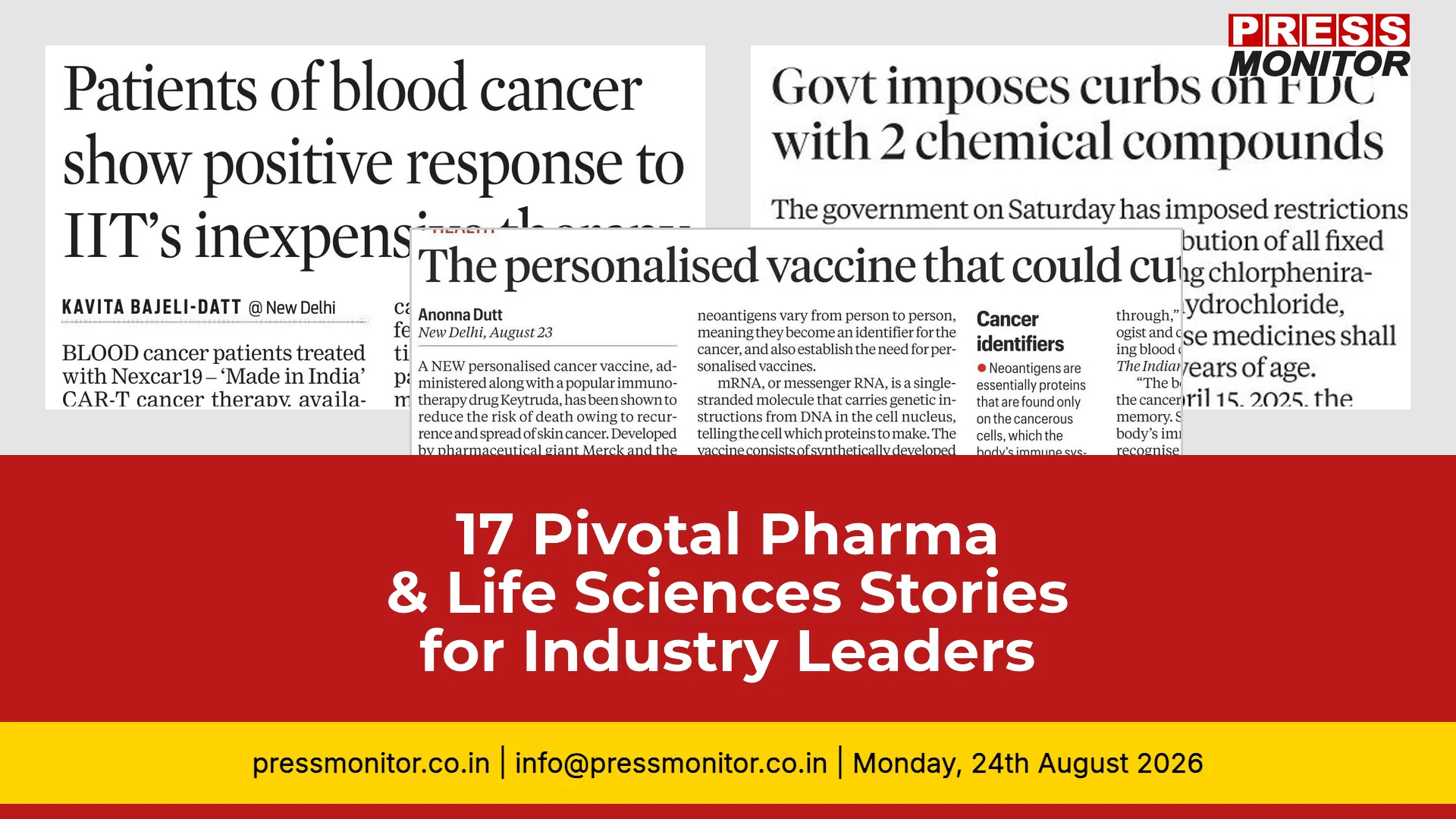
In today's rapidly evolving pharmaceutical landscape, staying ahead means knowing what's happening across print media in India. According to Press Monitor's tracking of Indian publications, here are 17 essential stories shaping the sector — from breakthrough cancer therapies to regulatory shifts and emerging risks. This press review delivers the media intelligence you need to make informed decisions.
1. NexCARl9 Blood Cancer Therapy Shows Success
A front-page report in New Indian Express says that India's first commercially approved CAR-T cell therapy, NexCARl9, has shown significant efficacy in treating advanced blood cancers. Developed by ImmunoACT and Tata Memorial Hospital, the inexpensive treatment helped 88% of certain leukaemia patients see cancer shrink or clear within 28 days.
Why it matters: India's first commercially approved CAR-T cell therapy offers affordable hope for advanced blood cancers.
Key detail: 88% of certain leukaemia patients saw cancer shrink or clear within 28 days.
Source: New Indian Express, Morning Standard
Next step: Monitor clinical adoption and pricing developments.
2. Govt Bans FDC Medicines for Children Below Four
A front-page report in Business Standard says the government has on Saturday imposed strict curbs on the manufacture, sale, and distribution of all fixed dose combinations (FDC) containing chlorpheniramine maleate and phenylephrine hydrochloride. The notification mandates a clear warning that these medicines shall not be used in children below four years of age. This latest measure extends a previous April 2, 2025 restriction, following expert committee and Drugs Technical Advisory Board recommendations.
Why it matters: Strict curbs on fixed-dose combinations protect vulnerable children from adverse effects.
Key detail: Manufacturing, sale, and distribution of FDCs with chlorpheniramine maleate and phenylephrine hydrochloride banned for kids under 4.
Source: Business Standard, Times of India
Next step: Ensure product labels comply with new warning requirements.
3. Personalised mRNA Vaccine Cuts Skin Cancer Risk
A front-page report in Indian Express says a new personalised mRNA vaccine, developed by Merck and Moderna, has significantly reduced the risk of death from skin cancer recurrence and spread. The therapy, administered with the drug Keytruda, targets specific mutations in a patient's tumour to train the immune system. However, experts note that high costs and the rarity of melanoma in India may limit its local impact.
Why it matters: Merck and Moderna's mRNA vaccine reduces recurrence and death from melanoma.
Key detail: Administered with Keytruda, it targets patient-specific tumour mutations.
Source: Indian Express
Next step: Assess affordability and potential for Indian melanoma patients.
4. Centre Prepares New Semaglutide Rules
A front-page report in Mint says the centre is preparing new rules for semaglutide, a drug under scrutiny for suspected side effects. The Drugs Controller General of India has asked states to ensure the drug can be prescribed only by specialist physicians. Several Indian drugmakers have launched cheaper versions of the drug following the expiry of its global patent.
Why it matters: DCGI restricts semaglutide prescription to specialist physicians amid safety concerns.
Key detail: Several Indian drugmakers have launched cheaper versions after patent expiry.
Source: Mint
Next step: Review prescribing protocols and patient monitoring.
5. New Standards for Weight-Loss Drug Semaglutide
A front-page report in Mint says the Indian Pharmacopoeia Commission is drafting a dedicated pharmacopoeial monograph for semaglutide, the key ingredient in blockbuster weight-loss drugs. This comes at a time when domestic drugmakers prepare for a generic manufacturing boom following key patent expiries.
Why it matters: Indian Pharmacopoeia Commission drafts monograph for semaglutide, anticipating generic boom.
Key detail: Standardisation will ensure quality of domestically manufactured semaglutide.
Source: Mint
Next step: Prepare for pharmacopoeial compliance in manufacturing.
6. Brain Pathway Identified for Chemotherapy Cold Pain
A front-page report in Times of India says CREST’s Centre for High Impact Neuroscience and Translational Applications (CHINTA), Kolkata, have found a pathway in the brain that appears to turn an otherwise harmless drop in temperature into a painful experience after chemotherapy. The study could eventually point towards new ways of treating cold allodynia.
Why it matters: CREST's CHINTA centre discovers the neural mechanism behind cold allodynia after chemo.
Key detail: The study could lead to new treatments for chemotherapy-induced pain.
Source: Times of India
Next step: Follow research for potential therapeutic applications.
7. Indian Labs Innovate Cancer Care with AI Frameworks
A front-page report in Business Line says research institutes under the Department of Science and Technology have developed two studies introducing an AI framework that helps identify cancer stem-like cells responsible for tumour recurrence. A parallel study led by researchers from IASST-Guwahati and IIT-Guwahati synthesised a small-molecule candidate, RK-251, which can selectively release compounds within cancer cells while leaving non-malignant tissue unharmed.
Why it matters: AI identifies cancer stem-like cells, and small-molecule candidate RK-251 targets malignant cells selectively.
Key detail: Developed by DST institutes, IASST-Guwahati, and IIT-Guwahati.
Source: Business Line
Next step: Explore collaboration opportunities with these research labs.
8. Drug Quality Under Scanner in Himachal Pradesh
A front-page report in Tribune says that 82 drugs manufactured by 65 pharmaceutical firms in Himachal Pradesh were among 240 drugs declared 'not of standard quality' (NSQ) nationally by the Central drugs regulator on Thursday evening.
Why it matters: 82 drugs from 65 pharma firms declared 'not of standard quality' nationally.
Key detail: The Central Drugs Regulator flagged 240 NSQ drugs; Himachal is a major manufacturing hub.
Source: Tribune
Next step: Conduct quality audits and ensure compliance with GMP standards.
9. Start-Up's Promise to PM: Meds to Be Made in Space
A front-page report in New Indian Express says, An Indian space start-up is working on manufacturing satellites that will travel into space, manufacture pharmaceuticals there, and return them to India. The start-up is working on developing satellites capable of manufacturing pharmaceutical products in the microgravity environment of space before bringing them back to Earth.
Why it matters: Indian space start-up proposes manufacturing pharmaceuticals in microgravity and returning them to Earth.
Key detail: Satellites would produce drugs in space, leveraging unique environment.
Source: New Indian Express, Morning Standard
Next step: Track policy response and feasibility studies.
10. Torrent Pharma Almost Retired Hurt from Drug Discovery
A front-page report in Business Line says Torrent Pharmaceuticals is almost retired hurt from drug discovery. But it is looking to get back into the field as it reaches a scale where it can contemplate taking the risks involved in developing new medicines.
Why it matters: Torrent is re-entering drug discovery after scaling up to manage risks.
Key detail: The company is now big enough to consider the risks of new medicine development.
Source: Business Line
Next step: Watch for Torrent's R&D pipeline announcements.
11. AI-Driven Pharma Healthcare Summit Held in Nagpur
A front-page report in Deshbandhu says... The two-day international summit held at Ram-Ish Institution of Vocational and Technical Education in Nagpur focused on AI's role in pharmaceutical innovation and healthcare advancements. Dr. Arvind Sharma emphasized the institution's commitment to AI-driven breakthroughs, while Prof. Gurdeep Gulati highlighted the need to bridge lab research with patient care.
Why it matters: Two-day international summit focused on AI's role in pharmaceutical innovation.
Key detail: Emphasised bridging lab research with patient care.
Source: Deshbandhu
Next step: Explore AI integration in your operations.
12. US Vaccine Policy Review
A front-page report in Business Line says that as the US administration reviews its childhood vaccines policy and leans towards fewer recommended vaccines, PhRMA’s Chief Medical Officer, Dr Michael Ybarra, has cautioned against accepting a ‘lower bar of protection’ against diseases.
Why it matters: PhRMA warns against lowering vaccine protection standards as US reviews childhood vaccine policy.
Key detail: Dr Michael Ybarra cautions against accepting a 'lower bar of protection'.
Source: Business Line
Next step: Monitor US policy impact on global vaccine supply chains.
13. Delhi Court Restrains Pharma Firm from Trademark Infringement
A front-page report in Economic Times says a Delhi court has permanently restrained a Hyderabad based pharmaceutical company from using the trademark ‘Udaan’ or any similar mark, ruling that it was a clear violation of the rights of consumer goods major RSPL Health.
Why it matters: Hyderabad-based pharma permanently barred from using 'Udaan' mark, upholding RSPL Health's rights.
Key detail: The court ruled clear violation of consumer goods major's trademark.
Source: Economic Times, The Pioneer
Next step: Review your own trademark portfolio and avoid infringement risks.
14. AI Moves from Reading Viral Genomes to Designing Them
A front-page report in The Hindu says that AI is beginning to move from analyzing biological information towards proposing biological designs that scientists can physically build. The Stanford experiment demonstrates that computers can now help decide what a virus’s genome should be, marking a significant step in AI-assisted biological design.
Why it matters: Stanford experiment shows AI can propose virus genome designs, raising biosecurity considerations.
Key detail: AI moves from analysis to design, a significant step in biotechnology.
Source: The Hindu
Next step: Engage in biosecurity discussions and ethical AI frameworks.
15. Industrial Cluster Blamed for Sirsa River Pollution
A front-page report in Tribune says the Punjab Pollution Control Board will install real-time water pollution monitoring sensors at major entry points of rivers from Himachal Pradesh, specifically at Ghanauli in Ropar district, where the Sirsa River enters Punjab. The Sirsa, a major tributary of the Sutlej, is emerging as one of North India’s critically polluted water bodies, with pharmaceutical compounds, toxic heavy metals, volatile chemicals, and industrial waste traced to the Baddi-Barotiwala-Nalagarh industrial cluster.
Why it matters: Pharma compounds and toxic heavy metals traced to Baddi-Barotiwala-Nalagarh cluster polluting Sirsa River.
Key detail: Punjab Pollution Control Board will install real-time monitoring sensors.
Source: Tribune
Next step: Assess environmental compliance in your supply chain.
16. Tender Invitation by Tamilnadu Medical Services Corporation
A front-page report in The Hindu says that Tamilnadu Medical Services Corporation Limited, Chennai, invites tenders from licensed drug manufacturers and other eligible entities for the supply of specialty drugs for one year.
Why it matters: TNMSC invites tenders for supply of specialty drugs for one year.
Key detail: Licensed drug manufacturers and eligible entities can apply.
Source: The Hindu
Next step: Submit bids if you are a qualified manufacturer.
17. Solara Active Pharma Sciences to Hold 9th AGM
A front-page report in Business Standard says that the 9th Annual General Meeting (AGM) of Solara Active Pharma Sciences Limited will be held on September 18, 2026, through video conference. The company has also notified that shares for which dividends have not been claimed for seven years or more will be transferred to the Investor Education and Protection Fund Authority.
Why it matters: Shareholders to meet via video conference on September 18, 2026; unclaimed dividends to be transferred to IEPF.
Key detail: Important for investors to update their records.
Source: Business Standard
Next step: Ensure dividend claims are made before transfer.
Closing: These 17 stories, powered by print media monitoring, offer a comprehensive view of the pharmaceutical landscape. Which of these developments will impact your strategy most? Share your thoughts below.