17 Pivotal Social Media Stories for PR Leaders


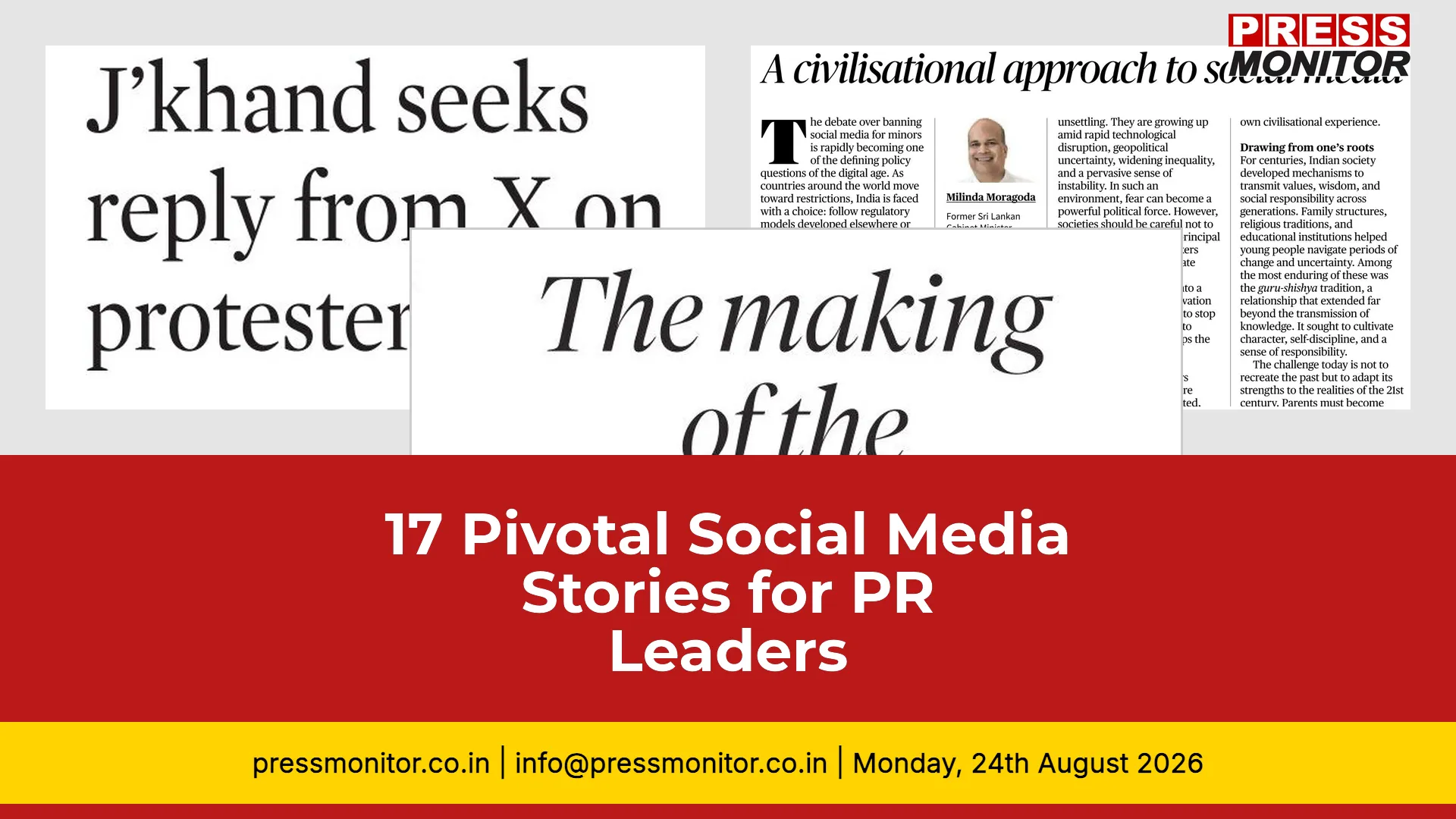
Tracking the rapid evolution of digital platforms requires precise media monitoring to separate signal from noise. This press review distills today’s most impactful developments across Indian print headlines, delivering actionable media intelligence for communications and policy leaders. Leveraging rigorous print media monitoring ensures you act on verified facts before rumors spread. Below are 17 key stories shaping the landscape.
1. Cyber Police Issue Notice To X Corp
A front-page report in New Indian Express says ramping police in Ranchi issued a notice to X Corp seeking details of the person managing the JPSC-JSSC Reform Manch’s social media account. The notice was issued under section 94 of the BNSS as part of a criminal investigation into false and misleading information disseminated during protests over the burning of CM Hemant Soren’s effigy.
Why it matters: Platform liability and data compliance are under intense scrutiny as law enforcement targets social media intermediaries.
Key detail: Ranchi cyber police issued a notice under section 94 of the BNSS to X Corp, demanding account manager details linked to the JPSC-JSSC Reform Manch amid allegations of false information during protests.
Source: New Indian Express
Next step: Review intermediary compliance protocols and incident response playbooks.
2. India Debates Social Media Regulation
A front-page report in The Hindu says... The article discusses India's policy debate over banning social media for minors, emphasizing the need for cultural approaches rather than strict bans, inspired by traditions like the guru-shishya system to prepare youth for technological shifts.
Why it matters: Policy shifts around youth protection could reshape platform design and age-gating requirements nationwide.
Key detail: The Hindu highlights a cultural approach inspired by the guru-shishya tradition rather than strict bans, urging proactive digital literacy frameworks.
Source: The Hindu
Next step: Align corporate youth engagement strategies with emerging regulatory sentiment.
3. Divisive Language Used as Political Weapon
A front-page report in Indian Express says the BJP has deployed a new abrasive social media team to silence opponents through abusive language rather than debate. The article highlights the shift from the old IT cell to a more foul-mouthed squad, illustrating how violent language is weaponized to exclude and marginalize dissent.
Why it matters: Escalating online hostility impacts brand safety and public discourse standards.
Key detail: Indian Express reports a shift toward abrasive, foul-mouthed social media squads replacing traditional IT cells to marginalize dissent.
Source: Indian Express
Next step: Audit community management guidelines and crisis communication thresholds.
4. Keerthana Criticizes Misogynistic Posts
A front-page report in New Indian Express says INDUSTRIES Minister S Keerthana hit out at social media posts that falsely identified a woman stepping out of a car in a black dress as her, calling the posts misogynistic and questioning why a woman’s clothes and appearance should become a subject of political attack.
Why it matters: Gender-based online harassment remains a critical reputational and legal risk for public figures and brands.
Key detail: INDUSTRIES Minister S Keerthana condemned misogynistic posts falsely identifying her, questioning why women’s appearances become political targets.
Source: New Indian Express
Next step: Strengthen anti-harassment policies and rapid response templates for executive teams.
5. News Channel Viewership Down Amid Social Media Shift
A front-page report in Times of India says news channels in India are a declining force, with viewership numbers down, ad volumes fallen sharply, and financial performance suffering alongside reported layoffs. While traditional channel viewing is down, content from news channels gains wide circulation on social media in the form of clips that often use theatrical, over-the-top framing.
Why it matters: Traditional broadcast decline accelerates as audiences migrate to clipped, theatrical social content.
Key detail: Times of India notes falling ad volumes and layoffs, while channel clips gain massive circulation online despite over-the-top framing.
Source: Times of India
Next step: Reallocate media budgets toward short-form distribution and platform-native storytelling.
6. India's Public Spaces Overwhelmed by Political Battles
A front-page report in Economic Times says India's public spaces have become battlegrounds for political narratives, with competitive and acrimonious politics dominating daily life. Social media platforms act as digital arenas while mature citizens are urged to cleanse society from institutional targeting. The article concludes depoliticization must begin from the top layers.
Why it matters: Digital arenas amplify acrimonious politics, demanding strategic depoliticization in corporate messaging.
Key detail: Economic Times argues mature citizens must cleanse society from institutional targeting, starting from top leadership layers.
Source: Economic Times
Next step: Calibrate stakeholder communications to maintain neutrality and focus on value delivery.
7. Brar Claims Gang Killed Hardeep Nijjar in Canada
A front-page report in First India says three years after the killing of Khalistan separatist Hardeep Singh Nijjar triggered India’s worst diplomatic row with Canada, an audio clip has surfaced on social media in which fugitive gangster-turned-terrorist Goldy Brar has claimed responsibility for Nijjar’s death.
Why it matters: Geopolitical tensions spill onto social platforms, requiring vigilant crisis comms and diplomatic awareness.
Key detail: First India reports an audio clip surfacing online where Goldy Brar claims responsibility for Nijjar’s death, reigniting India-Canada diplomatic friction.
Source: First India
Next step: Monitor cross-border narrative flows and prepare holding statements for international stakeholders.
8. War of Words Erupts on Social Media After Chautala Visit
"A war of words turned into a social media battle between the supporters of BJP Cabinet minister Anil Vij and INLD leader Abhay Singh Chautala after the latter’s recent visit to Ambala Cantonment. During the visit, Chautala targeted the minister over local issues and advised him to resign, noting that he had not been consulted on the freehold policy. However, the statements did not go down well with the supporters of the minister, who challenged the INLD to field Abhay Chautala against Anil Vij from Ambala Cantonment Assembly constituency in the next election. Supporters of both stalwart leaders have been making social media posts targeting each other ever since," a front-page report in The Tribune says.
Why it matters: Political rivalries quickly digitize, turning local visits into viral battlegrounds.
Key detail: Tribune details how Anil Vij and Abhay Singh Chautala supporters clashed online following remarks on freehold policy and election challenges.
Source: Tribune
Next step: Track political sentiment spikes and adjust grassroots engagement tactics accordingly.
9. AMU Faculty Member Lodges Complaint Against Social Media Harassment
A front-page report in Hindustan Times says, a faculty member from a northeastern state at Aligarh Muslim University (AMU) has lodged a complaint alleging cyber harassment, character assassination, and online defamation against a man running a social media page that allegedly targeted her. The page made comments aimed at provoking regional bias against her.
Why it matters: Academic institutions face rising cyber defamation risks tied to regional bias campaigns.
Key detail: Hindustan Times reports a northeastern faculty member filed complaints against a page targeting her with provocative, biased commentary.
Source: Hindustan Times
Next step: Implement robust digital footprint audits and legal support channels for staff.
10. New Guidelines for Security Personnel
A front-page report in Hindustan says, security agencies have prepared a unique and strict guideline for security personnel following recent violent protests at Jantar Mantar and questions raised on social media about police's role. The guidelines emphasize maintaining a calm demeanor and avoiding physical confrontation, instead focusing on using digital provocation and social media to counter the narrative.
Why it matters: Law enforcement is adapting to digital provocations, emphasizing calm deterrence over physical confrontation.
Key detail: Hindustan outlines strict protocols for security forces managing Jantar Mantar protests, prioritizing digital counter-narratives.
Source: Hindustan
Next step: Align public safety messaging with updated operational doctrines.
11. 5Cr IN Scams Target GoldENS ‘Golden Hour’ Victims By Hacking LinkedIn, Social Data
A front-page report in Deccan Herald says scammers exploit public social data, including LinkedIn profiles, real estate purchases and breached databases to systematically steal Rs 5 crore in funds. South India’s Karnataka Cyber Command disrupts mule account networks where payments are layered into offshore fraud schemes during critical ‘Golden Hour’ when fraudsters repel transfers before they become irreversible.
Why it matters: Professional networks are prime targets for sophisticated fraud exploiting public data.
Key detail: Deccan Herald reveals Karnataka Cyber Command disrupting mule networks stealing Rs 5 crore by leveraging breached databases and LinkedIn profiles during transfer windows.
Source: Deccan Herald
Next step: Enforce multi-factor authentication and employee training on data privacy.
12. Principal Suspended After Viral Video of Bathing with Students
The Education Department has taken strict action against Lalchand Meena, principal of Padak Chapli Government School in Alwar, following the circulation of an objectionable video on social media. The video allegedly showed the principal in an inappropriate situation with female students while bathing in a water body. The matter came to light after the video went viral, prompting the department to initiate action. Meena has now been suspended with immediate effect, and a departmental inquiry has been ordered into the allegations. He will be attached to the Directorate of Secondary Education in Bikaner during the suspension period. According to departmental rules, Meena will be entitled to subsistence allowance until the inquiry is completed.
Why it matters: Viral misinformation triggers immediate administrative action, highlighting the speed of digital accountability.
Key detail: First India confirms Lalchand Meena’s suspension pending inquiry after a dam bathing video circulated widely, violating public servant conduct codes.
Source: First India
Next step: Verify viral claims before amplification and establish rapid fact-checking workflows.
13. Three Missing Schoolgirls Found in Mumbai
A special team of the Faridkot police has traced three missing minor schoolgirls to Mumbai. They had gone missing on August 10. The girls are being brought back to Punjab. The missing girls, all Class X students at a local government school, are residents of Jot Ram Colony in Faridkot. According to the complaint lodged by their parents at the local police station, the trio left for school at 7.30 am on August 10, but did return. A police search was later launched to trace them. A police team was sent to Mumbai three days ago after technical analysis pointed toward the metro city. Investigators managed to crack the case by tracking the active digital foot-prints and locations associated with the girls’ Facebook and Instagram accounts. Following these social media leads, the team pinpointed their location to a rented room in Mumbai and took them into custody. A senior police official confirmed the development, stating that all three girls were safe. "Our team successfully traced the missing students. Further details regarding their departure and how they arranged accommodation in Mumbai will be known after the team reaches Faridkot and completes formal questioning," the official added.
Why it matters: Social media tracking proves crucial in modern search operations, bridging digital footprints with physical rescue.
Key detail: Tribune reports Faridkot police located missing Class X students by analyzing active Facebook and Instagram locations, confirming their safe return.
Source: Tribune
Next step: Leverage ethical digital forensics for community safety initiatives.
14. Police Deny Quota Protest Access to Jantar Mantar
A front-page report in The Hans India says that Delhi Police have denied permission for any protest or gathering at Jantar Mantar over reservation reforms and warned against misleading social media posts. Union Minister Chirag Paswan has stated that the government will engage in dialogue with anti-reservation protesters once they present their demands systematically.
Why it matters: Authorities are cracking down on misleading social media posts ahead of major demonstrations.
Key detail: The Hans India notes Delhi Police warned against false narratives while Union Minister Chirag Paswan called for systematic demand presentations.
Source: The Hans India
Next step: Prepare compliant protest coverage guidelines and monitor rumor mills.
15. Microdrama Gaining Ground in India
A front-page report in Economic Times says microdrama content is drawing similar audience engagement as long-form content in India. Recent study by Kantar shows microdrama is attracting 14% of viewers who watch content for more than two hours a day.
Why it matters: Short-form serialized content is capturing sustained attention, rivaling long-form viewing habits.
Key detail: Economic Times cites a Kantar study showing microdramas attract 14% of heavy viewers (>2 hours daily), with audiences bingeing 60-80 episodes across sessions.
Source: Economic Times
Next step: Test episodic micro-content for audience retention and brand integration.
16. Lawsuit Over Govinda's Marriage
A front-page report in Times of India says that actor Govinda has issued a public notice warning against the creation and circulation of false, defamatory or unverified content about his personal life. He is seeking up to ₹100 crore in damages.
Why it matters: Celebrities are wielding legal notices aggressively against unverified personal life content.
Key detail: Times of India reports actor Govinda seeking up to ₹100 crore in damages for defamatory posts regarding his marriage.
Source: Times of India
Next step: Update editorial standards and implement pre-publication verification checks.
17. Cybercrime Arrest in Hyderabad
A front-page report in Deccan Chronicle says a software engineer was arrested by Hyderabad cybercrime team for creating a fraudulent Instagram profile of a woman politician and posting abusive and sexually explicit comments.
Why it matters: Fake profiles targeting female politicians underscore the intersection of tech crime and gender-based abuse.
Key detail: Deccan Chronicle reports a software engineer arrested for creating a fraudulent Instagram account posting explicit comments.
Source: Deccan Chronicle
Next step: Deploy AI-driven identity verification and strengthen platform reporting mechanisms.
According to Press Monitor's tracking of Indian publications, these developments reflect a rapidly maturing digital ecosystem where print still anchors verified reporting. How will your organization adapt its platform governance strategy this quarter?