17 Pivotal Technology Stories for IT Leaders


Welcome to today's press review. According to Press Monitor's tracking of Indian publications, the technology sector is moving at breakneck speed. This media intelligence digest covers everything from global AI outages to domestic semiconductor pushes. Stay ahead with our print media monitoring insights.
1. ChatGPT, Gemini, Claude Face Global Outages
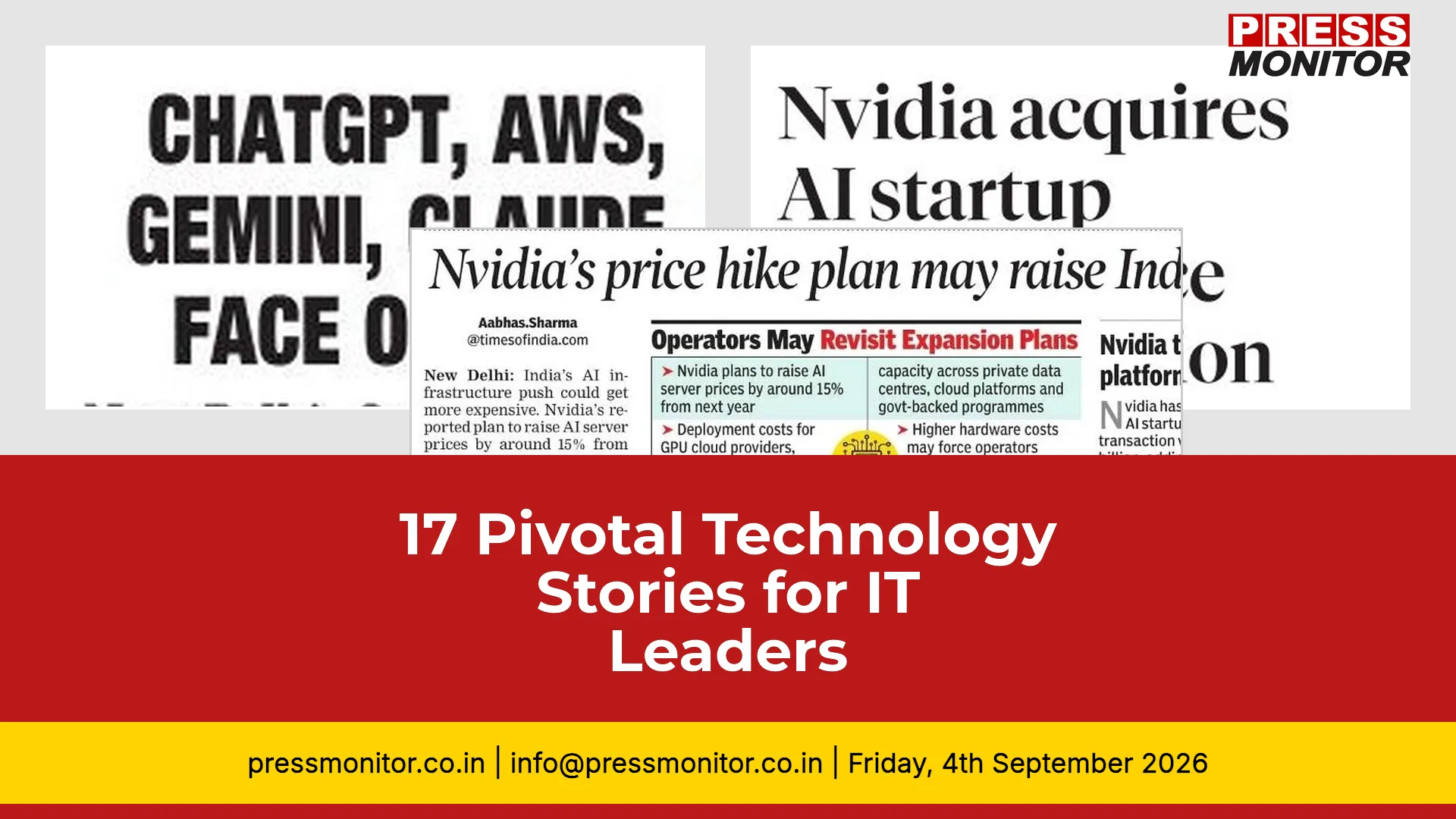
A front-page report in Asian Age says major artificial intelligence platforms, including OpenAI's ChatGPT, Google Gemini, and Anthropic's Claude, experienced significant service disruptions on Thursday, affecting thousands of users globally. According to outage tracking website Downdetector, reports of outages began surging in the evening (IST), with users flagging issues ranging from total website inaccessibility to internal server errors. The disruption also appeared to impact Grok and Amazon Web Services (AWS).
Why it matters: Cloud reliability directly impacts enterprise workflows and customer trust globally.
Key detail: Downdetector logged surging reports of total website inaccessibility and internal server errors across OpenAI, Google, Anthropic, Grok, and AWS starting Thursday evening IST.
Source: Asian Age
Next step: Review your cloud redundancy protocols and vendor SLAs before scaling next quarter.
2. Nvidia Acquires Hugging Face For $12.93 Billion
A front-page report in Business Standard says technology giant Nvidia has acquired AI startup Hugging Face for $12.93 billion. The New York-based company was founded in 2016 by French entrepreneurs Clement Delangue, Julien Chaumond, and Thomas Wolf. Nvidia chief Jensen Huang stated the acquisition will scale up Hugging Face's platform and expand AI access for developers worldwide.
Why it matters: Consolidation in the AI developer ecosystem signals a shift toward integrated model deployment.
Key detail: Nvidia chief Jensen Huang stated the acquisition will scale up Hugging Face's platform and expand AI access for developers worldwide.
Source: Business Standard
Next step: Evaluate how integrated model hubs might streamline your MLops pipeline.
3. Nvidia Raises AI Server Prices 15%
A front-page report in Times of India says Nvidia plans to raise artificial intelligence server prices by around 15 percent from next year, while also acquiring artificial intelligence startup Hugging Face for about US$13 billion. In India, as private data centres, cloud platforms and government-backed programmes scale AI compute capacity, CloudPe founder Ishan Talathi and Dataneers founder Amit Chaurasia said higher GPU, memory and storage costs may delay capacity additions or prompt operators to rethink expansion plans.
Why it matters: Hardware cost inflation will pressure data center capex and cloud pricing models.
Key detail: Nvidia plans to raise artificial intelligence server prices by around 15 percent from next year, impacting GPU, memory, and storage costs.
Source: Times of India
Next step: Lock in procurement contracts early or explore alternative silicon vendors.
4. US Backs OpenAI In Copyright Lawsuit
A front-page report in Times of India says the US government sided with OpenAI in a copyright lawsuit brought by the New York Times, arguing that training AI models on copyrighted works brings creative and public benefits. The justice department filed a 20-page document stating that constraining large language model development would harm American prosperity and economic mobility. The New York Times criticized the move, saying the administration is siding with trillion-dollar AI companies at the expense of American creators.
Why it matters: Regulatory precedent could redefine fair use and training data rights globally.
Key detail: The US justice department filed a 20-page document arguing that constraining large language model development would harm American prosperity and economic mobility.
Source: Times of India
Next step: Audit your training data sourcing policies against emerging IP frameworks.
5. India Flags Anthropic Boundary Error
A front-page report in Times of India says the Indian government flagged incorrect depiction of India's boundaries on AI company Anthropic's website following a complaint. The notice, dated Sept 1, stated that Jammu and Kashmir, Ladakh, and Arunachal Pradesh were depicted incorrectly with dotted lines, while the Andaman and Nicobar Islands and Lakshadweep were missing from the map. Anthropic said it has teams investigating the issue on priority.
Why it matters: Geopolitical accuracy in AI outputs is becoming a compliance priority for Indian enterprises.
Key detail: The Indian government flagged incorrect depiction of India's boundaries on Anthropic's website, noting missing islands and dotted lines for disputed regions.
Source: Times of India
Next step: Implement regional validation checks for geospatial AI features.
6. Meta Releases Muse Spark l.3 AI
A front-page report in Asian Age says Meta Platforms Inc. has released its most powerful artificial intelligence model yet, with chief AI officer Alexandr Wang stating capabilities are edging closer to top competitors. Developers can access and pay for the Muse Spark l.3 update via Meta Model API, with rollout planned for Instagram and Facebook users soon. Wang said Meta remains on track for the larger model dubbed Watermelon, while the company has not yet decided whether to release Muse Spark l.3 weights.
Why it matters: Competitive pressure intensifies as major platforms push proprietary model capabilities.
Key detail: Meta Platforms released its most powerful AI model yet, with rollout planned for Instagram and Facebook users soon via the Meta Model API.
Source: Asian Age
Next step: Benchmark Muse Spark l.3 against your current generative stack.
7. Broadcom Forecasts $115bn AI Chip Sales
A front-page report in Business Standard says Broadcom forecast strong artificial intelligence chip sales over the next two years, projecting sales of one hundred and fifteen billion United States dollars by twenty twenty eight. The Palo Alto, California-based company said the outlook reflects continuing demand from Big Tech for artificial intelligence infrastructure, even as investors question returns on heavy spending. Broadcom shares were down more than one per cent in extended trading after gaining about six per cent this year, underperforming rivals and the broader semiconductor index amid artificial intelligence spending concerns and competition including Marvell's custom chip deal with Google.
Why it matters: Semiconductor demand remains robust despite investor scrutiny on ROI timelines.
Key detail: Broadcom projects sales of one hundred and fifteen billion United States dollars by twenty twenty eight, reflecting continuing Big Tech infrastructure spending.
Source: Business Standard
Next step: Align hardware refresh cycles with projected chip availability windows.
8. 10,000 DU Students to Get AI Training from AMD
A front-page report in Times of India says that up to 10,000 Delhi University students will receive hands-on training in building, testing, and deploying artificial intelligence solutions under a yearlong collaboration with semiconductor company AMD. The programme, offered at no cost to the university, will also give faculty members access to tools used for developing AI and high-performance computing applications. Under an MoU signed Thursday, AMD will introduce its AI Engage Developer Program at DU, providing learning resources, technical workshops, and cloud-based graphics processing unit credits.
Why it matters: Workforce skilling initiatives are accelerating talent pipelines for enterprise AI adoption.
Key detail: Delhi University students will receive hands-on training in building and deploying AI solutions under a yearlong collaboration with AMD, including cloud-based GPU credits.
Source: Times of India
Next step: Partner with academic institutions to tap into emerging technical talent.
9. JK Bank Seeks AI Platform Partners
A front-page report in Business Line says Jammu and Kashmir Bank has issued an Expression of Interest from technology partners, solution providers, and OEMs for developing an Agentic AI and Generative AI enablement platform and evaluating the feasibility of deploying a private Large Language Model on public cloud or on-premises. The bank will accept bids on its e-Tendering Portal from 2 September 2026, with submissions closing on 24 September 2026, and complete documents are available on the bank's official website.
Why it matters: Financial institutions are actively procuring agentic and generative AI capabilities.
Key detail: Jammu and Kashmir Bank issued an Expression of Interest for developing an Agentic AI platform and evaluating private LLM deployment on public cloud or on-premises.
Source: Business Line
Next step: Prepare solution architectures tailored to regulated banking environments.
10. Modi De Wever Ink Five Pacts
A front-page report in Asian Age says Prime Minister Narendra Modi and Belgian Prime Minister Bart De Wever held wide-ranging talks in New Delhi on September 3, inked five pacts, and announced plans to double bilateral trade over the next five years. The two nations agreed to expand defence cooperation, renewable energy, semiconductor, and critical minerals ties, and signed a pact on combating cybercrime and transnational organised crime. They also pledged a comprehensive approach to counterterrorism and discussed the India-European Union free trade agreement.
Why it matters: International tech diplomacy is expanding semiconductor and cybersecurity cooperation.
Key detail: Prime Minister Narendra Modi and Belgian PM Bart De Wever inked five pacts, including agreements on semiconductor ties, renewable energy, and combating cybercrime.
Source: Asian Age
Next step: Monitor cross-border tech supply chain incentives and export controls.
11. India Targets Critical Component Self-Reliance
A front-page report in Business Standard says Prime Minister advisor Tarun Kapoor urged the automobile sector to rapidly develop domestic manufacturing for critical components like heavy rare-earth magnets and semiconductors. Speaking at the Society of Indian Automobile Manufacturers convention in New Delhi on Thursday, he warned that reliance on single-source imports, particularly from China, leaves India vulnerable to supply disruptions. The government is backing this localisation drive with a rupees seven thousand two hundred and eighty crore magnet production scheme and a rupees one point two five trillion semiconductor mission, while pushing for faster electric vehicle adoption to bolster energy security.
Why it matters: Domestic manufacturing mandates aim to reduce single-source import vulnerabilities.
Key detail: PM advisor Tarun Kapoor urged rapid development of critical components like heavy rare-earth magnets and semiconductors, backed by a rupees seven thousand two hundred and eighty crore magnet production scheme.
Source: Business Standard
Next step: Assess localization requirements for your hardware procurement strategy.
12. Microsoft India: AI Not Cutting Jobs
A front-page report in Business Standard says companies are not using artificial intelligence as a pretext to cut jobs, according to Puneet Chandok, president of Microsoft India and South Asia. Speaking in Bengaluru on 3 September, Chandok explained that the nature of work is changing, which requires skilling and new ways of working. Microsoft India president also noted that new roles such as forward design engineer and enterprise ontology expert have been created, while redundancies across global capability centres in India have soared with Uber cutting about 250 jobs.
Why it matters: Enterprise AI adoption is reshaping roles rather than eliminating headcount.
Key detail: Microsoft India president Puneet Chandok noted that new roles such as forward design engineer and enterprise ontology expert have been created while work nature evolves.
Source: Business Standard
Next step: Redesign job descriptions to integrate AI-augmented workflows.
13. WhatsApp Launches Bill Payments in India
A front-page report in Business Standard says WhatsApp launched a bill payments feature native to the app in India on Thursday, powered by the Bharat Connect network and allowing users to pay household and utility bills across categories including electricity, gas, water, Fastags, insurance, credit card and loan repayments, with access to 22,722 billers across 30 categories. Arun Srinivas, managing director and country head of Meta India, stated the launch deepens WhatsApp's presence in the market alongside the Unified Payments Interface system.
Why it matters: Super-app ecosystems are deepening fintech integration and consumer touchpoints.
Key detail: WhatsApp launched a native bill payments feature powered by Bharat Connect, providing access to 22,722 billers across 30 categories including utilities and insurance.
Source: Business Standard
Next step: Integrate payment APIs to capture embedded commerce opportunities.
14. RBI Urges Cyber-Security Investment
A front-page report in Asian Age says Reserve Bank of India deputy governor Shirish Chandra Murmu on Thursday asked non-banking financial companies and housing finance companies to diversify funding sources, strengthen underwriting standards and invest in strong cyber-security to protect customer data and maintain trust at the seventh non-banking financial company and housing finance company summit in Mumbai. Murmu said sustainable growth requires better governance, liquidity management, asset quality, customer protection and digital transformation, warning that liquidity events show exposure to market sentiment and concentrated funding.
Why it matters: Regulatory emphasis on digital resilience is raising compliance baselines for NBFCs and HFCs.
Key detail: RBI deputy governor Shirish Chandra Murmu directed non-banking financial companies to invest in strong cyber-security to protect customer data and maintain trust.
Source: Asian Age
Next step: Allocate budget for zero-trust architecture and threat detection upgrades.
15. IOB Cybernova Hackathon 2026 Grand Finale Concludes
A front-page report in Business Standard says Indian Overseas Bank successfully concluded the Grand Finale of its PAN-India IOB Cybernova Hackathon 2026 at R.M.K. Engineering College, Thiruvallur. Organised as part of the PSBs Hackathon Series 2026 in alignment with the Department of Financial Services, the initiative focused on advanced controls for mule account detection, deepfake resilient authentication, fraud prevention in digital payments, and digital KYC onboarding. The event was graced by IOB executive directors and senior managers alongside special guests from the R.M.K. Group of Institutions.
Why it matters: Public sector banks are crowdsourcing innovation for fraud prevention and KYC modernization.
Key detail: Indian Overseas Bank concluded its PAN-India hackathon focusing on mule account detection, deepfake resilient authentication, and digital KYC onboarding.
Source: Business Standard
Next step: Participate in or sponsor industry hackathons to scout emerging security solutions.
16. Uber and Wayve Launch London Robotaxis
A front-page report in Asian Age says Uber and British tech company Wayve are launching London’s first self-driving taxi service on Thursday, starting with a small rollout of Ford Mustang Mach-E electric vehicles fitted with Wayve’s autonomous vehicle technology. The London rollout will still have a person behind the wheel overseeing each trip, unlike more autonomous robotaxi services operating in several United States and Chinese cities.
Why it matters: Autonomous mobility pilots are testing regulatory frameworks and sensor fusion tech.
Key detail: Uber and British tech company Wayve launched London’s first self-driving taxi service using Ford Mustang Mach-E vehicles with human oversight initially.
Source: Asian Age
Next step: Track autonomous vehicle policy shifts that may impact logistics fleets.
17. Exato Technologies IPO Raises Rs 737.45 Crore
A front-page report in Business Standard says Exato Technologies Limited listed on the BSE SME platform in December 2025, raising Rs 737.45 crore through an oversubscribed IPO. Founded in 2016 and headquartered in Noida, the AI-first enterprise technology company serves over 150 enterprise clients across 10 countries including 9 of India's leading banks. Promoter Appuorv K Sinha outlined plans to scale international operations and accelerate proprietary platform revenue.
Why it matters: Capital markets are rewarding AI-first enterprise technology providers.
Key detail: Exato Technologies Limited listed on the BSE SME platform, raising Rs 737.45 crore through an oversubscribed IPO, serving over 150 enterprise clients across 10 countries.
Source: Business Standard
Next step: Monitor public market sentiment toward domestic AI SaaS valuations.
Which of these developments will reshape your Q4 roadmap? Share your take below.
