19 Essential Arts, Culture & Heritage Stories for Cultural Leaders


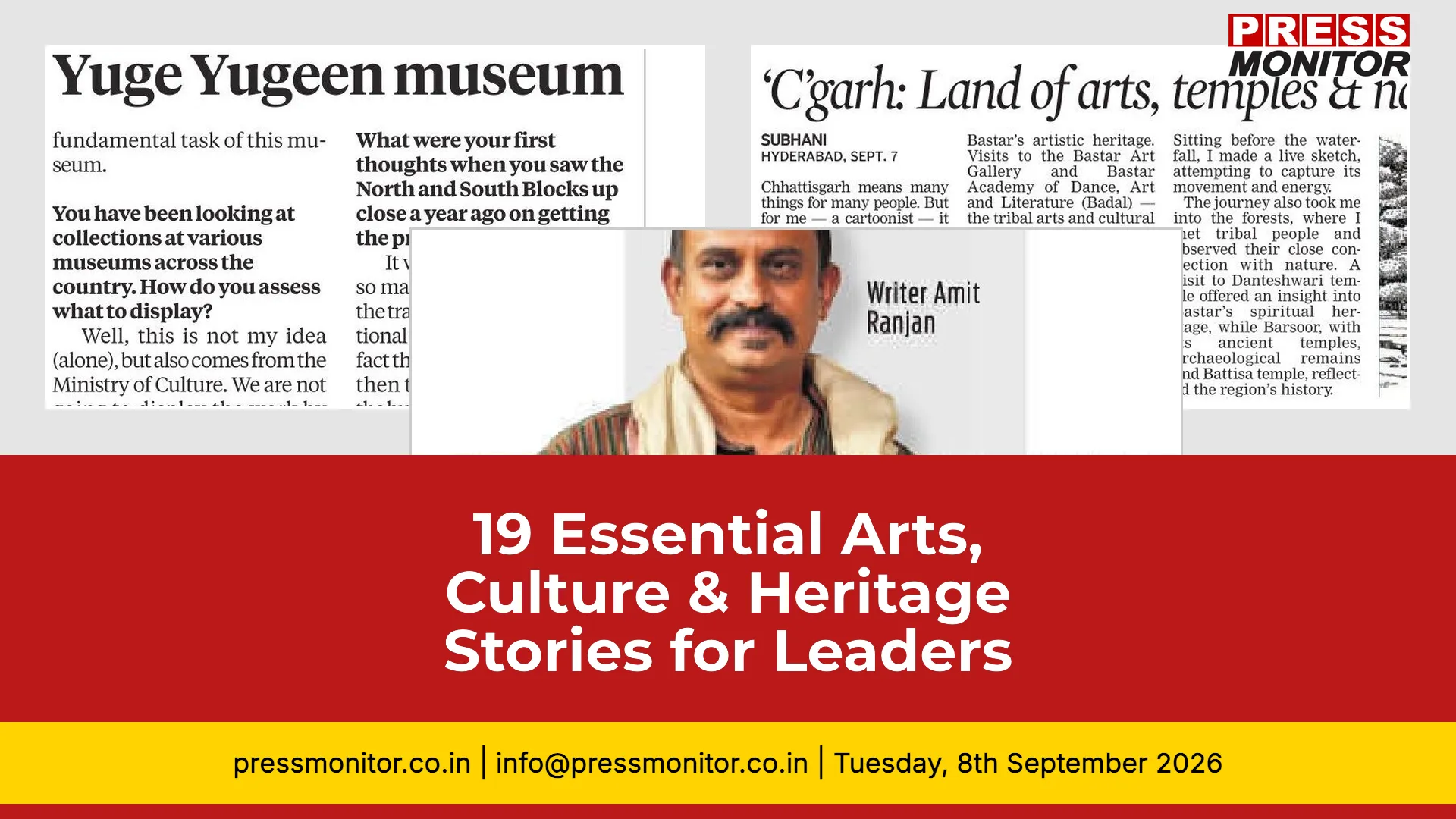
According to Press Monitor's tracking of Indian publications, today's print media delivers 19 essential stories on arts, culture, and heritage that every cultural leader should know. This press review combines media monitoring and media intelligence to cover museum transformations, literary discoveries, art market surges, heritage preservation, and cultural festivals across India. These are the news on arts, culture, and heritage developments shaping the sector today.
1. Kulapat Yantrasast Transforms Delhi Museum
A front-page report in Indian Express says Kulapat Yantrasast is leading the renovation of New Delhi's North Block and South Block buildings into the Yuge Yugeen Bharat Museum, the largest museum in the world. The architect states that museums must now inspire rather than merely inform, involving artisans from across India to create an accessible and welcoming space. The project aims to showcase five thousand years of continuous Indian civilization through thematic exhibits rather than chronological displays.
Why it matters: The largest museum project in the world is reshaping how India presents its civilizational narrative to global audiences.
Key detail: Five thousand years of continuous Indian civilization showcased through thematic exhibits rather than chronological displays, with artisans from across India creating an accessible and welcoming space.
Source: Indian Express, Delhi
Next step: Watch for Ministry of Culture announcements on Phase 2 of the renovation.
2. Chhattisgarh: Land of Arts and Nature
A front-page report in Asian Age says a cartoonist explored Chhattisgarh's natural and cultural heritage, beginning in Jagdalpur with visits to the Indravati river and Jagdalpur Palace. The journey featured Bastar's artistic traditions at the Bastar Art Gallery and Badal, a meeting with the present Raja of Bastar, and sketches of Chitrakote Waterfall during the monsoon. The trip also included forest encounters with tribal people and visits to Danteshwari temple and ancient temples at Barsoor.
Why it matters: A cartoonist's journey through Bastar highlights the intersection of tribal art and natural heritage, offering a model for cultural tourism.
Key detail: Visits to Indravati river, Jagdalpur Palace, Bastar Art Gallery, Danteshwari temple, and Chitrakote Waterfall during monsoon.
Source: Asian Age, Delhi
Next step: Consider Chhattisgarh for cultural tourism and heritage trail partnerships.
3. Dara Shukoh: The Faqir and the Throne of Thorns
A front-page report in Morning Standard says that writer Amit Ranjan's book Dara Shukoh: The Faqir and the Throne of Thorns revisits the intellectual and spiritual world of the seventeenth-century Mughal prince, looking beyond the familiar narrative of his defeat by Aurangzeb. The book argues that Aurangzeb's success was rooted in deceit and political manoeuvring rather than military prowess, and offers a revision to the familiar story of Mughal Delhi by crediting Dara and his sister Jahanara with overseeing the construction of monuments like the Red Fort, Jama Masjid, and Taj Mahal.
Why it matters: A revisionist book on Mughal prince Dara Shukoh challenges the familiar narrative of his defeat by Aurangzeb, offering new perspectives on Mughal Delhi's architectural legacy.
Key detail: The book credits Dara and his sister Jahanara with overseeing the construction of the Red Fort, Jama Masjid, and Taj Mahal, arguing Aurangzeb's success was rooted in deceit rather than military prowess.
Source: Morning Standard, New Delhi
Next step: Track Penguin's marketing push for the book and potential academic discussions.
4. India Art Auction Sales Surge 43.7% in 2026
A front-page report in Mint says India's art market is entering a new phase with auction sales surging 43.7% year-on-year to Rs 1,548.9 crore in the first half of 2026. Veteran Mumbai gallerist Dadiba Pundole states art is firmly established as an investment category, with growth driven by a widening collector base. The country's ultra-high-net-worth population reached 19,877 in 2026, projected to increase 27% by 2031, supporting further market expansion.
Why it matters: The Indian art market is entering a new phase with auction sales surging nearly 44% year-on-year, signaling growing collector confidence.
Key detail: Auction sales reached Rs 1,548.9 crore in the first half of 2026, driven by a widening collector base and India's ultra-high-net-worth population of 19,877, projected to grow 27% by 2031.
Source: Mint, Delhi
Next step: Monitor emerging auction houses and the entry of new collector demographics.
5. Kalakruthi Santhe 30-Day Bazaar
A front-page report in New Indian Express says Kalakruthi presents Santhe, a thirty-day extravaganza at Sri Sankara Hall on TTK Road, featuring over ninety craft groups from twenty-one states until September thirteen. The Madras Archive exhibition at Artworld runs until September twenty-two, showcasing twenty creators across art, literature and photography. Other events include a jewellery and silk showcase at The Folly at Amethyst on September eight and nine, and a special festive Ganesh Chaturthi offering from The Kitchen by Chef Deepa in Adyar.
Why it matters: Chennai's largest crafts festival brings together over 90 craft groups from 21 states, showcasing the diversity of Indian artisanal traditions.
Key detail: Events include the Madras Archive exhibition at Artworld, a jewellery and silk showcase at The Folly at Amethyst, and a festive Ganesh Chaturthi offering from The Kitchen by Chef Deepa in Adyar.
Source: New Indian Express, Chennai
Next step: Plan visits to key events and consider sponsorship or coverage opportunities.
6. UoH Preserves Sarojini Naidu Legacy
A front-page report in Deccan Chronicle says the will of freedom fighter and poet Sarojini Naidu, along with her personal letters and artefacts, were formally handed over to the University of Hyderabad on Monday to preserve her legacy. The documents were transferred under a Telangana government order dated February 9, 2026, and presented to Vice Chancellor Prof. J. Anuradha at the historic Golden Threshold building in Abids. Author Sheela Reddy and various trustees were felicitated for their role in discovering and preserving the rare material associated with the first woman president of the Indian National Congress.
Why it matters: The formal handover of Sarojini Naidu's will, personal letters, and artefacts to the University of Hyderabad marks a significant moment in heritage preservation.
Key detail: Documents transferred under a Telangana government order dated February 9, 2026, presented at the historic Golden Threshold building in Abids, with author Sheela Reddy and trustees felicitated.
Source: Deccan Chronicle, Hyderabad
Next step: Follow the University of Hyderabad's plans for digitisation and public access to the collection.
7. National Artist Creative Camp
A front-page report in First India says a four-day National Artist Creative Camp commenced at the Department of Drawing and Painting, Rajasthan University on Monday. The camp was inaugurated by educationist Archana Surana, Prof Vandana Kalla, Prof IU Khan, and art connoisseur Monika Sharda, who watered a Tulsi plant. Camp curator and creative art department head Dr Amita Raj Goyal stated the camp will continue till September 10, with artworks displayed from Thursday evening at the Art Gallery, Jaipur Centre for Culture and Arts (CCA), Nirman Nagar.
Why it matters: A four-day creative camp at Rajasthan University brings together artists, educators, and connoisseurs to foster artistic development and cultural exchange.
Key detail: Inaugurated by educationist Archana Surana, Prof Vandana Kalla, Prof IU Khan, and art connoisseur Monika Sharda, with artworks displayed from Thursday evening at the Art Gallery, Jaipur CCA.
Source: First India, Jaipur
Next step: Track participation numbers and potential for annual recurrence.
8. Constitucion Family Home Preserved By Heir
A front-page report in Economic Times says India turned to new crude oil sources during the Iran war, but nine of ten new suppliers together accounted for only 1.4 percent of imports. The top five suppliers still controlled 76 percent of crude imports, with Venezuela being the exception at nearly 5 percent.
Why it matters: A young heir's decision to restore and reside in a historic Art Deco family home highlights the growing global trend of architectural heritage preservation.
Key detail: The imposing stone building on Calle Virreyes features a secret garden patio and previously housed legal, dental, and media businesses before falling into disuse.
Source: Economic Times, Delhi
Next step: Monitor for heritage listing applications and restoration project updates.
9. Siddhesh Gautam's Anti-Caste Graphic Novel
A front-page report in New Indian Express says Siddhesh Gautam's The Blue Book is an anti-caste graphic novel that uses dream sequences to bring the author into conversation with figures such as Savitribai Phule, Doctor BR Ambedkar, and Guru Ravidas. The book questions whether the anti-caste movement was about one person and whether the state has done enough to annihilate caste.
Why it matters: The Blue Book uses dream sequences to engage with anti-caste icons like Savitribai Phule, Dr BR Ambedkar, and Guru Ravidas, sparking conversations about caste annihilation.
Key detail: The graphic novel questions whether the anti-caste movement was about one person and whether the state has done enough to annihilate caste.
Source: New Indian Express, Chennai
Next step: Watch for literary award nominations and academic syllabus inclusion.
10. Yakshagana Bheemarjunara Kaalaga Showcases Tradition
A front-page report in Deccan Herald says a scene from the 'Bheemarjunara Kaalaga' Yakshagana was showcased as part of the 'Moodalapaaya Sambhrama' event in Bengaluru on Monday. The Karnataka Yakshagana Academy and the Kannada and Culture department jointly hosted the programme.
Why it matters: Traditional Yakshagana theatre continues to thrive in Bengaluru, preserving Karnataka's rich performing arts heritage.
Key detail: The 'Bheemarjunara Kaalaga' was showcased as part of the 'Moodalapaaya Sambhrama' event, jointly hosted by the Karnataka Yakshagana Academy and the Kannada and Culture department.
Source: Deccan Herald, Bangaluru
Next step: Follow the Yakshagana Academy's calendar for upcoming performances.
11. UK Government Rejects Jamaica Slavery Reparations
A front-page report in Times of India says the United Kingdom government officially rejected Jamaica’s requests for slavery reparations on Monday. Jamaican Culture Minister Olivia Grange announced she would lead a delegation to present a petition to King Charles urging compensation for centuries of enslavement. Despite historical remorse expressed by modern British royals, the government maintains its firm stance against any formal apology or financial commitment.
Why it matters: The UK's firm stance against Jamaica's slavery reparations request has sparked international debate on historical accountability and cultural restitution.
Key detail: Jamaican Culture Minister Olivia Grange announced she would lead a delegation to present a petition to King Charles, despite historical remorse expressed by modern British royals.
Source: Times of India, New Delhi
Next step: Monitor diplomatic responses and potential impact on UK-Caribbean cultural relations.
12. Two-Day Odissi Workshop At IMFA
A front-page report in State Times says a two-day Odissi dance workshop was organised at the Institute of Music and Fine Arts in Jammu by renowned Krishnendu Saha from the Odissi School of Odissi in Udaipur, Rajasthan. Participants learned the distinctive movement vocabulary of Odissi, including typical walks and chari of the tradition. Faculty members and students from different streams of Indian classical dance attended the sessions.
Why it matters: Classical dance workshops at the Institute of Music and Fine Arts in Jammu are nurturing the next generation of Odissi performers.
Key detail: Renowned Krishnendu Saha from the Odissi School of Odissi in Udaipur led sessions on distinctive movement vocabulary including typical walks and chari of the tradition.
Source: State Times, Jammu
Next step: Track enrollment trends and potential for expanded classical dance programming.
13. Marudhar Mathur Samaj Women Celebrate Leheriya Festival
A front-page report in First India says Marudhar Mathur Samaj's women recently celebrated a Leheriya festival at a banquet hall on Aravali Marg, Mansarovar. Secretary Sudesh Roop Rai said President NM Mathur welcomed the guests and inaugurated the event, while Coordinator Vijay Lakshmi noted the women arrived in colourful sarees and performed to Rajasthani folk tunes. The celebration concluded with traditional dal baati churma as members including Amar Prakash, Dr Satish, and others enjoyed the joyful evening highlighting cultural traditions and community bonding.
Why it matters: Community-led cultural celebrations like the Leheriya festival reinforce the role of traditional festivals in strengthening social cohesion.
Key detail: Women arrived in colourful sarees and performed to Rajasthani folk tunes, concluding with traditional dal baati churma at a banquet hall on Aravali Marg, Mansarovar.
Source: First India, Jaipur
Next step: Document the event's reach and potential for cultural tourism integration.
14. Russia Closes German Consulate
A front-page report in Millennium Post says Russia has announced the closure of the German consulate in St Petersburg, ordering its workers to leave by September 18. The move also reaffirms the shutdown of German cultural centres in the country, reflecting simmering tensions between the two nations.
Why it matters: The closure of the German consulate in St Petersburg and shutdown of German cultural centres reflects simmering tensions with implications for cultural diplomacy.
Key detail: Workers ordered to leave by September 18, marking a significant downturn in Russia-Germany cultural relations.
Source: Millennium Post, Delhi
Next step: Monitor impact on Indo-Russia and Indo-Germany cultural exchange programs.
15. BJP West Bengal Rift Over Durga Puja Food
A front-page report in Asian Age says that within four months of coming to power in West Bengal, the BJP has been caught in a fierce internal clash over Bengali traditions and the Durga Puja festival. State BJP president Samik Bhattacharya publicly rejected self-styled godman Bageshwar Baba's diktat to ban non-vegetarian food during the celebration, affirming that Bengalis will continue their eating habits. Meanwhile, a separate controversy erupted when a government advertisement depicting Goddess Durga with eleven hands instead of ten was published, drawing sharp criticism from opposition parties before Chief Minister Suvendu Adhikari apologised for the error.
Why it matters: The BJP's internal clash over Bengali traditions and Durga Puja food rules highlights the politicization of cultural practices in West Bengal.
Key detail: State BJP president Samik Bhattacharya rejected Bageshwar Baba's diktat to ban non-vegetarian food, while a government advertisement depicting Goddess Durga with eleven hands drew opposition criticism before CM Suvendu Adhikari apologised.
Source: Asian Age, Delhi
Next step: Watch for further developments in the BJP's cultural policy stance ahead of upcoming festivals.
16. Delhi NCR Cultural Events This Week
A front-page report in Morning Standard says several cultural events are lined up across Delhi NCR this week. Events include a Carnatic vocal recital by Girijashankar Sundaresan at Habitat Centre, a poetry recital at IIC Lodhi Estate, a comedy show at The Laugh Casa in Noida, a film screening at India International Centre, an art exhibition at Sameksha Art Gallery, and a block printing workshop in Malviya Nagar.
Why it matters: A packed week of cultural events across Delhi NCR demonstrates the capital's vibrant arts ecosystem, from Carnatic vocal recitals to block printing workshops.
Key detail: Events include a Carnatic vocal recital by Girijashankar Sundaresan at Habitat Centre, a poetry recital at IIC Lodhi Estate, a comedy show at The Laugh Casa in Noida, a film screening at India International Centre, an art exhibition at Sameksha Art Gallery, and a block printing workshop in Malviya Nagar.
Source: Morning Standard, New Delhi
Next step: Plan attendance at key events and consider partnerships with venue organizers.
17. Rajasthan Police Academy Hosts Satirical Play
A front-page report in First India says the play Jamun Ka Ped was successfully staged at the Rajasthan Police Academy auditorium on Monday evening for trainees, receiving enthusiastic applause. Adapted from a story by Krishan Chander and directed by Ishwar Dutt Mathur, the satire critiques bureaucratic red tape through the tale of an individual trapped under a jamun tree who dies amid prolonged official procedures.
Why it matters: The staging of Jamun Ka Ped at the Rajasthan Police Academy demonstrates the growing role of satire and theatre in public sector training and cultural engagement.
Key detail: Adapted from a story by Krishan Chander and directed by Ishwar Dutt Mathur, the satire critiques bureaucratic red tape through the tale of an individual trapped under a jamun tree.
Source: First India, Jaipur
Next step: Explore opportunities for similar cultural programs in other government training institutions.
18. DIPR Jammu Hosts Cultural Evening for First IFFJK
A front-page report in State Times says the Department of Information and Public Relations (DIPR) Jammu organised a special cultural event at Wave Mall on Monday to generate public awareness and mark the commencement of the first-ever International Film Festival of Jammu and Kashmir (IFFJK), inaugurated at Srinagar today. The three-hour event featured cultural performances including folk dances, ghazals, and theme-based songs presented by artists from the Culture Wing DIPR Jammu and renowned artists of the region, attracting audiences from all walks of life.
Why it matters: The Department of Information and Public Relations Jammu's cultural event marks the commencement of the first International Film Festival of Jammu and Kashmir, signaling a new era for the region's creative economy.
Key detail: The three-hour event at Wave Mall featured folk dances, ghazals, and theme-based songs by artists from the Culture Wing DIPR Jammu and renowned regional artists.
Source: State Times, Jammu
Next step: Follow the IFFJK schedule and look for coverage of key film screenings.
19. Jammu And Kashmir Launches International Film Festival
A front-page report in State Times says Chief Minister Omar Abdullah inaugurated the first International Film Festival of Jammu and Kashmir, urging filmmakers to look beyond scenic landscapes and engage with the region’s living culture and creative youth. Highlighting the new Jammu and Kashmir Film Policy, he announced streamlined single-window clearances, shooting subsidies, and investments in local production ecosystems to transform the territory into a globally filmmaker-friendly destination.
Why it matters: Chief Minister Omar Abdullah's inauguration of the first IFFJK and announcement of the new Jammu and Kashmir Film Policy mark a transformative moment for the region's film and cultural ecosystem.
Key detail: The policy includes streamlined single-window clearances, shooting subsidies, and investments in local production ecosystems to transform the territory into a globally filmmaker-friendly destination.
Source: State Times, Jammu
Next step: Monitor the implementation of the film policy and track international filmmaker participation.
Which of these stories will shape the cultural landscape tomorrow? Follow Press Monitor for daily print media monitoring and cultural intelligence.