19 Essential Retail and Consumer Goods Stories for Industry Leaders


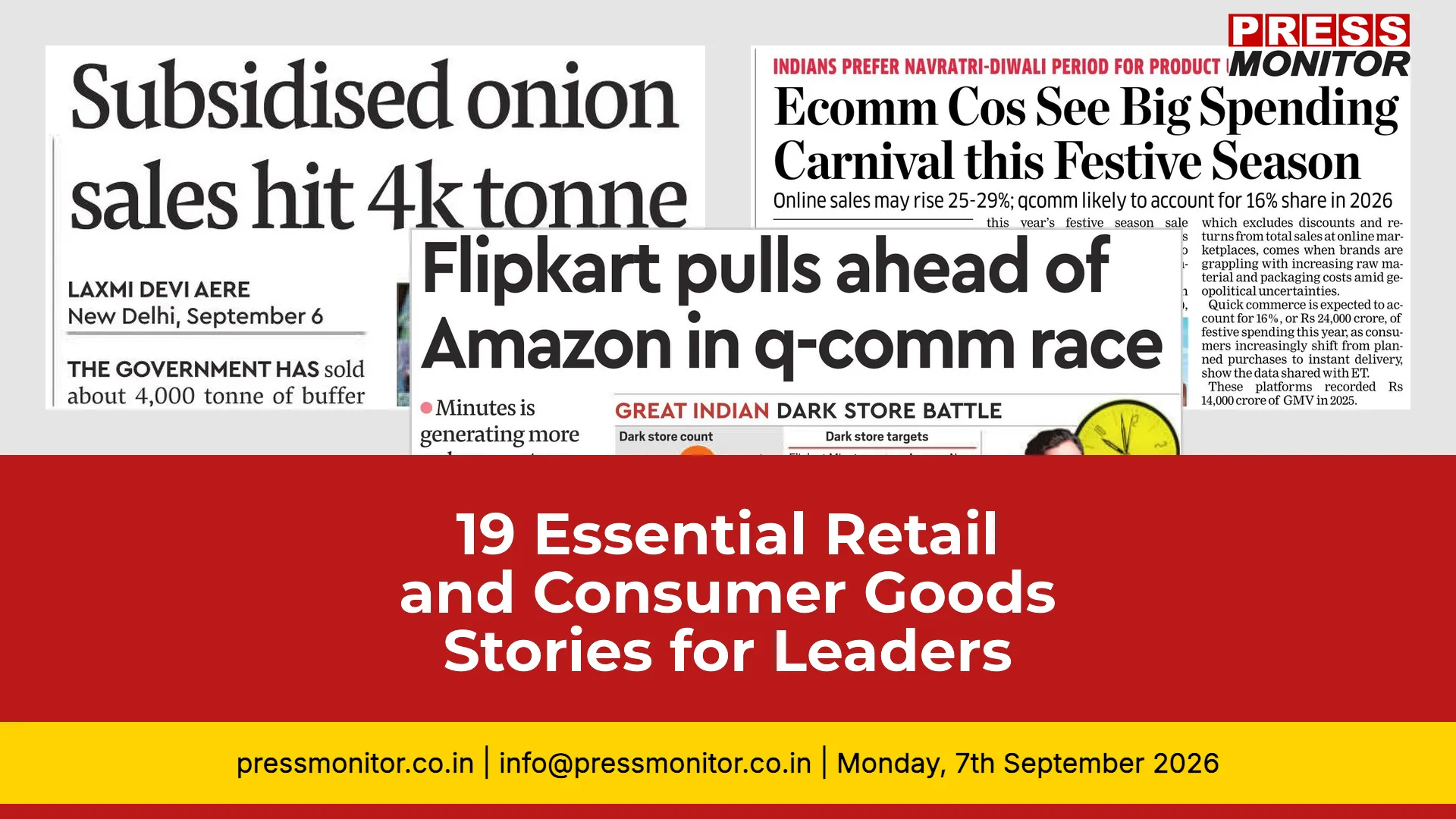
This media monitoring report covers 19 distinct developments across Indian retail and consumer goods, from quick commerce battles and festive e-commerce surges to government price interventions and jewellery retail momentum. According to Press Monitor's tracking of Indian publications, these stories define the sector's trajectory this week and offer actionable intelligence for decision-makers.
1. Government Sells 4,000 Tonnes of Buffer Onions Across 17 Cities
A front-page report in Financial Express says the Government has sold about 4,000 tonnes of buffer onions across 17 cities in the first ten days of a subsidised sale aimed at curbing skyrocketing prices. Consumer Affairs Secretary Nidhi Khare stated that the Centre, through agencies NCCF and Nafed, is sitting on a buffer stock of 1,21,000 tonnes of onion for 2026 and is transporting stored onions in bulk from producing states to consuming centres via the Kanda Express or trucks. Onions are being sold at a subsidised rate of 35 rupees per kg in select price-sensitive cities, bringing some relief to consumers as prices have fallen slightly. The Centre's subsidised onion intervention sold approximately 4,000 tonnes across 17 cities in the first ten days, with Consumer Affairs Secretary Nidhi Khare confirming the sales. Onions were sold at Rs 35 per kg, bringing a Rs 2-3 per kg reduction in market prices. The government holds a buffer stock of 1,21,000 tonnes for 2026, transported via the Kanda Express and trucks from producing states to consuming centres. This price management effort underscores the ongoing tension between food inflation and household budgets.
2. Festive Online Sales to Rise 25 to 29 Percent
A front-page report in Economic Times says ecommerce marketplaces and online retailers are expected to sell a record Rs 1.50 to 1.55 lakh crore worth of goods during this year's festive season sale events, up 25 to 29 percent from around Rs 1.20 lakh crore in 2025. Quick commerce is expected to account for 16 percent, or Rs 24,000 crore, of festive spending this year, as consumers increasingly shift from planned purchases to instant delivery. Ecommerce marketplaces and online retailers are expected to sell a record Rs 1.50 to 1.55 lakh crore worth of goods during this year's festive season, up 25 to 29 percent from around Rs 1.20 lakh crore in 2025. Quick commerce is expected to account for 16 percent, or Rs 24,000 crore, of festive spending as consumers shift from planned purchases to instant delivery. This growth signals a structural change in how Indian consumers shop during festivals.
3. Flipkart Minutes Pulls Ahead Of Amazon
A front-page report in Financial Express says Flipkart Minutes is gaining an edge over Amazon Now in quick commerce, operating more than 1,000 dark stores across 120 to 130 cities. Amazon Now has slowed expansion to 500 to 600 stores across 11 cities due to operational issues. Flipkart converts a larger share of existing customers and generates more orders per store, giving it an advantage ahead of the festive season. Flipkart Minutes is gaining an edge over Amazon Now in quick commerce, operating more than 1,000 dark stores across 120 to 130 cities. Amazon Now has slowed expansion to 500 to 600 stores across 11 cities due to operational issues. Flipkart converts a larger share of existing customers and generates more orders per store, giving it a significant advantage ahead of the festive season.
4. Blinkit's 2,443 Dark Stores Lead Battle
A front-page report in Financial Express says that Blinkit leads the dark store race with 2,443 stores, far ahead of Instamart's 1,171 and Zepto's 1,139. Flipkart Minutes shows strong customer adoption with 40 to 45 percent of Flipkart customers also using Minutes, while Amazon Now has activated fewer than one in ten of Amazon's regular users. The report compares store productivity, capex requirements, and order values across platforms as they prepare for the festive season. Blinkit leads the dark store race with 2,443 stores, far ahead of Instamart's 1,171 and Zepto's 1,139. Flipkart Minutes shows strong customer adoption with 40 to 45 percent of Flipkart customers also using Minutes, while Amazon Now has activated fewer than one in ten of Amazon's regular users. The report compares store productivity, capex requirements, and order values across platforms preparing for the festive season.
5. India E-Commerce Market Triples by 2030
A front-page report in Asian Age says India's e-commerce and quick commerce platforms are gearing up for the festive season with non-metro markets, early festive demand, and AI emerging as key growth drivers. Infisum projects India's e-commerce market to nearly triple from Rs 125 billion in 2024 to Rs 345 billion by 2030, growing at a compound annual rate of 18.4 per cent. India's e-commerce and quick commerce platforms are gearing up for the festive season with non-metro markets, early festive demand, and AI emerging as key growth drivers. Infisum projects India's e-commerce market to nearly triple from Rs 125 billion in 2024 to Rs 345 billion by 2030, growing at a compound annual rate of 18.4 percent. This long-term trajectory makes retail and consumer goods a priority sector for investors and operators alike.
6. Modern Bazaar Halves Stores as Q-Comm Pressure Grows
A front-page report in Mint says Modern Bazaar, a Delhi-NCR premium grocery retailer, has cut its store count from 28-30 to around 14 as quick commerce reshapes the market. The company is restructuring toward smaller neighbourhood Express formats and says it will focus on customer loyalty rather than competing on delivery speed. Modern Bazaar, a Delhi-NCR premium grocery retailer, has cut its store count from 28-30 to around 14 as quick commerce reshapes the market. The company is restructuring toward smaller neighbourhood Express formats and says it will focus on customer loyalty rather than competing on delivery speed. This pivot illustrates how traditional retailers are adapting to the quick commerce wave.
7. 18% E-commerce Surge
A front-page report in The Pioneer says that India’s e‑commerce and quick‑commerce platforms are positioning for a strong festive season, with analysts forecasting healthy value growth and divergent spending trends as premium and bargain‑hunting consumers coexist. The report also projects a boom in consumer electronics and quick‑commerce, driven by AI integration and changing shopping habits. India's e-commerce and quick-commerce platforms are positioning for a strong festive season, with analysts forecasting healthy value growth and divergent spending trends as premium and bargain-hunting consumers coexist. The report projects a boom in consumer electronics and quick-commerce, driven by AI integration and changing shopping habits. Retailers who align inventory and marketing to these dual segments stand to gain the most.
8. Slotted Delivery Outlasts Quick Commerce Wave
A front-page report in Financial Express says that although quick commerce has shifted grocery shopping toward speed, scheduled delivery slots remain popular for large baskets and routine replenishment. Industry leaders like BigBasket, Zepto, and DMart continue to offer delivery windows because quick commerce mainly serves emergency purchases, with only 12 percent of consumers using it for monthly stock-ups, according to a Grant Thornton Bharat report. The article notes that offline chains and fresh staple sellers also rely on predictability, while some companies like BuyBuyCart are shifting to faster fulfilment to match changing consumer expectations. Although quick commerce has shifted grocery shopping toward speed, scheduled delivery slots remain popular for large baskets and routine replenishment. Industry leaders like BigBasket, Zepto, and DMart continue to offer delivery windows because quick commerce mainly serves emergency purchases, with only 12 percent of consumers using it for monthly stock-ups according to a Grant Thornton Bharat report. Offline chains and fresh staple sellers rely on predictability.
9. Capital Surge in Quickcommerce
A front‑page report in Financial Express says that vertical quickcommerce startups are raising significant capital to build shared dark store networks in India, with Fairdeal.Market raising fifteen crore rupees in May and DocPharma raising two crore rupees in August, and a BCG report outlines the order density needed for profitability. Vertical quickcommerce startups are raising significant capital to build shared dark store networks in India, with Fairdeal.Market raising fifteen crore rupees in May and DocPharma raising two crore rupees in August. A BCG report outlines the order density needed for profitability, signalling that the sector is maturing from speculative growth to unit-economics-driven expansion.
10. NEWME Gen Z Fashion
A front-page report in Financial Express says that four founders built NEWME, an online-first fashion brand focused on Gen Z, to deliver frequently changing styles at affordable prices. Launched in July 2022 during a funding winter, the company raised about Rs 210-215 crore and expanded to 25 stores across 14 cities. Its operating model emphasises supply chain speed, producing over 500 new styles every week and generating Rs 175 crore in operating revenue in FY25. Four founders built NEWME, an online-first fashion brand focused on Gen Z, to deliver frequently changing styles at affordable prices. Launched in July 2022 during a funding winter, the company raised about Rs 210-215 crore and expanded to 25 stores across 14 cities. Its operating model emphasises supply chain speed, producing over 500 new styles every week and generating Rs 175 crore in operating revenue in FY25.
11. Jewellery Demand Keeps Retailers Shining
A front-page report in Business Standard says jewellery retailers in Mumbai are keeping demand strong by shifting to exchange programmes, lower price points, lightweight designs and cheaper gold options despite higher gold costs. Listed jewellery majors such as Titan, Kalyan Jewellers, Bluestone Jewellery and Senco Gold have outperformed broader market indices over the past year, supported by wedding and festival demand, while GRT Jewellers acquired Tribhovandas Bhimji Zaveri in a major consolidation move. Jewellery retailers in Mumbai are keeping demand strong by shifting to exchange programmes, lower price points, lightweight designs and cheaper gold options despite higher gold costs. Listed jewellery majors such as Titan, Kalyan Jewellers, Bluestone Jewellery and Senco Gold have outperformed broader market indices over the past year, supported by wedding and festival demand. GRT Jewellers acquired Tribhovandas Bhimji Zaveri in a major consolidation move.
12. DP Abhushan Targets Rs 15,000 Crore
A front-page report in Business Standard says jewellery retailer DP Abhushan is targeting revenue of Rs 15,000 crore by 2029-30. The company plans to increase its store count to 51 locations, mainly in central, north and west India, across tier-II and III cities. Currently, it has 12 stores in Madhya Pradesh and Rajasthan, and is expanding to Gujarat, Chhattisgarh and Maharashtra using a franchise model as well as company-owned stores. Jewellery retailer DP Abhushan is targeting revenue of Rs 15,000 crore by 2029-30. The company plans to increase its store count to 51 locations, mainly in central, north and west India, across tier-II and III cities. Currently, it has 12 stores in Madhya Pradesh and Rajasthan, and is expanding to Gujarat, Chhattisgarh and Maharashtra using a franchise model as well as company-owned stores.
13. India Festive Consideration Builds Eight Weeks Early
A front-page report in Business Line says Taboola's performance advertising platform Realize has outlined its twenty twenty six festive playbook, Light the Right Moments, for India's festival season. The report finds that consumer consideration can begin nearly eight weeks before the festive peak, with patterns varying across technology, automotive, home, finance, fashion, jewellery and travel. Alis is shortening the search-to-shortlist journey, but consumers still validate major decisions through reviews, comparisons, expert views, brand content, retailers and trusted publishers. Taboola's performance advertising platform Realize has outlined its 2026 festive playbook, Light the Right Moments, for India's festival season. Consumer consideration can begin nearly eight weeks before the festive peak, with patterns varying across technology, automotive, home, finance, fashion, jewellery and travel. Alis is shortening the search-to-shortlist journey, but consumers still validate major decisions through reviews, comparisons, expert views, brand content, retailers and trusted publishers.
14. Rs 40,000 Crore Risque 2.O Playbook
A front-page report in Business Line says brands are moving from risqué advertising to risqué brand architecture, embedding provocation into products, purchase occasions and transactions. The shift spans liquor, intimatewear, sexual wellness and grooming, with a combined market value estimated at Rs 38,300-44,000 crore and annual growth rates of up to 22 per cent. IndoBevs, UNDRESS, Bold Care and BroCode are cited as examples of the new playbook. Brands are moving from risque advertising to risque brand architecture, embedding provocation into products, purchase occasions and transactions. The shift spans liquor, intimatewear, sexual wellness and grooming, with a combined market value estimated at Rs 38,300-44,000 crore and annual growth rates of up to 22 percent. IndoBevs, UNDRESS, Bold Care and BroCode are cited as examples of the new playbook.
15. India Retail Inflation Projected at 4.88%
A front-page report in Free Press Journal says India's retail inflation is projected to rise to 4.88% in August from 4.44% in July, Union Bank of India said. Food inflation is expected to climb to 6.03%, while core inflation is estimated to rise to 4.30%. Sugar inflation is projected at a record 11.53%, and milk inflation could strengthen after retail price revisions across several states. India's retail inflation is projected to rise to 4.88% in August from 4.44% in July, Union Bank of India said. Food inflation is expected to climb to 6.03%, while core inflation is estimated to rise to 4.30%. Sugar inflation is projected at a record 11.53%, and milk inflation could strengthen after retail price revisions across several states. This inflationary environment will shape consumer spending patterns across retail categories.
16. Onion Prices Rise to Rs 50.79 Per Kg
A front-page report in Millennium Post says approximately 4,000 tonnes of buffer onion have been sold in 17 cities through initiatives like the Kanda Express and NCCF outlets. NCCF Managing Director Anice Joseph Chandra stated that the intervention reduced prices by Rs 2-3 per kg, yet the all-India average retail price rose to Rs 50.79 per kg on September 5 from Rs 48.5 on August 28. Approximately 4,000 tonnes of buffer onion have been sold in 17 cities through initiatives like the Kanda Express and NCCF outlets. NCCF Managing Director Anice Joseph Chandra stated that the intervention reduced prices by Rs 2-3 per kg, yet the all-India average retail price rose to Rs 50.79 per kg on September 5 from Rs 48.5 on August 28. The persistence of high prices despite government intervention signals continued supply-side challenges.
17. Lemon Prices Hit Rs 225/kg
A front-page report in Deccan Chronicle says that lemon prices have risen sharply in Hyderabad to 225 rupees per kilogram in retail markets, bringing them close to chicken price, while most other vegetables have remained largely stable. Lemon prices have risen sharply in Hyderabad to 225 rupees per kilogram in retail markets, bringing them close to chicken price, while most other vegetables have remained largely stable. The sharp rise is attributed to declining rainfall affecting citrus supply chains across the region.
18. Hinas Pangdonglai Second Chance Hiring
A front-page report in Morning Standard says Hinas Pangdonglai retail chain recently created a hiring channel for people released from prison, highlighting that employment is central to reintegration. Across nations like China, Vietnam, Turkey, Norway, and India, various approaches are used, including State-directed placement, public works integration, employer mandates, and reintegration guarantees. The report notes that India’s Delhi Tihar prison conducts placement drives while Telangana regularly provides jobs, but these efforts must evolve into policy with job certainties, and the last year of a prisoner’s term should be devoted to vocational training and skill development. Hinas Pangdonglai retail chain recently created a hiring channel for people released from prison, highlighting that employment is central to reintegration. Across nations like China, Vietnam, Turkey, Norway, and India, various approaches are used, including State-directed placement, public works integration, employer mandates, and reintegration guarantees. India's Delhi Tihar prison conducts placement drives while Telangana regularly provides jobs, but these efforts must evolve into policy with job certainties.
19. YERA Glassware Diwali Display 2026
A front-page report in First India says YERA Glassware organised the Savan Bhado Sneha Milan Samaroh and Diwali Product Display 2026 in New York, bringing together retailers from Rajasthan. The event showcased brands including YERA Glassware, Asian, Varmora, Bonjour, Pearlpet and Kitchen Essentials, with Vikas Malhotra, Head of Sales, expressing gratitude to retailers for seven decades of association. YERA Glassware organised the Savan Bhado Sneha Milan Samaroh and Diwali Product Display 2026 in New York, bringing together retailers from Rajasthan. The event showcased brands including YERA Glassware, Asian, Varmora, Bonjour, Pearlpet and Kitchen Essentials, with Vikas Malhotra, Head of Sales, expressing gratitude to retailers for seven decades of association. This diaspora retail engagement highlights the global reach of Indian retail brands.
What trends in this news on retail and consumer goods will matter most for your business this quarter? Share your perspective in the comments and tag the stakeholders who need to see these insights.