19 Key Environment & Conservation Stories for Sustainability Leaders


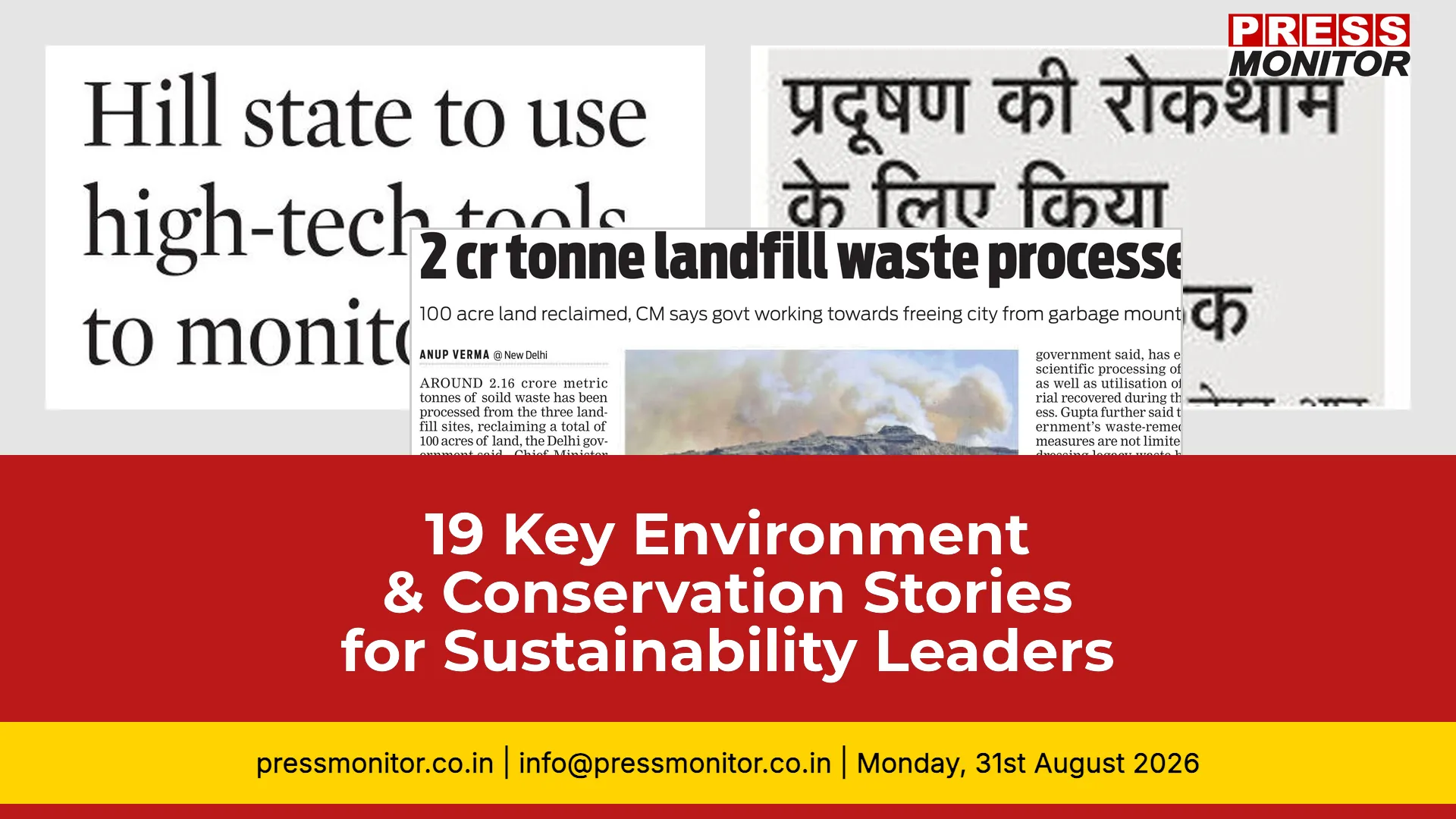
India's print media landscape is buzzing with environment and conservation stories that demand attention. From glacial lake monitoring in the Himalayas to citizen-led protests in Bengaluru, here are 19 essential stories curated by Press Monitor's comprehensive media monitoring of Indian publications. This press review cuts through the noise to deliver the insights you need.
1. Uttarakhand Deploys Drones to Monitor Glacial Lakes
Selon New Indian Express, Uttarakhand is preparing to deploy satellite imagery, remote-sensing tools and drones for real-time monitoring of potentially dangerous glacial lakes, as climate change and unstable Himalayan conditions sharpen concerns over sudden flooding in vulnerable valleys. The proposed network will track changes in lake water levels, surface area and unusual indicators. Early-warning systems are planned in at-risk zones. At a review meeting at the State Emergency Operations Centre on Sunday, officials assessed the condition of glacial lakes and the threats. Officials said a rise in water level or expansion of a glacial lake could signal future danger, including a possible outburst flood. Integrating satellite data with field observations and drone surveys would help identify such changes faster and improve evacuation planning for settlements downstream. Disaster Management Minister Madan Kaushik directed departments to coordinate with scientific institutions to builda reliable monitoring grid across remote terrain. "Early-warning systems will be installed wherever required so that any abnormal development is detected in time,” Kaushik said.
Why it matters: Climate change is accelerating glacial melt, increasing flood risk.
Key detail: Uttarakhand is using satellite imagery, remote sensing and drones for real-time monitoring of dangerous glacial lakes. Disaster Management Minister Madan Kaushik has directed coordination with scientific institutions.
Source: New Indian Express, Morning Standard
Next step: Early-warning system installation in vulnerable valleys.
2. Anti-Pollution Campaign Launched Across Delhi and 5 States
A front-page report in Pioneer says that an anti-pollution campaign involving eight key points will be launched across five states, including Delhi, under the supervision of the Air Quality Management Commission. The campaign aims to raise awareness and inform officials about steps to curb pollution, a major problem during winter in the Delhi-NCR region.
Why it matters: Winter pollution in Delhi-NCR is a recurring public health crisis.
Key detail: An eight-point anti-pollution campaign under the Air Quality Management Commission will cover five states.
Source: Pioneer
Next step: Awareness drives and official training on pollution control.
3. Land Reclamation in Delhi: 100 Acres Recovered
A front-page report in Morning Standard says that the Delhi government has reclaimed 100 acres of land by processing around 2.16 crore metric tonnes of solid waste from three landfill sites. Chief Minister Rekha Gupta highlighted the government's efforts in removing garbage mountains and plans to prevent future waste accumulation through Waste-to-Energy plants.
Why it matters: Tackling the city's garbage mountains sustainably.
Key detail: Delhi government processed 2.16 crore metric tonnes of waste from three landfill sites, reclaiming 100 acres. CM Rekha Gupta announced plans for Waste-to-Energy plants.
Source: Morning Standard
Next step: Using inert material for road bases and low-lying areas.
4. Adopt Policies for Reuse of Treated Water
A front-page report in The Hindu says that recently notified treated wastewater reuse policies for Uttar Pradesh and Uttarakhand offer an instructive example of what contextualised policymaking can look like.
Why it matters: Water scarcity demands innovative reuse policies.
Key detail: Uttar Pradesh and Uttarakhand have notified treated wastewater reuse policies, offering a model for climate-resilient urban growth.
Source: The Hindu
Next step: Other states to study and adopt similar frameworks.
5. Gomti River Cleanup Pledge
A front-page report in Statesman says that Uttar Pradesh Chief Minister Yogi Adityanath has announced the cleaning of the Gomti River by the end of the year. The Army’s Central Command has provided full support for this initiative.
Why it matters: River health is vital for ecology and livelihoods.
Key detail: UP CM Yogi Adityanath announced cleaning the Gomti River by year-end, with support from the Army’s Central Command.
Source: Statesman
Next step: Mobilisation of resources for the cleanup.
6. Himalayan Glaciers Pose Growing Disaster Risks
A front-page report in Indian Express says melting Himalayan glaciers are causing unstable glacial lakes and flash floods, as seen in recent disasters in Nepal and Sikkim. The report emphasizes the need for improved cross-border monitoring and stricter environmental standards for infrastructure projects in the fragile mountain ecology.
Why it matters: Melting glaciers cause flash floods and instability.
Key detail: Recent disasters in Nepal and Sikkim highlight the need for cross-border monitoring and stricter environmental standards for infrastructure.
Source: Indian Express
Next step: Improved monitoring and policy enforcement.
7. ₹8,700-Crore Thiruvananthapuram Airport Expansion Gets Green Nod
A front-page report in Morning Standard says the State Expert Appraisal Committee-l (SEAC-l) recommended integrated environmental clearance for Thiruvananthapuram International Airport Ltd's 8,700-crore expansion project at Thiruvananthapuram. The recommendation paves the way for upgrades to passenger capacity and infrastructure, handled by Thiruvananthapuram International Airport Ltd (TIAL).
Why it matters: Balancing development with environmental clearance.
Key detail: SEAC-I recommended integrated environmental clearance for the expansion, handled by TIAL.
Source: Morning Standard
Next step: Upgrades to passenger capacity and infrastructure.
8. Experts Plan Arunachal Glacier Survey Amid Nepal Catastrophe Fears
“Alarmed by the devastation in Nepal reportedly caused by a collapsed glacier, a special team of experts are gearing up to carry out a bathymetric survey of the Khangri Glacier in Arunachal Pradesh’s Tawang, district bordering Tibet. The team, which is likely to begin the expedition in September, will comprise experts from IIT-Roorkie, IIT-Mandi, Birbal Sahni Institute of Palaeosciences, National Centre for Polar and Ocean Research and the Centre for Earth Sciences and Himalayan Studies (CESHS), Arunachal Pradesh. A bathymetric survey of lakes helps estimate water volume, depth, moraine stability of dam and ways to lower ter level and topography mapping to reduce the impact of a Glacier Lake Outburst Flood (GLOF) or Landslide Lake Outburst Flood (LLOF). Situated at over 16,000 feet, the Khangri is a glacier complex hosting numerous glacial lakes. It represents one of the most environmentally sensitive regions in the Eastern Himalayas, where scientific understanding remains limited. By integrating glacier monitoring with detailed lake investigations and hazard assessments, we aim to strengthen disaster preparedness and contribute to resilient mountain development. This work will enhance our understanding of glacier evolution and associated risks while supporting informed decision-making for the data-deficient Eastern Himalayas,” CESHS director Tana Tage told DHon Sunday. Climate change study suggests that glaciers of the Eastern Himalayas, which nourish the headwaters of the Brahmaputra River Basin, are undergoing rapid transformation under a changing climate. Their accelerated retreat and the expansion of glacial lakes are emerging as major environment concerns with far-reaching implications for water security, disaster risk, infrastructure, and sustainable development across the downstream regions.
Why it matters: Understanding glacial lake outburst flood (GLOF) risks.
Key detail: A team from IITs, Birbal Sahni Institute, and others will survey Khangri Glacier in Tawang. The bathymetric survey will assess water volume and moraine stability.
Source: Deccan Herald
Next step: Strengthen disaster preparedness in the Eastern Himalayas.
9. Biodiversity Conservation: The Foundation of Life
A front-page report in State Times says biodiversity is the foundation of life on Earth. It encompasses the enormous variety of plants, animals, microorganisms and systems that sustain ecological balance and support human civilization.
Why it matters: Ecosystem health supports human civilization.
Key detail: The article emphasizes the vast variety of species and systems that sustain ecological balance.
Source: State Times
Next step: Integrate biodiversity into development planning.
10. 8,000 Sanitation Units Deployed for Amarnath Yatra
A front-page report in State Times says the Prime Minister highlighted the comprehensive sanitation and scientific waste management model implemented during the Shri Amarnath Ji Yatra in the latest episode of Mann Ki Baat. The initiative, concluded on August 28, 2026, saw over 8,000 sanitation units deployed across Baltal and Pahalgam axes to maintain hygienic conditions for devotees while preserving the fragile Himalayan ecosystem.
Why it matters: Sustainable waste management in fragile ecosystems.
Key detail: PM highlighted the comprehensive sanitation model during the Yatra, with 8,000 units deployed across Baltal and Pahalgam.
Source: State Times
Next step: Replicate the model for other pilgrimage sites.
11. Tribal Youth Transforms Village Into Dark Sky Community
A front-page report in Times of India says Vipul Khiradi, a tribal youth from Nashik’s Surgana taluka, is leading an effort to transform his native village, Udmal, into Maharashtra’s first Dark Sky Community.
Why it matters: Light pollution reduction and astro-tourism.
Key detail: Vipul Khiradi is leading efforts to make Udmal, Nashik, Maharashtra’s first Dark Sky Community.
Source: Times of India
Next step: Promote sustainable tourism and conservation.
12. Sirsa River Pollution Risks Sutlej
A front-page report in Tribune says the Sirsa river near Ghanauli village in Ropar district has become heavily polluted, posing a risk to the Sutlej river. Data from the Punjab Pollution Control Board reveals alarming levels of faecal and total coliform, violating biochemical oxygen demand standards.
Why it matters: River pollution threatens major water sources.
Key detail: Punjab Pollution Control Board data shows alarming faecal and total coliform levels in the Sirsa, violating BOD standards.
Source: Tribune
Next step: Immediate remediation and monitoring.
13. Himalayan Glaciers Warning
A front-page report in Indian Express says that the relentless spoliation of the Himalayan region has led to accelerated melting of high peaks due to global warming. Despite warnings, human activities continue to provoke the fury of the mountains, causing death and destruction.
Why it matters: Human activities are provoking mountain fury.
Key detail: Shyam Saran’s commentary warns of accelerated melting due to global warming and ongoing spoliation.
Source: Indian Express
Next step: Rethink development in the Himalayas.
14. Japan Opens Carbon Credit Opportunity for Indian Green Projects
India has concluded bilateral arrangements with Japan and South Korea, while talks are on with Singapore, Switzerland and Sweden, according to Yashodhan Ramteke, CEO of EcoGuard Global. This potentially lucrative market is opening up under Article 6.2 of the Paris Agreement, which provides a framework for countries to cooperate and transfer emission reductions inter-nationally, while ensuring that the same emission reduction is not counted twice. Japan operates its own Joint Credit-ing Mechanism (JCM) — with methodologies, procedures and registry arrangements for tracking projects and credits — rather than functioning as a project under a voluntary carbon credit programme such as Verra or Gold Standard. The country aims to secure cumulative emission reductions and removal of around 100 million tonnes of carbon dioxide by 2030.
Why it matters: New revenue stream for emission reduction projects.
Key detail: India has bilateral arrangements with Japan and South Korea under Article 6.2 of the Paris Agreement. Japan aims for 100 million tonnes CO2 reduction by 2030 through its JCM.
Source: Business Line
Next step: Indian projects to register under JCM.
15. Fire Breaks Out at Kodungaiyur Dump Site Again
A front-page report in New Indian Express says a fire broke out at the Kodungaiyur dump yard on Sunday afternoon, spreading over two acres and covered in dense white smoke. Firefighters and Greater Chennai Corporation staff brought the blaze under control after more than three hours using seven excavators to lift garbage and pour water. The fire was reportedly triggered by methane discharge from bio-waste.
Why it matters: Landfill fires are a recurring environmental and health hazard.
Key detail: A fire triggered by methane discharge spread over two acres; firefighters controlled it after three hours.
Source: New Indian Express
Next step: Improve waste management and methane capture.
16. Delhi's Waste-to-Energy Strategy
A front-page report in Statesman says that Delhi Chief Minister Rekha Gupta announced the utilization of inert material from waste processing at Ghazipur to fill low-lying areas and prepare the base beneath roads. The government is planning to set up four new Waste-to-Energy plants to manage waste scientifically and prevent the formation of new garbage mountains.
Why it matters: Scientific waste management to prevent new garbage mountains.
Key detail: CM Rekha Gupta announced four new Waste-to-Energy plants and use of inert material for road bases.
Source: Statesman
Next step: Implementation of the plan.
17. Glacial Lakes in Himalayas Under Scrutiny
A front-page report in Hindustan Times says the National Disaster Management Authority has identified 195 vulnerable glacial lakes across six Himalayan states and Union territories, including 67 classified as Category A, or “very high risk”. The Central Water Commission also flagged 147 glacial lakes that recorded an increase in water spread during June 2026.
Why it matters: 195 vulnerable glacial lakes identified across six states.
Key detail: NDMA classified 67 lakes as Category A (very high risk). CWC flagged 147 lakes with increased water spread in June 2026.
Source: Hindustan Times
Next step: Prioritise risk mitigation for Category A lakes.
18. Thousands Demand Lalbagh Protection
A front-page report in Deccan Herald says thousands of citizens, environmental activists, and public figures gathered at Lalbagh Botanical Garden on Sunday to demand withdrawal of the Karnataka Government Parks (Preservation) (Amendment) Bill, 2026, allowing up to 5% park and garden land diversion for infrastructure projects. The Bill was recently passed and sparks fears of ecosystem disruption from tunnelling and machinery use.
Why it matters: Urban green spaces under threat from infrastructure projects.
Key detail: Citizens protested the Karnataka Parks (Preservation) (Amendment) Bill, 2026, which allows up to 5% park land diversion.
Source: Deccan Herald
Next step: Withdrawal of the bill and public consultation.
19. Delhi Cleanliness Campaign Gains Momentum
A front-page report in Statesman says that the Delhi government has launched the 'Delhi Ko KudeSe Azadi-Swachhta Abhiyan 2026' to make Delhi clean, beautiful, and free of garbage. Citizens across Delhi have stepped up since August 17 to clean their homes, colonies, streets, and markets, transforming civic responsibility into collective action.
Why it matters: Civic responsibility drives urban cleanliness.
Key detail: The 'Delhi Ko KudeSe Azadi-Swachhta Abhiyan 2026' has seen citizen participation in cleaning homes, colonies, streets, and markets.
Source: Statesman
Next step: Expand the campaign across all wards.
These stories represent the depth of environmental challenges and solutions in India. Stay informed with Press Monitor for daily print media intelligence on the issues that matter. Which of these will impact your work?