19 Pivotal Climate Stories for Leaders


India's print media today delivers a sweeping panorama of climate impacts — from record ocean temperatures to political accountability on flood relief. This media monitoring roundup distills 19 front-page stories that demand the attention of every decision-maker. Each story is a signal: of what's breaking, what's changing, and what's next.
1. Record-Breaking Ocean Temperatures Signal Climate Crisis
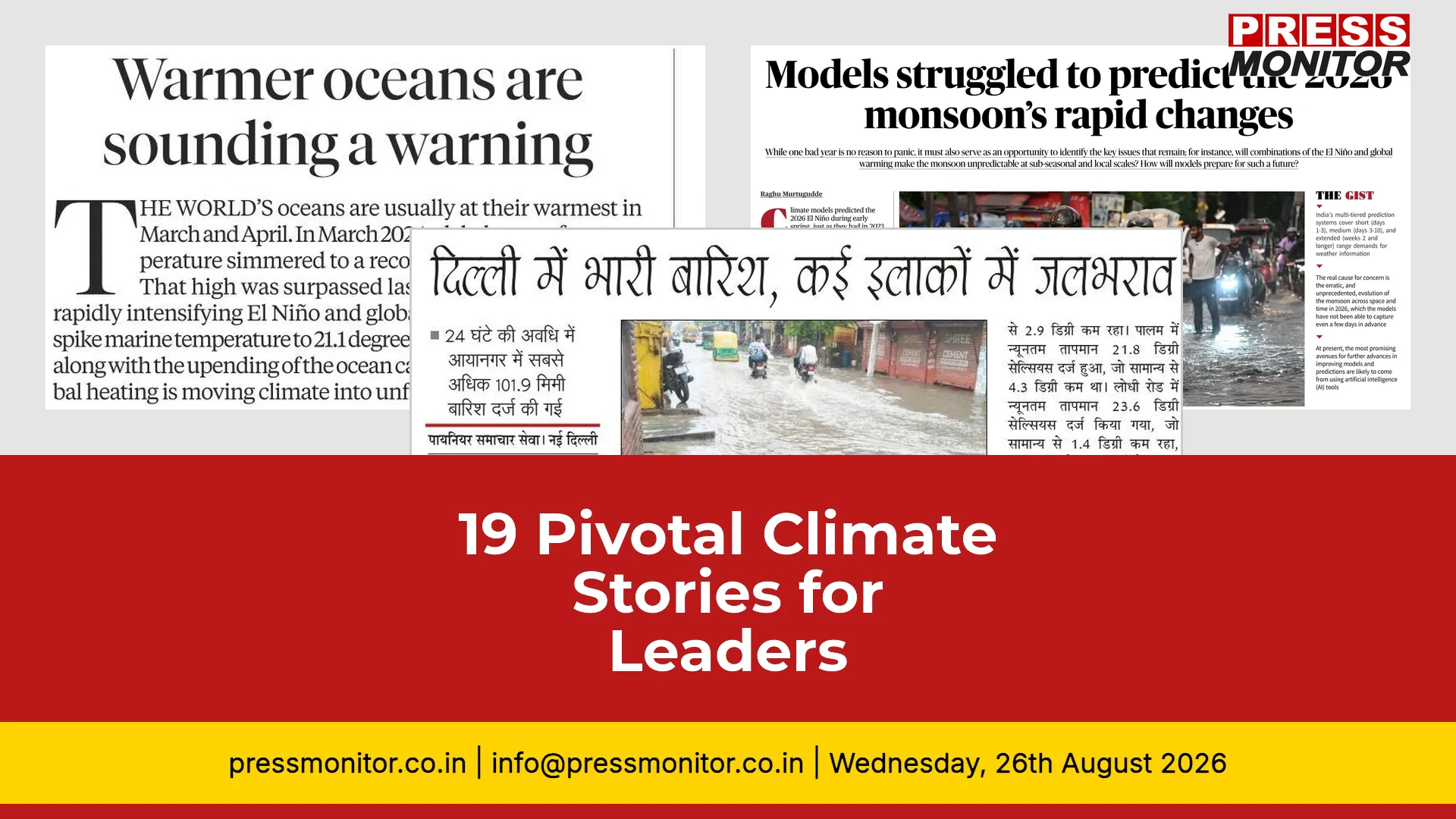
A front-page report in Indian Express says that global sea surface temperatures have reached unprecedented levels due to a rapidly intensifying El Niño and global warming. The oceans are absorbing more than 90 per cent of excess heat generated by global warming, which places stress on marine ecosystems, disrupts food webs, and affects the oceans’ capacity to regulate weather.
Why it matters: El Niño and global warming are driving oceans to absorb over 90% of excess heat, disrupting marine ecosystems and weather regulation.
Key detail: Indian Express reports unprecedented sea surface temperatures globally.
Source: Indian Express (Delhi), front page.
Next step: Monitor ocean temperature trends to anticipate extreme weather patterns.
2. Erratic Monsoon Predictions in 2026
A front-page report in The Hindu says that climate models struggled to predict the rapid changes in the 2026 monsoon. While one bad year is no reason to panic, it must also serve as an opportunity to identify the key issues that remain; for instance, will combinations of the El Nino and global warming make the monsoon unpredictable at subseasonal and local scales?
Why it matters: Climate models failed to predict the rapid monsoon shifts, raising concerns about food security and water management.
Key detail: The Hindu notes combinations of El Niño and global warming make monsoons unpredictable at subseasonal scales.
Source: The Hindu (Delhi), front page.
Next step: Invest in AI-based forecasting to improve seasonal predictions.
3. Heavy Rain Causes Flooding in Delhi
A front-page report in Pioneer says that heavy rain in Delhi caused flooding in several areas, affecting traffic. In the 24 hours ending at 8:30 AM, Ayanagar recorded the highest rainfall of 404.9 mm, followed by Ridge with 30.4 mm. Many parts of the city experienced waterlogging, including areas around AIIMS and the Supreme Court.
Why it matters: Ayanagar recorded 404.9 mm rainfall in 24 hours — crippling traffic and exposing urban drainage gaps.
Key detail: Waterlogging hit AIIMS and Supreme Court areas.
Source: Pioneer (Delhi), front page.
Next step: Review city infrastructure resilience plans.
4. Karnataka Deputy CM Reports 102 Talukas Facing Drought
A front-page report in Statesman says Karnataka Deputy Chief Minister G Parameshwara announced that 102 talukas in the state are currently facing drought conditions. A comprehensive report on the situation will be submitted to the Union government by the end of August.
Why it matters: Drought threatens agricultural livelihoods across the state.
Key detail: Deputy CM G Parameshwara says a report will be submitted to the Union government by end of August.
Source: Statesman (Delhi), front page.
Next step: Track policy response for drought relief allocation.
5. Tornado Tears Through Village in Southern France
A front-page report in The Pioneer says a tornado ravaged a small village in southern France, leaving dozens injured, local authorities said on Tuesday. Rescue teams were continuing their search after the tornado left the village of Pomas in ruins.
Why it matters: Extreme weather events are no longer confined to the global south.
Key detail: Tornado ravaged Pomas village, leaving dozens injured.
Source: The Pioneer (Delhi), front page.
Next step: Assess cross-border climate risk for global operations.
6. Delhi Reels Under Rain, Waterlogging Disrupts Traffic
"A front-page report in Punjab Kesari says that Delhi was inundated with rain on Tuesday, with waterlogging disrupting traffic and exacerbating congestion. Major roads like Rajokari Village, ITO, Copernicus Marg, Connaught Place, and Raja Ji Marg experienced severe waterlogging due to continuous rainfall. Several key roads, including Kushak Road, were submerged while areas around Ram Manohar Lohia Hospital, AIIMS, Ashok Road, and the Supreme Court also faced waterlogging issues. Vehicular movement slowed and traffic jams emerged on many routes. Drivers had to navigate submerged roads and numerous potholes, causing delays and congestion."
Why it matters: Waterlogging on major roads like Connaught Place highlights chronic drainage failures.
Key detail: Punjab Kesari reports knee-deep water on Kushak Road and near hospitals.
Source: Punjab Kesari (Delhi), front page.
Next step: Engage with urban planning authorities on flood mitigation.
7. Heavy Rain Forecasts Across Himachal, U.P., M.P. as Monsoon Deficit Concerns Rise
“A front-page report in Business Line says” heavy clouds have been observed over several regions of northern, central, and southern India, including Himachal Pradesh, Uttar Pradesh, Rajasthan, Jharkhand, and Tamil Nadu. The story details a late-season monsoon burst and raises concerns about its potential to significantly reduce the current 13% monsoon deficit, particularly given the influence of El Nino. Historical data shows varied rainfall impacts associated with El Nino years, ranging from near-normal to significant deficits, and the situation is complicated by factors such as the Indian Ocean Dipole and the Madden-Julian Oscillation, making September a crucial period for mitigating the damage.
Why it matters: A late monsoon burst could reduce the 13% deficit, but El Niño complicates outcomes.
Key detail: Business Line highlights influence of Indian Ocean Dipole and MJO on September rains.
Source: Business Line (Delhi), front page.
Next step: Prepare for both deficit and surplus scenarios in water management.
8. Prakasam’s Drought Woes — Velugonda Project Launch
A front-page report in The Hans India says Chief Minister N Chandrababu Naidu announced the completion of Phase-I of the Velugonda project, which will bring Krishna river water to drought-hit areas. Scheduled for August 31, the launch will release 10.7 tmc ft of water into the Nallamala Sagar reservoir, irrigating 1.19 lakh acres.
Why it matters: CM Chandrababu Naidu to release Krishna water into Nallamala Sagar, irrigating 1.19 lakh acres.
Key detail: Phase-I completion of Velugonda project brings relief to drought-hit areas.
Source: The Hans India (Delhi), front page.
Next step: Monitor water release effectiveness for agricultural outcomes.
9. JMC Exposed as Jammu Floods Again
A front-page report in State Times says that Dr. Varinder Sharma, Co-convener, Health Cell, J&K BJP, criticized the Jammu Corporation's mitigation efforts following floods in several residential and commercial areas in Jammu, including Canal Road near Science and Commerce College. He noted that the same stretch was flooded last year despite assurances of corrective measures. He demanded a drainage audit and an independent third-party assessment of alleged backflow of Tawi waters into Rajinder Nagar and Canal Road.
Why it matters: Dr. Varinder Sharma criticizes Jammu Corporation for repeated flooding despite assurances.
Key detail: Same stretch flooded last year; demand for drainage audit and third-party assessment.
Source: State Times (Jammu), front page.
Next step: Advocate for independent infrastructure audits.
10. Flood-Hit People Protest Relief Delay in Assam
"A front-page report in The Hindu says that flood-affected people in eastern Assam’s Sivasagar district staged a protest on Tuesday, demanding immediate release of a one-time financial assistance of %l5,OOO announced by the State government. Leading the protest, Sib-sagar MLA and Raijor Dal president Akhil Gogoi said many flood-hit families did not receive the financial aid two months after the devastation caused by the Dikhow river. "Immediate relief is supposed to be provided fast, ideally within 48 hours," he said. He also demanded that the government increase the assistance to %lO lakh per family, given the scale of destruction in June. "The government has said it will provide a maximum of %3.85 lakh per flood-affected family, but the scale of the damage is such that even %lO lakh would not suffice," he said. Mr. Gogoi set a 48-hour deadline for the government to release the financial assistance to the floodaffected families in Sivasa- gar, Charaideo, Jorhat, and other flood-hit districts. "We cannot tolerate the delay in relief disbursement. We will intensify our protest by taking the floodaffected people to the Chief Minister’ss office in Guwahati if the government does not heed our demand," he said. 106 deaths According to the Assam State Disaster Management Authority, 105 people died in the flood that affected up to 16 districts from April to mid-August. Most of them died in Sivasagar, Charai-deo, and Jorhat districts. On August 12, Chief Minister Himanta Biswa Sarma said %l,OOO crore would be needed to repair damaged properties and rehabilitate flood-affected people. The government provided some relief to the floodhit, but various political parties and organisations criticised it for supplying poor-quality food grains and cooking oil. The government was also criticised for supplying about 1 lakh sub-standard mattresses, measuring at most 6 square feet each, to the flood-affected in four districts."
Why it matters: MLA Akhil Gogoi demands ₹10 lakh per family; 105 deaths reported from April to mid-August.
Key detail: Government criticized for poor-quality relief supplies including mattresses.
Source: The Hindu (Delhi), front page.
Next step: Assess supply chain transparency in disaster relief.
11. BJP Targeted Over Gurugram Waterlogging
A front-page report in The Hindu says residents and Opposition leaders have criticised the Haryana government and local administration after heavy rain caused massive waterlogging and traffic jams in Gurugram. Former MP Brijendra Singh and Rohtak MP Deepender Hooda questioned the city's poor drainage infrastructure despite high property prices and tax revenues.
Why it matters: Opposition questions high property taxes vs. poor drainage infrastructure.
Key detail: Former MP Brijendra Singh and MP Deepender Hooda criticize Haryana government.
Source: The Hindu (Delhi), front page.
Next step: Track political accountability on urban infrastructure.
12. Minister Seeks Shift Against Drought
A front-page report in The Hindu says Union Environment Minister Bhupender Yadav emphasised the need for a fundamental, technology-enabled shift in fighting droughts from reactive relief to proactive resilience at the United Nations Convention to Combat Desertification conference in Ulaanbaatar, Mongolia.
Why it matters: Union Environment Minister Bhupender Yadav calls for proactive resilience using technology at UNCCD conference.
Key detail: Shift from reactive relief to prevention.
Source: The Hindu (Delhi), front page.
Next step: Align corporate sustainability with national drought strategy.
13. Monsoon Lashes UP
A front-page report in Statesman says Monsoon rains continue to lash Uttar Pradesh and on Tuesday morning, 15 cities, including Varanasi, Ayodhya, Jhansi, Jaunpur, and Ghazipur, have been experiencing rainfall. In the past 24 hours, seven people have died in rain-and flood-related incidents.
Why it matters: Seven deaths in 15 cities including Varanasi and Ayodhya.
Key detail: Continuous rainfall causing flood-related incidents.
Source: Statesman (Delhi), front page.
Next step: Enhance early warning systems for flood-prone districts.
14. Temporary Accumulation: Minister Says Steps Being Taken in Delhi
A front-page report in The Hindu says heavy rain continued to lash Delhi for the second consecutive day, leaving several roads waterlogged and commuters wading through knee and waist-deep water. Public Works Department (PWD) Minister Parvesh Sahib Singh acknowledged temporary water accumulation at several locations.
Why it matters: PWD Minister Parvesh Sahib Singh acknowledges waterlogging as commuters wade through knee-deep water.
Key detail: Rain continued for second consecutive day.
Source: The Hindu (Delhi), front page.
Next step: Evaluate drainage master plan implementation.
15. Plasma Heating Cuts Cement Waste Heat
A front-page report in New Indian Express says a new electrifying method using plasma heating can produce cement clinkers nearly 100 times faster than traditional methods. Presented at a meeting of the American Chemical Society, the technique replaces fossil fuel-powered kilns to reduce carbon dioxide emissions and improve thermal efficiency to 80 per cent.
Why it matters: New technique achieves 80% thermal efficiency, reducing CO2 emissions from cement production.
Key detail: Method 100 times faster than traditional kilns.
Source: New Indian Express (Chennai), front page.
Next step: Explore partnerships for clean manufacturing technologies.
16. Turbulence More Frequent Due to Warming Planet
A front-page report in The Pioneer says turbulence is becoming more frequent and violent as the planet warms. Air turbulence is an important topic for research, and there are enough studies on North Atlantic and North Pacific routes. The relatively bump-free air experiences in the future would need actionable forecasts using data on atmospheric information from many sources and artificial intelligence.
Why it matters: Air travel safety at risk with increasing turbulence on North Atlantic and North Pacific routes.
Key detail: AI-based actionable forecasts needed.
Source: The Pioneer (Delhi), front page.
Next step: Integrate turbulence data into aviation risk management.
17. Delhi Drainage Overhaul Underway
A front-page report in Indian Express says that Chief Minister Rekha Gupta has taken stock of the waterlogging situation in Delhi post heavy rain. Gupta mentioned that the government is addressing the city's long-standing drainage issues with the Centre’s cooperation, and has implemented a Rs 56,000-crore Drainage Master Plan.
Why it matters: CM Rekha Gupta announces ₹56,000-crore Drainage Master Plan with Centre’s cooperation.
Key detail: Long-standing drainage issues being addressed.
Source: Indian Express (Delhi), front page.
Next step: Monitor budget allocation and project milestones.
18. WEF's Global Lighthouse Network Expands
A front-page report in Times of India says the World Economic Forum's Global Lighthouse Network now covers 238 advanced industrial sites across more than 30 countries, with over 1,200 proven use cases. These factories have reported major gains, including 50% productivity improvements and sharp reductions in defects and emissions.
Why it matters: 238 advanced industrial sites report 50% productivity gains and emission reductions.
Key detail: Over 1,200 proven use cases across 30+ countries.
Source: Times of India (New Delhi), front page.
Next step: Benchmark factory operations against lighthouse standards.
19. Rs 27,345 Crore Musi Project Approved
A front-page report in Deccan Chronicle says Chief Minister Revanth Reddy has directed officials to provide double-bedroom houses to families displaced from the Musi riverbed. The Musi Phase-I project, approved at Rs 27,345.12 crore, involves a 21-km stretch focused on flood mitigation and riverfront infrastructure.
Why it matters: CM Revanth Reddy approves Phase-I flood mitigation and riverfront development in Hyderabad.
Key detail: 21-km stretch with double-bedroom houses for displaced families.
Source: Deccan Chronicle (Hyderabad), front page.
Next step: Engage with project developers for urban resilience opportunities.
This press review is powered by Press Monitor's tracking of Indian publications across 12 sources. For those who need to stay ahead of climate risks and policy shifts, consistent media intelligence is the new competitive advantage. Which of these stories will impact your sector most?