19 Pivotal Trade Stories for Global Executives


Navigating today’s complex global marketplace demands sharp, verified insights. According to Press Monitor's tracking of Indian publications, this press review distills the most critical developments shaping international commerce, supply chains, and financial policy. Below are 19 pivotal stories you need to know before markets react. Stay ahead with actionable media intelligence on news on trade.
1. Modi-Trump Likely Bilateral G20 Meeting
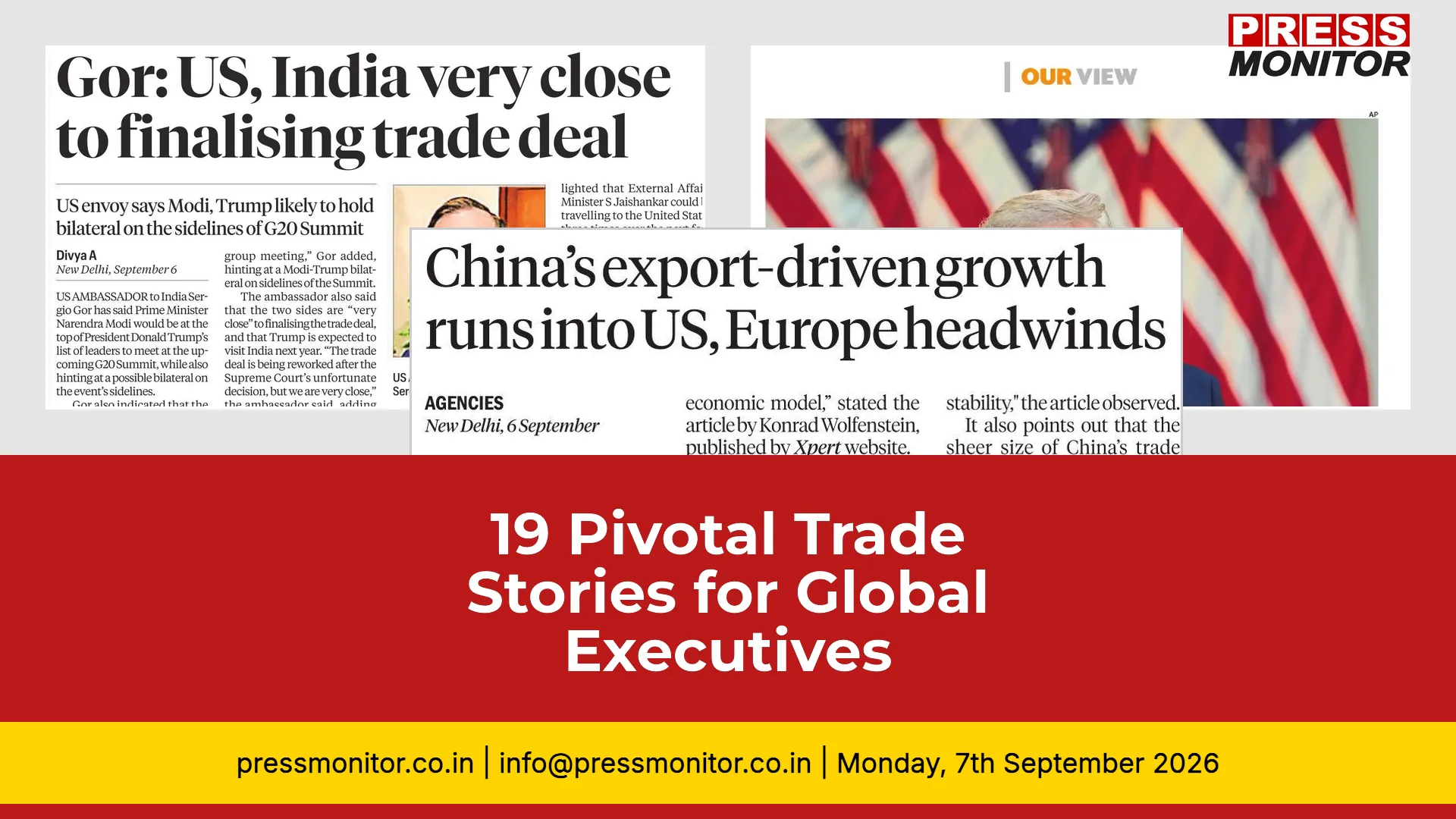
A front-page report in Indian Express says US Ambassador Sergio Gor stated Prime Minister Narendra Modi is at the top of President Donald Trump's list for meetings at the upcoming G20 Summit in Florida. Gor hinted at a possible bilateral meeting on the sidelines and indicated the Quad Leaders' Summit may be held during the event. The ambassador also noted that trade deal negotiations are very close to finalisation despite recent Supreme Court hurdles and that Trump is expected to visit India next year.
Why it matters: A potential US-India bilateral trade agreement could reshape trans-Pacific commerce and Quad dynamics.
Key detail: US Ambassador Sergio Gor confirms Prime Minister Narendra Modi tops President Donald Trump’s meeting list, with trade negotiations nearing finalisation despite recent Supreme Court hurdles.
Source: Indian Express
Next step: Monitor tariff schedules and compliance frameworks ahead of the Florida summit.
2. Trump Threatens Trade with Rate Cut
A front-page report in Mint says that Donald Trump, the 47th President of the United States, threatened to halt trade with countries running a deficit unless the Federal Reserve cuts its policy rate, while also calling for a Fed rate cut to address inflation.
Why it matters: Monetary policy shifts directly impact export competitiveness and currency valuation.
Key detail: The 47th President links trade deficit reduction to Federal Reserve rate cuts, warning of halted trade flows unless inflation targets align.
Source: Mint
Next step: Hedge currency exposure and review debt servicing costs.
3. China Exports Clash With Western Tariffs
A front-page report in Statesman says China’s export-driven economic model is facing severe pressure as the United States and Europe implement protective tariffs against Chinese goods. Despite recording a merchandise trade surplus of approximately one point one nine trillion dollars in twenty twenty five, Beijing’s reliance on overseas sales underscores a weakening domestic market marked by a property downturn, subdued consumption, and rising joblessness. Washington recently imposed a new twelve point five percent duty on these imports following the expiration of previous rates, intensifying global trade friction.
Why it matters: Escalating protectionism disrupts global manufacturing networks and raw material sourcing.
Key detail: Washington imposes a new 12.5% duty on Chinese imports, compounding pressure on Beijing’s $1.19 trillion merchandise surplus amid domestic consumption weakness.
Source: Statesman
Next step: Diversify supplier bases and audit tariff classification codes.
4. India Pushes BRICS Summit Success
A front-page report in Tribune says that India is preparing to host the BRICS summit in New Delhi at the end of the week, with the Modi government pulling out all stops to ensure its success, and the country leveraging the New Development Bank and other BRICS tools to advance its interests. The summit also focuses on digital public infrastructure, central bank digital currencies, and de‑dollarisation efforts to strengthen the Global South's financial autonomy. India’s approach balances multilateral cooperation with a pragmatic stance toward the United States and Western sanctions.
Why it matters: Multilateral financial architecture is shifting toward de-dollarisation and alternative payment rails.
Key detail: New Delhi leverages the New Development Bank and central bank digital currencies to strengthen Global South financial autonomy while balancing Western relations.
Source: Tribune
Next step: Evaluate CBDC interoperability pilots and cross-border settlement options.
5. India Navigates Rising Economic Nationalism
A front-page report in First India says the world's economy is moving toward economic nationalism as globalization faces pressure from tariffs, sanctions, and protectionism. The trade rivalry between the United States and China is reshaping global supply chains, prompting India to seek a stronger position as an alternative to China while deepening ties with multiple partners. The article warns that rising tariffs could trigger retaliation, leading to costlier trade and weaker global growth, and argues that India must balance domestic industry strength with global competitiveness.
Why it matters: Protectionist policies are accelerating supply chain regionalisation and reshoring trends.
Key detail: US-China trade rivalry forces India to position itself as a viable manufacturing alternative while managing retaliatory tariff risks.
Source: First India
Next step: Stress-test logistics routes and localise critical components.
6. Oil Import Price Nears $100 Barrel
A front-page report in Mint says India's crude oil import price rose to nearly $100 a barrel, its highest level in three months, amid renewed volatility in global oil markets. The price of the Indian crude basket was $99.35 a barrel on Wednesday, according to the Petroleum Planning and Analysis Cell, and both petrol and diesel consumption increased. Experts said that if international oil prices continue to rise, state-run oil companies could seek the government's approval to raise pump prices.
Why it matters: Energy costs directly influence freight rates, production margins, and consumer inflation.
Key detail: India’s crude basket hits $99.35 per barrel, prompting state refiners to seek pump price approvals as demand rises.
Source: Mint
Next step: Lock in forward fuel contracts and optimise inventory turnover.
7. Iran Vows Painful Response to US Sanctions
A front-page report in Mint says Iran will step up efforts to tackle problems created by US sanctions crippling its economy, while a senior Iranian official warned of a painful response if it comes under further attack. Following the attacks, Iran's Parliament Speaker Mohammad Bager Qalibaf said the US should understand that the rules of the game in the war against Iran have changed before it is too late.
Why it matters: Geopolitical friction in the Middle East threatens maritime chokepoints and energy security.
Key detail: Parliament Speaker Mohammad Bager Qalibaf warns that proportionate responses are over, signalling escalated retaliation protocols.
Source: Mint
Next step: Review insurance premiums and reroute high-value cargo.
8. Iran's Strait Leverage Wanes Amid US Economic Squeeze
A front-page report in Hindustan Times says Iran is facing an unprecedented economic offensive from Washington, with a US naval blockade and tougher sanctions curbing oil exports and restricting access to foreign currency. Six months after a conflict that rattled markets, the balance of power has tilted against Iran as mounting economic pressure exposes growing strains in the economy. The campaign has led US and regional officials to wager that the pressure can force Iran to allow free passage through the Strait of Hormuz, which carries a fifth of global oil and LNG.
Why it matters: Naval blockades and sanctions alter global LNG and crude transit volumes.
Key detail: Six months of conflict tilt power against Tehran, with US officials betting pressure will force free passage through the Strait of Hormuz.
Source: Hindustan Times
Next step: Secure alternative pipeline access and diversify LNG contracts.
9. US Iran Trade Attacks Intensify
A front-page report in Hindustan Times says US energy secretary Chris Wright stated that sanctions on Iran will continue until Iran changes its position or replaces its government. The tensions escalate as the conflict drags on.
Why it matters: Targeted financial restrictions fragment global banking corridors and compliance landscapes.
Key detail: Energy Secretary Chris Wright states sanctions persist until Tehran alters its stance or leadership changes.
Source: Hindustan Times
Next step: Conduct enhanced due diligence on sanctioned entity lists.
10. FAO: Food Prices Hit Highest Since 2022
A front-page report in Statesman says global food prices climbed to their highest level since late 2022 in August, as extreme weather, geopolitical tensions and disruptions to major trade routes raised concerns over the availability of key agricultural commodities, according to the United Nations Food and Agriculture Organization. The FAO Food Price Index rose to 133.3 points in August, marking the third consecutive monthly rise, with sugar posting the biggest jump of 19 per cent to its highest level since June 2025. FAO Chief Economist Maximo Torero attributes the increase to a growing risk premium from climate shocks, geopolitical tensions and trade logistics disruptions, while the FAO has lowered its forecast for global cereal production in 2026 by 34 million metric tonnes.
Why it matters: Agricultural commodity volatility impacts food security budgets and retail pricing.
Key detail: FAO index climbs to 133.3 points, driven by a 19% sugar spike and a 34 million tonne downward revision in 2026 cereal forecasts.
Source: Statesman
Next step: Adjust procurement cycles and explore contract farming alternatives.
11. Houthi Conflict Hits Pakistan Trade
A front-page report in Statesman says the escalating Houthi conflict in the Red Sea zone has hit Pakistan's shipping and trade. Pakistan's foreign exchange earnings depend on overseas remittances from Pakistani nationals working on merchant ships and trade flows through Karachi and Gwadar ports. The shifting threat from piracy to missile and drone attacks since late 2023 creates a dangerous zone that Pakistan cannot independently secure.
Why it matters: Regional instability disrupts South Asian port throughput and remittance flows.
Key detail: Missile and drone threats in the Red Sea zone strain Karachi and Gwadar operations, jeopardising overseas merchant crew earnings.
Source: Statesman
Next step: Audit port contingency plans and secure maritime risk coverage.
12. Twenty Five Nations Back Nuclear Shipping
A front-page report in Mint says roughly twenty five nations agreed to plan nuclear-powered merchant ships at a recent International Atomic Energy Agency summit in Washington. The initiative seeks to speed up ocean freight and drastically cut maritime carbon emissions, but analysts warn excluding China from drafting the rules will sabotage progress and fuel a new geopolitical arms race.
Why it matters: Next-generation propulsion could redefine freight economics and carbon compliance.
Key detail: IAEA summit participants agree to plan nuclear-powered merchant vessels, though exclusion of China raises geopolitical implementation concerns.
Source: Mint
Next step: Track IMO regulatory drafts and assess fleet retrofit viability.
13. Belgium and India Hedge Against Unpredictable US
A front-page report in The Pioneer says Belgian Prime Minister Bart De Wever visited New Delhi to strengthen ties with India amid concerns over US trade policy. The visit yielded ten outcomes including defence co-production agreements and a focus on trade, technology, and talent. Both nations aim to build a rules-based economic order as Washington's commitment to open trade appears conditional.
Why it matters: Strategic partnerships are accelerating defence co-production and technology transfer.
Key detail: PM Bart De Wever secures ten outcomes focusing on trade, talent, and a rules-based economic order independent of Washington’s conditional openness.
Source: The Pioneer
Next step: Explore joint venture frameworks and dual-use tech licensing.
14. Export Utilisation at 98%
A front-page report in Business Standard says that the Indian commerce minister, TNC Rajagopalan, called on the country to maximise utilisation of Free Trade Agreements after a meeting last Thursday. The government noted low awareness and data gaps on Free Trade Agreement benefits, citing a revenue impact of 98,569 crore in 2024‑25 and a lack of public utilisation figures. He urged better export data capture and policy support to help exporters compete on cost, quality and delivery.
Why it matters: Underused FTAs represent billions in unrealised revenue and market access.
Key detail: Commerce Minister TNC Rajagopalan highlights a ₹98,569 crore revenue impact gap, urging better data capture and policy support for exporters.
Source: Business Standard
Next step: Align product catalogs with preferential tariff schedules.
15. Piyush Goyal Calls For Pharma Investment
A front-page report in The Pioneer says that Commerce and Industry Minister Piyush Goyal called for more investment in pharmaceutical clinical trials and research and development in India. He urged domestic regulators to study global practices and adopt best practices to achieve regulatory convergence with developed countries. Goyal also emphasized building resilient supply chains and moving away from a protective approach to attract investment in the sector.
Why it matters: Regulatory convergence attracts R&D capital and stabilises clinical trial pipelines.
Key detail: The minister urges adoption of global best practices, resilient supply chains, and reduced protectionism to draw foreign pharma investment.
Source: The Pioneer
Next step: Benchmark compliance standards and prepare facility audits.
16. AYUSH Visas Rise in India Diplomacy Push
A front-page report in The Hindu says India is using yoga and Ayurveda more prominently in global health diplomacy through new trade agreements with Oman, New Zealand and the European Union. The agreements seek to ease licensing, build standards and allow AYUSH practitioners and instructors to work or teach abroad, while the Ministry of AYUSH points to visas, medical tourism and fellowships as growth channels.
Why it matters: Health services are becoming a major export category under new bilateral agreements.
Key detail: Deals with Oman, New Zealand, and the EU ease licensing for practitioners, boosting medical tourism and fellowship channels.
Source: The Hindu
Next step: Register service providers and standardise cross-border credentials.
17. RBI U-turn on FCNR Scheme Deadline
A front-page report in Tribune says the Reserve Bank of India reversed its position on the FCNR(B) scheme, advancing the closing date from September 30 to August 31 after initially assuring no early closure. The article examines how economic policy reversals, or U-turns, arise from political pressure, poor preparation, or changing evidence, citing examples from India and globally.
Why it matters: Sudden monetary policy reversals trigger liquidity adjustments and investor sentiment shifts.
Key detail: The central bank advances the FCNR(B) closing date from September 30 to August 31, citing evolving evidence and political pressures.
Source: Tribune
Next step: Rebalance foreign currency deposits and update treasury models.
18. Rs400 Crore Defence Diplomacy Push
A front-page report in Business Line says the Ministry of Defence plans to expand defence diplomacy worldwide by establishing eighty five to ninety defence wings by the end of twenty thirty, with priority in twelve countries that already host Indian defence attaches in New Delhi. The Ministry of Defence is allocating rupees four hundred crore to the defence diplomacy fund in fiscal year twenty six, up from rupees one hundred ten crore when it began in fiscal year twenty two, to support defence exports, international cooperation and concessional credit. Defence Minister Rajnath Singh approved ten more wings in twenty twenty four and released the Raksha framework, a ten year roadmap for strategic outreach and defence industrial collaboration.
Why it matters: Strategic outreach expands defence export markets and industrial collaboration.
Key detail: MoD allocates ₹400 crore to establish 85–90 defence wings by 2030, prioritising twelve host nations under the Raksha framework.
Source: Business Line
Next step: Identify target markets and align export promotion campaigns.
19. Banque Misr UAE Branches Sanctioned
A front-page report in Indian Express says the US Treasury has identified the UAE branches of Banque Misr as a primary money laundering concern, alleging they processed transactions for Iran's shadow-banking networks. The Treasury invoked Special Measure Five under Section 311 of the USA PATRIOT Act, targeting Banque Misr's five UAE branches, which allegedly facilitated about $1.8 billion in transactions between January 2024 and June 2026.
Why it matters: Secondary sanctions expose financial intermediaries to severe compliance penalties.
Key detail: US Treasury invokes Special Measure Five, alleging $1.8 billion in shadow-banking transactions facilitating Iranian networks between 2024 and 2026.
Source: Indian Express
Next step: Freeze related accounts and report suspicious activity immediately.
Closing: These developments underscore why rigorous print media monitoring remains essential for executives navigating volatile markets. Which of these trade shifts will impact your sector first? Share your analysis below.