19 Pivotal Water & Wastewater Stories for Infrastructure Leaders


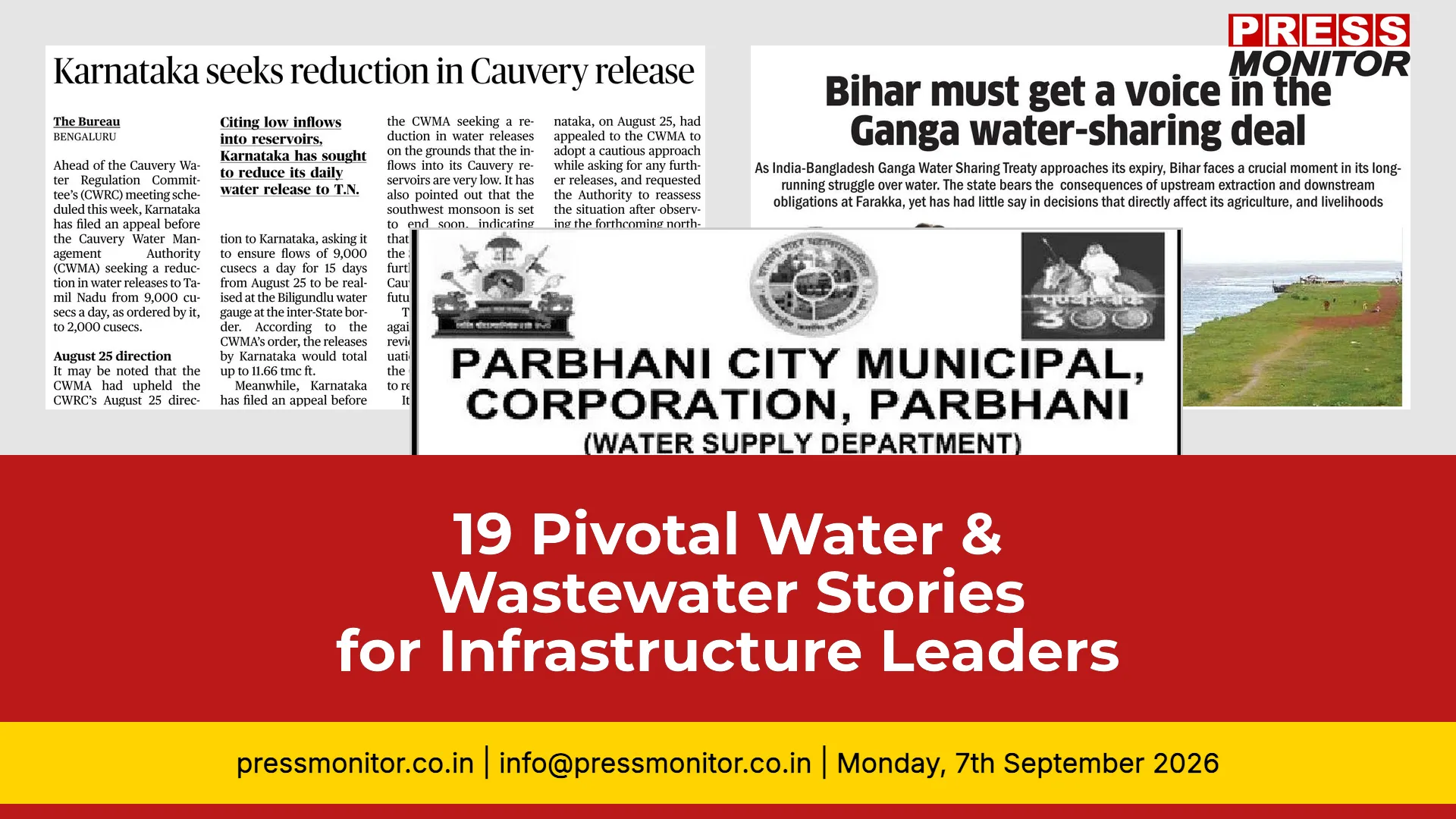
Today's Water & Wastewater briefing arrives via print media monitoring. As water scarcity and infrastructure decay accelerate across India, staying ahead requires precise media monitoring. This media intelligence roundup distills 19 critical developments shaping water utilities, wastewater treatment, and national policy. According to Press Monitor's tracking of Indian publications, here is your essential daily briefing.
1. Parbhani Sewerage Tender
A front-page report in Mint says Parbhani City Municipal Corporation has invited e-tenders for an Underground Sewerage system Project under AMRUT 2.0 Second Call. The tender cost is Rs 343 crore, excluding GST tax. The detailed document is available from September 7, 2026, on the Mahatenders website.
Why it matters: Municipal corporations are scaling up AMRUT 2.0 deployments to meet urban sanitation targets.
Key detail/stat: Estimated cost stands at Rs 343 crore excluding GST, with bids opening on Mahatenders.
Source: Mint
Next step: Contractors should review technical specifications before the submission window closes.
2. Guruvayur & Konkan Water Tenders
A front-page report in Indian Express says Guruvayur Municipality has issued a tender for AMRUT 2.0 implementation of 24x7 water supply. The estimated project cost is Rs 2 crore with a form price of Rs 11,025 plus 18% GST to be paid by the bidder to the GST department directly under Reverse Charge Mechanism. The last date for submitting the tender is 7 October 2026 at 3:00 pm.
Why it matters: Regional municipalities and railways are prioritizing 24x7 reliable water access.
Key detail/stat: Guruvayur tender estimates Rs 2 crore; Konkan Railway shaft structures cost Rs 1.39 crore.
Source: Indian Express
Next step: Evaluate procurement timelines and bid security requirements.
3. Karnataka Seeks Cauvery Release Cut
A front-page report in The Hindu says Karnataka has filed an appeal before the Cauvery Water Management Authority seeking a reduction in daily water releases to Tamil Nadu from 9,000 cusecs to 2,000 cusecs due to low reservoir inflows and an ending southwest monsoon. The Cauvery Water Regulation Committee and the Authority are scheduled to review the ground-level situation in meetings on September 8. Why itearing it matters: Interstate water diplomacy intensifies as monsoon patterns shift.
Key detail/stat: Karnataka appeals to CWMA to reduce Tamil Nadu releases from 9,000 to 2,000 cusecs.
Source: The Hindu
Next step: Monitor September 8 committee reviews for regulatory adjustments.
4. Bihar Excluded From Ganga Treaty
A front-page report in The Pioneer says the impending expiry of the India-Bangladesh Ganga Water Sharing Treaty in December 2026 has intensified Bihar's demand for a voice in renegotiations. The article highlights how upper-riparian extraction and central neglect have marginalised the state, leaving it to shoulder downstream obligations while facing floods and droughts. Authors Subodh Kumar Mehta and Sudhakar Singh argue for formal representation in treaty talks and a sustainable water management framework.
Why it matters: Federal water governance faces scrutiny as treaty renegotiations approach.
Key detail/stat: Bihar demands formal representation in India-Bangladesh talks due to downstream marginalization.
Source: The Pioneer
Next step: Track legislative pushes for equitable flow mechanisms.
5. JDU Campaigns Against Farakka Treaty
A front-page report in Free Press Journal says the Janata Dal United held a Nitish Samvad on the Farakka Water Treaty in Buxar on 5 September 2026, with National Executive President Sanjay Kumar Jha and State President Umesh Singh Kushwaha addressing leaders and workers. Jha said the 1996 treaty between India and Bangladesh harms Bihar's water management and should not be renewed unless Bihar's water needs until 2050 are considered. The event included a documentary, pamphlets and officials from affected Ganges-facing districts, with members of the legislative assembly Santosh Nirala, Rahul Singh and Shubhanand Mukesh supporting the campaign.
Why it matters: Political mobilization around transboundary water rights is accelerating.
Key detail/stat: JDU argues the 1996 treaty ignores Bihar's water needs until 2050.
Source: Free Press Journal
Next step: Watch for state assembly resolutions and public hearings.
6. AP Seeks CWC Review Of Telangana LIM
A front-page report in Deccan Chronicle says Andhra Pradesh will present its case before the Central Water Commission chairman on Monday to seek a review of the approval granted to Telangana's Kaleshwaram Lift Irrigation Project. The meeting chaired by CWC president Anupam Prasad will also deliberate on the Polavaram-Nallamala Sagar linkage project which aims to utilise Godavari floodwaters. Officials said the AP delegation will argue that the Kaleshwaram project was constructed in violation of Godavari tribunal guidelines.
Why it matters: Godavari basin disputes test central water commission arbitration.
Key detail/stat: Andhra Pradesh challenges Kaleshwaram project alignment with tribunal guidelines.
Source: Deccan Chronicle
Next step: Await CWC chairman's deliberations on linkage projects.
7. BRS Raises Kaleshwaram Project Issues
A front-page report in The Pioneer says BRS president K Chandrasekhar Rao directed party legislators to raise the Congress Government's alleged failure to release water from the Kaleshwaram project and neglect of the Palamuru-Ranga Reddy irrigation project during the monsoon session beginning Monday. Rao announced he would soon launch agitations with lakhs of people against the alleged negligence, while BRS MLA T Harish Rao dismissed ruling Congress criticism and alleged betrayal of all sections of society.
Why it matters: Opposition parties leverage irrigation delays for monsoon session debates.
Key detail/stat: KCR threatens mass agitations over alleged Congress negligence in Palamuru-Ranga Reddy.
Source: The Pioneer
Next step: Monitor parliamentary questions and budget allocations.
8. Major Reservoirs Running Dry Across India
A front-page report in Hindustan Times says major reservoirs in most Indian states are running dry with August and September dry in large parts of the country. Among the fifteen states with at least one billion cubic metres of storage, ten had a deficit, with six having a deficit of more than ten percent. Only reservoirs in Uttar Pradesh, Chhattisgarh, Gujarat, Maharashtra, Odisha, and Uttarakhand had a surplus.
Why it matters: National water security metrics signal urgent storage management needs.
Key detail/stat: Ten of fifteen major states report deficits exceeding ten percent.
Source: Hindustan Times
Next step: Assess regional drought contingency planning.
9. India Nearly Half Faces Deficient Rainfall
A front-page report in Hindustan Times says almost half of India was in a deficient or large deficient rainfall category as of 6 September, with 49.9% of the country affected and reservoir storage below normal in many regions. The India Meteorological Department says surplus rainfall has shifted toward a band from Uttarakhand to northern Odisha, reducing shortfalls in Uttar Pradesh and Jharkhand while increasing them elsewhere. The Central Water Commission says storage in 178 main reservoirs was 3.25% below normal on 3 September, with only six states holding surplus.
Why it matters: Meteorological shifts directly impact agricultural and municipal water budgets.
Key detail/stat: 49.9% of India classified deficient; 178 main reservoirs sit 3.25% below normal.
Source: Hindustan Times
Next step: Review IMD forecasts for short-term allocation adjustments.
10. 4,800-km Pipelines Face Critical Decay
A front-page report in Deccan Herald says that 4,800 km of Bengaluru's 10,000-km water supply pipelines were laid 70 to 80 years ago, causing frequent leaks and contamination risks. BWSSB Chairperson Dr Manjula N stated that the board is using robotics and artificial intelligence to identify leaks and plan priority replacements, while also ordering a complete inspection of all Ground Level Reservoirs. Unaccounted for Water remains at 30 to 35 percent, meaning the city may be losing about one-third of its Cauvery water supply to leaks.
Why it matters: Urban water loss threatens city sustainability and revenue stability.
Key detail/stat: BWSSB reports 30-35% unaccounted water loss; deploying AI robotics for leak detection.
Source: Deccan Herald
Next step: Follow priority replacement roadmaps and tech integration updates.
11. BMC May Hike Water Charges 6-7%
A front-page report in Free Press Journal says the BMC administration has begun reviewing the possibility of increasing water charges by 6-7%, citing rising expenditure on maintaining, repairing and laying new pipelines. Mumbai receives around 4,000 million litres of water daily from seven reservoirs, and the civic body has already forgone around Rs 100 crore in annual revenue since tariffs remained unchanged after 2022. The proposal has been put on hold following the 2026 BMC elections, but if water charges are not increased this year, the civic administration may have to forgo revenue of around Rs 100-125 crore.
Why it matters: Municipal tariff reforms aim to close maintenance funding gaps.
Key detail/stat: Mumbai forgone Rs 100 crore annually since 2022 tariffs; hike proposal paused post-elections.
Source: Free Press Journal
Next step: Track civic board approvals and public consultation outcomes.
12. BBMB Operating with 40% Staff
A front-page report in Tribune says the Bhakra Beas Management Board is operating with heavily depleted staff following retirements, raising dam safety concerns. The irrigation wing has 56.6 per cent vacant posts and the power wing functions at only 37.2 per cent of sanctioned strength. Former Chief Engineer Narinder Mohan warned that critical technical posts remain vacant, risking loss of institutional knowledge on maintaining Bhakra and Pong dams.
Why it matters: Workforce depletion creates operational risks for critical dam infrastructure.
Key detail/stat: Irrigation wing 56.6% vacant; power wing at 37.2% sanctioned strength.
Source: Tribune
Next step: Monitor recruitment drives and safety protocol audits.
13. Himachal Water Schemes Tender Invited
A front-page report in Indian Express says the Executive Engineer, JSY Division, Sujanpur, has invited e-tendering from approved eligible contractors for revision and reconstruction of water supply, sewerage and lift irrigation schemes on the left bank of the River Beas in Sujanpur, Hamirpur district of Himachal Pradesh. The notice says tenders will be accepted until 15 September 2026 at 11:00 AM, with tender details available on www.hptenders.gov.in. The work includes intake structures, clear water tanks, pump houses, water treatment plants, rising mains, pumping machinery, lift irrigation systems and a sewage treatment plant.
Why it matters: Northern states expand rural water and sewage infrastructure.
Key detail/stat: JSY Division seeks contractors for Beas left-bank intake, treatment plants, and lift systems.
Source: Indian Express
Next step: Review hptenders.gov.in portal for bidding deadlines.
14. Rs 154.20 Lakh Water Retrofitting Tender
A front-page report in Hindustan Times says the Government of Odisha has invited percentage-rate bids through electronic procurement for retrofitting two rural public water supply schemes under the Kataka division. The tender, issued by the Superintending Engineer of the Rural Water Supply and Sanitation Division, carries an estimated cost between Rs 85.39 lakhs and Rs 154.20 lakhs. Successful contractors will be required to complete the works within nine calendar months, with applications available from September 9 to September 30, 2026.
Why it matters: Odisha modernizes rural supply networks under e-procurement frameworks.
Key detail/stat: Two schemes require completion within nine calendar months.
Source: Hindustan Times
Next step: Verify percentage-rate bid eligibility and document submission windows.
15. Baddi Effluent Disaster
A front-page report in Tribune says untreated industrial effluent was discharged into the Ratta khud at Bhud village in Baddi on Sunday, creating heavy frothing and raising concerns over environmental compliance, with local environmental activist Gurdyal Singh and Deputy Commissioner Solan Manmohan Sharma calling for action.
Why it matters: Industrial compliance failures trigger environmental enforcement actions.
Key detail/stat: Untreated effluent caused heavy frothing in Ratta khud; activists demand CPCB intervention.
Source: Tribune
Next step: Track regulatory penalties and remediation mandates.
16. Solinas Integrity Saves 0.9m Litres
A front-page report in Economic Times says that Deep‑tech firm Solinas Integrity, incubated by IIT Madras, used robotics and AI to inspect 5.1 kilometres of pipeline in Lucknow, finding 34 critical defects, 28 of which were repaired, saving an estimated 0.9 million litres of water daily for 1,750 households.
Why it matters: Deep-tech startups demonstrate scalable solutions for non-revenue water.
Key detail/stat: IITM-incubated firm repaired 28 of 34 defects across 5.1 km using AI robotics.
Source: Economic Times
Next step: Explore partnership models for municipal tech adoption.
17. Rs 66.2 Crore Water Access Initiative
A front-page report in Economic Times says the Water Access Through Ecosystem Restoration (WATER) initiative is active in 7 states, impacting 11,872 acres of irrigation, 1,352 ponds, 568 solar lifts, and 422 wells with Rs 66.2 crore convergence and 14,132 women asset managers. The report also notes a solid waste management setup from 2001 has diverted 1,450+ MT waste, achieved 90% segregation, 94% collection, and a 1,111 tcO2e cut in peri-urban Bengaluru.
Why it matters: Convergence funding accelerates ecosystem restoration and women-led asset management.
Key detail/stat: Impacts 11,872 acres, 1,352 ponds, and 422 wells across seven states.
Source: Economic Times
Next step: Study replication frameworks for peri-urban waste and water integration.
18. 78 Crore Projects Launched in Haryana
A front-page report in Tribune says Chief Minister Nayab Singh Saini inaugurated seven development projects worth approximately Rs 78 crore in Bawani Khera, Bhiwani, on September 6, 2026. The projects include new schools, hospitals, road links, and waterworks, with costs ranging from Rs 3.5 crore to Rs 28.89 crore.
Why it matters: District-level development bundles waterworks with healthcare and education.
Key detail/stat: CM Nayab Singh Saini inaugurated seven projects ranging from Rs 3.5 to 28.89 crore.
Source: Tribune
Next step: Monitor implementation timelines and inter-department coordination.
19. 21-Year-Old River Cleaner Wins Global Job
A front-page report in The Pioneer says that 21-year-old Surendra Singh Choudhary from Madhya Pradesh has been offered a position at The Ocean Cleanup by its founder Boyan Slat, following his extensive solo campaign to cleanse the Ajnar River. Beginning on January twenty-six, Choudhary personally funded machinery and manually removed waste from the severely polluted waterway, earning acclaim from national figures and local authorities. His dedicated grassroots efforts have successfully elevated a regional environmental mission onto the global stage.
Why it matters: Grassroots activism gains international recognition and institutional backing.
Key detail/stat: Surendra Singh Choudhary offered role at The Ocean Cleanup after solo Ajnar River campaign.
Source: The Pioneer
Next step: Highlight youth leadership in environmental stewardship communications.
Which of these water infrastructure shifts will impact your sector most? Share your take below.