20 Pivotal Supply Chain & Procurement Stories for Logistics Leaders


media monitoring reveals a complex landscape where procurement strategies collide with geopolitical volatility. According to Press Monitor's tracking of Indian publications, today's news on supply chain and procurement highlights urgent adjustments in sourcing, freight routing, and government tenders. Here is your essential briefing.
1. Brics Summit 2026: India's Balancing Act
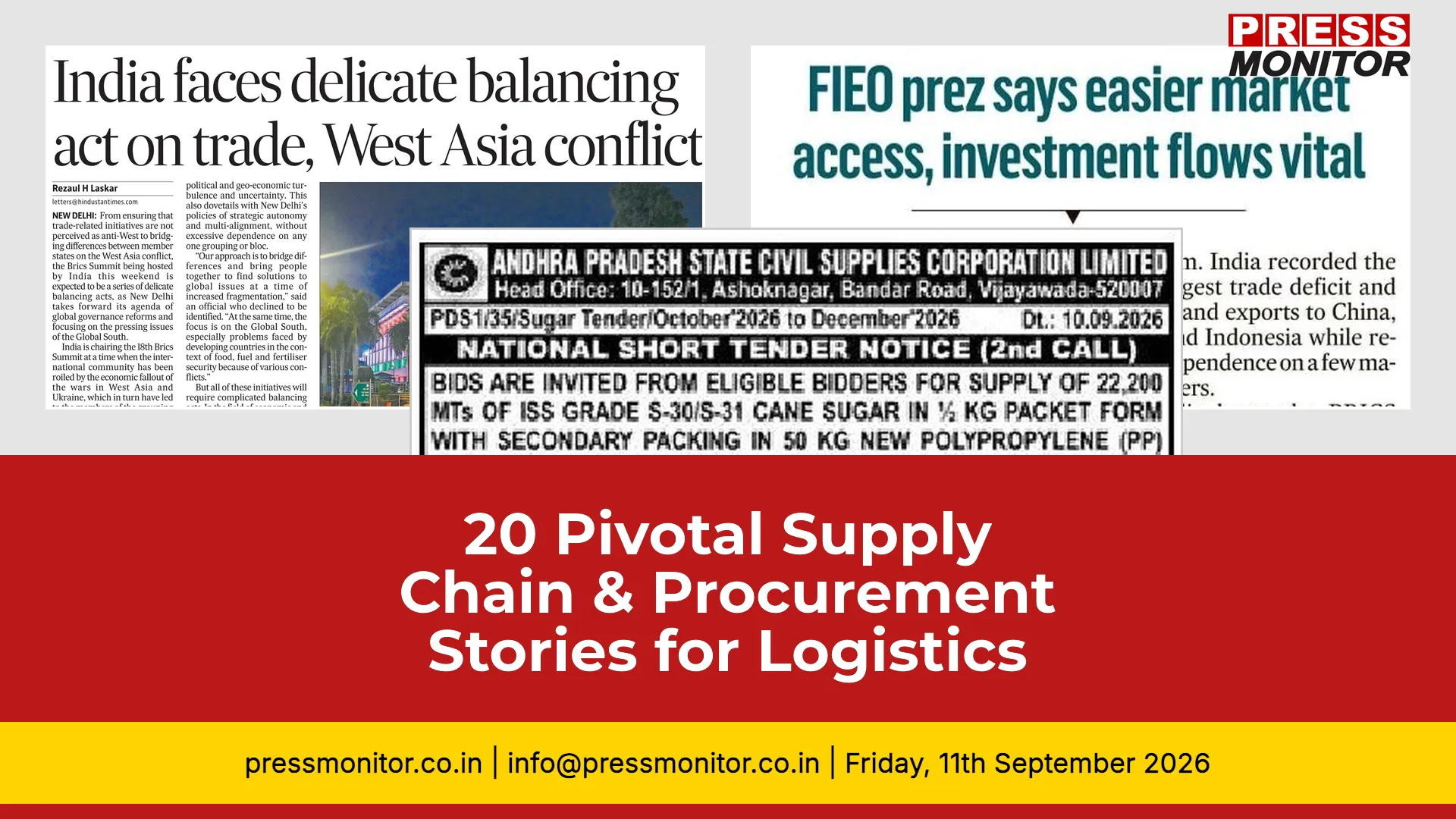
A front-page report in Hindustan Times says that India is balancing trade initiatives with geopolitical concerns at the eighteenth Brics Summit while Brazil pushes for the C‑390 Millennium aircraft for the Indian Air Force. The summit, scheduled for September twelfth, brings together India, Brazil, Russia, China, South Africa, Iran, Egypt, Ethiopia, and the United Arab Emirates, with discussions on trade, supply-chain resilience, and North‑South cooperation. Meanwhile, Embraer executives will meet Indian officials on India’s aviation procurements, including the C‑390 and the Make‑in‑India production plan.
Why it matters: Multilateral trade frameworks are reshaping procurement alliances.
Key detail: Brazil pushes for the C‑390 Millennium aircraft deal while discussions focus on trade and supply-chain resilience across nine nations.
Source: Hindustan Times
Next step: Evaluate defense and aviation procurement pipelines ahead of September twelfth.
2. FIEO Prez Urges Easier BRICS Access
A front-page report in Deccan Herald says India's trade with BRICS countries more than doubled from $203.1 billion in FY2020-21 to $417.5 billion in FY2025-26, with the trade deficit tripling from $74.5 billion to $226.1 billion. Exports grew by 48.8 percent to $95.7 billion but imports surged 131.8 percent to $321.8 billion, with China dominating the BRICS trading network. FIEO President SCRalhan said BRICS should move beyond strategic dialogue to measurable commercial outcomes including easier market access and stronger supply-chain partnerships.
Why it matters: Commercial outcomes are taking precedence over strategic dialogue.
Key detail: India's trade with BRICS doubled to $417.5 billion, though the deficit tripled. SCRalhan calls for measurable market access and stronger supply-chain partnerships.
Source: Deccan Herald
Next step: Align export compliance with emerging BRICS commercial corridors.
3. Andhra Pradesh seeks 22,200-tonne sugar supply
A front-page report in Asian Age says the Andhra Pradesh State Civil Supplies Corporation has issued a national short tender for the supply of 22,200 metric tonnes of Indian Standard specification cane sugar. The procurement supports the Annapurna Yojana and Public Distribution System schemes across twenty eight districts and covers the period from October to December twenty twenty six. Eligible sugar manufacturers and traders nationwide may register on the designated electronic marketplace portal ahead of the scheduled online bidding process.
Why it matters: Public distribution systems require agile commodity sourcing.
Key detail: A national short tender covers October to December twenty twenty six across twenty eight districts via an electronic marketplace.
Source: Asian Age
Next step: Register vendors for the upcoming online bidding cycle.
4. Hartron Invites Tender For 25 Laptops
A front-page report in Tribune says HARTRON on behalf of HSIIDC has issued a tender for the procurement of 25 laptops. The opening date is 10 September 2026 and the closing date is 24 September 2026, with an EMD of Rs 50,000.
Why it matters: Government IT infrastructure refresh cycles drive steady procurement demand.
Key detail: HARTRON on behalf of HSIIDC sets closing date at 24 September 2026 with an EMD of Rs 50,000.
Source: Tribune
Next step: Submit technical bids before the deadline.
5. 20,000 Rupee Bid Opens
A front-page report in Tribune says that the Himachal Pradesh Public Works Department has invited percentage‑rate bids through an electronic tendering system for several projects, including maintenance of Himachal Niketan in New Delhi, construction of Type‑III family quarters in Dharamshala, and road restoration in Chowari. The invitations specify start and submission dates, bid values in rupees, and eligibility criteria for registered contractors.
Why it matters: Infrastructure maintenance contracts stabilize regional contractor revenue.
Key detail: Himachal Pradesh PWD invites percentage-rate bids for New Delhi facility maintenance and Dharamshala housing construction.
Source: Tribune
Next step: Verify eligibility criteria for registered contractors.
6. $100k Daily Tanker Rates Surge
A front-page report in Economic Times says global tanker freight rates are surging to record levels as traders, shipowners, producers and buyers grapple with a drawn-out conflict in the Persian Gulf and increasingly complex workarounds. Earnings for supertankers sailing on the benchmark West Asia to China route are at a record of nearly eighty lakh rupees a day, while charterers on the US Gulf to Asia run face a record lump-sum fee of twenty nine point five million dollars.
Why it matters: Freight volatility directly impacts landed costs for imported goods.
Key detail: Supertanker earnings on the West Asia to China route hit record highs amid Persian Gulf conflicts.
Source: Economic Times
Next step: Hedge chartering contracts and diversify routing options.
7. Maithon Power Invites EOI for Biomass Fuel
A front-page report in Business Line says Maithon Power Limited, a joint venture between Tata Power and DVC, invites expression of interest from eligible vendors for the supply of agro-based biomass pellets at its Dhanbad facility. Eligible vendors may submit their expression of interest along with the tender fee for issue of bid documents latest by 18 September 2026.
Why it matters: Renewable fuel procurement supports decarbonization mandates.
Key detail: Tata Power-DVC JV seeks agro-based biomass pellets for its Dhanbad facility, with submissions due by 18 September 2026.
Source: Business Line
Next step: Prepare vendor documentation and tender fee payments.
8. Saudi Arabia Reroutes Oil Shipping
A front-page report in Free Press Journal says Saudi Arabia has increasingly relied on the Red Sea shipping route after the Iran conflict shut the Strait of Hormuz. Tensions remain high as Houthi forces launch attacks in southwestern Saudi Arabia amid regional rivalry with Tehran.
Why it matters: Strategic rerouting alters maritime transit times and insurance premiums.
Key detail: Increased reliance on the Red Sea route follows Strait of Hormuz disruptions, raising Middle East tensions.
Source: Free Press Journal
Next step: Update transit risk models for MENA-bound cargo.
9. Houthis Take Yemeni Port City
A front-page report in Hindustan Times says the Iran-backed Houthi rebel group took over Yemen's port city of Mokha on Thursday, placing a vital Red Sea shipping area under their control. The capture of Mokha, located near the Bab el-Mandeb Strait, intensifies fighting with Saudi-backed government forces and threatens global maritime trade, as shipping through the strait has already fallen by about 60% since late 2023. Meanwhile, Brent crude spiked to 107 dollars a barrel on Thursday as Middle East tensions heightened supply worries, with the Houthis shifting focus to control Yemen's long coastline.
Why it matters: Control of Mokha threatens Bab el-Mandeb Strait navigation.
Key detail: Shipping through the strait fell 60% since late 2023, while Brent crude spiked to $107 a barrel.
Source: Hindustan Times
Next step: Activate alternative Suez Canal scheduling protocols.
10. Houthis seize Yemen port, attacks escalate
A front-page report in Free Press Journal says Iran-aligned Houthi militants seized control of Yemen's port city of Mocha on Thursday, escalating concerns over global energy supplies and shipping through the Red Sea. The group also launched attacks on the strategically located Hanish Islands, intensifying tensions in the region and gaining greater leverage over the Bab el-Mandeb Strait. Pakistan ruled out a military response under the Mecca agreement following the attacks on Saudi Arabia, while maintaining it would act when the time comes.
Why it matters: Regional instability forces immediate supply chain contingency planning.
Key detail: Attacks on Hanish Islands intensify leverage over maritime chokepoints, prompting diplomatic recalibrations.
Source: Free Press Journal
Next step: Review cargo security protocols for Red Sea transits.
11. Houthi rebels seize key Yemen port
A front-page report in Deccan Chronicle says Iran-backed Houthi rebels seized control of Mokha, a vital Yemeni port city near the Bab el Mandeb Strait, on Thursday. The takeover has halted local commerce and triggered fears of a renewed civil war, posing significant risks to global energy transit. Government-aligned commanders and rebel officials confirmed the strategic shift amid broader Middle Eastern military escalations.
Why it matters: Local commerce halts trigger broader regional logistics bottlenecks.
Key detail: Government-aligned commanders confirm strategic shifts amid civil war fears.
Source: Deccan Chronicle
Next step: Diversify supplier bases away from vulnerable coastal hubs.
12. Red Sea Gateway at Risk
A front-page report in Asian Age says: The Iran‑backed Houthi rebels seized Mokha, Yemen's strategic port about eighty kilometres from the Bab el‑Mandeb Strait, crucial for shipping in the Red Sea, on Thursday. This move threatens the flow of about twelve percent of the world's oil and other goods, highlighting the growing tension in the region.
Why it matters: Twelve percent of global oil flows through contested waters.
Key detail: Heightened tension underscores the fragility of just-in-time delivery networks.
Source: Asian Age
Next step: Stress-test inventory buffers for critical raw materials.
13. Houthi Rebels Enter Yemen's Mokha Port City
A front-page report in The Pioneer says Iranian-backed Houthi rebels have entered Yemen's strategic Red Sea port city of Mokha, threatening a fragile civil war truce and bringing the group closer to targeting shipping through the Bab el-Mandeb strait. Separately, an Israeli strike killed at least four people in northern Gaza, including two children, while Israel warned Iran of a powerful response if Tehran attacks its energy facilities.
Why it matters: Civil war truce fractures threaten sustained maritime disruption.
Key detail: Israeli warnings to Iran highlight the interconnected nature of energy and defense supply chains.
Source: The Pioneer
Next step: Coordinate with geopolitical risk advisors for Q4 planning.
14. India LPG imports fall 25% in August
A front-page report in Hindustan says the Ministry of Defence is exploring joint development with Japan and France for fifth-generation fighter jets, noting that standalone progress remains unfeasible. Separately, the Prime Minister shared footage of final arrangements at Bharat Mandapam in New Delhi, confirming complete readiness for the forthcoming Brics twenty twenty six summit.
Why it matters: Import dependency drops force domestic production scaling.
Key detail: Global seaborne LPG exports contracted, while industrial consumption plunged 80% in July.
Source: Economic Times
Next step: Adjust storage allocation for cooking gas distributors.
15. IIHR Aims To Cut Fruit Imports
A front-page report in Hindustan Times says the Government Polytechnic, Asthawan, Nalanda has issued a corrigendum to tender notice number GPAST/RFP/O1/2026-27 for private service agency staff including security guards and housekeeping personnel. The amendment extends the contract period from one year to three years, deletes the requirement for a pen drive submission, and cancels the technical presentation scheduled for 8 October 2026. This corrigendum forms an integral part of the original tender notice issued by the Principal of Government Polytechnic, Asthawan, Nalanda.
Why it matters: Horticulture research targets import substitution to secure farmer supply chains.
Key detail: Director Tusar Kanti Behera notes vegetable imports rose to $3.82 billion, prompting development of planting material for twenty-five crops.
Source: Business Line
Next step: Partner with ICAR initiatives for localized sourcing.
16. Houthis threaten Saudi oil exports
A front-page report in Times of India says Houthis seized Yemen's port city of Mocha and advanced down the Red Sea coast to strategic islands, threatening Saudi oil exports. Yemen's Houthi-run humanitarian operations coordination centre stated Red Sea navigation is safe for all shipping companies except Saudi vessels. Brent crude prices jumped as much as 4% to 105 dollars a barrel on concern over disruption to supply routes.
Why it matters: Direct threats to export terminals elevate energy commodity volatility.
Key detail: Navigation warnings exclude Saudi vessels, pushing Brent crude up 4% to $105.
Source: Times of India
Next step: Secure forward contracts for refined petroleum products.
17. Oil Prices Jump 4% on Strait Threats
A front-page report in Economic Times says oil prices jumped 4 percent on Thursday with benchmark Brent crude hitting 107 dollars a barrel after the biggest spike in attacks on shipping since the Iran war began spurred trader concerns about supply disruptions. Brent crude futures were up 5.8 percent at 107.2 dollars a barrel while the West Texas Intermediate rose 5.7 percent to trade at 101.6 dollars per barrel. Tran-aligned Houthi militants seized control of Yemen's port city of Mocha on Thursday, posing a further threat to global energy supplies hours after President Donald Trump said he expected the war to end after mid-term elections.
Why it matters: Benchmark crude spikes accelerate inflationary pressures on transport.
Key detail: WTI rose to $101.6 per barrel as trader concerns mount over supply disruptions.
Source: Economic Times
Next step: Lock in freight rates before peak season surcharges apply.
18. Oilmeal Exports Fall 12.5%
A front-page report in Business Line says oilmeal exports declined 12.5 per cent during April-June 2026-27 to 9.57 lakh tonnes, driven by a sharp fall in soybean meal shipments amid pricing disadvantages against South American competitors. The Solvent Extractors' Association of India noted high domestic prices and Red Sea shipping disruptions further restricted surplus availability for large-scale export shipments.
Why it matters: Agri-commodity pricing disadvantages reduce overseas market share.
Key detail: Red Sea shipping disruptions and high domestic prices restricted surplus availability.
Source: Business Line
Next step: Explore inland rail alternatives for bulk agricultural shipments.
19. India Boosts LPG Output 10%
A front-page report in Economic Times says India is ramping up domestic cooking gas production to bridge a supply gap amid US‑Iran tensions, with local refiners aiming to add about four thousand tonnes per day—a ten percent increase—to the current output of roughly thirty‑seven to thirty‑eight thousand tonnes per day. The Strait of Hormuz, which accounted for ninety percent of India’s LPG imports pre‑war, remains unreliable, and US President Donald Trump has hinted that oil prices may stay high until the mid‑term elections.
Why it matters: Domestic refiners ramp capacity to bridge US-Iran tension gaps.
Key detail: Local output aims for 4,000 tonnes daily increase, offsetting unreliable Hormuz imports.
Source: Economic Times
Next step: Align procurement schedules with upgraded domestic refining capacity.
20. BRICS summit to discuss energy supplies and local currencies
A front-page report in Business Standard says the BRICS summit in New Delhi on 10 September is expected to call for an end to hostilities in West Asia and discuss long-term energy supply agreements amid regional security concerns. Experts note India and China, the world's largest oil importers, are particularly vulnerable to disruption in the Strait of Hormuz, while talks may also cover using local currencies for cross-border payments and strengthening critical mineral supply chains. The summit will additionally build consensus on transportation issues including urban mobility, logistics cooperation, and transport decarbonisation.
Why it matters: Cross-border payment reforms could streamline critical mineral procurement.
Key detail: India and China seek long-term energy agreements while exploring transport decarbonisation and logistics cooperation.
Source: Business Standard
Next step: Monitor policy shifts affecting multinational sourcing contracts.
This press review synthesizes real-time developments. Which procurement adjustment will define your Q4 strategy? Tag your operations lead below to share insights.