21 Essential Environment & Conservation Stories for Decision-Makers


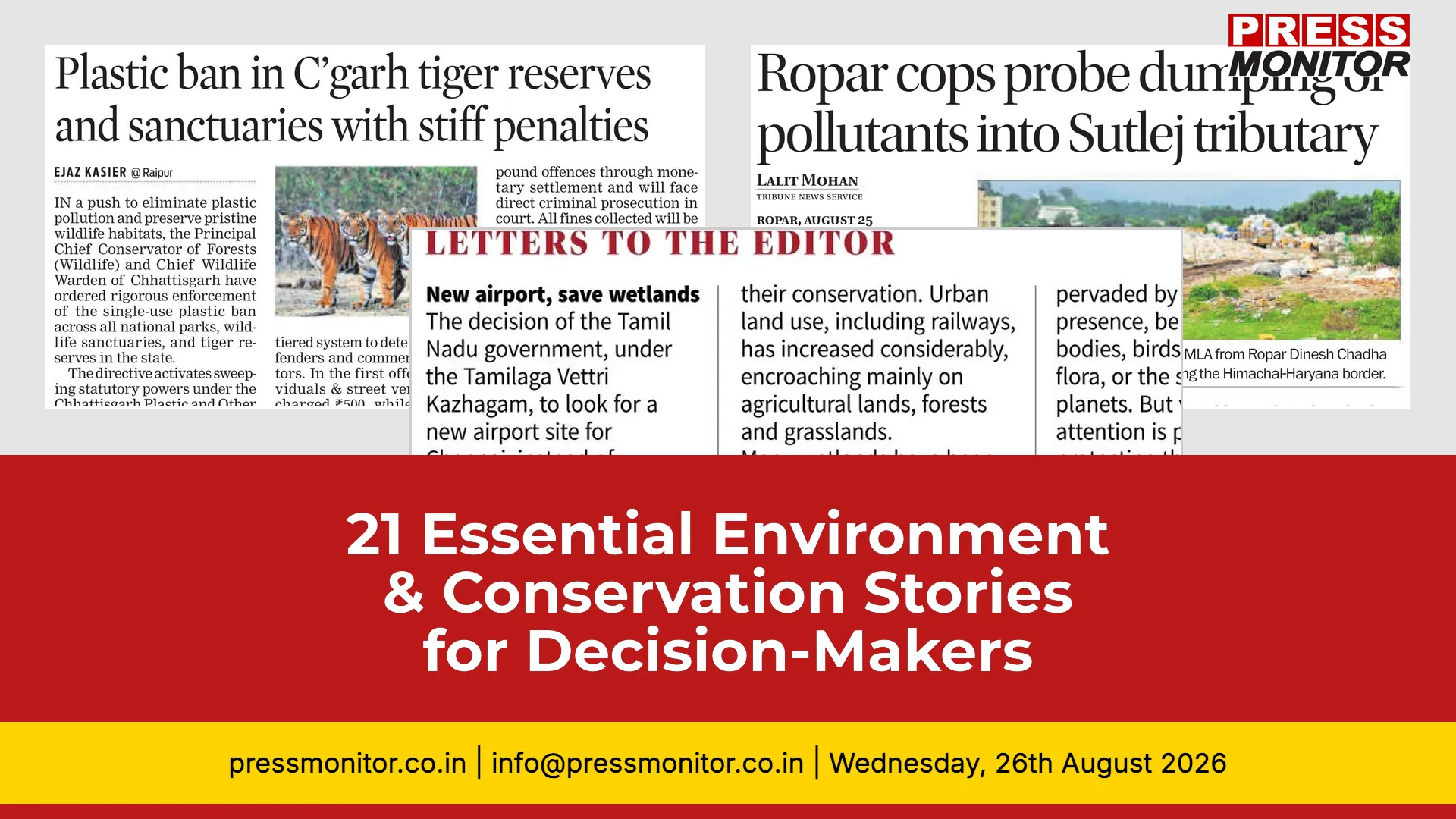
Welcome to today's curated press review, powered by Press Monitor's tracking of leading Indian publications. These stories are not just headlines; they are signals of shifting regulations, emerging risks, and opportunities for Indian businesses and policymakers. We bring you 21 stories that matter, grounded in media monitoring of India's vast print landscape.
1. Plastic Ban Tightened in Chhattisgarh Tiger Reserves
A front-page report in Morning Standard says the Principal Chief Conservator of Forests (Wildlife) and Chief Wildlife Warden of Chhattisgarh have ordered rigorous enforcement of the single-use plastic ban across all national parks, wildlife sanctuaries, and tiger reserves in the state.
Why it matters: Strict enforcement signals a zero-tolerance approach for plastics in ecologically sensitive zones, impacting tourism and waste management contracts.
Key detail: The Principal Chief Conservator of Forests (Wildlife) has ordered rigorous implementation of the single-use plastic ban across all national parks, sanctuaries, and tiger reserves in the state.
Source: Morning Standard (Raipur), also reported by Tribune and New Indian Express.
Next step: Review your supply chain for single-use plastics if your operations are near protected areas.
2. Ropar Police Probe Sutlej Tributary Pollution
A front-page report in Tribune says the Ropar police have started investigating the flow of pollutants and solid waste into the Sutlej that accumulated at the Ropar headworks on Sunday. The probe aims to trace the source of pollutants and solid waste entering the Sutlej through the Sirsa river and its tributaries.
Why it matters: Criminal investigation into industrial dumping highlights escalating enforcement of water pollution laws.
Key detail: Police are tracing the source of pollutants and solid waste entering the Sutlej via the Sirsa river after accumulation at Ropar headworks.
Source: Tribune (Delhi).
Next step: Companies with discharge points in Punjab should audit compliance immediately.
3. Chennai: New Airport Site Needed to Save Wetlands
A front-page report in The Hindu says the Tamil Nadu government's decision to look for a new airport site for Chennai instead of Parandur to protect agricultural lands and local livelihoods is commendable. The state government should enact a law for the protection of all identified wetlands along with an effective policy for their conservation.
Why it matters: Balancing infrastructure with wetland conservation sets a statewide precedent for environmental impact assessments.
Key detail: Tamil Nadu government's decision to reconsider the Parandur airport site is praised, with calls for a dedicated wetland protection law.
Source: The Hindu (Delhi).
Next step: Infrastructure developers should closely monitor this evolving policy.
4. NGT Expresses Alarm Over National Sewage Crisis
"Selon le Free Press Journal, le tribunal national vert (NGT) a exprimé de sérieuses préoccupations concernant la situation et a demandé au gouvernement de prendre des mesures correctives dans les délais. Selon un rapport du gouvernement de l'état, 1315 égouts transportent environ 637 MLD d'eaux usées et de déchets dans les sources d'eau. Bien que des stations d'épuration des eaux usées avec une capacité combinée de 736 MLD aient été proposées, le rapport ne précise pas clairement les échéanciers de leur achèvement. Par ailleurs, 1,267 milliers de foyers restent hors du réseau d'égouts, ce qui permet aux eaux noires et grises d'entrer dans les égouts et de finalement atteindre les rivières et autres plans d'eau."
Why it matters: Judicial pressure on sewage management could lead to massive compliance costs for municipalities and industries.
Key detail: 1,315 drains carry 637 MLD of wastewater into water bodies; 1,267 lakh households remain unconnected.
Source: Free Press Journal (Mumbai).
Next step: Urban local bodies must fast-track sewage treatment plant projects.
5. Tamirabharani River Granted Legal Personhood
A front-page report in Deccan Herald says the Madras High Court's July 2026 judgment recognized the Tamirabharani River as a deity and granted it legal rights against pollution, intersecting environmental law and religious practices. The ruling follows India's precedent of granting personhood to natural bodies like rivers and animals, while the Supreme Court had previously declined to extend similar protections nationwide. Legal scholars note the decision could catalyze policy changes despite challenges in enforcement.
Why it matters: Legal rights for rivers could transform environmental litigation and corporate liability.
Key detail: Madras High Court recognized the river as a deity with rights against pollution, following the precedent of the Ganga and Yamuna.
Source: Deccan Herald (Bengaluru).
Next step: Legal teams should prepare for potential expansion of this doctrine.
6. Hilsa Fish Returns to Upper Ganga After 25 Years
A front-page report in Times of India says the hilsa fish has been discovered in Uttar Pradesh's Chandauli district after a 25-year absence. The discovery is a result of joint efforts by the Central Inland Fisheries Research Institute and the National Mission for Clean Ganga to restore river biodiversity.
Why it matters: Indicator of successful river restoration through inter-agency collaboration.
Key detail: Discovery in Chandauli district, UP, attributed to CIFRI and NMCG efforts.
Source: Times of India (New Delhi).
Next step: Highlight in CSR reports as a positive outcome of clean Ganga initiatives.
7. Kishtwar Himalayas Emerge as Snow Leopard Refuge
A front-page report in Tribune says the Kishtwar Himalayas have emerged as a key stronghold for snow leopards and other high-altitude wildlife in Jammu and Kashmir.
Why it matters: Data for conservation planning and potential eco-tourism development.
Key detail: The region in Jammu & Kashmir is now a key stronghold for high-altitude wildlife.
Source: Tribune (Delhi).
Next step: Conservation groups can target this area for funding and monitoring.
8. Banswara Garments Fined Rs 147 Crore for Pollution
A front-page report in Free Press Journal says Banswara Garments in Daman has been slapped with an environmental compensation of Rs 147 crore for alleged violations of air and water pollution control norms.
Why it matters: Exemplary penalty underscores financial risk of non-compliance with air and water norms.
Key detail: Environmental compensation for violations in Daman.
Source: Free Press Journal (Mumbai).
Next step: Textile and manufacturing units must strengthen pollution control infrastructure.
9. Land Revival Key to Climate Balance: Bhupender Yadav
"A front-page report in First India says that Union Minister Bhupender Yadav has described the revival of land on the world stage as the biggest need. At the United Nations Convention on Desert Control in Ulaanbatar, Mongolia, India's Environment and Climate Change Minister Bhu-pender Yadav has spoken strongly on the world stage. He told the world from this platform that India is working extensively on its own level to save nature and deal with disasters like drought. Land revival is important in this. In the United Nations COP l7 conference, Yadav said that India has revived 2l.76 hectares of wasteland under drought management in the last ten years and made it fertile."
Why it matters: India's global stance on desertification and land restoration influences policy and investment.
Key detail: At UNCCD COP17 in Mongolia, Minister Yadav noted India revived 21.76 lakh hectares of wasteland.
Source: First India (Jaipur).
Next step: Align land restoration projects with national targets for funding.
10. Hyderabad Air Quality Could Improve 15-20% with Efficient Sweepers
A front-page report in Deccan Chronicle says the Telangana Pollution Control Board (TGPCB) plans to improve Hyderabad's ambient air quality significantly by ensuring mechanical road sweepers work efficiently. IIT Hyderabad's study reveals that proper functioning of these sweepers could improve air quality by fifteen to twenty percent, helping the city reach National Ambient Air Quality standards.
Why it matters: Low-cost interventions can yield significant air quality gains in urban areas.
Key detail: IIT Hyderabad study shows mechanical road sweepers' proper functioning can help meet National Ambient Air Quality Standards.
Source: Deccan Chronicle (Hyderabad).
Next step: Municipal corporations should audit sweeper efficiency.
11. PMC Has Rs 705 Crore Unspent Clean Air Funds
A front-page report in Free Press Journal says Pune Municipal Corporation (PMC) received ₹716.24 crore from air-quality funds and 15th Finance Commission grants, with ₹705.25 crore remaining unspent. Municipal Commissioner Naval Kishor Ram directed utilisation under the National Clean Air Programme, leading to recommendations being submitted for efficient fund use. PMC action follows directives from Maharashtra Environment and Climate Change Department to expedite allocation
Why it matters: Lapsed funds reveal implementation gaps in the National Clean Air Programme.
Key detail: PMC received ₹716.24 crore but has ₹705.25 crore unspent; directives from Maharashtra Environment Department.
Source: Free Press Journal (Mumbai).
Next step: Fast-track proposals to avoid central fund reallocation.
12. Supreme Court Panel Criticized for Aravali Study
A front-page report in The Hindu says a high-powered committee tasked with studying the Aravalis has not conducted adequate scientific assessment, public consultation, and field trips across the mountain range. As the August 31 deadline for the panel to submit its report approaches, independent experts and conservationists have written to the committee expressing concerns.
Why it matters: Inadequate scientific assessment raises concerns about mining regulation in a critical ecosystem.
Key detail: Experts and conservationists wrote to the panel citing lack of public consultation and field trips ahead of August 31 deadline.
Source: The Hindu (Delhi).
Next step: Mining companies should brace for stricter oversight.
13. Petitions Urge More Time for Aravali Review
A front-page report in Indian Express says Rajasthan Opposition MPs and independent experts, including the renowned ecologist Pradip Krishen, have pressed a Supreme Court-appointed committee reviewing the Aravalli hill definition to extend its deadline. Leaders urged the panel to seek more time to analyze the impact of mining on these natural ecological barriers, with elected representatives flagging institutional gaps in stakeholder engagement, mining violations, and lack of consultation with tribal communities and local ecosystems. The original deadline for submission concluded on August 31, but calls for further assessment emphasize the need for rigorous evaluation, particularly with regards to tribal communities, health pollutants, and regional environment safeguards.
Why it matters: Delay in defining the Aravali hill area extends uncertainty for mining and real estate.
Key detail: Rajasthan MPs and ecologist Pradip Krishen pressed the committee to seek extension for deeper impact analysis.
Source: Indian Express (Delhi).
Next step: Monitor timeline for clear regulatory boundaries.
14. Centre Moves to Ban Carbosulfan Insecticide
A front-page report in Tribune says the Centre has moved to ban carbosulfan, an insecticide used on paddy, cotton and horticultural crops, citing concerns over its risks to human health and the environment. The Ministry of Agriculture and Farmers Welfare has also directed the Registration Committee to recall all certificates of registration issued for the insecticide.
Why it matters: Health and environmental risks from pesticide use; ban will affect paddy, cotton, horticulture supply chains.
Key detail: Agriculture Ministry directs Registration Committee to recall all certification for carbosulfan.
Source: Tribune (Delhi).
Next step: Agriculture firms should identify alternatives immediately.
15. Khijadiya Sanctuary Sees 100% Breeding Success for Black-Necked Storks
A front-page report in Free Press Journal says Gujarat's Khijadiya Bird Sanctuary has achieved a cent percent breeding success rate for black-necked storks, with four nests and eight fledglings recorded by scientists from the Gujarat Ecological Education and Research Foundation. The study, conducted between July 2024 and March 2025, covered 48 georeferenced sampling points across eight management zones.
Why it matters: Conservation success story with implications for habitat management.
Key detail: Four nests with eight fledglings recorded by GEER Foundation study.
Source: Free Press Journal (Gandhinagar).
Next step: Use as case study for biodiversity funding.
16. Delhi Plans Rs 1,427 Crore Sewage Reuse System
A front-page report in Morning Standard says the Delhi government plans to reuse treated sewage to secure water supplies. The initiative involves creating a circular water economy where 120 MGD of treated water will be sold for non-potable uses like gardening and industrial cooling. Additionally, investments of 1,427 crore are being made in piped water systems for the city's West and Southwest zones.
Why it matters: Circular water economy model for urban water security.
Key detail: 120 MGD treated water to be sold for gardening and industrial cooling; investments in piped water for West and Southwest zones.
Source: Morning Standard (New Delhi).
Next step: Industries should evaluate feasibility of purchasing treated water.
17. TNPCB Public Hearings for Quarries in Thoothukudi and Krishnagiri
A front-page report in New Indian Express says the Tamil Nadu Pollution Control Board is conducting public hearings for two proposed rough stone and gravel quarries. One project is located in Kollamparambu Village, Thoothukudi District, and the other in Berigai Village, Krishnagiri District.
Why it matters: Community participation in environmental clearance shapes project timelines.
Key detail: Public hearings for rough stone and gravel quarries in Kollamparambu and Berigai villages.
Source: New Indian Express (Chennai).
Next step: Quarry operators must prepare for robust environmental impact assessments.
18. Public Hearing for Berigai Stone Quarry
A front-page report in New Indian Express says that the Tamil Nadu Pollution Control Board has made public hearing mandatory for certain projects covered under the Environmental Impact Assessment Notification, 2OO6 as amended. The public hearing for the proposed project of Thiru. W.Sankar Rough Stone Quarry in Surney Numbers: at Mantapam, No. 344/l/344/2) S.F.No 3O54 (part), is scheduled for 26.lO.2O26 at 11:OOAM Berikai Village, Theertham, Berigai Village, Shoolagiri e 5 Road, Shoolagiri Taluk, Krishnagiri District.
Why it matters: Local livelihood and environment at stake in Krishnagiri district.
Key detail: Proposed Rough Stone Quarry by Thiru W. Sankar; hearing on 26-10-2026.
Source: New Indian Express (Chennai).
Next step: Affected communities should submit objections within 30 days.
19. Hearing for MP Mining Grey Granite Quarry
A front-page report in New Indian Express says a public hearing is mandatory for certain projects under the Environmental Impact Assessment Notification, 2OO6 as amended. The Tamil Nadu Pollution Control Board will conduct the public hearing for the proposed project of M/s. MP Mining and Leasing Company Grey Granite Quarry.
Why it matters: Mining in ecologically fragile zones faces scrutiny.
Key detail: TNPCB announces mandatory public hearing under EIA Notification 2006.
Source: New Indian Express (Chennai).
Next step: Submit feedback via prescribed channels.
20. Sillanatham Village Quarry Public Hearing
A front-page report in New Indian Express says that TamilNadu Pollution Control Board plans a public hearing for stone and gravel quarries in Sillanatham Village, Ottapidaram, Thoothukudi District, mandated under the 1994 Environmental Impact Assessment Notification. Submissions must be submitted to multiple local officials within 30 days, with hearings focusing on environmental impacts.
Why it matters: Thoothukudi region faces cumulative impact of multiple quarry projects.
Key detail: Hearing for stone and gravel quarries under 1994 EIA Notification; 30-day submission window.
Source: New Indian Express (Chennai).
Next step: Monitor cumulative impact assessments.
21. Black Granite Quarry Hearing in Tamil Nadu
A front-page report in New Indian Express says that a public hearing for the environmental impact assessment of M/s. Thiru.B.Sharath Black Granite (Dolerite) Quarry in Tamil Nadu is mandatory as per the Environmental Impact Assessment Notification, 2OO6 as amended.
Why it matters: Special focus on dolerite extraction and environmental safeguards.
Key detail: Public hearing for M/s B. Sharath Black Granite (Dolerite) Quarry.
Source: New Indian Express (Chennai).
Next step: Engage with EIA reports available for public review.
Closing: These stories demonstrate how media monitoring across India's print press provides early signals for environmental compliance, policy shifts, and conservation opportunities. Which story impacts your work most? Share your thoughts—we welcome your perspective.
