21 Essential Human Resources Stories for HR Leaders


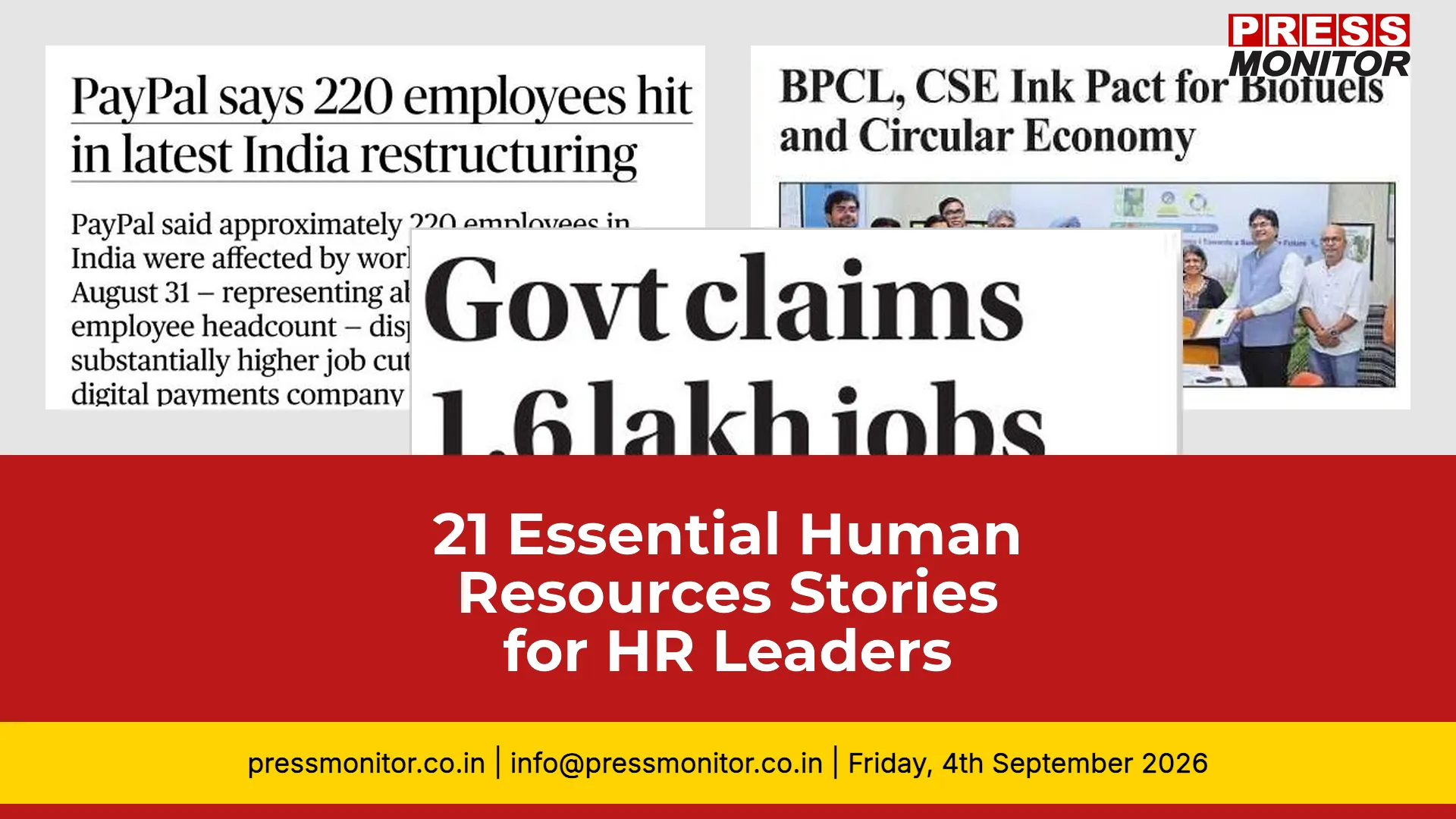
According to Press Monitor's tracking of Indian publications, today's print media monitoring reveals 21 essential stories shaping the human resources landscape across India. This press review delivers news on human resources that HR leaders, labor relations professionals, and workforce planners need to know — from corporate restructuring and labour disputes to policy reforms and skills development. Powered by media intelligence from India's largest print ecosystem, this roundup connects the dots between corporate decisions, government policy, and worker welfare.
1. PayPal India Cuts 220 Jobs
A front-page report in Business Line says PayPal said approximately 220 employees in India were affected by workforce reductions on August 31, representing about 4 per cent of its India employee headcount and disputing reports of substantially higher job cuts. The digital payments company said the reduction was part of its previously announced multi-year transformation programme aimed at simplifying global operations, strengthening execution, and positioning the company for long-term growth.
Why it matters: Workforce reductions at a major digital payments firm signal broader restructuring trends in India's tech-enabled services sector. HR leaders tracking layoffs need to understand the scope and rationale behind such moves.
Key detail: Approximately 220 employees in India were affected, representing about 4 per cent of PayPal's India headcount, as part of a multi-year transformation programme aimed at simplifying global operations.
Source: Business Line and Business Standard, 4 September 2026
Next step: Monitor whether other fintech and payments firms follow suit with similar restructuring. Consider the impact on talent retention in the digital payments ecosystem.
2. BPCL CSE Sign MoU for Biofuels
A front-page report in Hindustan Times says Bharat Petroleum Corporation Ltd and Centre for Science and Environment signed an MoU to explore collaboration in biofuels, biomass resource utilisation, waste-to-resource solutions, and circular economy initiatives. The two organisations will work together to identify and explore opportunities across the biofuels value chain. Additionally, Lal Bahadur Shastri Institute of Management, Delhi, hosted HR Conclave 2026, and four Indian students from Rajasthan, Haryana, and Madhya Pradesh were selected for an educational visit to NASA after evaluation of their performances in the 2025-26 edition of Mittsure Olympiad Masters (MOM).
Why it matters: Corporate partnerships in the biofuels and circular economy space are creating new workforce and sustainability roles. HR teams in the energy sector should track these developments for talent planning.
Key detail: Bharat Petroleum Corporation Ltd and Centre for Science and Environment signed an MoU to explore collaboration in biofuels, biomass resource utilisation, waste-to-resource solutions, and circular economy initiatives.
Source: Hindustan Times, 4 September 2026
Next step: Assess how biofuels and circular economy initiatives may create new HR demands in the energy and manufacturing sectors.
3. Himachal Targets One Lakh Government Jobs
A front-page report in the Tribune says that Himachal Pradesh Industries Minister Harshwardhan Chauhan announced the state government will provide one lakh regular government jobs to educated youth by December 2027. During a Vidhan Sabha debate on employment generation, Chauhan highlighted an unemployment rate of 6.5 per cent in the state while emphasising the need for private sector expansion. The opposition Bharatiya Janata Party staged a walkout, with Leader of Opposition Jai Ram Thakur criticising the administration for failing to meet its earlier permanent job pledge.
Why it matters: Large-scale government employment targets directly affect the public sector HR pipeline and labor market dynamics in the state.
Key detail: Himachal Pradesh Industries Minister Harshwardhan Chauhan announced the state government will provide one lakh regular government jobs to educated youth by December 2027, amid an unemployment rate of 6.5 per cent.
Source: Tribune, 4 September 2026
Next step: Track private sector expansion plans that could complement the government job push and absorb the educated youth workforce.
4. Services Sector PMI Rises to 54.1
A front-page report in Business Standard says India's services sector activity expanded slightly in August, with the HSBC India Services Purchasing Managers' Index rising to 54.1 from 53.3. The 3 September New Delhi dateline says HSBC's survey found stronger output and employment, while manufacturing slipped to a five-year low.
Why it matters: Services sector expansion signals growing employment demand in India's largest economic segment, directly relevant to HR hiring and workforce planning.
Key detail: India's services sector activity expanded slightly in August, with the HSBC India Services PMI rising to 54.1 from 53.3, while manufacturing slipped to a five-year low.
Source: Business Standard, 4 September 2026
Next step: Align recruitment strategies with the services sector growth trajectory and monitor manufacturing sector contraction for workforce reallocation needs.
5. 100 Workers Demand Job Regularisation
A front-page report in New Indian Express says over one hundred workers affiliated with the CITU's Madras Corporation Redflag Union staged a separate protest at the Ripon building in Chennai on Thursday. The Redflag Union demanded that the civic body regularise sanitary workers based on seniority, reinstate more than one hundred workers from Zones 5 and 6 whose contracts ended in July 2025, provide weekly offs, and repair battery-operated and other vehicles used by civic staff.
Why it matters: Civic worker regularisation disputes highlight the growing gap between contract and permanent employment, a key concern for HR policy and labor relations.
Key detail: Over one hundred workers affiliated with the CITU's Madras Corporation Redflag Union demanded that the civic body regularise sanitary workers based on seniority and reinstate more than one hundred workers from Zones 5 and 6.
Source: New Indian Express, 4 September 2026
Next step: Monitor municipal corporations across India for similar regularisation demands and their impact on public sector HR policies.
6. Hisar Sanitation Strike Day 29
A front-page report in Tribune says Hisar's sanitation crisis has deepened as a strike by sanitation workers entered its 29th day, leaving large quantities of garbage piling up across the city. Clashes between striking workers and police have been reported, and controversy has emerged over an allegedly fake photograph of police action against women protesters. Around 220 tonnes of garbage is generated daily in the 20 wards of Hisar town, and nearly 149 garbage collection vehicles have remained off the roads.
Why it matters: Prolonged sanitation strikes disrupt essential services and highlight the urgent need for better labor relations and public sector workforce management.
Key detail: Hisar's sanitation crisis has deepened as a strike entered its 29th day, with around 220 tonnes of garbage generated daily and nearly 149 garbage collection vehicles off the roads.
Source: Tribune, 4 September 2026
Next step: Assess the role of essential services legislation in resolving public sector labor disputes and protecting worker rights.
7. JAC Protests Delay Minister Meeting
A front-page report in Deccan Chronicle says the Autorickshaw Joint Action Committee staged protests across Hyderabad on September 3 over the delay in holding a meeting with transport minister Ponnam Prabhakar. The JAC had withdrawn an indefinite strike after the minister assured a meeting on September 1, but the official communication delayed it to the first week of September. A delegation met the joint labour commissioner seeking an early meeting.
Why it matters: Transport worker protests over delayed government meetings underscore the importance of timely stakeholder engagement in labor dispute resolution.
Key detail: The Autorickshaw Joint Action Committee staged protests across Hyderabad over the delay in holding a meeting with transport minister Ponnam Prabhakar, after the minister assured a meeting on September 1.
Source: Deccan Chronicle, 4 September 2026
Next step: Monitor how transport policy delays impact worker morale and whether the government commits to a resolution timeline.
8. Govt Orders Sanitation Workers Return
A front-page report in Tribune says the Haryana state government has ordered striking sanitation workers to resume duty by September five, warning that failure will invite legal and departmental action. The order, issued by the Urban Local Bodies Department, follows a strike that began on August six and involves workers from the Nagar Palika Karamchari Sangh who have protested at a dumping site in Jhajjar and threatened to shut down sanitation services.
Why it matters: Government orders compelling striking workers to resume duty raise important questions about the balance between essential service continuity and worker rights.
Key detail: The Haryana state government ordered striking sanitation workers to resume duty by September five, warning of legal and departmental action. The strike began on August six and involves workers from the Nagar Palika Karamchari Sangh.
Source: Tribune, 4 September 2026
Next step: Evaluate the implications of essential services legislation on public sector labor relations and worker protest rights.
9. ESIC Privatisation Warning For Union Government
A front-page report in Business Line says that Safe In India, a non-profit organisation, has prepared a report on the functioning of the Employees' State Insurance Corporation warning the Union government against attempts to privatise the ESIC. The report recommends increasing the wage ceiling to avail ESIC coverage to Rs 33,000 from the present figure of Rs 72,000. Director General Ashok Kumar Singh released the report, stating that the Code on Social Security would help more workers avail ESIC benefits.
Why it matters: The debate over ESIC privatisation directly affects millions of workers and the social security framework, making it a critical HR policy issue.
Key detail: Safe In India, a non-profit organisation, prepared a report warning the Union government against attempts to privatise the Employees' State Insurance Corporation, recommending increasing the wage ceiling to Rs 33,000 from Rs 72,000.
Source: Business Line, 4 September 2026
Next step: Track the Code on Social Security implementation and its impact on ESIC coverage and worker benefits.
10. 23.5 Crore Compensation Ordered
A front-page report in Free Press Journal says that in Gujarat a National Human Rights Commission camp ordered more than 23.5 crore rupees in compensation after hearing cases of industrial deaths, police excesses, bonded labour and civic failures. The commission, led by Justice V. Ramasubramanian, awarded compensation for deaths from toxic gas exposure in Dahej and a fire at a Bharuch unit, and recommended 27.5 lakh rupees for a police misconduct case in Ahmedabad.
Why it matters: Industrial accident compensation cases highlight the intersection of worker safety, corporate accountability, and labor rights enforcement.
Key detail: The National Human Rights Commission camp ordered more than 23.5 crore rupees in compensation after hearing cases of industrial deaths, police excesses, bonded labour, and civic failures in Gujarat.
Source: Free Press Journal, 4 September 2026
Next step: Review workplace safety compliance requirements and the role of NHRM in enforcing labor rights in industrial zones.
11. Punjab DSP Reinstated After Court Clears Dismissal
A front-page report in The Hans India says the Punjab and Haryana High Court quashed the dismissal of Punjab Police DSP Gursher Singh Sandhu over the controversial television interview of jailed gangster Lawrence Bishnoi and ordered his reinstatement with consequential benefits. Justice Namit Kumar held that the state failed to establish circumstances that justified dispensing with a regular departmental inquiry, setting aside the Punjab government's January 2, 2025 order dismissing Sandhu under Article 311(2)(b) of the Constitution.
Why it matters: High Court interventions in police personnel dismissals set precedents for due process and departmental inquiry standards in public sector HR.
Key detail: The Punjab and Haryana High Court quashed the dismissal of Punjab Police DSP Gursher Singh Sandhu and ordered his reinstatement with consequential benefits, setting aside the state government's January 2025 order.
Source: The Hans India, 4 September 2026
Next step: Monitor the implications of this ruling for public sector disciplinary procedures and administrative fairness.
12. Employees' Provident Fund 75 Percent ATM Withdrawals
A front-page report in Tribune says the Indian government is likely to unveil a centralised Employees' Provident Fund Organisation platform in New Delhi by the end of October, enabling subscribers to withdraw provident fund balances through nearby ATMs or the Unified Payments Interface. Under the proposed EPFO three point zero system, the withdrawable share would rise from fifty to seventy five percent of the total balance, with online claims through the EPFO member portal or a Unified Account Number or Aadhaar one-time password, and money credited to linked bank accounts within three working days. A Labour Ministry official said members may receive a dedicated provident fund withdrawal card linked to their provident fund account, reducing the need for claim forms or employer approval.
Why it matters: EPFO reforms expanding withdrawal access represent a significant shift in retirement savings policy, affecting millions of Indian workers and HR benefits planning.
Key detail: The Indian government is likely to unveil a centralised EPFO platform enabling subscribers to withdraw provident fund balances through ATMs or UPI, with the withdrawable share rising from 50 to 75 percent of the total balance.
Source: Tribune, 4 September 2026
Next step: Prepare HR teams for the operational impact of streamlined PF withdrawals on employee financial planning and retention.
13. Haryana Caps Teachers Leave at 89 Days
A front-page report in Tribune says Haryana School Education Department has ordered field officers not to grant teachers leave exceeding 89 days or extend sanctioned leave beyond this period until the ongoing online transfer drive completes. The directive issued by the Director General of Secondary Education aims to ensure teacher availability during the 'Teachers Transfers Drive-2026'. Meanwhile, the Haryana School Lecturer Association president urges the government to announce the schedule after data verification ends on September 9.
Why it matters: Government-imposed leave caps for teachers reflect broader workforce management policies that HR departments in education and public sectors must navigate.
Key detail: Haryana School Education Department ordered field officers not to grant teachers leave exceeding 89 days during the ongoing Teachers Transfers Drive-2026.
Source: Tribune, 4 September 2026
Next step: Assess how leave policy changes in the education sector may influence broader public sector HR practices.
14. Maharashtra Mandates Healthy Food at Government Events
A front-page report in Free Press Journal says that 1,268 rural youth in Gujarat secured employment through the Deen Dayal Upadhyaya Grameen Kaushalya Yojana during 2025-26. The scheme, implemented by the Gujarat Livelihood Promotion Company Limited, offers free skill training in over 40 sectors with a minimum monthly salary of Rs 10,000. Trainees also receive 12 months of post-placement assistance to build sustainable careers.
Why it matters: Workplace wellness mandates in government settings signal a growing trend toward health-focused HR policies that private sector organizations may follow.
Key detail: The Maharashtra state cabinet chaired by Chief Minister Devendra Fadnavis made healthy snacks, nutritious meals, and balanced menus mandatory at government and semi-government meetings, official programmes, and canteens.
Source: Free Press Journal, 4 September 2026
Next step: Consider how workplace wellness mandates may influence corporate HR policies and employee satisfaction programs.
15. Power Grid Annual Meeting Held Virtually
A front-page report in Hindustan Times says the thirty-seventh annual general meeting of Power Grid Corporation of India Limited was convened through virtual mode. The meeting was chaired by Vamsi Rama Mohan, chairman and managing director of Power Grid. Other events included a pre-placement drive at Guru Jambheshwar University of Science and Technology and a dividend presentation by Bharat Heavy Electricals Limited.
Why it matters: Corporate governance events like Power Grid's AGM highlight the intersection of workforce planning, talent acquisition, and organizational strategy in India's public sector enterprises.
Key detail: The thirty-seventh annual general meeting of Power Grid Corporation of India Limited was convened through virtual mode, chaired by chairman and managing director Vamsi Rama Mohan.
Source: Hindustan Times, 4 September 2026
Next step: Monitor pre-placement drives and talent acquisition initiatives at public sector enterprises for HR benchmarking.
16. 1,268 Rural Youth Trained Under DDU-GKY
A front-page report in Free Press Journal says that 1,268 rural youth in Gujarat secured employment through the Deen Dayal Upadhyaya Grameen Kaushalya Yojana during 2025-26. The scheme, implemented by the Gujarat Livelihood Promotion Company Limited, offers free skill training in over 40 sectors with a minimum monthly salary of Rs 10,000. Trainees also receive 12 months of post-placement assistance to build sustainable careers.
Why it matters: Skill development programs for rural youth are critical for workforce development and addressing India's employment challenges in underserved regions.
Key detail: 1,268 rural youth in Gujarat secured employment through the Deen Dayal Upadhyaya Grameen Kaushalya Yojana during 2025-26, with free skill training in over 40 sectors and a minimum monthly salary of Rs 10,000.
Source: Free Press Journal, 4 September 2026
Next step: Explore partnerships with skill development schemes to build a sustainable talent pipeline for organizations operating in rural and semi-urban areas.
17. Dr Virendra Kumar Urges Ability Focus for Persons with Disabilities
A front-page report in Hindustan Times says Union Minister for Social Justice and Empowerment Dr Virendra Kumar called for building an inclusive society where persons with disabilities are recognised by their abilities, talent, competence and potential rather than their disability at the Dr Ambedkar International Centre in New Delhi on 18 July 2026. He was speaking at the signing ceremony of an MoU between the Department of Empowerment of Persons with Disabilities and the Rajyoga Education and Research Foundation, a sister organisation of Brahma Kumaris, for the launch of the Divyang Samanata, Sanrakshan evam Sashaktikaran Abhiyan.
Why it matters: Inclusive workforce policies for persons with disabilities are increasingly important for HR leaders committed to diversity, equity, and accessibility.
Key detail: Union Minister Dr Virendra Kumar called for building an inclusive society where persons with disabilities are recognised by their abilities, talent, competence, and potential at the Dr Ambedkar International Centre in New Delhi.
Source: Hindustan Times, 4 September 2026
Next step: Review organizational disability inclusion policies and ensure alignment with the Divyang Samanata initiative.
18. PMC Trains Staff on Snakebite Management
A front-page report in Free Press Journal says the Pune Municipal Corporation conducted a training programme for medical officers and staff on the timely management of snakebite cases. The workshop was organised by the Metropolitan Surveillance Unit of the PMC Health Department on Wednesday with 118 medical officers, employees and MSU staff participating under the guidance of snakebite expert Dr Sadanand Raut, who explained the appropriate use and dosage of Anti-Snake Venom and the Rule of Ten.
Why it matters: Public health training programs for municipal staff highlight the importance of workforce preparedness and continuous learning in civic service roles.
Key detail: The Pune Municipal Corporation conducted a training programme for 118 medical officers and staff on snakebite case management, organised by the Metropolitan Surveillance Unit.
Source: Free Press Journal, 4 September 2026
Next step: Consider how municipal health training programs can serve as models for corporate employee wellness and emergency preparedness training.
19. 100 Liquor Outlets Shut Amid Buy-Back Row
A front-page report in New Indian Express says more than one hundred Tasmac shops remained shut in Kancheepuram and Chengalpattu districts on Thursday as employees protested demanding separate staff for the bottle buy-back scheme and government funding for outlet operating expenses. Employees said the recent salary hike did not cover shop-level costs such as arranging workers, loading and unloading, and coin commission charges, while Tasmac officials said the protest was linked to a crackdown on employees charging extra and that twenty-three employees had been suspended over consumer complaints.
Why it matters: Public sector retail labor disputes over wage structures and working conditions reflect broader challenges in employee compensation and benefits management.
Key detail: More than one hundred Tasmac shops remained shut in Kancheepuram and Chengalpattu districts as employees protested demanding separate staff for the bottle buy-back scheme and government funding for outlet operating expenses.
Source: New Indian Express, 4 September 2026
Next step: Monitor how public sector retail wage disputes may influence broader labor negotiations in the state.
20. JAC Amaravati Demands Day Protests
A front-page report in The Hans India says Andhra Pradesh Joint Action Committee Amaravati organised Demands Day protests across Andhra Pradesh on Thursday, with employees, teachers, and pensioners demanding immediate settlement of pending financial issues including salaries, allowances, and other benefits. The state chairman Bopparaju Venkateswarlu participated in the protest at Ongole, while secretary general Palisetti Damodara Rao led the agitation at the NTR district collectorate in Vijayawada. The leaders warned that the agitation would be intensified if the government continued to delay action.
Why it matters: Government employee protests over pending financial issues including salaries and allowances highlight the ongoing tension between public sector budgets and workforce expectations.
Key detail: Andhra Pradesh Joint Action Committee Amaravati organised Demands Day protests with employees, teachers, and pensioners demanding immediate settlement of pending financial issues including salaries, allowances, and other benefits.
Source: The Hans India, 4 September 2026
Next step: Track how public sector wage demands in Andhra Pradesh may influence labor negotiations in other states.
21. BEST Announces Rs 1,111 Crore Wage Plan
A front-page report in Free Press Journal says the proposed wage revision for around 38,200 BEST employees and wet-lease workers could add Rs 1,111 crore annually to the undertaking’s salary bill. The plan includes Rs 475 crore yearly for approximately 9,000 wet-lease staff and Rs 636 crore for regular employees, alongside a massive Rs 6,000 crore arrear liability covering wages from 2016 to 2025. This proposal will soon be submitted to the BMC and the state government’s Study Committee for consideration.
Why it matters: Major wage revision proposals for public sector transport workers set precedents for employee compensation benchmarking across India's municipal corporations.
Key detail: BEST proposed a wage revision adding Rs 1,111 crore annually to its salary bill, covering approximately 38,200 employees and wet-lease workers, with a massive Rs 6,000 crore arrear liability.
Source: Free Press Journal, 4 September 2026
Next step: Assess how municipal wage revisions may influence private sector compensation strategies and labor market dynamics in Mumbai.
Closing: Which of these stories will reshape your HR strategy in the coming quarter? Stay tuned to Press Monitor for the latest news on human resources, updated daily from India's print media landscape.