21 Essential Rural Affairs Stories for Policy Makers


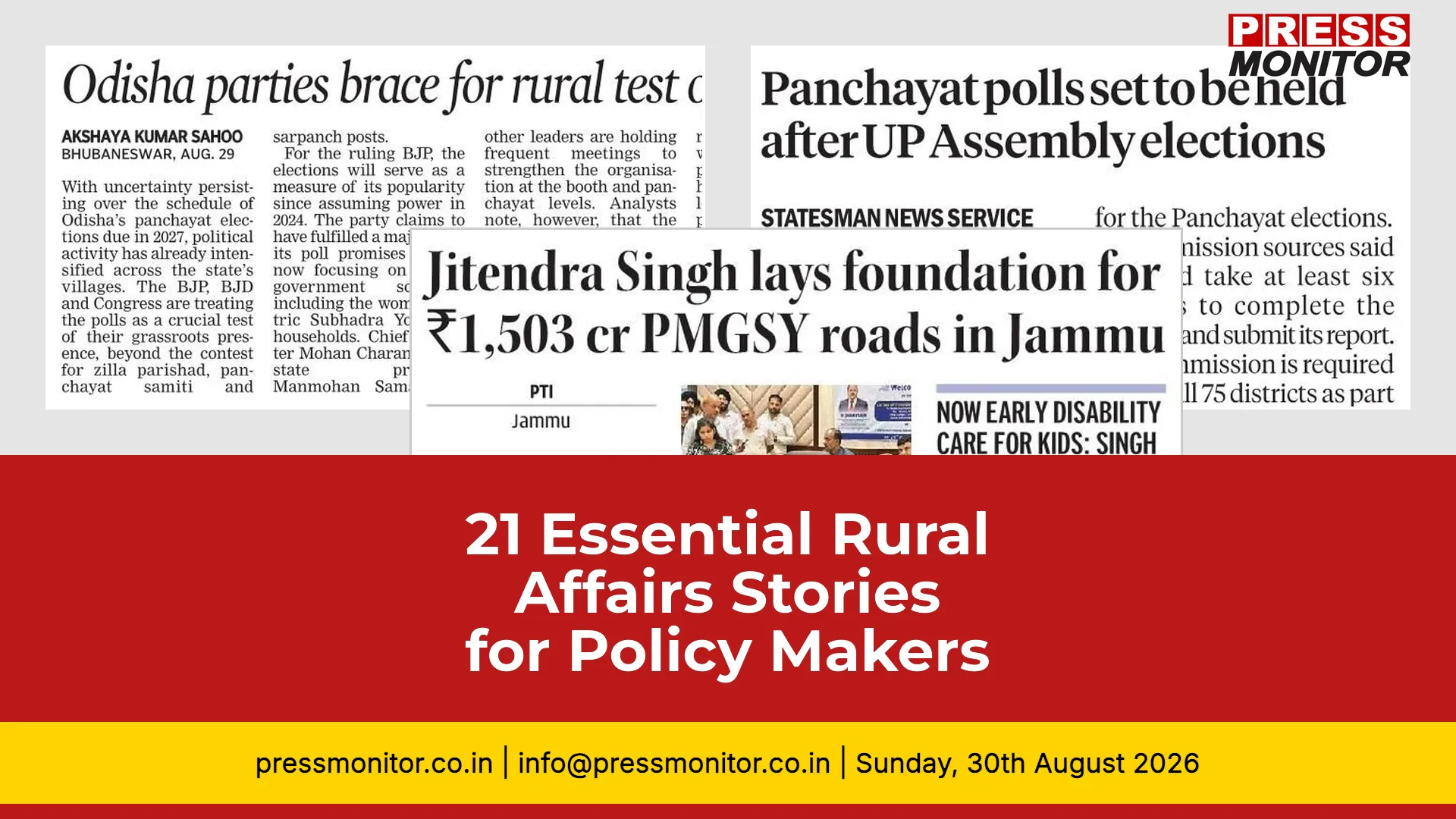
In today's rapidly evolving rural landscape, staying ahead means tracking every policy shift, infrastructure project, and economic indicator. According to Press Monitor's tracking of Indian publications, here are 21 essential rural affairs stories from August 30, 2026, that demand your attention. This media monitoring roundup covers panchayat elections, rural roads, agri-tech, water crisis, and more — curated for policy makers and development professionals.
1. Odisha Parties Brace for Rural Test of Strength
A front-page report in Asian Age says that as uncertainty persists over the schedule of Odisha's scheduled panchayat elections in 2027, the BJP, BJD and Congress are intensifying political activity across the state's villages. The ruling BJP is measuring its popularity since assuming power in 2024 and taking government schemes, including the women-centric Subhadra Yojna, to households. The BJD, which lost power after 24 years in 2024, is seeking to revive its organisational base and relies on its long-standing local leaders and grassroots networks.
Why it matters: The upcoming panchayat elections will gauge popularity of ruling BJP vs opposition BJD and Congress.
Key detail: BJP is leveraging schemes like Subhadra Yojna; BJD relies on grassroots networks.
Source: Asian Age
Next step: Monitor ground reports as campaigns intensify.
2. Panchayat Polls Set to Be Held after UP Assembly Elections
A front-page report in Statesman says that the Uttar Pradesh Backward Classes Commission, set up to examine reservation for the three-tier Panchayat elections, is likely to submit its report only in November or December, making it increasingly likely that the rural local body polls will be held after the 2027 Assembly elections.
Why it matters: Delay could shift political dynamics in Uttar Pradesh.
Key detail: Backward Classes Commission report likely in Nov/Dec.
Source: Statesman
Next step: Watch for commission recommendations.
3. PMGSY Project Worth Rs 1,503 Crore Launched
A front-page report in First India says... Union Minister Jitendra Singh laid the foundation stone for 110 PMGSY road projects worth Rs 1,503 crore in his Udhampur parliamentary constituency, aimed at improving rural connectivity in the remote and challenging terrain of Jammu and Kashmir.
Why it matters: Rural connectivity boost in tough terrain.
Key detail: 110 road projects in J&K's Udhampur constituency.
Source: First India
Next step: Track project timelines for local impact.
4. Rajasthan-OIFAD Partnership for Rural Development
A front-page report in First India says that Rajasthan Chief Secretary V Srinivas met with IFAD President Dr Alvaro Lario to discuss rural development, drought management, and water infrastructure. Both parties expressed commitment to sustainable agriculture and drought mitigation strategies. During his Rome visit, Srinivas also met Pope Leo XIV, presenting a medallion on behalf of the IIAS delegation.
Why it matters: International collaboration for drought management and water infrastructure.
Key detail: Chief Secretary met IFAD President; also met Pope Leo XIV.
Source: First India
Next step: Follow up on sustainable agriculture commitments.
5. Karnataka Struggles with VB-GRAMS Teething Problems
A front-page report in Deccan Herald says that two months after its inception, Karnataka's new job guarantee scheme, Viksit Bharat- Guarantee for Rozgar and Ajeevika Mission (Gramin), is facing significant implementation hurdles. Problems include administrative bottlenecks, a centralised funding system, and technical glitches reducing the scheme's ability to provide employment.
Why it matters: New job guarantee scheme faces implementation hurdles.
Key detail: Administrative bottlenecks, centralised funding, and tech glitches.
Source: Deccan Herald
Next step: Check for corrective measures.
6. Madhya Pradesh Digitises Agricultural Sector
A front-page report in Free Press Journal says the Madhya Pradesh Agriculture Department is expanding drone technology and AI-driven smart farming to modernise the state's agricultural sector. The initiative includes distributing over 10.76 lakh Soil Health Cards, establishing 265 soil testing labs, and investing Rs 21,500 crore in an agri-tech innovation hub in Indore.
Why it matters: AI and drones modernise farming.
Key detail: 10.76 lakh Soil Health Cards, 265 labs, Rs 21,500 crore agri-tech hub.
Source: Free Press Journal
Next step: Explore digital tools for farmers.
7. PMFME Reshapes Fortunes
A front-page report in Free Press Journal says that farmers in Madhya Pradesh are turning into corporate tycoons by launching food processing units with the help of the PM Formalisation of Micro Food Processing Enterprises scheme and government grants.
Why it matters: Farmers become food processing entrepreneurs.
Key detail: PM Formalisation of Micro Food Processing Enterprises scheme.
Source: Free Press Journal
Next step: Identify grant opportunities for rural enterprises.
8. Drone Tech and Soil Health Cards Boost Agriculture
A front-page report in Free Press Journal says that the Agriculture Department is extensively expanding the use of drone technology. The use of drones is resulting in significant savings of pesticides and water, while reducing time and labor costs. Additionally, the department is conducting a massive campaign to distribute Soil Health Cards to provide precise information regarding nutrient deficiencies in the soil and specific fertilizer needs.
Why it matters: Precision farming reduces costs and improves yields.
Key detail: Drones save pesticides, water, labour; massive Soil Health Card distribution.
Source: Free Press Journal
Next step: Adopt drone technology in your region.
9. Affordable Electricity Benefits Under Surya Mitra Scheme
A front-page report in Free Press Journal says that Madhya Pradesh has ushered in a new revolution in the agricultural sector through the use of solar energy. The government is transforming farmers into energy providers through the Department of New and Renewable Energy.
Why it matters: Solar energy transforms farmers into energy providers.
Key detail: Government promoting solar in Madhya Pradesh agriculture.
Source: Free Press Journal
Next step: Explore solar microgrids for rural areas.
10. K-Shaped Economy in Indian Consumption Basket
A front-page report in Morning Standard says the executives of Hindustan Unilever, Nestlé, Britannia and other major companies have resigned while India’s GDP is projected to grow at seven point two percent in the April-June quarter. The reasons cited include a K-shaped economy where consumption spending is diverging between rural, informal and corporate sectors with lagging wages across agricultural and non-agricultural occupations in rural areas and urban areas, constraining demand for daily consumer staples.
Why it matters: FMCG companies see rural demand lag despite GDP growth.
Key detail: Executives of HUL, Nestlé, Britannia resign; consumption divergence.
Source: Morning Standard
Next step: Monitor rural wage trends.
11. India's Gig Work Beats Factory Wages
A front-page report in Times of India says that gig work in India often provides higher monthly earnings than formal garment factory jobs and rural employment schemes. The analysis compares the earnings of platform drivers and Zomato workers against Bangladeshi garment workers and MNREGA labourers.
Why it matters: Gig economy offers higher earnings than rural schemes.
Key detail: Comparison of platform drivers, Zomato workers, vs MNREGA.
Source: Times of India
Next step: Consider gig work as rural employment option.
12. Gig Economy vs Garment Industry
A front-page report in Times of India says that while Bangladesh has moved millions of rural women into factories, India has created 12 million gig workers. Experts argue that gig work, which pays more and offers flexibility, should be supported as a step forward in development.
Why it matters: India created 12 million gig workers, while Bangladesh moved rural women to factories.
Key detail: Experts support gig work as development step.
Source: Times of India
Next step: Evaluate gig regulation for worker protection.
13. TDS Exceeds Limit in 62% of Haryana Blocks
A front-page report in Tribune says the Haryana Government has admitted that groundwater in 62% of 142 blocks exceeds acceptable TDS levels, with 35 blocks surpassing 1,000 mg/litre. Water samples in villages like Belarkhan (9,553 mg/litre) and Ashraf Pur Matinlu (8,791 mg/litre) show critical contamination. Villages in Nuh and Palwal villages also face severe water shortages, with over 160 villages receiving below the Jal Jeevan Mission threshold.
Why it matters: Groundwater contamination poses health and economic risks.
Key detail: 35 blocks exceed 1,000 mg/litre; critical in Belarkhan and Ashraf Pur Matinlu.
Source: Tribune
Next step: Advocate for water treatment infrastructure.
14. Revanth Reddy Urges Farm Diversification
A front-page report in Deccan Chronicle says Chief Minister A. Revanth Reddy has urged the Telangana Agriculture and Farmers Welfare Commission to prioritise crop diversification and horticultural cultivation. During a meeting on Saturday, the commission submitted a report recommending the restoration of minor irrigation tanks and the removal of encroachments to secure water for rural livelihoods.
Why it matters: Telangana's CM pushes for crop diversification and horticulture.
Key detail: Commission recommends restoring minor irrigation tanks.
Source: Deccan Chronicle
Next step: Support water security and tank renovation.
15. Assam Announces Bridge Feasibility Study
A front-page report in Hindustan Times says the Government of Assam has issued a request for expressions of interest for consultancy services to conduct the feasibility study, design, and prepare a detailed project report (DPR) for 32 bridges across Cachar, Hailakandi, Karbi-Angiong, and Sribhumi districts of Assam.
Why it matters: 32 bridges to improve connectivity in four districts.
Key detail: Consultancy services for DPR preparation.
Source: Hindustan Times
Next step: Track bidding process.
16. Karnataka Invites Tenders for Rural Road Development
Karnataka Rural Road Development Agency (KRRDA) has issued a notice inviting tenders for routine maintenance of 9 post numbers of rural roads under the Karnataka Rural Road Improvement Project (KRRIP) — Pragathi Patha — financed by the Asian Development Bank. Eligible contractors, registered with the Public Works Department, or non-registered contractors, can submit bids online through the KPP Portal by September 15, 2026. Further details and corrigendums will be available exclusively on the KPP Portal.
Why it matters: ADB-funded road maintenance project.
Key detail: Tenders for 9 post numbers; bids by Sept 15.
Source: Times of India
Next step: Eligible contractors should apply.
17. Notice Inviting Tender for Road Works in Odisha
A front-page report in Hindustan Times says the Chief Construction Engineer, Rural Works Circle, Anugola, is inviting tenders for road works in Odisha with an estimated cost ranging from Rs. 119.41 lakhs to Rs. 604.19 lakhs. The tender includes 12 works to be completed as per the annexure.
Why it matters: 12 road works costing ₹119-604 lakhs.
Key detail: Rural Works Circle, Anugola.
Source: Hindustan Times
Next step: Submit bids for rural infrastructure contracts.
18. Odisha Invites Tenders for Road and Storage Structure
A front-page report in Hindustan Times says that the Government of Odisha is inviting tenders for road works and the construction of Bharatpur In-stream Storage Structure across River Icha.
Why it matters: Integrated water and road infrastructure.
Key detail: Bharatpur In-stream Storage Structure across River Icha.
Source: Hindustan Times
Next step: Participate in tenders.
19. BJP MLA Criticizes Road Quality
A front-page report in New Indian Express says Ajay Vishnoi, the former minister and BJP MLA from Jabalpur’s Patan, questioned his own party government on the deteriorating condition of roads under both the PWD and the Prime Minister Rural Roads Scheme.
Why it matters: Internal party criticism highlights poor rural road conditions.
Key detail: Ajay Vishnoi questions PWD and PMGSY roads.
Source: New Indian Express
Next step: Demand accountability in road construction.
20. Inauguration of Rs 17.52-cr School Building at Nadaun
A front-page report in Tribune says Chief Minister Sukhvinder Singh Sukhu laid the foundation stone of the Government Senior Secondary School, Nadaun, on August 29. The six-story building, costing Rs 17.52 crore, will have labs, a library, music room, and staff quarters, aimed at modern facilities for students.
Why it matters: Modern educational facilities in Himachal Pradesh.
Key detail: Six-story building with labs, library, music room.
Source: Tribune
Next step: Replicate model in other districts.
21. Timure Flooding Devastates Rural Area
A front-page report in Free Press Journal says: Residents in Timure, a rural region of Nepal-Tibet, face severe hardship following catastrophic flooding that transformed the landscape. Satellite imagery reveals colorful buildings largely obliterated by mud, water and debris with critical infrastructure submerged and local communities isolated.
Why it matters: Natural disaster isolates communities, destroys infrastructure.
Key detail: Satellite imagery shows obliterated buildings.
Source: Free Press Journal
Next step: Prioritise disaster response and rebuilding.
These 21 stories, tracked by Press Monitor, provide a comprehensive view of India's rural landscape. This press review is part of our media intelligence service. For ongoing print media monitoring of rural affairs, rely on Press Monitor.
Which of these stories impacts your work most? Share your thoughts below.