21 Essential Water & Wastewater Stories for Urban Planners


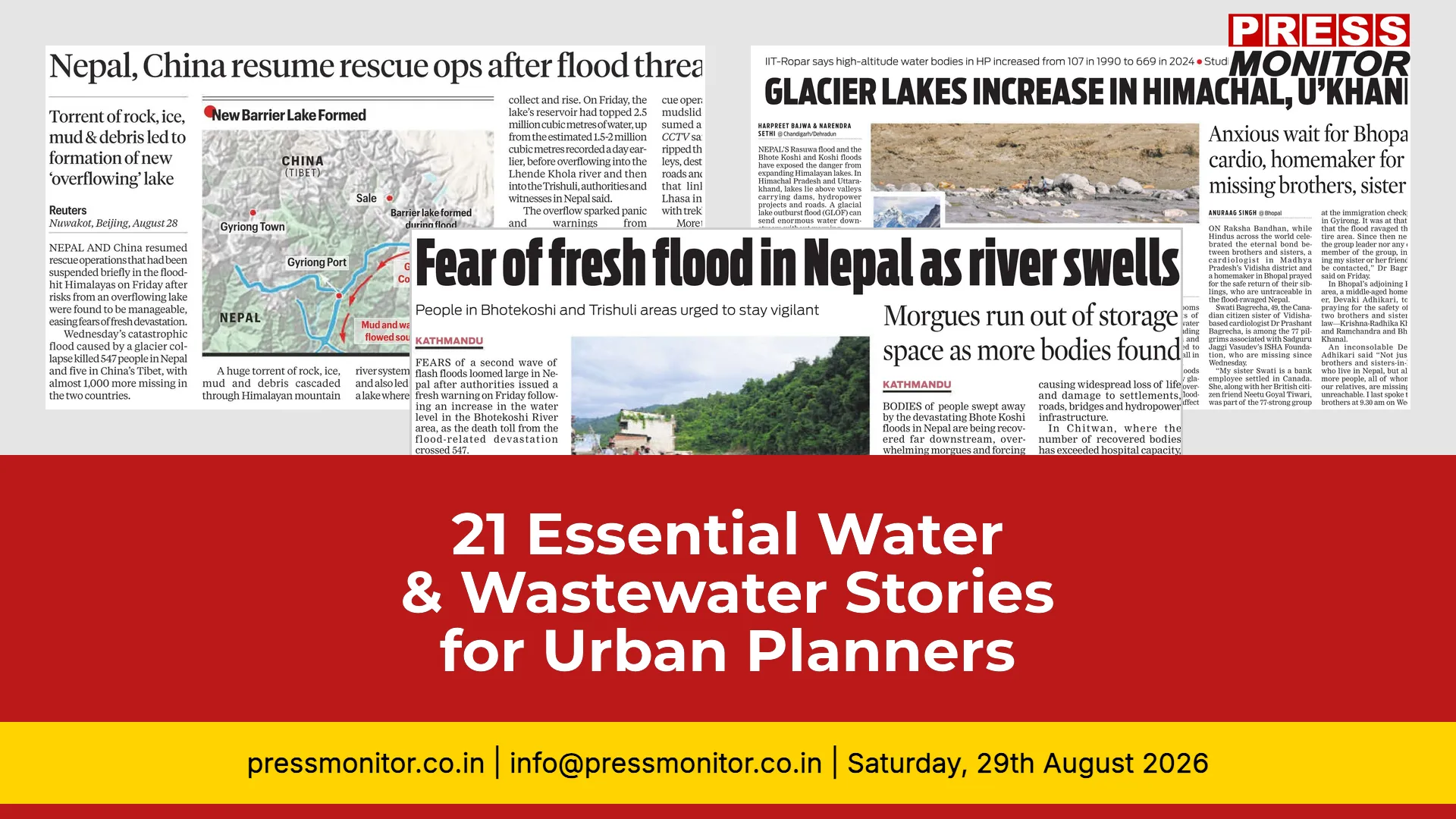
India's water landscape is shifting rapidly—from glacial disasters in the Himalayas to digital water governance in Goa. This press review, powered by Press Monitor's tracking of Indian publications, brings you the 21 most impactful water and wastewater stories from today's print media. Whether you need media monitoring for water policy or a comprehensive press review of infrastructure developments, these stories are essential reading.
1. Nepal Glacier Collapse: 547 Dead, Rescue Resumes
A front-page report in Indian Express says Nepal and China resumed rescue efforts following the resumption of a manageable threat from the overflowing Ewer Barrier Lake formed during an early-August glacial collapse behind Langtang l ruins. The disastrous flood killed 547 in Nepal and five in Tibet, China, with thousands more reported missing. Earlier in Nepal, the lake, rising to 2.5 train-load volumes, posed a risk before rescue teams steadied the situation, allowing operations to restart.
Why it matters: The Himalayan disaster underscores the transboundary nature of water risks. Key detail: 547 killed in Nepal, 5 in Tibet; lake formed by glacial collapse.
Source: Indian Express, Millennium Post. Next step: Monitor glacial lake outburst risk in your region.
2. Glacial Lakes in Himachal Increase 525%
A front-page report in New Indian Express says that the number of high-altitude water bodies in Himachal Pradesh increased from 107 in 1990 to 669 in 2024, a 525% rise. Studies show that 25 vulnerable lakes in Chamoli and Pithoragarh could trigger glacial lake outburst floods (GLOF) threatening dams, hydropower projects, and roads.
Why it matters: 25 vulnerable lakes threaten hydropower and roads. Key detail: Lakes grew from 107 (1990) to 669 (2024).
Source: New Indian Express, Morning Standard. Next step: Assess GLOF risk for infrastructure projects.
3. Fresh Flood Warning in Nepal
A front-page report in Morning Standard says fears of a second wave of flash floods loomed large in Nepal after authorities issued a fresh warning on Friday following an increase in the water level in the Bhotekoshi River area, as the death toll from the flood-related devastation crossed 547.
Why it matters: Bhotekoshi River level rising, death toll crosses 547. Key detail: Authorities warn of second wave.
Source: Morning Standard, New Indian Express. Next step: Prepare evacuation plans for downstream areas.
4. Nepal Flood Debris Chokes Gandak River
"Selon Hindustan Times, flash floods in Nepal have sent a heavy load of silt, wood, and household debris into the Gandak river system in Kushinagar and Maharajganj districts, prompting irrigation authorities to temporarily shut canals amid concerns that the sediment could choke the network. Chief engineer Vikas Singh stated nearly 13 cubic metres of silt has been added, making the sediment load a major concern. Debris, including LPG cylinders and tyres, has washed down from flood-affected areas of Nepal, with teams monitoring the river and vulnerable stretches. Officials have advised residents to remain alert and evacuate if the situation worsens."
Why it matters: Silt, wood, LPG cylinders threaten irrigation canals. Key detail: 13 cubic metres of silt added.
Source: Hindustan Times. Next step: Clear sediment to prevent canal blockage.
5. Uttarakhand Invites Bids for Rishikesh Water Project
A front-page report in The Hindu says the Uttarakhand Urban Sector Development Agency is inviting online bids for the Rishikesh Integrated Urban Infrastructure Development Programme. Financed by the Kreditanstalt für Wiederaufbau Bank, the project focuses on developing a water supply system in Rishikesh. Bidders must submit their proposals through the state e-procurement portal by 14 October 2026.
Why it matters: KfW-financed project to improve water supply. Key detail: Bids due 14 October 2026.
Source: The Hindu. Next step: Infrastructure firms should review tender documents.
6. Revanth Reddy Insists on Krishna Water Share
A front-page report in Deccan Chronicle says Telangana Chief Minister Revanth Reddy insists on securing the state's share of Krishna river water. He emphasized effective arguments before the Krishna Waters Disputes Tribunal (KWDT)-II to ensure Telangana gets 5ll tmc ft of water. In a separate event, forest minister Konda Surekha tied a rakhi to Revanth Reddy on Raksha Bandhan, signaling a possible easing of tensions after a disciplinary recommendation against her.
Why it matters: Telangana seeks 511 tmc ft from KWDT-II. Key detail: CM argues for state's rights.
Source: Deccan Chronicle. Next step: Legal teams prepare for tribunal arguments.
7. India's Water Crisis: A Question of Social Power
A front-page report in Statesman says that India’s water crisis is often described in terms of climate change, failing monsoons, depleted aquifers and inadequate infrastructure. But there is another variable that determines how a water crisis is experienced: social power. When a village has too few functioning water sources, access to them becomes a question not merely of availability but of who can approach them, when they can do so and at what cost.
Why it matters: Access to water depends on caste and social standing. Key detail: Rural villages face unequal distribution.
Source: Statesman. Next step: Policy makers must address equity in water schemes.
8. India Needs a Water Budget for Industrial Projects
A front-page report in Statesman says India lacks a water budget to manage the cumulative water stress from industrial projects. The article discusses the semiconductor fab in Dholera, Gujarat, which requires large amounts of water from the Narmada river despite the area having no usable groundwater. It argues that a basin-level cumulative water budget is needed before approving water-intensive projects.
Why it matters: Dholera semiconductor fab threatens Narmada water. Key detail: No basin-level cumulative water budget exists.
Source: Statesman. Next step: Advocate for water budgeting before approving new projects.
9. Andhra Pradesh, Telangana Escalate Nagarjunasagar Water War
A front-page report in Deccan Chronicle says that Andhra Pradesh and Telangana have stepped up their tit-for-tat battle over water releases from Nagarjunasagar reservoir, with both states increasing the amount of water being released to 6,553 and 6,650 cusecs respectively on Friday. Andhra Pradesh has accused Telangana of drawing excess water at Srisailam during power generation while the latter rejects the claim.
Why it matters: Both states release increased water, accusations fly. Key detail: Releases at 6,553 and 6,650 cusecs.
Source: Deccan Chronicle. Next step: Monitor inter-state water dispute resolution.
10. Himalayan Exploitation Threatens 40% of Global Population
A front-page report in Hindustan Times says the Himalayas, despite housing only 4% of the world's population, are crucial for the water supply of at least 40% of the global population. The exploitation and recession of glaciers in the region pose ecological and economic threats, leading to the construction of high dams that displace local communities and threaten national security.
Why it matters: Glacier recession, high dams displace communities. Key detail: Himalayas supply water to 40% of world.
Source: Hindustan Times. Next step: Support sustainable hydropower policies.
11. Sustainable Water Management Crucial for Urban Regions
A front-page report in Economic Times says climate change-driven floods increasingly threaten urban infrastructure while traditional irrigation projects continue failing each year. Nepal's Millennia-old floods now join modern city inundations harming societies requiring ecosystem adaptation strategies. Recent inundations demonstrate how water mismanagement ruins freshwater reserves worsening flood events impacting rich communities and MasuWat communities alike.
Why it matters: Climate change floods threaten infrastructure. Key detail: Water mismanagement worsens flood events.
Source: Economic Times. Next step: Invest in ecosystem-based adaptation.
12. Goa Launches Single-Window Water System via PWD GOA App
A front-page report in Free Press Journal says the Department of Drinking Water and Sanitation has introduced a single-window system via the "PWD GOA" mobile application. This digital platform allows citizens to apply for water connections, report leakages, and track grievances in real time. The initiative follows concerns raised by the Goa Human Rights Commission regarding water quality issues in Korgao.
Why it matters: Digital platform for connections, leak reporting, grievances. Key detail: Follows Goa Human Rights Commission concerns.
Source: Free Press Journal. Next step: Citizens can download app for real-time tracking.
13. Delhi Plans Integrated Urban Water Cycle
A front-page report in Millennium Post says Delhi is planning an integrated urban water cycle combining water supply, sewage, and drainage management into interconnected water-linked infrastructures. The plan emphasizes long-term water security and defines Water Sensitive Urban Design (WSUD) to integrate water management into urban planning.
Why it matters: Water sensitive urban design for long-term security. Key detail: Combines supply, sewage, drainage.
Source: Millennium Post. Next step: Urban planners should adopt WSUD principles.
14. Delhi Faces 200 MGD Water Deficit by 2047
A front-page report in Navbharat Times says Delhi will face a 200 million gallons per day water shortage by 2047 as the population is projected to reach 3.2 crore. Urban Development Minister Ashish Sood stated that the government is developing short-term groundwater recharge and long-term dam projects to address the gap.
Why it matters: Population projected at 3.2 crore. Key detail: Minister Ashish Sood announces recharge and dam projects.
Source: Navbharat Times. Next step: Delhi residents should conserve water.
15. Andhra Pradesh Initiates AMRUT 2.0 in Ongole
A front-page report in The Hindu says that the Andhra Pradesh government has undertaken the AMRUT 2.0 scheme at a cost of 424.42 crore to ensure round-the-clock drinking water supply to the residents of Ongole. Human Resource Development Minister Nara Lokesh laid the foundation stone for a major drinking water project at Rangarayudu Cheruvu in Ongole on Friday.
Why it matters: Rs 424.42 crore for 24x7 drinking water. Key detail: Nara Lokesh lays foundation stone.
Source: The Hindu. Next step: Monitor project implementation for best practices.
16. Tamil Nadu Invests Rs 972 Crore in River Projects
A front-page report in New Indian Express says the Tamil Nadu government will invest Rs 972 crore to prevent seawater intrusion and improve the Kollidam, Vellar and Noyyal rivers. Minister for Water Resources N Anand announced the projects on Friday, which include constructing a protective wall and a new barrage to combat climate change effects.
Why it matters: Prevent seawater intrusion, restore Kollidam, Vellar, Noyyal. Key detail: Minister N Anand announces protective wall and barrage.
Source: New Indian Express. Next step: Track climate resilience infrastructure.
17. Gurgaon to Use Injection Wells for Waterlogging
A front-page report in Indian Express says the Haryana government plans to install high-capacity rainwater injection wells and underground reservoirs to curb perennial waterlogging in Gurgaon. Chief Minister Nayab Singh Saini briefed Prime Minister Narendra Modi on the project, which involves a partnership with IIT Gandhinagar to overhaul the city's drainage network.
Why it matters: Partnership with IIT Gandhinagar to overhaul drainage. Key detail: CM Saini briefs PM Modi.
Source: Indian Express. Next step: Other cities can replicate this model.
18. MPD 2047 Proposes Groundwater Recharge via Flyovers
A front-page report in Millennium Post says the MPD 2047 plan proposes recharging groundwater through water bodies, gardens, and flyovers to ensure long-term water security. The strategy integrates water supply, wastewater management, and stormwater drainage as interconnected infrastructure using Water Sensitive Urban Design.
Why it matters: Integrated water supply, wastewater, stormwater management. Key detail: Water sensitive urban design adopted.
Source: Millennium Post. Next step: Developers should align with MPD 2047 guidelines.
19. Nepal Flood Survivors Haunted by Loss
A front-page report in Indian Express says they may have survived the flash floods, but are haunted by the horror of Wednesday morning, when a wall of mud, rock and water took away the lives of their loved ones and their livelihoods.
Why it matters: Human cost of glacial disasters. Key detail: Wall of mud, rock, water took lives.
Source: Indian Express. Next step: Support humanitarian relief efforts.
20. E.coli Found in 43 Water Samples in Zone II
A front-page report in New Indian Express says that as many as 43 water samples collected from Zone ll between May 26 and August 12 tested positive for E.coli, including 36 samples collected from Metro Water facilities.
Why it matters: Contamination from Metro Water facilities. Key detail: 36 samples from Metro Water.
Source: New Indian Express. Next step: Citizens should boil water; authorities must investigate.
21. Govindpuri Residents Face Water Shortage for 2.5 Months
A front-page report in Pioneer says that people in Govindpuri, Delhi, have been facing water shortage for two to two and a half months. Water supply is irregular and often contaminated, affecting daily life, work, and children's education.
Why it matters: Irregular supply, contamination affects daily life. Key detail: Children's education impacted.
Source: Pioneer. Next step: Delhi Jal Board must address the crisis.
Closing: Which of these water stories impacts your work most? Let us know in the comments. This media intelligence roundup was curated by Press Monitor—your source for print media monitoring across India.
