21 Pivotal Electricity & Power Generation Stories for Energy Leaders


Electricity & power generation remains the backbone of India's economic trajectory. In today's press review, we track critical infrastructure upgrades, grid stress points, and regulatory shifts shaping the market. Leveraging advanced media intelligence, this report distills verified print coverage into actionable insights for decision-makers.
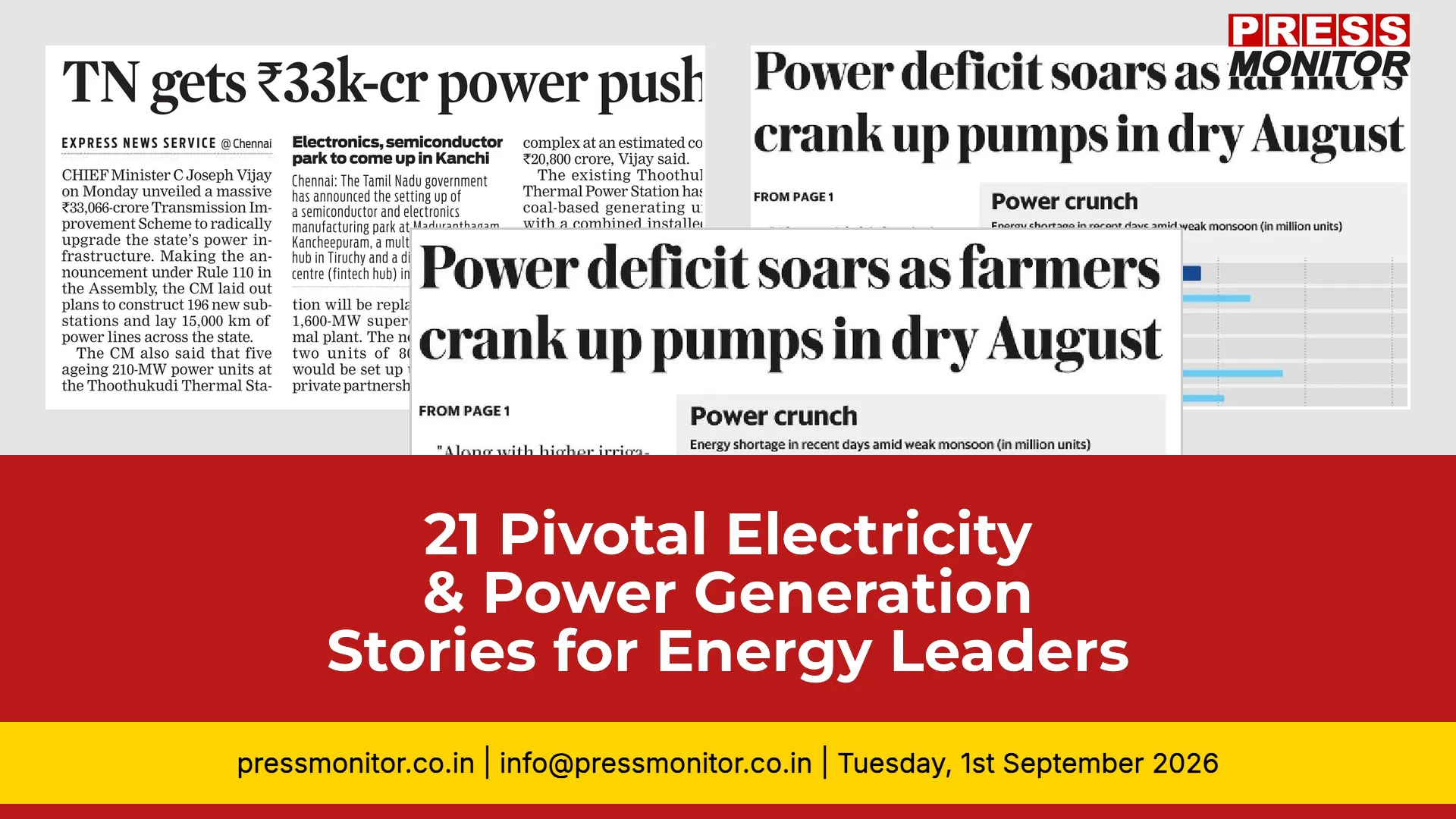
1. Rs 33k-crore power push, new coal plant
A front-page report in New Indian Express says Tamil Nadu Chief Minister M K Stalin unveiled a 33,066 crore Transmission Improvement Scheme to upgrade the state's power infrastructure, including 196 new substations and 15,000 km of power lines. The announcement also included a plan to replace aging coal-fired units at the Thoothukudi Thermal Power Station with six new units of 800 MW each, alongside plans for a semiconductor and electronics manufacturing park.
Why it matters: Massive state-level capital deployment signals accelerated grid modernization.
Key detail/stat: ₹33,066 crore allocated for 196 new substations and 15,000 km of transmission lines, alongside replacement of aging Thoothukudi units.
Source: New Indian Express
Next step: Monitor tender releases for EPC contractors and equipment suppliers.
2. India power deficit hits 10 million units
A front-page report in Mint says a severe dry spell in August has triggered power shortages across India, with the national deficit exceeding 10 million units on 27 August. Increased irrigation needs and air-conditioning use, coupled with low coal stocks and hydro output, have forced grid operators to implement planned blackouts.
Why it matters: Supply-demand mismatch highlights vulnerability to climate variability.
Key detail/stat: National deficit exceeded 10 million units on August 27 due to dry spells, low hydro output, and depleted coal stocks.
Source: Mint
Next step: Assess storage solutions and demand response programs for Q4 preparedness.
3. 270.8GW peak power demand hits India
A front-page report in Mint says India's peak power demand reached 270.8 gigawatts in May as a weak monsoon increased irrigation and air-conditioning needs. This surge has depleted coal stocks at 46 thermal power plants to critical levels while hydropower generation fell 14 per cent in July.
Why it matters: Record consumption strains existing thermal baseload capacity.
Key detail/stat: May peak reached 270.8 GW, driven by weak monsoon irrigation and AC loads, dropping coal reserves at 46 plants to critical levels.
Source: Mint
Next step: Evaluate peaking power contracts and gas-based expansion pipelines.
4. Hundreds Missing After Nepal-China Floods
A front-page report in Economic Times says hundreds of workers believed to be trapped in tunnels at hydropower sites on the Nepal-China border are at risk after catastrophic flooding. The combined deaths in Nepal and China have surpassed 950, with more than 4,400 people missing.
Why it matters: Cross-border climate disasters threaten regional hydropower assets.
Key detail/stat: Over 950 deaths and 4,400 missing reported; dozens of hydropower tunnel workers remain unaccounted for along the border.
Source: Economic Times
Next step: Review insurance coverage and contingency plans for Himalayan projects.
5. NTPC Profit Growth Outpaces Revenue Growth
A front-page report in Indian Express says, NTPC’S PROFIT GROWTH HAS OUTPACED ITS REVENUE GROWTH IN THE PAST THREE YEARS, COINCIDING WITH A PERIOD WHEN INDIA SIGNIFICANTLY RAMPED UP RENEWABLE ENERGY CAPACITY ADDITION.
Why it matters: Operational efficiency gains are decoupling from top-line expansion.
Key detail/stat: Three-year profit growth trajectory exceeds revenue growth amid national renewable capacity ramp-up.
Source: Indian Express
Next step: Analyze margin drivers and cost optimization strategies for peer benchmarking.
6. No Investment in Thermal, Hydel Projects for 5 Years: CM
"A front-page report in New Indian Express says that Tamil Nadu has not made major investments in new thermal and hydel power projects over the past five years. Vijay pointed out that thermal power generation will continue to play a key role in ensuring uninterrupted power supply, particularly during peak demand. The government will also implement a ₹1,762-crore programme to strengthen Chennai’s electricity distribution infrastructure, including 36 new 83/11kV substations and installation of new distribution transformers to improving power supply amid rising electricity consumption and frequent disruptions during the monsoon."
Why it matters: Policy shift toward renewables creates supply gaps during peak demand.
Key detail/stat: Tamil Nadu acknowledges lack of major thermal/hydel investments over five years, pledging ₹1,762 crore for Chennai distribution upgrades.
Source: New Indian Express
Next step: Track state-level balancing mechanisms and battery storage tenders.
7. Panel Advises Thermal Plants Damage Mitigation
A committee formed by the power ministry has recommended measures to reduce wear and tear in coal-based power plants, suggesting plants operating at low loads avoid frequent ramp-up and ramp-down operations. The panel proposed rotating ramping schedules among a pool of units and enabling two-shift operations for old coal-based units. Why itancing: Frequent ramping accelerates asset degradation in aging fleets.
Key detail/stat: Ministry committee recommends rotating ramp schedules and two-shift operations for old coal units to reduce wear and tear.
Source: Business Standard
Next step: Implement predictive maintenance protocols and optimize dispatch algorithms.
8. Govt Opposes Parallel Power Distribution Licence
A front-page report in Tribune says the state government is opposing the proposal to grant a parallel electricity distribution licence in Gurugram-Nuh to private power companies. Energy Minister Anil Vij clarified that the government would continue to oppose the proposal and will approach the court if needed.
Why it matters: Regulatory clarity remains critical for private utility entry.
Key detail/stat: Haryana government firmly rejects parallel distribution licenses in Gurugram-Nuh, threatening legal action if proposal proceeds.
Source: Tribune
Next step: Monitor court filings and state discom consolidation trends.
9. SJVN's Capacity Expansion and Financial Performance
A front-page report in Financial Express says SJVN has expanded its capacity with the operationalization of the 1,000-MW Bikaner Solar Power Project and the 70-MW Dhubri solar project in Assam. The company also ventured into large-scale thermal power generation with the commissioning of the first 660-MW unit of its 1,320-MW Buxar project.
Why it matters: PSUs are successfully diversifying across solar, thermal, and hydro.
Key detail/stat: Commissioned 1,000 MW Bikaner solar, 70 MW Dhubri solar, and first 660 MW unit of 1,320 MW Buxar thermal project.
Source: Financial Express
Next step: Follow dividend announcements and debt restructuring updates.
10. Explosion near Manori power house causes extensive damage
A front-page report in The Hans India says widespread damage occurred to the factory and nearby infrastructure due to an explosion occurring near the Manori power house on 18 July 2026. Immediate impact assessments are underway following the incident reported to authorities.
Why it matters: Infrastructure safety vulnerabilities require immediate audit.
Key detail/stat: Significant factory and grid-side damage reported following July incident; impact assessments ongoing.
Source: The Hans India
Next step: Review industrial safety compliance and emergency response frameworks.
11. Power Reforms Need an Urgent Push
A front-page report in Business Standard says that power regulation is failing India and needs to be overhauled. Electricity consumption is expected to grow faster than economic growth, but inefficiencies in power distribution companies are leading to losses and debt.
Why it matters: Discom inefficiencies threaten fiscal sustainability of the sector.
Key detail/stat: Electricity consumption outpacing GDP growth, but distribution losses and debt continue to strain public finances.
Source: Business Standard
Next step: Advocate for smart meter rollout and tariff rationalization policies.
12. 4 Years Post-IBC Approval: Litigation Halts SKS Power's Unviable Exit Completion
A front-page report in Financial Express says: The Supreme Court's rejection of Vantage Point’s review petition, sparking insidious litigation delays, signals the IBC cannot be gutted through endless disputes. In India, four years after SKS Power Generation’s insolvency initiation due to unresolved disputes, the Supreme Court’s renewed commitment to resolution finality threatens to disrupt even commercial losses from controlled industry forums. Skirting major bid outcomes that once approved over 100% creditor consensus should have legitimised revival by June 2023, a rift persisted amid braces dubbing draft irregularities. It confirmed litigants threaten creditor-backed transitions as control erodes resolution integrity, dissuading critical players facing prolonged waivers.
Why it matters: Insolvency resolution delays deter private capital in distressed assets.
Key detail/stat: Supreme Court rejection of review petition extends litigation, undermining creditor consensus achieved in 2023.
Source: Financial Express
Next step: Track appellate outcomes and potential restructuring pathways.
13. Floating Solar Gets Cabinet Nod
A front-page report in Business Standard says the Union Cabinet has approved a national scheme for floating solar power projects, setting in motion a larger debate around the technology, including its potential in the Indian energy context, commercial viability and benefits.
Why it matters: Land-constrained states gain viable renewable expansion route.
Key detail/stat: Union Cabinet approved national floating solar scheme, sparking debate on commercial viability and ecological impact.
Source: Business Standard
Next step: Monitor state-level implementation guidelines and financing models.
14. India’s Climate-Tech Bankability Gap
A front-page report in Mint says India’s green investment story is a success. In 2024, 83% of all investment in its power sector went into clean energy, according to the International Energy Agency. However, the country is much less adept at financing technologies it will need for the next stage of its transition to a low-carbon economy.
Why it matters: Clean energy investment success masks next-stage financing bottlenecks.
Key detail/stat: 83% of 2024 power sector investment flowed to renewables, yet bankability remains weak for grid-scale storage and green hydrogen.
Source: Mint
Next step: Engage with development finance institutions and blended finance structures.
15. Noida Men Ran Illegal Power Networks
A front-page report in Times of India says that two Noida residents, Rampal and Chatru, were found operating private electricity distribution networks to illegally supply power to hundreds of homes in floodplains and slums. The men set up private transformers and charged consumers higher rates than the official discom, leading to FIRs and the confiscation of equipment.
Why it matters: Informal distribution networks undermine revenue recovery and safety.
Key detail/stat: Two residents operated private transformers in floodplains/slums, charging premium rates before FIR registration and confiscation.
Source: Times of India
Next step: Strengthen grid monitoring and community engagement programs.
16. Election Season Challenges Rajasthan Power Supply
A front-page report in First India says that ensuring uninterrupted power supply during the election season has emerged as a major challenge in Rajasthan. The electricity demand is rising sharply amid the ongoing weak monsoon, putting additional pressure on the state's power grid.
Why it matters: Political cycles intensify pressure on already stressed grids.
Key detail/stat: Weak monsoon and rising demand create blackout risks during critical election periods.
Source: First India
Next step: Coordinate with state election commissions for load management protocols.
17. State to Accelerate Rooftop Solarisation of Govt Buildings
A front-page report in Free Press Journal says the state government will accelerate rooftop solar installations on government buildings under the PM Surya Ghar Muft Bijli Yojana. Additional Chief Secretary, Energy Department, Gaurav Gupta reviewed the progress of solarising government buildings and the scheme’s payment mechanism.
Why it matters: Public sector leadership drives decentralized renewable adoption.
Key detail/stat: Additional Chief Secretary Gaurav Gupta reviewed PM Surya Ghar Muft Bijli Yojana progress and payment mechanisms.
Source: Free Press Journal
Next step: Align corporate PPAs with government procurement timelines.
18. Bihar, Jharkhand Sign Sone River Water Pact
A front-page report in The Pioneer says that Bihar and Jharkhand have signed a long-awaited water-sharing agreement for the Sone River, ending a 25-year dispute and paving the way for irrigation, storage, and power projects.
Why it matters: Interstate water agreements unlock integrated irrigation and power development.
Key detail/stat: 25-year dispute resolved, paving way for joint storage and hydropower projects.
Source: The Pioneer
Next step: Track feasibility studies and central funding allocations.
19. Tata Power-DDL Invites Tenders
A front-page report in Hindustan Times says that Tata Power-DDL invites tenders for short term procurement of up to 750 MW power under the Ministry of Power from 16.04.2027 to 30.09.2027.
Why it matters: Urban utilities secure short-term supply to manage seasonal peaks.
Key detail/stat: Procurement for up to 750 MW under Ministry of Power framework, valid April–September 2027.
Source: Hindustan Times
Next step: Prepare bidding documentation and capacity verification reports.
20. Oil India Arm Signs MoU for Waste-to-Clean-Energy Projects
A front-page report in Free Press Journal says Oil India Limited's arm, OIL Green Energy Limited (OGEL), signed Memoranda of Understanding (MoUs) with four Municipalities of Haryana for development of Integrated CBG and Wasteto-Energy Projects across the respective clusters. The four projects are proposed across the Hisar (56OO TPD), Ambala (9OO TPD), Faridabad (l,6OO TPD) and Gurugram (2,OOO TPD) clusters. Together, the facilities will have the capacity to scientifically process 5,OOO tonnes of municipal solid waste per day and are expected to produce 7O-75 TPD of Compressed Biogas (CBG) along with 5O MW of green power.
Why it matters: Circular economy initiatives convert municipal waste into grid-ready power.
Key detail/stat: OGEL partners with four Haryana municipalities to process 5,000 TPD waste, yielding 70-75 TPD CBG and 50 MW green power.
Source: Free Press Journal
Next step: Monitor project commissioning milestones and emission reduction credits.
21. Power and Defence Drive Capital Goods
A front-page report in Business Standard says that power transmission, data centres and defence are driving strong order inflows for India's capital goods sector. While private sector capex is picking up and government spending remains robust, margins have been pressured by global tensions and high raw material costs.
Why it matters: Industrial demand fuels manufacturing recovery in energy infrastructure.
Key detail/stat: Transmission, data centres, and defence sectors drive strong order inflows, though raw material costs pressure margins.
Source: Business Standard
Next step: Hedge commodity exposure and negotiate long-term supplier contracts.
What emerging technology or policy shift will define your portfolio in the next quarter? Share your perspective below.