23 Essential Water & Wastewater Stories for Infrastructure Leaders


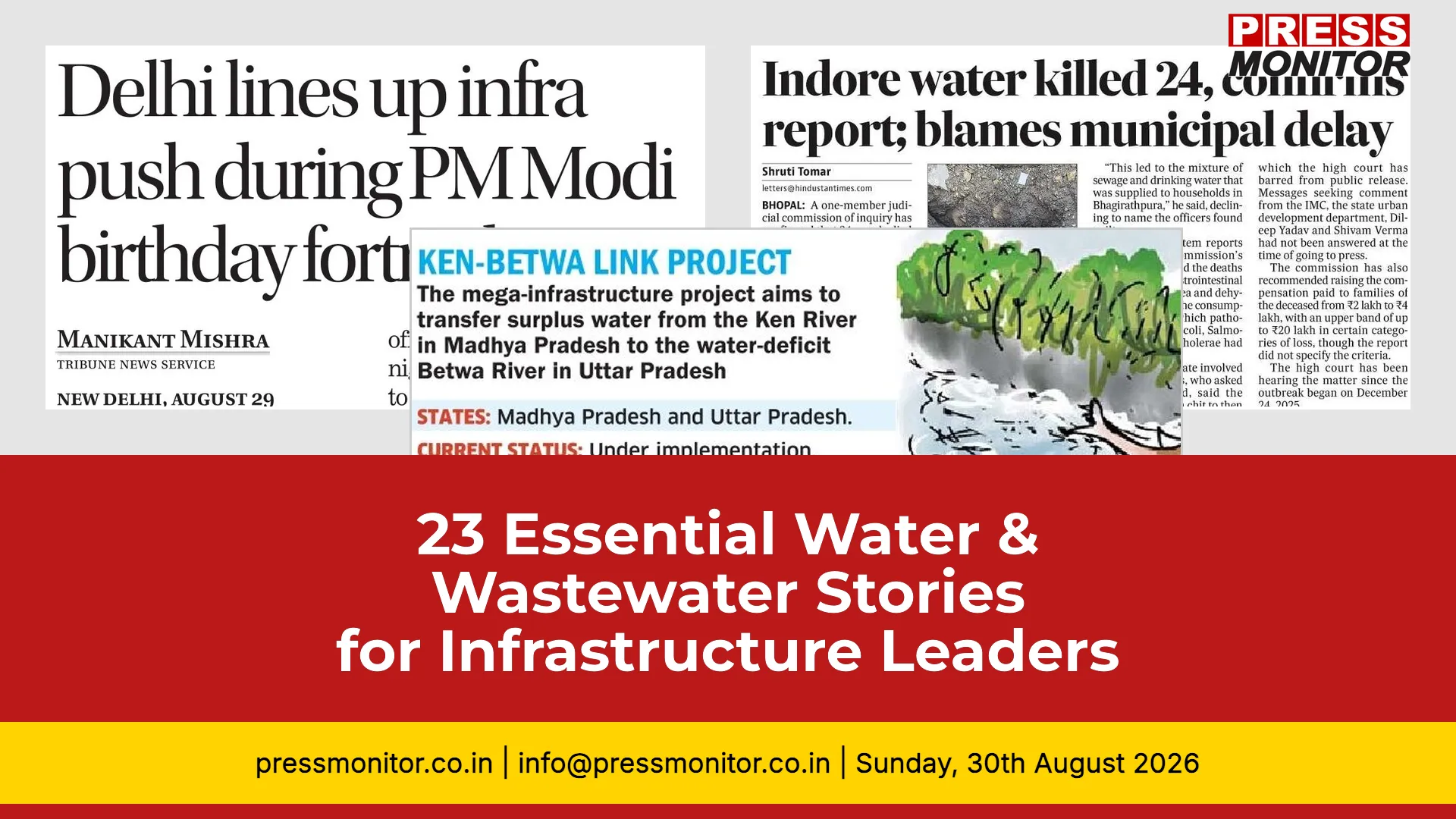
India's water infrastructure is at a crossroads. From deadly contamination outbreaks to mega river-linking projects, the news is non-stop. Press Monitor’s media monitoring of Indian print publications reveals 23 must-know developments today. Here’s what every decision-maker needs to track.
1. Delhi’s Sewa Pakhwada to Launch Rs 1,635 Crore Barapullah Road & Water Projects
“Selon {source_name}, the fortnight will see the inauguration of projects spanning roads, transport, sewerage, water management, education, power and civic amenities. The biggest among them is the Rs 1,635 crore Phase III of the Barapullah Elevated Road. CM Gupta said the programme has added significance this year as Modi, who became Gujarat chief minister on October 7, 2001, is set to complete 25 years in public office. She described the fortnight as an initiative dedicated to Delhi’s residents and the development of the capital. Among the road projects ready for inauguration are an underpass near Mukarba Chowk on the Outer Ring Road and a Rs 54.10 crore approach road connecting Badli Junction with Haiderpur Metro Station. Water and sewerage projects worth Rs 863.38 crore will also be taken up. These include a 2-MGD recycling plant at Bawana, a 564-MLD waste-water treatment plant at Okhla, and sewerage infrastructure linked to Barapullah Drain, Batla House and Okhla. The education package includes a permanent G+3 school building in Dwarka and new classrooms in East Vinod Nagar and Rohini. Their combined cost is Rs 148.02 crore.
Why it matters: The Delhi government’s fortnight of infrastructure inaugurations includes water and sewerage projects worth Rs 863 crore. This signals a major push for urban water management.
Key detail: A 564-MLD wastewater treatment plant at Okhla and a 2-MGD recycling plant at Bawana will be inaugurated.
Source: Tribune, Statesman
Next step: Track which projects get completed on time — this is a bellwether for Delhi’s infrastructure delivery.
2. Indore Water Contamination Kills 24: Judicial Commission Blames Delayed Pipeline Tender
A front-page report in Hindustan Times says that 24 people died in Indore’s Bhagirathpura between December 2025 and February 2026 after consuming water contaminated by sewage supplied through Indore Municipal Corporation pipelines. The commission blames a delayed tender process for laying a new Narmada-water pipeline as the primary cause of the epidemic.
Why it matters: The deaths from sewage-contaminated water highlight the lethal cost of infrastructure delays.
Key detail: 24 residents died between Dec 2025 and Feb 2026; a commission blames Indore Municipal Corporation’s slow Narmada pipeline tender.
Source: Hindustan Times
Next step: Validate your municipal water supply contracts for emergency response clauses.
3. Rs 74,605 Crore Ken-Betwa River Link Gets March 2030 Deadline
A front-page report in The Pioneer says the Union government has set a firm completion target of March 2030 for a mega-infrastructure project. The initiative aims to transfer surplus water from the Ken River in Madhya Pradesh to the water-deficit Betwa River in Uttar Pradesh to provide irrigation, drinking water, and hydropower.
Why it matters: This flagship interlinking project aims to transfer water from Madhya Pradesh to Uttar Pradesh for irrigation and drinking water.
Key detail: The Union government set a firm completion target; the project will also generate hydropower.
Source: The Pioneer
Next step: Monitor land acquisition and interstate water-sharing agreements.
4. Telangana-Maharashtra Talks on Tummidihatti Barrage Set for Sept 1
A front-page report in Deccan Chronicle says the state government expects talks with Maharashtra, convened in New Delhi by the Union Jal Shakti ministry on September 1, to help divert eighty tmc ft of water from Pranahita river to Sundilla barrage via gravity. The meeting will examine Telangana’s proposal to construct a l52-metre full reservoir level barrage at Tummidihatti.
Why it matters: The project could divert 80 TMC ft of water from Pranahita river to Sundilla barrage, benefiting Telangana's irrigation.
Key detail: A 152-metre FRL barrage is proposed; Union Jal Shakti ministry will mediate.
Source: Deccan Chronicle
Next step: Watch for final clearance and feasibility studies.
5. National River Interlinking Plan Envisages 30 Rivers
A front-page report in The Pioneer says the National Perspective Plan envisages interlinking of 30 rivers through Himalayan and Peninsular projects to transfer surplus water to water-deficit regions and promote equitable water distribution. The project faces challenges such as sedimentation, floods, and variable rainfall patterns. The government recognizes the importance of agreement among concerned states for interlinking projects.
Why it matters: The National Perspective Plan aims to transfer surplus water to deficit regions, but faces sedimentation and flooding challenges.
Key detail: Himalayan and Peninsular projects require interstate agreements.
Source: The Pioneer
Next step: Policy professionals should engage with state water resource departments.
6. Salem Water Privatization Challenged in Madras High Court
Chennai: The Madras High Court has directed the Tamil Nadu government and Salem Corporation Commissioner to respond to a petition challenging the decision to privatise the city’s round-the-clock drinking water supply project under the union government’s AMRUT 2.O scheme. Petitioner Rameshkumar said privatisation could increase water charges by up to 500%, severely affecting poor and middle-class residents. He also pointed out that all 60 Salem Corporation councillors had unanimously opposed the move through a resolution, but officials were proceeding with the project. During the hearing before Justice Krishnan Ramasamy, the petitioner alleged that details of the selected bidder among three participating companies had not been disclosed and that tender transparency rules were violated. ENS
Why it matters: Privatization could raise water charges by 500%, according to petitioner; all 60 councilors opposed the move.
Key detail: The court sought state’s response; tender transparency is under scrutiny.
Source: New Indian Express
Next step: Public sector water managers should study the court outcome for outsourcing precedents.
7. Rajasthan Partners with IFAD for Drought Management and Water Infrastructure
A front-page report in First India says that Rajasthan Chief Secretary V Srinivas met with IFAD President Dr Alvaro Lario to discuss rural development, drought management, and water infrastructure. Both parties expressed commitment to sustainable agriculture and drought mitigation strategies. During his Rome visit, Srinivas also met Pope Leo XIV, presenting a medallion on behalf of the IIAS delegation.
Why it matters: Global partnerships bring finance and expertise for rural water security.
Key detail: Chief Secretary met IFAD president in Rome; discussions covered sustainable agriculture and drought mitigation.
Source: First India
Next step: Explore IFAD’s water-related funding opportunities in your state.
8. Bengaluru’s Evergreen Layout Ruined by Sewage Spills for 8 Months
A front-page report in Deccan Herald says severe sewage overflows have repeatedly damaged the poorly maintained road in Evergreen Layout, Kothanur, for almost eight months. Residents face constant drainage leakage, foul odors, and blackened roads, while coordination failures between Greater Bengaluru Authority (GBA) and Bengaluru Water Supply and Sewerage Board (BWSSB) delays fixes. Fluctuating circumferential maintenance quality, spanning GBA’s KR Puram and Mahadevapura jurisdictions, further propels delays. Residents demand prompt drainage repairs, road restoration, and non-functional streetlight fixes to curb daily sewage spills on pedestrians at night.
Why it matters: Coordination failures between GBA and BWSSB leave residents facing daily sewage overflow.
Key detail: Road damage, foul odor, and night-time spills due to jurisdictional confusion.
Source: Deccan Herald
Next step: Civic agencies must streamline maintenance responsibilities.
9. Former DJB CEO and Middleman Remanded in STP Tender Corruption Case
"Selon Times of India, une Delhi court a accordé à l’Anti-Corruption Branch (ACB) une garde à révocation de deux jours au former DGJ Udit Prakash et à l’accusé intermédiaire Nagendra Yadav, estimant qu’une garde à révocation était nécessaire pour une enquête sur une vaste conspiration impliquant une corruption de plusieurs crores de rupees. Le juge spécial a déclaré qu’une garde à révocation policière était nécessaire pour une enquête équitable et pour «dévoiler d’autres aspects de la conspiration», y compris l’implication d’autres personnes. Le procureur Manish Rawat a soumis que Prakash avait approuvé divers amendements après avoir reçu leur contenu par WhatsApp des co-accusés avant leur émission officielle. La cour a également examiné un accord de prêt litigieux et a observé que «il ne semble apparemment pas s’agir d’une erreur typographique dans la date», notant que Prakash avait lui-même signé le document daté du 10 février 2023. La cour a déclaré que l’ACB craignait que l’accord de prêt «ne puisse pas être rejeté à ce stade» et pourrait avoir été créé ultérieurement pour donner au transaction «une couleur de légitimité" . Elle a également observé que les témoignages des témoins «suggèrent l’implication des accusés dans la conspiration". Concernant Yadav, la cour a déclaré que son rôle présumé dans les transactions de hawala nécessitait une enquête approfondie. Les rôles des deux accusés étaient apparus dans les déclarations de témoins ultérieures et a conclu qu’une garde à révocation de deux jours était nécessaire pour une enquête équitable. Prakash et Yadav ont été arrêtés avec le ministre DJB Satyendar Jain le 18 août dans le cadre d’une affaire liée à la manipulation des appels d’offres pour l’augmentation et l’amélioration de 10 stations d’épuration des eaux (STP). L’ACB a allégué que le processus d’appel d’offres avait été truqué pour favoriser Euroteck Environmental Pvt Ltd, entraînant des pertes pour le trésor public."
Why it matters: Corruption in STP upgrades undermines public trust and costs the exchequer crores.
Key detail: ACB got 2-day custody of Udit Prakash over alleged tender rigging favoring Euroteck Environmental.
Source: Times of India
Next step: Compliance teams should review tender evaluation processes.
10. Karnataka to Seek Centre’s Approval for Mekedatu Project After SC Nod
A front-page report in Morning Standard says that the state government is getting ready to approach the central government to seek approval for implementing the Mekedatu project following a favourable Supreme Court ruling.
Why it matters: The Mekedatu storage project on Cauvery is crucial for Bengaluru’s drinking water.
Key detail: Supreme Court ruling cleared the way; Karnataka government will approach central government.
Source: Morning Standard
Next step: Interstate coordination on Cauvery water sharing will intensify.
11. Yamuna Revival: Sabarmati’s Transformation Offers Blueprint
A front-page report in Hindustan Times says that the transformation of the Sabarmati offers Delhi an important lesson: river rejuvenation must begin by addressing pollution sources.
Why it matters: Delhi’s Yamuna rejuvenation can learn from Ahmedabad’s success — starting with pollution source control.
Key detail: River revival must begin by stopping sewage and industrial discharge.
Source: Hindustan Times
Next step: Urban planners should study Sabarmati Riverfront model for replication.
12. Himachal’s First Ozone-Based Water Treatment Plant at Dehra
A front-page report in Tribune says Chief Minister Sukhvinder Singh Sukhu announced Himachal Pradesh’s first ozone-based drinking water treatment project would be established in Dehra of Kangra district at a cost of Rs 46 crore to ensure the supply of clean and safe drinking water to residents.
Why it matters: Ozone treatment ensures chemical-free drinking water — a model for hilly states.
Key detail: Rs 46 crore project in Kangra district announced by CM Sukhu.
Source: Tribune
Next step: Water technology vendors can explore ozone-based solutions in Himalayan regions.
13. Telangana Tenders for Revenue, Billing and Collection Services
A front-page report in Deccan Chronicle says the Government of Telangana, Hyderabad Metropolitan Water Supply & Sewerage Board, is inviting tenders for the Manning and Operation of Revenue, Billing and Collection (Services and Materials) for a period of one year under Ameerpet Ward, Ameerpet Circle, Khairatabad Zone, Hyderabad Region.
Why it matters: Revenue management of water supply is critical for utility finances.
Key detail: One-year contract for Manning and Operation of billing under Ameerpet Ward.
Source: Deccan Chronicle
Next step: Billing and collection companies should track this opportunity.
14. UP Jal Nigam Invites E-bids for O&M of 13 STPs in Meerut
A front-page report in Hindustan Times says that on behalf of U.P. Jal Nigam (Urban), e-bids are invited for the comprehensive operation and maintenance of 13 Nos Sewerage Treatment Plant in Meerut. E-bid documents will be available on U.P. Govt. e-procurement portal and U.P.J.N. (Urban) website from dated 02.09.2026.
Why it matters: Operation of sewage treatment plants is a recurring need; this tender covers comprehensive maintenance.
Key detail: Documents available from Sept 2 on UP e-procurement portal.
Source: Hindustan Times
Next step: Infrastructure firms should bid for the O&M contract.
15. Rs 6.2 Crore World Bank-Funded Tender for Uttarakhand Water Projects
A front-page report in Hindustan Times says the Government of India, with World Bank financing, is inviting e-quotations for Rs 6.2 crore security protection for water-related revival projects in Dhalwala, Rishikesh, under the U-PREPARE mission. This includes infrastructure such as survey, design, and construction of retaining walls, boundary walls, staff quarters, and retention of water supply systems for ensuring civic safety under a census town scheme.
Why it matters: International funding for water revival infrastructure in Rishikesh under U-PREPARE mission.
Key detail: Includes survey, design, and construction of retaining walls and staff quarters.
Source: Hindustan Times
Next step: Contractors specializing in World Bank projects should examine the tender.
16. Amit Shah Proposes River Interlinking to Solve Water Shortage for 100 Years
A front-page report in The Pioneer says Union Home Minister Amit Shah has proposed linking India’s great rivers to ensure no water shortage for the next 100 years. The proposition sits within India’s long-standing National Perspective Plan for interlinking rivers, but requires defined route, diversion mechanisms, and agreements among affected states.
Why it matters: Political push for a massive infrastructure agenda — but requires state consensus.
Key detail: Home Minister’s call aligns with National Perspective Plan; diversion mechanisms pending.
Source: The Pioneer
Next step: Policy analysts should assess constitutional hurdles in inter-state water sharing.
17. Phoenix (US) Water Crisis Deepens — Lessons for India’s Arid Regions
A front-page report in The Pioneer says, Cave Creek, a town near Phoenix, is struggling with dwindling water supplies from the Colorado River due to climate change, overuse, and a new federal plan. The town relies almost entirely on the river for its water needs, and recent cuts have already impacted residents.
Why it matters: Climate change and overuse are draining the Colorado River; Cave Creek faces cuts.
Key detail: Town relies almost entirely on the river; federal plan now restricts supply.
Source: The Pioneer (covering global story)
Next step: Indian policymakers should study water demand management strategies from the West.
18. Large-scale Inter-basin Water Transfers Need Public Scrutiny, Says Report
A front-page report in The Pioneer says India's proposed inter-basin water transfer systems, like Brahmaputra to Cauvery and Godavari, require detailed public scrutiny on costs, benefits, and ecological impacts.
Why it matters: Proposals like Brahmaputra to Cauvery require ecological and cost-benefit analysis.
Key detail: Detailed public scrutiny is necessary before implementation.
Source: The Pioneer
Next step: Environmental groups should prepare impact assessments.
19. 62% of Haryana Blocks Have TDS Exceeding Safe Limits
A front-page report in Tribune says the Haryana Government has admitted that groundwater in 62% of 142 blocks exceeds acceptable TDS levels, with 35 blocks surpassing 1,000 mg/litre. Water samples in villages like Belarkhan (9,553 mg/litre) and Ashraf Pur Matinlu (8,791 mg/litre) show critical contamination. Villages in Nuh and Palwal villages also face severe water shortages, with over 160 villages receiving below the Jal Jeevan Mission threshold.
Why it matters: Groundwater contamination affects over 160 villages; some blocks have TDS over 9,000 mg/litre.
Key detail: Jal Jeevan Mission threshold not met for many; Belarkhan village worst-hit.
Source: Tribune
Next step: Water purifiation technologies demand in Haryana’s rural markets.
20. Karnataka Forms Two Committees for Cloud Seeding Amid Rainfall Deficit
A front-page report in Deccan Herald says the Karnataka government has constituted two separate committees to ensure the smooth implementation and monitoring of the cloud seeding programme, addressing rainfall deficit and drought-like situations caused by below-normal monsoon.
Why it matters: Below-normal monsoon threatens agriculture and drinking water; cloud seeding is a mitigation measure.
Key detail: Committees will monitor implementation and address drought-like situations.
Source: Deccan Herald
Next step: Meteorological agencies can partner with state governments on cloud seeding operations.
21. CAG Report: Rajasthan Used Only 30% of Jal Jeevan Mission Funds
A front-page report in New Indian Express says that Rajasthan failed to utilise more than 70% of the Central funds allocated under the Jal Jeevan Mission (JJM), and the scheme’s implementation was marred by irregular payments, poor quality checks and procedural lapses, according to a Comptroller and Auditor General (CAG) report.
Why it matters: Underutilization of central funds for rural water access indicates implementation failures.
Key detail: Irregular payments and poor quality checks flagged by CAG; Rs 70% + funds unutilized.
Source: New Indian Express
Next step: State governments must streamline fund flow and contractors for AMC.
22. England’s ‘Flash Drought’ Pushes Water Network to Breaking Point
A front-page report in Times of India says that the severe 'flash drought' gripping England is pushing an already struggling water network toward breaking point. It shows no sign of easing, particularly dire in the southeast where water companies are trucking supplies around, seeking emergency restrictions.
Why it matters: Global examples show water stress can hit even developed nations; India’s utilities should anticipate similar events.
Key detail: Water companies in southeast England are trucking supplies and seeking emergency restrictions.
Source: Times of India
Next step: Indian water utilities should stress-test their networks for sudden droughts.
23. Delhi Identifies 8 ‘Troublesome’ Drains for First Time — Encroachments and Sewage Hamper Flow
"Selon Asian Age, Delhi authorities have identified eight ‘troublesome’ drains for the first time, complicated by encroachments, sewage discharge, and waste dumping, hindering flood management. These drains are detailed in the service plan report shared by the irrigation and flood control (IFC) department, and the issues were flagged in the recently approved Master Plan of Delhi 2O47. Various agencies, including the MCD, IFC, Delhi Development Authority, and Delhi Jal Board, face challenges in maintenance, with solutions proposed such as shifting pipelines and parallel carriageways."
Why it matters: Flood management in Delhi depends on clearing these drains; encroachments complicate matters.
Key detail: MP-2047 flagged issues; IFC department report shared with multiple agencies.
Source: Asian Age
Next step: RWA and civic groups should track desilting progress before monsoon.
Closing: These 23 stories show the breadth of water challenges and opportunities across India. Press Monitor’s press review keeps you ahead of the policies, tenders, and crises that shape the industry. Which water story affects your work most? Share your view with us.