25 Essential AI Stories for Business Leaders


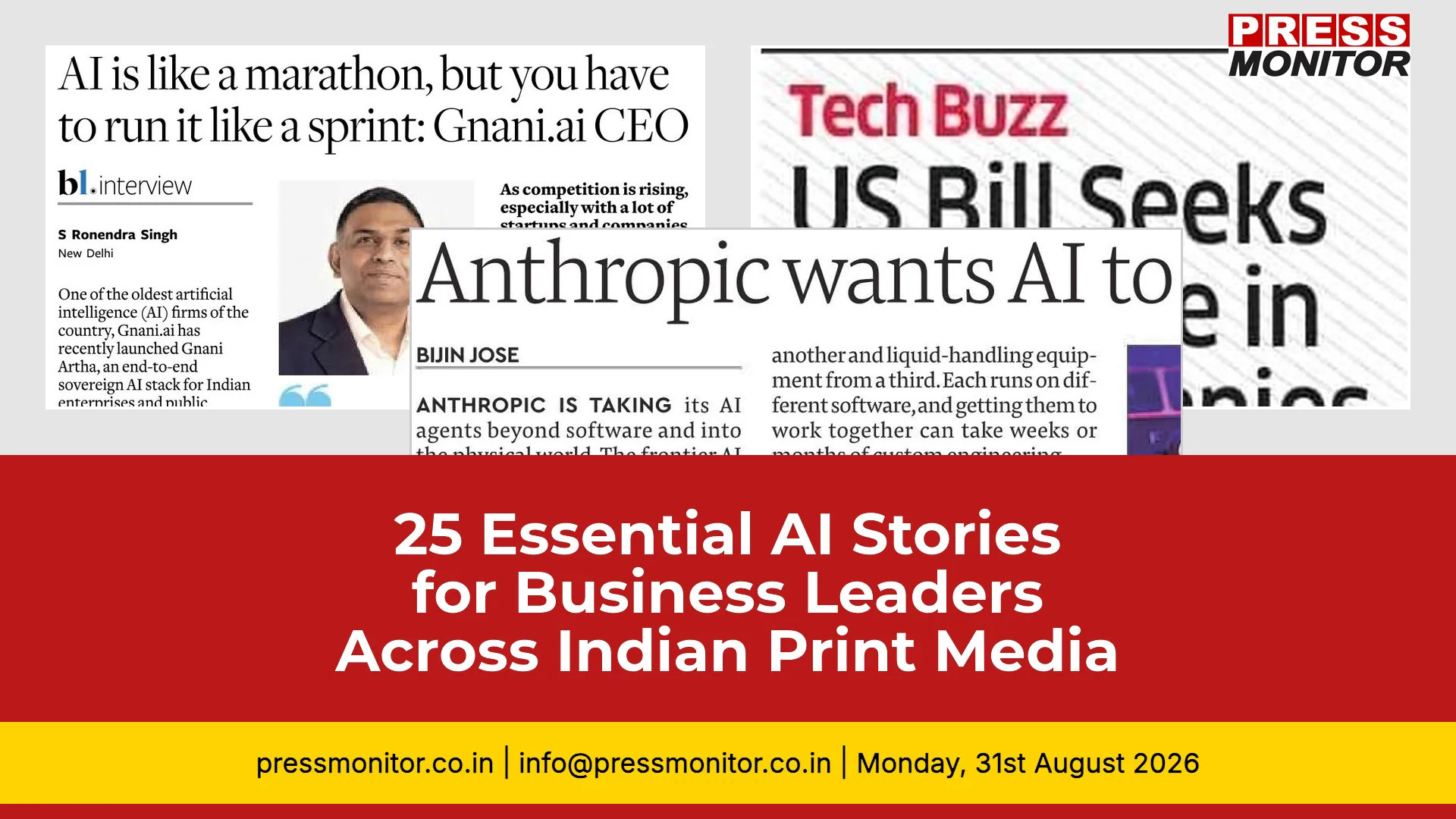
Artificial Intelligence is reshaping how India builds, regulates and competes. This media monitoring roundup distills 25 front-page stories from 11 Indian publications on 31 August 2026 — from sovereign AI stacks to cyber defences. For decision-makers who need news on Artificial Intelligence without the noise, this is the day in print.
According to Press Monitor's tracking of Indian publications, these are the stories that moved markets, policy and tech strategy today.
1. Gnani.ai launches sovereign AI stack
“A marathon, but you have to run it like a sprint,” says Gnani.ai CEO Ganesh Gopalan. The company, known for its largest deployments of voice AI, has recently launched Gnani Artha, an end-to-end sovereign AI stack built on two key components: Gnani Evon v3.3, a 30-billion-parameter open-weights model trained natively across 11 Indian languages, and Gnani Plexus, the company’s agentic AI platform. Backed by the government’s India AI Mission, Gnani Artha is designed to host a family of models, including one with 70-billion parameters, with the aim of achieving 100-billion parameter models and beyond, utilizing Indic language capabilities with significantly reduced token consumption compared to global models.
Why it matters: India is building its own AI foundation instead of importing one.
Key detail: Gnani Artha combines Evon v3.3, a 30-billion-parameter model trained in 11 Indian languages, with the Plexus agentic platform. Backed by India AI Mission.
Source: Business Line
Next step: Watch whether 100B-parameter Indic models close the cost gap with global LLMs.
2. US proposes AI equity transfer to government fund
A front-page report in Economic Times says, US legislation would require certain Artificial Intelligence (AI) companies to transfer a 50% equity stake to a government-managed sovereign wealth fund, according to a new congressional report that warns the measure could face constitutional challenges.
Why it matters: A radical governance experiment could redraw AI ownership.
Key detail: A US congressional report proposes requiring certain AI companies to transfer a 50% equity stake to a government-managed sovereign wealth fund, while warning of constitutional challenges.
Source: Economic Times
Next step: Track how this proposal influences India's own AI governance debate.
3. Anthropic's AI agents manage machines
A front-page report in Financial Express says Anthropic is taking its AI agents beyond software into the physical world. The company has introduced a research preview of the Model Hardware Standard (MHS), a new interface designed to help AI agents communicate with and operate programmable machines used in laboratories, manufacturing, and scientific research.
Why it matters: AI is moving from text into physical operations.
Key detail: Anthropic's Model Hardware Standard research preview lets AI agents control lab, manufacturing and scientific equipment.
Source: Financial Express
Next step: Evaluate which industrial workflows in India could adopt an MHS-style standard.
4. Murf AI raises Rs 15M for real-time conversational AI
A front-page report in Deccan Herald says Murf AI, a Bengaluru-based startup, revolutionised voice AI by launching Falcon 2—a real-time text-to-speech solution—designed to address global gaps in real-time voice agent technology. Built by founders Ankur Edkie (CEO), Sneha Roy (COO), and Divyanshu Pandey (CBSO), the company raises Rs 15M and targets India’s oversaturated yet fast-growing conversational AI market, aiding multilingual (including code-mixed scripts) and scalable voice AI deployments despite data challenges in regional languages.
Why it matters: Bengaluru's voice AI stack is targeting global real-time speech gaps.
Key detail: Falcon 2, a real-time text-to-speech product, was launched with Rs 15M seed funding; founders target code-mixed Indian languages.
Source: Deccan Herald
Next step: Watch Murf AI's enterprise voice deployments for multilingual scale.
5. Generative AI designs gene-editing proteins
A front-page report in Business Line says Mandrake Bio, a Bengaluru-based biotech startup, is using generative AI to design proteins for precise gene editing, aiming to address genetic diseases and improve agricultural output.
Why it matters: AI is entering biotech's most consequential frontier — gene editing.
Key detail: Mandrake Bio, a Bengaluru startup, uses generative AI to design proteins for precise gene editing in healthcare and agriculture.
Source: Business Line
Next step: Follow regulatory readiness for AI-designed biological tools.
6. World Bank: AI is India's opportunity to lift jobs and living standards
The global economy continues to show resilience despite fresh energy and supply-chain shocks, with growth and job creation remaining firm across many regions, World Bank managing director and chief knowledge officer Paschal Donohoe tells Deepshikha Sikarwar. The former Irish finance minister, who was on a visit here, believes artificial intelligence (AI) could be a powerful opportunity for emerging economies, particularly India, to lift productivity, jobs and living standards. India wants to build domestic AI capability while also using foreign frontier models. Some economies will focus on advance AI. But there is great potential for others to adapt and adopt these technologies. Adaptation means making large AI models more appropriate through the use of local content. In India, for example, local culture, language and law need to be reflected in these models.
Why it matters: International institutions are framing AI as an economic multiplier for India.
Key detail: World Bank managing director Paschal Donohoe says adapting AI to local language, culture and law is India's edge.
Source: Economic Times
Next step: Align AI skilling and local-model strategy with this policy signal.
7. Supreme Court tells law schools to teach AI, not ban it
A front-page report in Statesman says the Supreme Court of India has directed law schools to integrate generative artificial intelligence into the classroom rather than prohibit it. Chief Justice Surya Kant emphasized that students must cultivate discernment to understand when AI tools assist and when they must be set aside. Meanwhile, the 2026-27 Union Budget announced an allocation exceeding Rs 1.39 lakh crore for the Ministry of Education to establish high-powered committees and the India AI Mission for creating indigenous language models.
Why it matters: The judiciary has entered the AI classroom debate.
Key detail: Chief Justice Surya Kant says students need discernment; Budget 2026-27 allocates Rs 1.39 lakh crore plus the India AI Mission for indigenous models.
Source: Statesman
Next step: Law schools and edtechs should design AI-discretion modules now.
8. Open-source AI models top security threat list
A front-page report in Business Standard says that Meerah Rajavel, CIO of Palo Alto Networks, believes that open-source AI models pose the greatest security threat to cybersecurity. She explains that cheap access to large language models has changed the game in cybersecurity and that enterprises’ sensitive documents getting into LLMs without the right controls has made security more important.
Why it matters: Cheap LLM access has created a new enterprise attack surface.
Key detail: Palo Alto Networks CIO Meerah Rajavel says sensitive documents entering LLMs without controls is the biggest risk.
Source: Business Standard
Next step: CISOs need LLM data-loss-prevention controls before the next model update.
9. Atlassian doubles down on India as AI changes software development
A front-page report in Business Line says... Atlassian is positioning its India development centre as a strategic R&D hub as the company expands its use of AI agents and builds products around its Teamwork Graph technology, said Vikram Rao, CTO, Enterprise and Chief Trust Officer at Atlassian. The India site has grown to more than 2,700 employees, with a large portion working across engineering, product and design, while the company is also expanding its sales workforce in the country.
Why it matters: India's R&D centres are becoming AI product hubs.
Key detail: Atlassian's India site has crossed 2,700 employees; CTO Vikram Rao says AI agents and Teamwork Graph will shape the roadmap.
Source: Business Line
Next step: Benchmark your engineering org against Atlassian's AI-agent workflow.
10. Meta reverses job cuts, bets on AI reskilling
"Selon Economic Times, Meta has reversed its planned widespread job cuts, highlighting the limitations companies face when pursuing AI-native strategies. Instead of aggressive layoffs, the company is focusing on reskilling employees to work alongside artificial intelligence, recognizing that a clean swap between human and AI roles is rare. This approach aligns with a broader trend of companies prioritizing human-AI collaboration over wholesale deskilling, acknowledging the complexities and potential risks of complete automation."
Why it matters: A clean swap of humans for AI is rare in practice.
Key detail: Meta is prioritising employee reskilling over mass layoffs, signalling the limits of AI-native workforce strategies.
Source: Economic Times
Next step: HR leaders should compare reskilling vs replacement economics.
11. Nvidia targets global robotics market
A front-page report in Mint says that Nvidia is betting big on artificial intelligence for real-world objects like robots, cars, and drones with China emerging as a major customer.
Why it matters: Physical AI could be the next growth engine.
Key detail: Nvidia is betting on robots, cars and drones, with China emerging as a major customer.
Source: Mint
Next step: Watch India's robotics supply chain for Nvidia-linked opportunities.
12. Cashfree deploys AI agents for payments
A front-page report in Business Standard says Cashfree Payments is rolling out artificial intelligence (AI) agents to automate payment operations. The AI agent called Relay can be deployed by merchants for use cases such as retrying failed payments, following up on abandoned carts, confirming cash-on-delivery orders before dispatch, managing failed subscriptions and filing disputes, among others.
Why it matters: AI agents are automating revenue operations, not just chat.
Key detail: Relay retries failed payments, follows up on abandoned carts, confirms cash-on-delivery orders and files disputes.
Source: Business Standard
Next step: Merchants should map which payment workflows can be delegated.
13. Musk and Harari agree AI will reshape civilisation
A front-page report in Mint says that Elon Musk and Yuval Noah Harari have differing views on AI's impact but agree on its transformative path. Musk warns about AI's potential existential threat, while Harari fears its influence on human agency. Both agree AI will change civilization, raising questions about human control and ownership.
Why it matters: Two very different thinkers converge on AI's scale of impact.
Key detail: Musk warns of existential risk; Harari warns of lost human agency; both see transformation.
Source: Mint
Next step: Use this debate to pressure-test your AI ethics framework.
14. India turns to AI for faster disaster warnings
A front-page report in Business Standard says India is integrating artificial intelligence and machine learning into its weather forecasting and disaster management systems to speed up early warnings. The Ministry of Earth Sciences has deployed AI weather models and collaborated with technology institutes to strengthen response capabilities against floods, landslides and extreme weather events using satellite data and sensor networks.
Why it matters: AI now sits inside public safety infrastructure.
Key detail: The Ministry of Earth Sciences has deployed AI weather models with satellite and sensor data to speed up flood and landslide warnings.
Source: Business Standard
Next step: State disaster cells should integrate AI outputs into last-mile alerts.
15. Nvidia's price hike pushes US firms to innovate
A front-page report in Financial Express says, US firms will need to start thinking more like their counterparts in China after Nvidia raised the prices of its accelerator processors by more than 15%.
Why it matters: Hardware cost shocks are changing AI economics.
Key detail: Nvidia raised accelerator prices by more than 15%, forcing US firms to think more like their Chinese counterparts.
Source: Financial Express
Next step: CFOs should stress-test AI infrastructure budgets for price volatility.
16. World Bank calls for global AI standards
A front-page report in Economic Times says, the World Bank believes there is an important role for global standards in relation to AI because those can make a contribution to inclusive use of AI across the world. The bank can provide the policy advice and support needed to develop appropriate regulation and governance.
Why it matters: Global standards could make AI adoption inclusive.
Key detail: The World Bank sees an important role for common standards and can support AI regulation and governance policy.
Source: Economic Times
Next step: Indian policymakers can use this signal to shape cross-border AI rules.
17. AI trust drops below 40%
Selon Hindustan, la confiance des clients dans l'intelligence artificielle générative diminue. Une étude de McKinsey a révélé que la confiance est tombée en dessous de 40 %. L'étude a découvert que les entreprises font peu référence à leurs propres sites web lorsque l'IA répond aux questions des utilisateurs, et que les jeunes consommateurs font moins confiance aux recommandations de leurs amis et de leur famille par rapport à l'information provenant de diverses sources.
Why it matters: Consumer confidence in generative AI is eroding.
Key detail: McKinsey research finds trust below 40%; companies rarely cite their own websites in AI answers.
Source: Hindustan
Next step: Brands need transparent, verifiable AI citations.
18. NHAI makes AI-MC mandatory for big highways
A front-page report in Times of India says the National Highways Authority of India (NHAI) has made Automated and Intelligent Machine-Aided Construction (AI-MC) compulsory for highway projects exceeding 20 km or Rs 500 crore, aiming to address quality concerns. The AI-MC system uses on-board computers and sensors on heavy machinery to monitor construction layers like embankments and granular sub-bases. Officials state this move improves accuracy, minimizes errors, and creates digital records of roadworks
Why it matters: AI is becoming a construction-quality standard.
Key detail: Projects over 20 km or Rs 500 crore must use Automated Intelligent Machine-Aided Construction with sensors on heavy machinery.
Source: Times of India
Next step: Infrastructure contractors should adopt AI-MC workflows to stay eligible for tenders.
19. Vivek Raghavan named among TIME's top 100 AI leaders
A front-page report in Business Standard says... Vivek Raghavan, cofounder of Sarvam AI, has been named as one of the 100 most influential leaders in artificial intelligence (AI) by TIME Magazine.
Why it matters: Indian AI talent is now a global benchmark.
Key detail: Sarvam AI cofounder Vivek Raghavan made TIME Magazine's list of 100 most influential AI leaders.
Source: Business Standard
Next step: Track Sarvam AI's Indic-model roadmap.
20. US voters turn on AI data centres
A front-page report in Deccan Chronicle says that US voters are increasingly opposing data centres powering the artificial intelligence boom due to rising electricity bills and noise. Candidates in at least 21 races across 18 states have aired advertisements targeting Big Tech, while Texas Governor Greg Abbott has frozen new projects to assess their impact on power and water supplies.
Why it matters: AI infrastructure is becoming a political flashpoint.
Key detail: Candidates in 21 races across 18 states have run ads against Big Tech; Texas froze new projects.
Source: Deccan Chronicle
Next step: Energy and tech firms should monitor community-impact risk.
21. BlupaceTech opens global capability centre
A front-page report in Economic Times says... BlupaceTech has announced the opening of its new Global Capability Centre (GCC), marking a significant milestone in the company’s international growth strategy and strengthening its ability to deliver Artificial Intelligence, digital transformation and next-generation technology services to enterprises worldwide.
Why it matters: India continues to win AI services mandates.
Key detail: BlupaceTech's new GCC strengthens delivery of AI and digital transformation services globally.
Source: Economic Times
Next step: Track GCC expansion as a measure of India's AI services demand.
22. CXOs race to sharpen AI edge
A front-page report in Economic Times says senior executives are increasingly enrolling in artificial intelligence programmes to keep pace with the rapidly changing digital teams. At Emeritus, enrolments among execs with over 20 years of experience rose by over 2O% in FY26. At upGrad, enrolments in C-suite AI programmes grew nearly sixfold year-on-year between the first quarters of 2O25 and 2O26. Simplilearn reported more than 4O% on-year growth in its AI category, with agentic AI programmes recording over lOO% growth. This is largely because senior leaders are increasingly moving from wanting to understand the technology to being accountable for driving AI transformation.
Why it matters: Leadership accountability for AI is rising.
Key detail: Emeritus C-suite AI enrolments grew, upGrad saw C-suite AI programme growth of nearly 6x year-on-year, and agentic AI courses doubled.
Source: Economic Times
Next step: Boards should invest in AI fluency for senior executives.
23. 67% of Indian telecom operators see AI as top revenue driver
A front-page report in Business Standard says Indian telecommunications and network service providers are optimistic about AI’s financial benefits, with 67% Agreeing strongly that AI-driven network services will drive revenue growth over the next three to five years.
Why it matters: Telecom is moving from connectivity to AI services.
Key detail: 67% strongly agree AI-driven network services will drive revenue over the next 3-5 years.
Source: Business Standard
Next step: Network vendors should target AI-service revenues.
24. RBI and SEBI tighten cyber net against AI threats
A front-page report in Indian Express says the Reserve Bank of India and the Securities and Exchange Board of India are strengthening cybersecurity frameworks to combat AI-driven threats. The regulators are introducing new resilience indices and reporting formats to protect the financial ecosystem from sophisticated fraud and deepfakes.
Why it matters: Financial regulators are defending against deepfakes and AI fraud.
Key detail: New resilience indices and reporting formats are being introduced for the financial ecosystem.
Source: Indian Express
Next step: Banks and fintechs must align cyber reporting with new RBI and SEBI formats.
25. DWS shifts AI investments from chips to hyperscalers
A front-page report in Business Standard says DWS Group has shifted its artificial intelligence investment focus from semiconductor companies to hyperscalers due to anticipated slowdowns in AI infrastructure spending.
Why it matters: Institutional money is rotating inside the AI trade.
Key detail: DWS is reducing semiconductor exposure and moving toward hyperscalers ahead of a possible AI infrastructure spending slowdown.
Source: Business Standard
Next step: Investors should model AI-spend rotation.
That was today's AI print landscape, tracked by Press Monitor. Which of these 25 stories will matter most to your organisation? The answer is often on the next front page.
