3 Essential Climate Stories for Policy Leaders


According to Press Monitor's tracking of Indian publications, news on climate from September 3 reveals three defining developments shaping India's environmental and policy landscape. From UNEP's stark warning on global temperature thresholds to the devastating Nepal flood toll and Bihar's flood alert, these stories demand immediate attention from decision-makers.
1. UNEP Report: 1.5°C Threshold Breach Inevitable
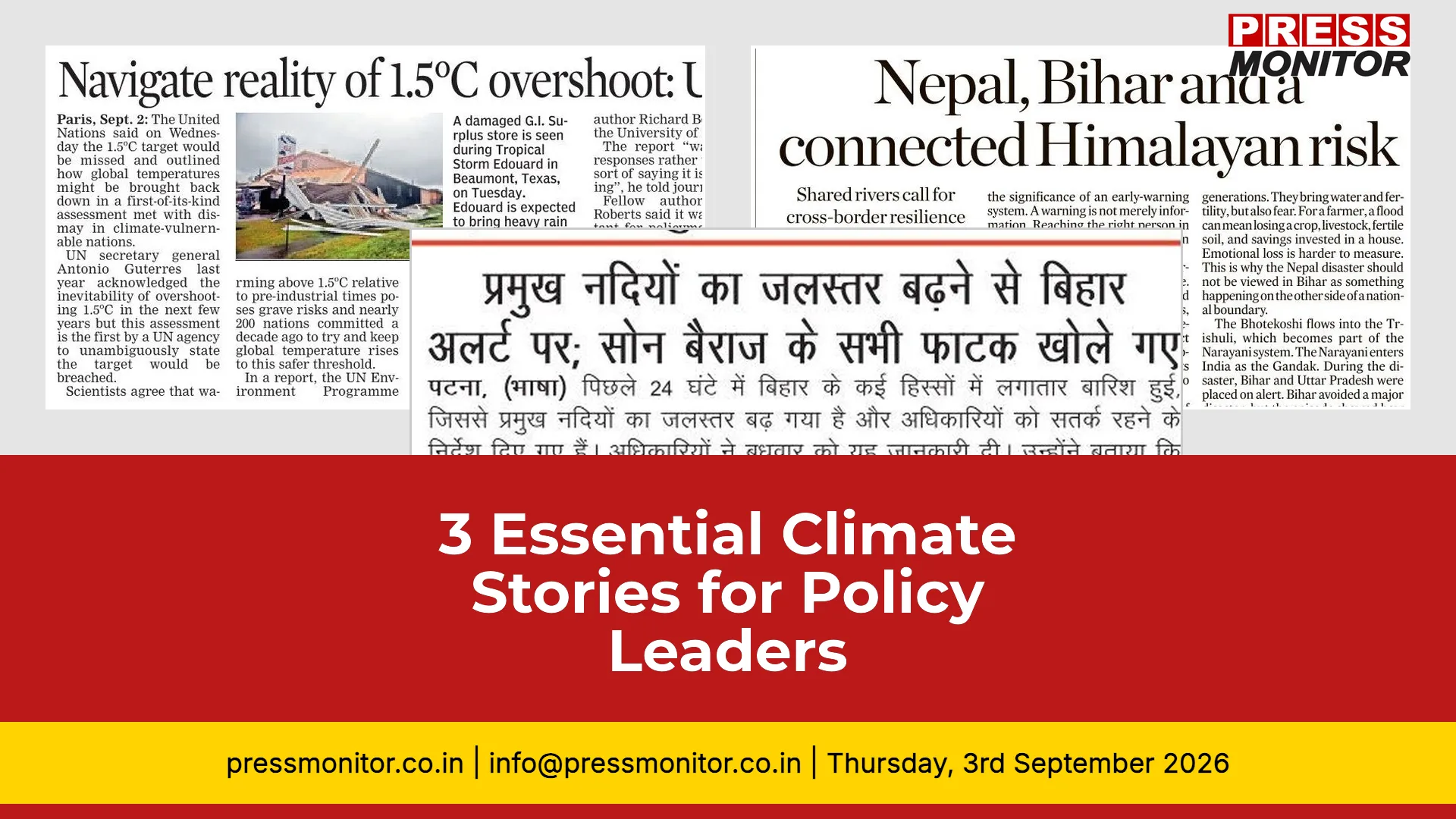
A front-page report in Deccan Chronicle says the United Nations has warned that the 1.5°C global warming target will be breached, in a first-of-its-kind assessment met with dismay in climate-vulnerable nations. The UN Environment Programme report says the best remaining option has shifted from avoiding overshoot to navigating it, with co-author Debra Roberts urging policymakers to reconfigure climate governance around an overshoot pathway. UN Secretary-General Antonio Guterres had earlier acknowledged that overshooting 1.5°C in the next few years was inevitable.
The United Nations Environment Programme has for the first time unambiguously stated that the 1.5°C global warming target will be breached in the next few years. Co-authors Richard Betts and Debra Roberts urge policymakers to reconfigure climate governance around an overshoot pathway. UN Secretary-General Antonio Guterres had earlier acknowledged that overshooting 1.5°C was inevitable. This marks a pivotal shift from avoidance to adaptation planning.
Why it matters: Every fraction of a degree above 1.5°C amplifies extreme weather, sea-level rise, and ecosystem collapse. Governments and corporations must now plan for a world beyond the Paris Agreement's safest threshold.
Key detail: The UNEP report says the best remaining option has shifted from avoiding overshoot to navigating it.
Source: Deccan Chronicle, New Delhi
Next step: Climate policy teams should integrate overshoot scenarios into risk models and communicate revised timelines to stakeholders.
2. Nepal Floods: Death Toll Surges Past 939
A front-page report in Deccan Herald says a sudden collapse of ice and rock near the Nepal-Tibet border on 26 August sent floods surging through the Bhotekoshi, Trishuli and Narayani river systems, killing at least 939 people and displacing thousands, with hundreds of hydropower workers rescued or stranded. Writer Ashutosh Kumar Thakur, who grew up in Mithila in Madhubani, says the disaster shows India and Nepal must treat their rivers as shared ecological systems and ensure early warnings reach vulnerable communities in time.
A sudden collapse of ice and rock near the Nepal-Tibet border on 26 August sent floods surging through the Bhotekoshi, Trishuli, and Narayani river systems, killing at least 939 people and displacing thousands. Writer Ashutosh Kumar Thakur says the disaster shows India and Nepal must treat their rivers as shared ecological systems and ensure early warnings reach vulnerable communities in time.
Why it matters: The transboundary flood exposes gaps in disaster preparedness and climate adaptation across South Asia. Hydropower infrastructure and downstream communities face escalating risks.
Key detail: Hundreds of hydropower workers were rescued or stranded in tunnels along the Bhotekoshi river.
Source: Deccan Herald, Bangaluru
Next step: India-Nepal joint disaster response protocols need urgent review and investment in early warning systems.
3. Bihar Flood Alert: 69 Sone Barrage Gates Opened
A front-page report in Focus News says heavy rain over the past 24 hours has pushed Bihar's major rivers, including the Kosi, Gandak, Burhi Gandak, Ganga and Punpun, above or near the danger mark at several places. All 69 gates of the Sone barrage at Indrapuri in Rohtas district were opened on Wednesday to ease the water flow, with the barrage discharging 5.59 lakh cusecs by evening. Officials said no casualties have been reported and people from low-lying areas have been moved to safety.
Heavy rain pushed Bihar's major rivers, including the Kosi, Gandak, Burhi Gandak, Ganga, and Punpun, above or near the danger mark. All 69 gates of the Sone barrage at Indrapuri in Rohtas district were opened to ease water flow, discharging 5.59 lakh cusecs by evening. No casualties have been reported and people from low-lying areas have been moved to safety.
Why it matters: As climate change intensifies monsoon patterns, states like Bihar face recurring flood risks that test infrastructure resilience and emergency response capacity.
Key detail: Officials confirmed no casualties despite the scale of water discharge.
Source: Focus News, Patna
Next step: State disaster management authorities should pre-position resources ahead of the monsoon season and update evacuation protocols.
This press review was compiled through media monitoring and print media monitoring across India's leading publications. The climate intelligence gathered here reflects the editorial rigor that only dedicated media monitoring can deliver. What climate story will break next in your sector?