3 Essential Climate Stories for Policy Leaders


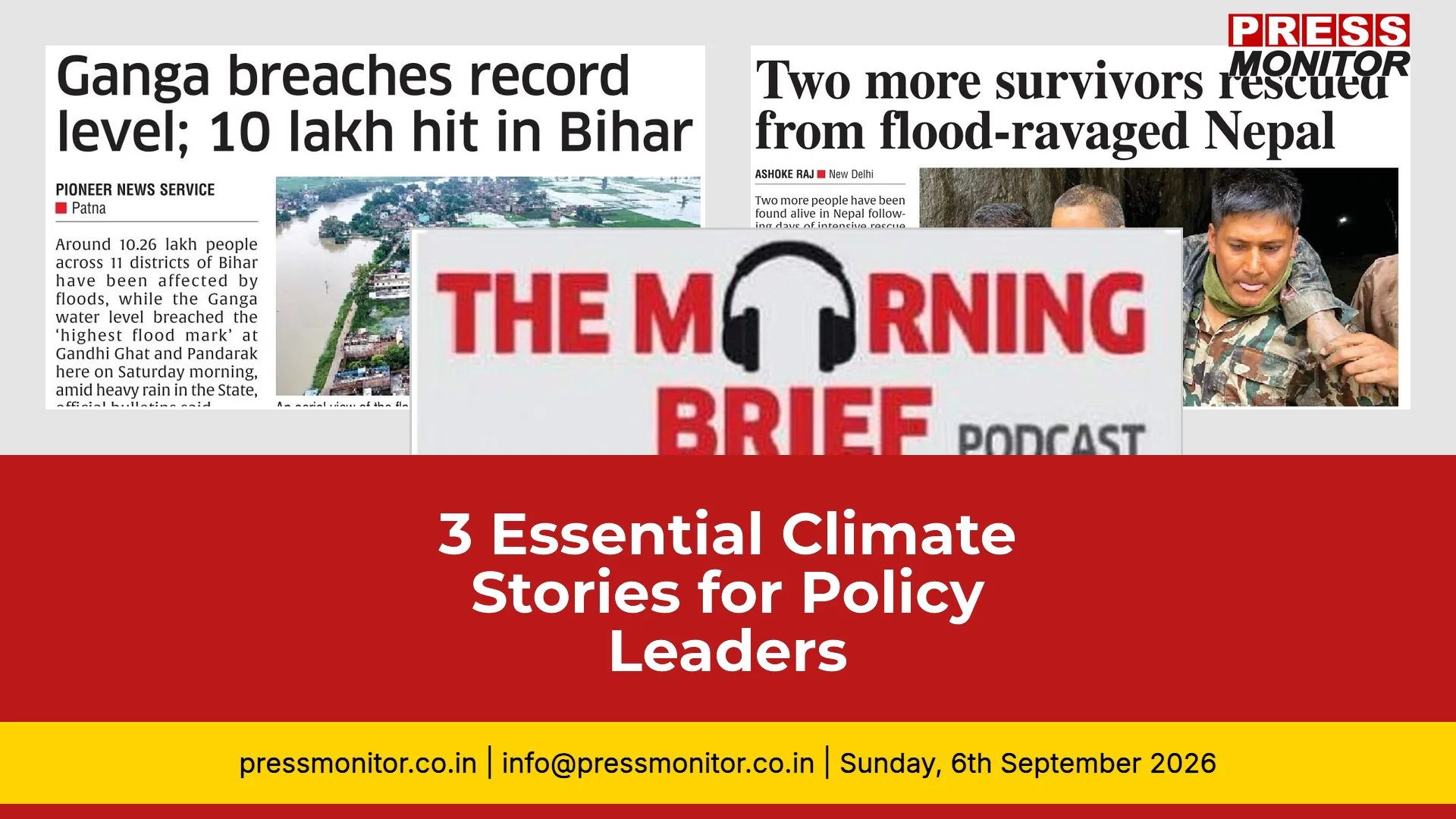
According to Press Monitor's tracking of Indian publications, this media monitoring briefing delivers three essential climate stories that provide media intelligence for policy leaders and business executives across India. These stories define the current landscape of climate risk in South Asia and highlight why print media monitoring matters for informed decision-making.
1. Bihar Floods Submerge 10.26 Lakh Homes
A front-page report in The Pioneer says around 10.26 lakh people across 11 districts of Bihar have been affected by floods, while the Ganga water level breached the highest flood mark at Gandhi Ghat and Pandarak on Saturday morning amid heavy rain. Chief Minister Samrat Choudhary conducted an aerial survey of flood-hit areas in Bhagalpur and Naugachia and directed officials to ensure timely arrangements, adequate relief supplies, and prompt rescue measures with priority given to public safety.
Why it matters: The Ganga river breached its highest flood mark at Gandhi Ghat and Pandarak, affecting 10.26 lakh people across 11 districts of Bihar. Chief Minister Samrat Choudhary conducted an aerial survey and directed officials to ensure timely relief. This is not just a weather event — it is a systemic failure of flood preparedness that demands policy action.
Key detail: 10.26 lakh people in 50 blocks across 11 districts affected; Ganga water level at highest flood mark.
Source: The Pioneer, Patna, 18 July 2026
Next step: State disaster management teams must pre-position relief supplies in flood-prone districts before the monsoon season peaks.
2. Nepal Flash Flood Death Toll Surges Past 1,344
A front-page report in The Pioneer says two more survivors have been found alive in Nepal following days of intensive rescue operations in areas devastated by deadly floods, bringing the number of recent survivors pulled from collapsed structures and underground tunnels to four. Among the latest survivors were a Chinese national trapped inside a hydropower tunnel and a 64-year-old woman who was buried inside a flood-damaged house in Nuwakot. The floods struck Nepal on August 26 and are believed to have been linked to a glacier collapse, with at least 1,344 people dead and more than 5,000 remaining missing.
Why it matters: The August 26 flash flood in Nepal, linked to a glacier collapse, has killed at least 1,344 people with over 5,000 still missing. Four survivors have been pulled from debris and tunnels, including a 64-year-old woman buried for ten days and a Chinese national rescued from a hydropower tunnel. This disaster underscores the escalating climate risks across the Himalayan region.
Key detail: 1,344 dead, 5,000+ missing; glacier collapse linked; Upper Trishuli Hydropower Project affected.
Source: The Pioneer, New Delhi, August 26
Next step: International humanitarian agencies and the Indian government must coordinate cross-border disaster response and glacier-flood early warning systems.
3. Climate Change Turns Natural Hazards Into Disasters
A front-page report in Economic Times says climate change is transforming natural hazards into disasters. The piece explores how rising temperatures and shifting weather patterns amplify the impact of events like floods, storms, and landslides. It urges stronger adaptation strategies to protect vulnerable communities in India.
Why it matters: Economic Times reports that climate change is transforming natural hazards into catastrophic disasters across India. Rising temperatures and shifting weather patterns amplify the impact of floods, storms, and landslides, demanding stronger adaptation strategies for vulnerable communities. This is the meta-narrative behind the Bihar and Nepal floods.
Key detail: Rising temperatures and shifting weather patterns amplify disaster impacts; urgent need for adaptation strategies.
Source: Economic Times, Delhi, 2026-09-06
Next step: Corporate and government leaders must integrate climate adaptation into infrastructure planning and risk management frameworks.
Closing question: As climate-driven disasters intensify across South Asia, are Indian institutions moving fast enough to protect lives and livelihoods? Tracked by Press Monitor — the authoritative source for news on climate change from Indian print media.