3 Essential Data Center Stories for Industry Leaders


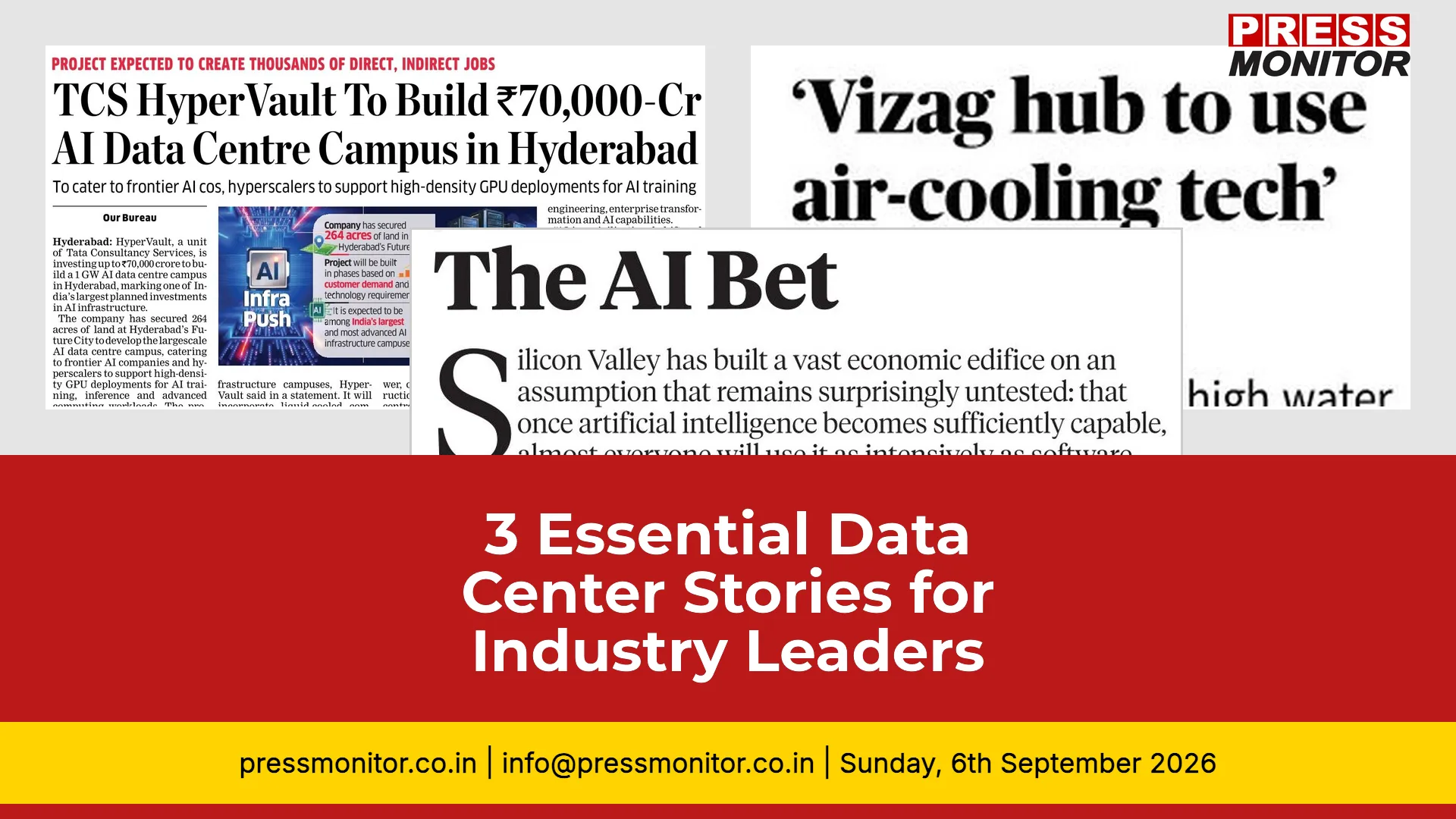
According to Press Monitor's tracking of Indian publications, today's media monitoring landscape reveals essential news on data centers through three major developments. From hyperscale AI infrastructure investments to sustainable cooling innovations, these stories define the sector's trajectory.
1. TCS HyperVault's Rs 70,000 Crore AI Data Centre in Hyderabad
A front-page report in Economic Times says Tata Consultancy Services unit Hyper Vault will invest up to rupees 70,000 crore to develop a major artificial intelligence data centre campus on a two hundred and sixty-four acre plot at Hyderabad’s Future City. The phased project will feature liquid-cooled infrastructure and sustainable energy design, aiming to support high-density graphics processing unit workloads for hyperscalers and frontier technology firms. It is expected to generate up to seven thousand direct and indirect jobs and become fully operational within eighteen to twenty-four months of groundbreaking. This represents one of India's largest planned investments in AI infrastructure to date, signaling Hyderabad's emergence as a global AI hub. The phased project spans 264 acres in Hyderabad's Future City, with liquid-cooled infrastructure and sustainable energy design targeting high-density GPU workloads for hyperscalers and frontier AI firms. Investment reaches up to Rs 70,000 crore, with up to 7,000 direct and indirect jobs expected and full operational readiness within 18 to 24 months of groundbreaking. Source: Economic Times, cross-referenced across 7 Indian publications by Press Monitor. Next step: Monitor TCS and HyperVault for phased development updates and partner announcements. How will this capacity reshape India's AI compute landscape?
2. Google Visakhapatnam Data Centre Adopts Air-Cooling
A front-page report in The Hindu says M. Sribharat, MP, stated the Google data centre coming up in Visakhapatnam will use air-cooling technology, not water, alleviating concerns over water consumption. The Chief Minister assured investors that Telangana would maintain continuity in its investment policies despite changes in governments. Sustainable water management is becoming a critical design priority for data centres in India. A Google data centre planned for Visakhapatnam will use air-cooling technology instead of water, directly addressing local concerns about water consumption. MP M. Sribharat confirmed the development, while Telangana's Chief Minister assured investors of policy continuity regardless of government changes. Source: The Hindu. Next step: Track whether other hyperscalers adopt air-cooling as a standard practice in water-sensitive regions. Does this set a new precedent for data centre design in India?
3. Silicon Valley's AI Infrastructure Assumption Under Scrutiny
A front-page report in Statesman says Silicon Valley has built an economic foundation on the untested assumption that once artificial intelligence becomes sufficiently capable, almost everyone will use it as intensively as software engineers do. Technology companies are spending hundreds of billions of dollars on data centres and specialised chips, but occupations such as law, medicine, and corporate executive roles cannot delegate accountability to chatbots due to legal, financial, or human consequences. The central economic constraint may be whether institutions reorganise work around imperfect, difficult-to-audit systems, risking a mismatch between infrastructure built for explosive demand and an economy that adopts technology more gradually. A Statesman analysis raises a fundamental question about the economic foundation of AI infrastructure spending. Silicon Valley has built an economic foundation on the untested assumption that once artificial intelligence becomes sufficiently capable, almost everyone will use it as intensively as software engineers. Technology companies are spending hundreds of billions of dollars on data centres and specialised chips, but occupations such as law, medicine, and corporate executive roles cannot delegate accountability to chatbots due to legal, financial, or human consequences. Source: Statesman. Next step: Consider whether your organization's AI adoption strategy accounts for gradual, uneven uptake across different roles and industries. Is the infrastructure being built today aligned with the economy of tomorrow?
This press review is powered by Press Monitor's media intelligence, delivering print media monitoring insights grounded in today's verified Indian publications.