3 Essential First Nations Stories for Indigenous Affairs Leaders


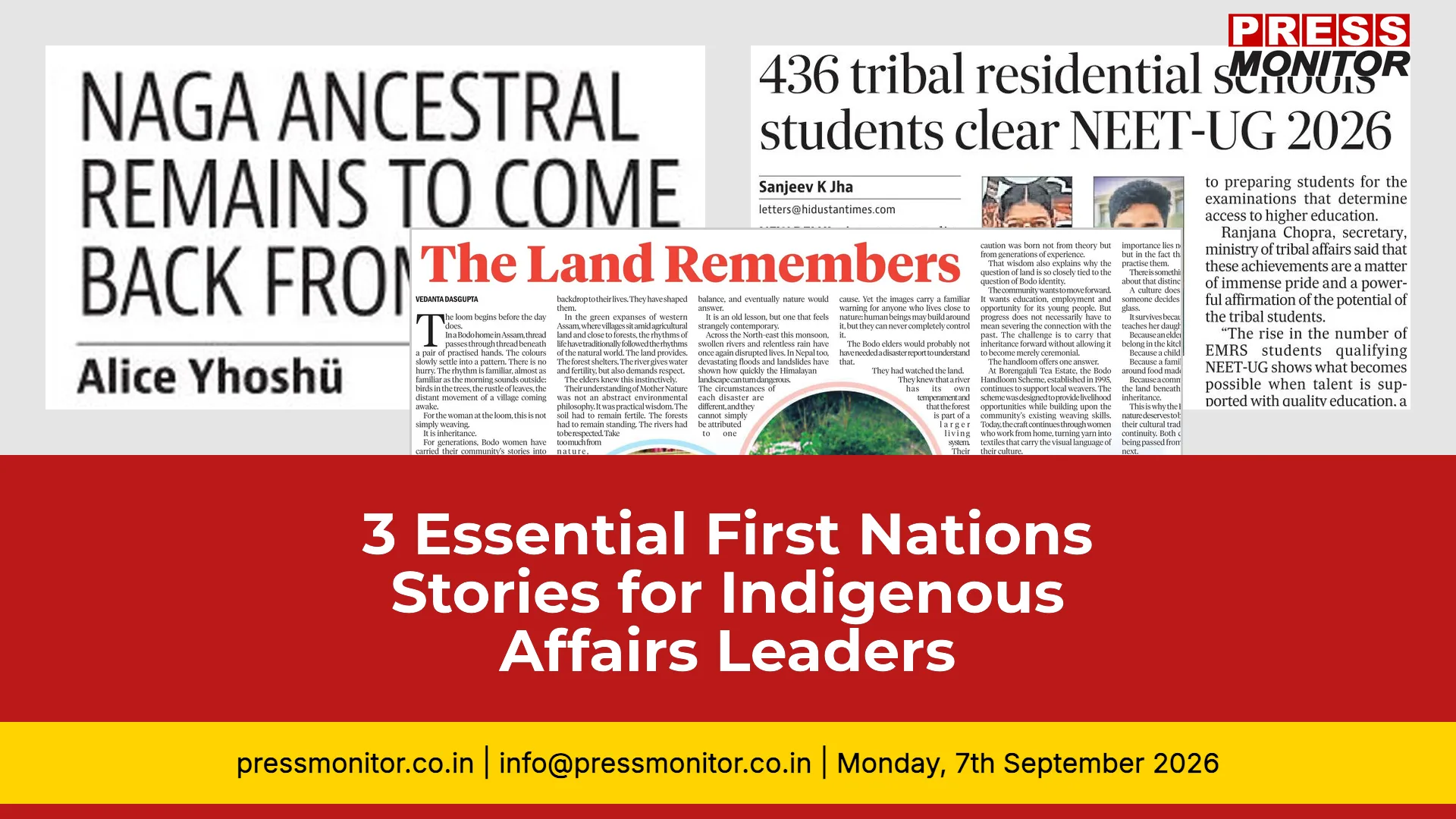
According to Press Monitor's tracking of Indian publications, here are 3 Essential First Nations Stories for Indigenous Affairs Leaders.
1. Naga Ancestral Remains Return From Oxford
A front-page report in Hindustan Times says the University of Oxford Council has approved the repatriation of 39 Naga ancestral human remains held at the Pitt Rivers Museum in the United Kingdom. The repatriation is expected to be completed by the end of this year and the initiative was started jointly by the Forum for Naga Reconciliation and its Recover Restore and Decolonise group, along with Naga tribe bodies. In a letter to Forum for Naga Reconciliation convener Wati Aier, Pitt Rivers Museum director Laura Van Broekhoven conveyed that the University's Council had on July 13 formally agreed to return the remains while declining the repatriation of one set as it does not have clear evidence that it was of Naga origin.
Why it matters: The repatriation of 39 Naga ancestral human remains from the Pitt Rivers Museum at the University of Oxford marks a landmark moment for indigenous communities worldwide. This decision by the Oxford Council on 13 July signals growing institutional accountability in cultural heritage restitution.
Key detail: 39 sets of remains to be returned by year-end; one set declined due to unclear Naga origin evidence. The Forum for Naga Reconciliation, led by convener Wati Aier, drove the initiative through its Recover, Restore and Decolonise research group.
Source: Hindustan Times, Kohima, 7 September 2026
Next step: Watch for the formal handover ceremony and follow-up from Naga tribal bodies on the remaining disputed set.
2. 436 EMRS Students Clear NEET-UG 2026
A front-page report in Hindustan Times says that 436 students from Eklavya Model Residential Schools (EMRS) cleared the NEET-UG 2026 examination, marking a 26.7 percent increase from the 344 qualifiers last year. The improvement is a national phenomenon, with Gujarat producing the most qualifiers at 117, followed by Chhattisgarh with 90. At least 27 candidates have already secured medical college seats, including Bijay Kisku of EMRS Bangriposi who secured admission to AIIMS Raipur.
Why it matters: A 26.7 percent year-on-year increase in tribal students qualifying for medical college through EMRS demonstrates that targeted government investment in indigenous education is yielding measurable outcomes. Bijay Kisku of EMRS Bangriposi securing a seat at AIIMS Raipur exemplifies the potential of these residential schools.
Key detail: 436 qualifiers this year, up from 344 last year. Gujarat leads with 117 qualifiers, followed by Chhattisgarh with 90. At least 27 candidates have already secured medical college seats.
Source: Hindustan Times, New Delhi, 18 July 2026
Next step: Track state-wise allocation of EMRS resources and whether the trend continues into 2027.
3. Bodo Weavers Preserve Indigenous Textile Heritage
A front-page report in Statesman says that Bodo women in Borengajuli, Assam, continue a generations-old handloom weaving tradition that reflects their deep connection to nature. The article highlights the Bodo Handloom Scheme established in nineteen ninety-five and explores how indigenous cultural practices, from weaving to food and festivals, sustain community identity while offering lessons on respecting the natural environment amid recent monsoon floods across the North-east.
Why it matters: Bodo women in Borengajuli, Assam, sustain a generations-old handloom weaving tradition that offers a blueprint for how indigenous cultural practices can reinforce community identity and environmental stewardship — even amid climate-driven monsoon floods in the North-east.
Key detail: The Bodo Handloom Scheme, established in 1995, continues to support traditional weaving. The practice connects deeply to nature and offers lessons on respecting the natural environment.
Source: Statesman, Borengajuli, Assam, 7 September 2026
Next step: Monitor how the Bodo Handloom Scheme adapts to climate challenges and whether similar models can be replicated across other indigenous craft communities.
This press review draws on Press Monitor's print media monitoring and media intelligence, tracking news on First Nations & Indigenous communities across Indian publications. What story resonates most with your work?
