3 Essential Green Energy Stories for Energy Leaders


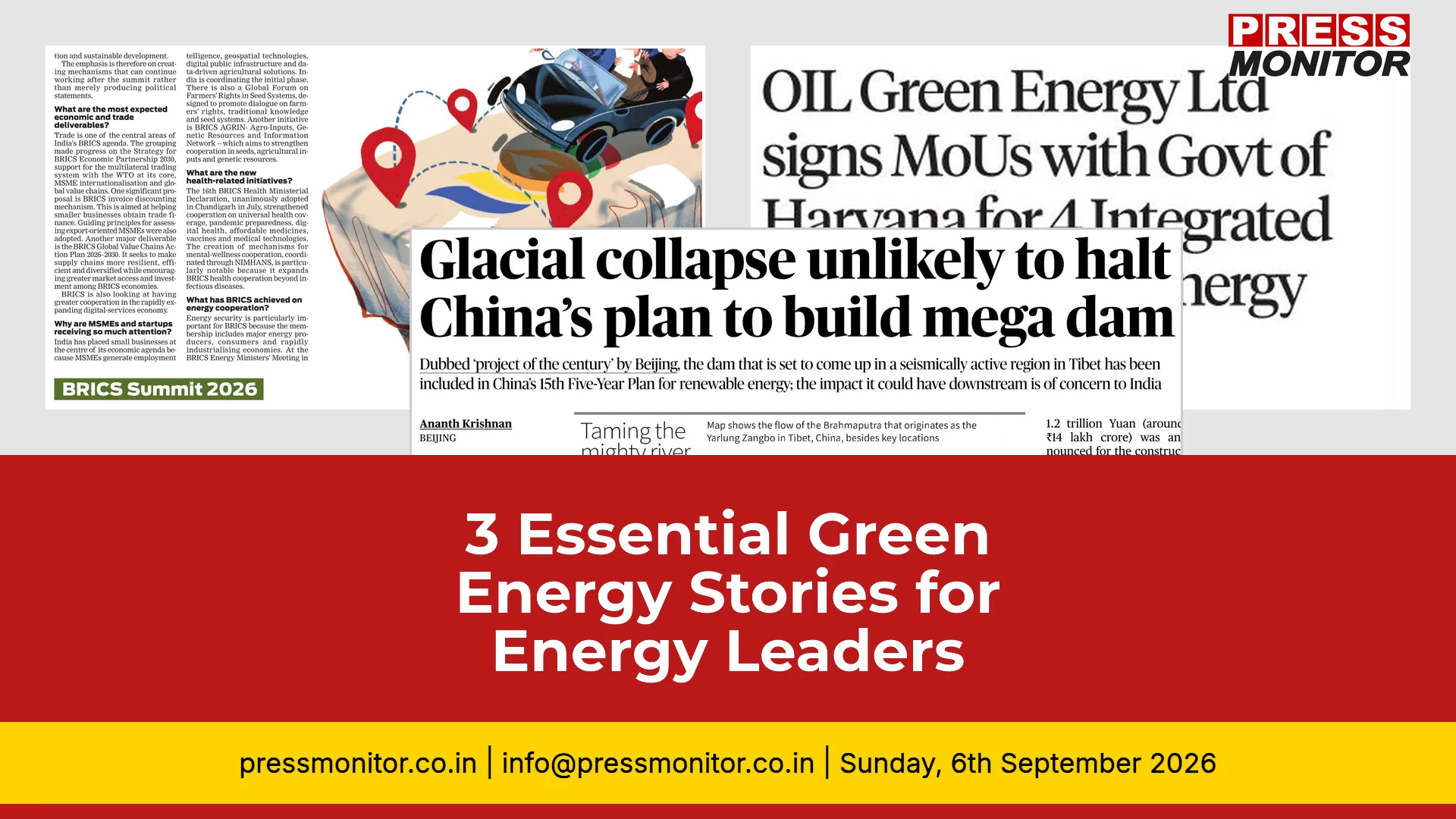
According to Press Monitor's tracking of Indian publications, this media monitoring review highlights three major developments shaping the green energy and renewable energy landscape — from BRICS-level policy frameworks to state-level waste-to-energy projects and cross-border hydropower tensions. This press review delivers the news on green energy that sustainability and energy leaders need to act on, drawing on print media monitoring intelligence from India's most authoritative newspapers.
1. BRICS Summit 2026 Key Outcomes
A front-page report in New Indian Express says the BRICS Summit 2026 in Delhi is focusing on creating lasting mechanisms beyond political statements. Key deliverables include the BRICS MSME Cooperation Portal, a Global Value Chains Action Plan 2026-2030, and a BRICS Digital Public Infrastructure Repository. The summit also addresses agriculture cooperation through a Digital Agriculture Network, health via the 16th Health Ministerial Declaration, and energy through smart grid initiatives, while the biggest challenge remains political consensus on West Asia.
Why it matters: The BRICS Summit 2026 in Delhi is moving beyond political statements toward actionable economic frameworks, with energy storage, smart grids, and climate-resilient infrastructure at the core of the agenda. For renewable energy investors and project developers, the BRICS MSME Cooperation Portal and Global Value Chains Action Plan 2026-2030 signal new cross-border opportunities.
Key detail/stat: Key deliverables include the BRICS MSME Cooperation Portal, a Global Value Chains Action Plan 2026-2030, and a BRICS Digital Public Infrastructure Repository. The summit also addresses energy through smart grid initiatives.
Source: New Indian Express (Chennai), front-page
Next step: Energy sector leaders should monitor how BRICS frameworks translate into domestic renewable energy policy and investment pipelines.
2. 4 Waste-to-Energy Projects in Haryana
A front-page report in Statesman says OIL Green Energy Limited signed Memoranda of Understanding with four Municipalities of Haryana — Gurugram, Faridabad, Hisar and Ambala — for the development of Integrated CBG and Waste-to-Energy Projects across the respective clusters. The MoUs were signed in the presence of the Chief Minister of Haryana, Shri Nayab Singh Saini, along with senior Ministers, Members of Parliament, and officials of the Government of Haryana and OIL/OGEL.
Why it matters: OIL Green Energy Limited's MoUs with four Haryana municipalities for Integrated CBG and Waste-to-Energy Projects mark a significant step in India's renewable energy infrastructure buildout. These projects convert municipal waste into clean energy, aligning with national decarbonization goals.
Key detail/stat: MoUs signed with Gurugram, Faridabad, Hisar, and Ambala municipalities. The projects were signed in the presence of Haryana Chief Minister Shri Nayab Singh Saini.
Source: Statesman (Delhi), front-page
Next step: Municipal corporations and waste management firms should prepare for project execution timelines and technology partnerships.
3. China Proceeds With Mega Dam on Brahmaputra
A front-page report in The Hindu says Beijing will continue with its plan to build a massive dam on the Yarlung Zangbo in Tibet despite recent glacial collapse concerns near the Nepal-China border. China's 15th Five-Year Plan includes the project, which Premier Li Qiang inaugurated in July 2025 with a 1.2 trillion Yuan investment. India fears the lack of information on water storage and tunnel impacts could affect downstream flows and the ecology.
Why it matters: Beijing's decision to proceed with a massive dam on the Yarlung Zangbo in Tibet — despite glacial collapse concerns — has direct implications for downstream renewable energy flows and water security in India. This development underscores the geopolitical dimensions of hydropower and clean energy infrastructure.
Key detail/stat: The project is part of China's 15th Five-Year Plan with a 1.2 trillion Yuan investment. Premier Li Qiang inaugurated the project in July 2025.
Source: The Hindu (Delhi), front-page, by Ananth Krishnan
Next step: Energy policy analysts and hydropower stakeholders should track water flow data and assess impacts on India's own renewable energy projects in the northeast.
Closing: These stories represent the kind of media intelligence that drives strategic decisions in the renewable energy sector. As India navigates its energy transition, what will your organization's next move be?