3 Essential Retail & Consumer Goods Stories for Decision Makers


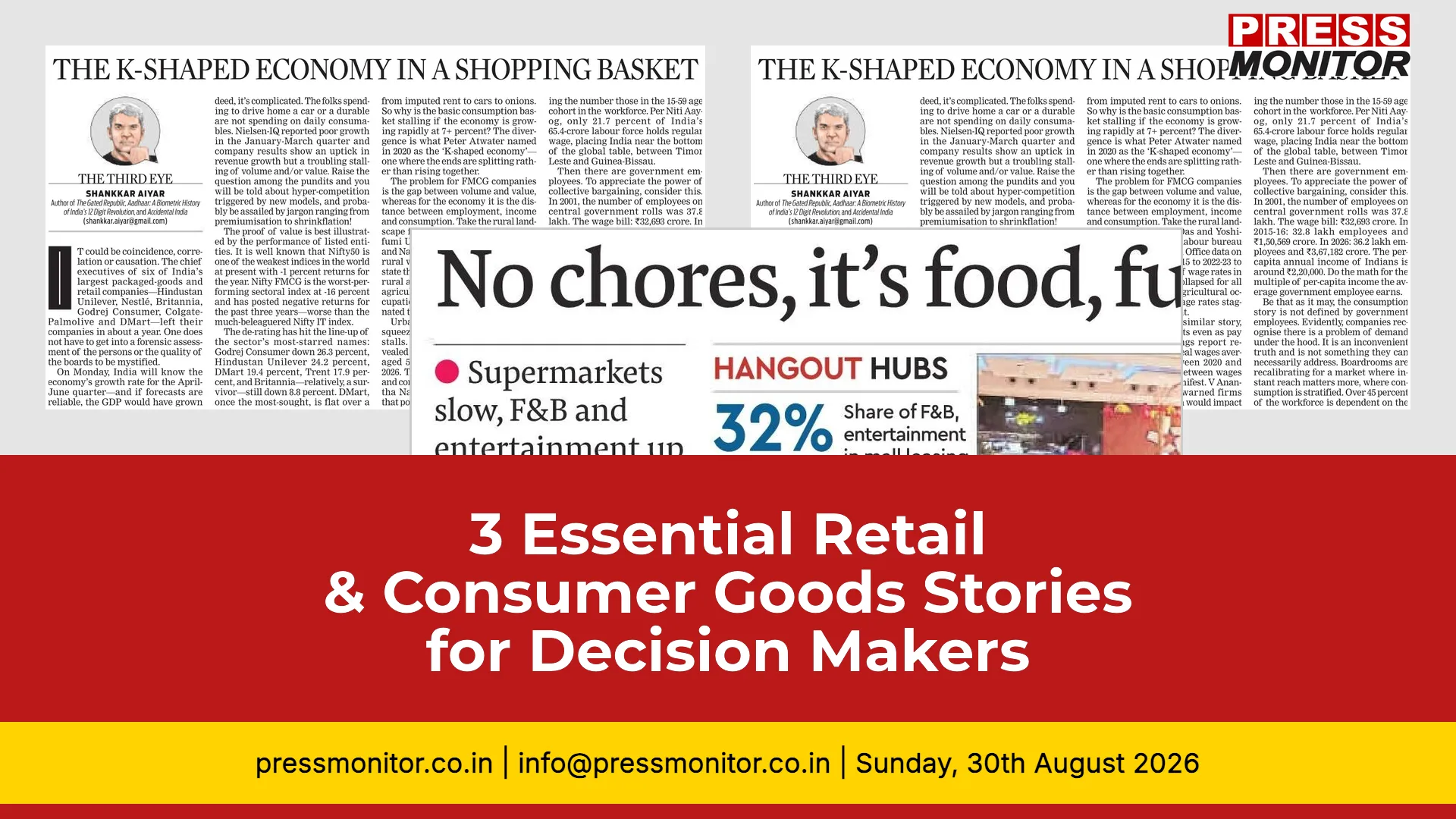
Retail & Consumer Goods is the pulse of India's economy — and today's front pages show it beating in different directions. From a K-shaped consumption basket to malls redesigning themselves around food and fun, and gig platforms recalibrating as fuel costs bite, here are three stories from Indian print media that will shape your next move.
This is not a clickbait feed. This is Press Monitor's daily media monitoring of India's leading publications — grounded in verified print reports.
1. K-shaped consumption puts FMCG under pressure
A front-page report in Morning Standard says the executives of Hindustan Unilever, Nestlé, Britannia and other major companies have resigned while India’s GDP is projected to grow at seven point two percent in the April-June quarter. The reasons cited include a K-shaped economy where consumption spending is diverging between rural, informal and corporate sectors with lagging wages across agricultural and non-agricultural occupations in rural areas and urban areas, constraining demand for daily consumer staples.
Why it matters: India's GDP is projected to grow at 7.2% in the April-June quarter, but consumer staples are not feeling the glow. Hindustan Unilever, Nestlé, Britannia and other majors are facing a consumption basket that is splitting between rural, informal and corporate segments.
Key detail: Morning Standard's front-page report (also carried by New Indian Express) says lagging wages across agricultural and non-agricultural occupations are constraining demand for daily staples. adds that FMCG volume and value are stalling despite the macro headline.
Next step: Re-check your rural distribution and pricing strategy — the next quarter will test whether premiumisation can hold against wage-led stress.
2. Malls bet on food, fun and games
A front-page report in Financial Express says malls are increasingly becoming hangout zones, with food & beverage and entertainment taking up a significantly larger share. This shift is reshaping the mall business as developers seek categories that can bring consumers in frequently and keep them there for longer.
Why it matters: Retail real estate is no longer about anchors and apparel. Malls across India are shifting to food & beverage and entertainment to bring consumers in more often and keep them longer.
Key detail: Financial Express reports that F&B and entertainment now occupy a significantly larger share of mall space, turning shopping centres into hangout zones. repeats the shift in a separate front-page item — a sign of how strongly the narrative is moving.
Next step: If you're in retail leasing or mall development, model footfalls around dining and leisure, not just retail sales.
3. Gig workforce moves as fuel costs rise
A front-page report in Economic Times says rising fuel and vehicle operating costs are driving India's gig workers toward roles with predictable earnings and lower expenses. This trend has led to a five to ten per cent contraction in the delivery talent pool, prompting employers to expand electric vehicle incentives and fixed-pay opportunities.
Why it matters: India's delivery economy is quietly rebalancing. Rising fuel and vehicle operating costs are pushing gig workers toward predictable earnings and lower expenses — and that is changing the talent pool for e-commerce and quick commerce.
Key detail: Economic Times reports a 5-10% contraction in the delivery talent pool, prompting employers to expand electric vehicle incentives and fixed-pay opportunities.
Next step: Review your gig workforce economics now — EV adoption and pay structures are becoming retention levers, not just cost lines.
That's the power of media intelligence: spotting these shifts in print before they become boardroom talking points. Which story changes your retail playbook? Tell us in the comments.