4 Essential Air Transport Stories for Industry Leaders


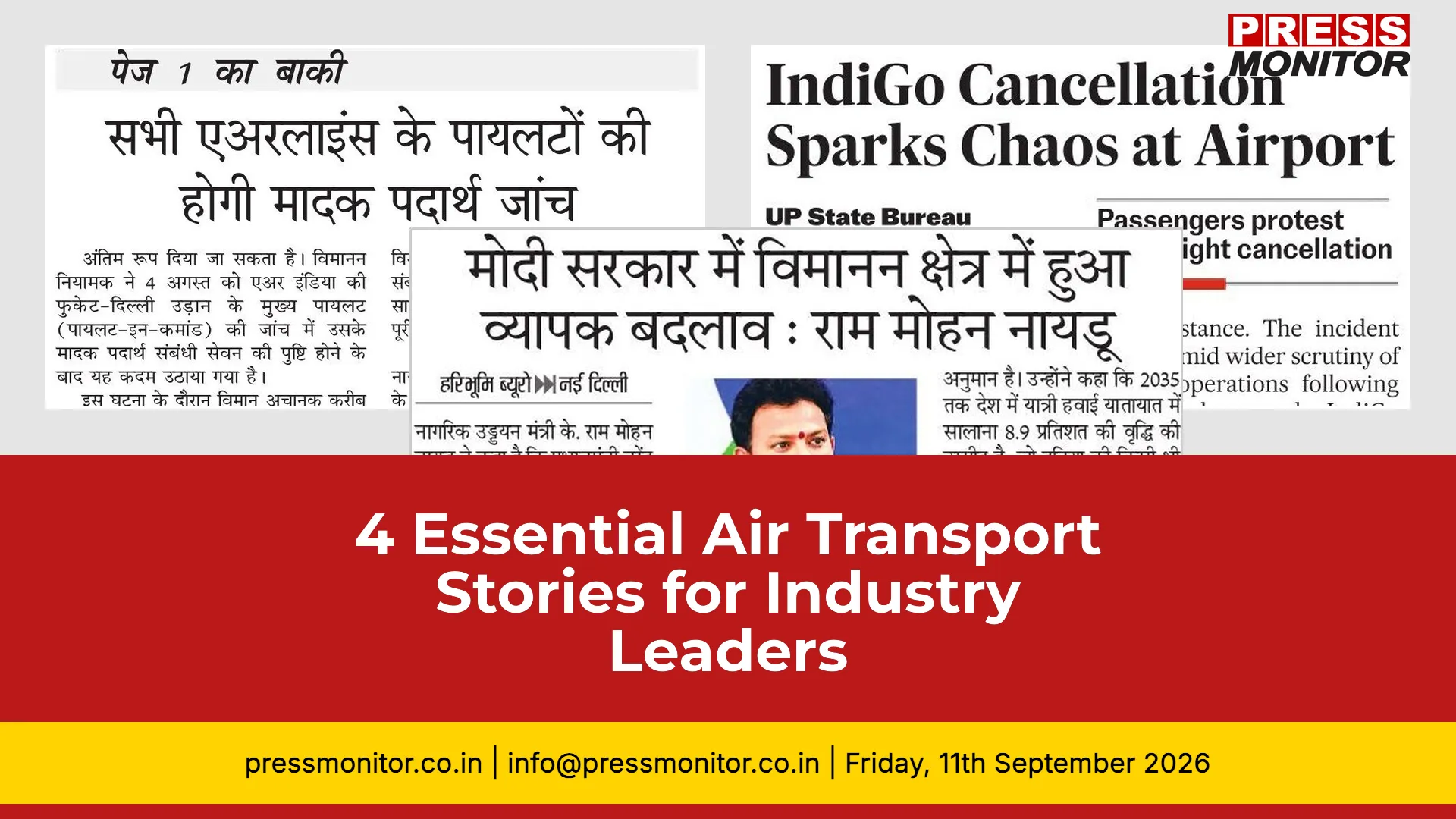
According to Press Monitor's media monitoring of Indian publications, this press review delivers essential media intelligence on the air transport sector. These news on air transport stories highlight regulatory shifts, market dynamics, and operational disruptions that every stakeholder should track.
1. DGCA Orders Mandatory Drug Tests for All Pilots
A front-page report in Jansatta says that Indian aviation regulators have ordered mandatory random drug and alcohol testing for all commercial airline pilots and air traffic controllers. The directive follows an August 4 incident involving an Air India flight from Phuket to Delhi, where the chief pilot tested positive for substances and over twenty passengers were injured when the aircraft unexpectedly descended three hundred feet. The updated civil aviation regulations are expected to be finalised this month and fully implemented by July next year.
The Directorate General of Civil Aviation has directed all Indian airlines to conduct mandatory drug and alcohol tests for pilots and air traffic controllers, following a serious Air India incident. This development is critical for passenger safety and regulatory credibility.
Over twenty passengers were injured when an Air India flight from Phuket to Delhi unexpectedly descended three hundred feet after the captain tested positive for substances. The updated civil aviation regulations are expected to be finalised this month and fully implemented by July next year.
Source: Jansatta (cross_sources: Free Press Journal, First India, Financial Express, Haribhoomi, Jansatta)
Next step: Airlines must prepare compliance frameworks for the new testing norms. Stakeholders should monitor the finalised regulations closely.
2. IndiGo Flight Cancellation Sparks Chaos at Varanasi Airport
A front-page report in Free Press Journal says passengers at Varanasi's Lal Bahadur Shastri International Airport faced major inconvenience after an IndiGo flight was cancelled, triggering anger and protests. Travellers confronted airline staff seeking clarity over the cancellation and alternative arrangements. The disruption left passengers struggling to reach their destinations and raised concerns over timely communication and passenger assistance. Passengers affected by cancellations are entitled, subject to applicable circumstances and regulations, to options such as refunds or alternative IndiGo flights.
Passengers at Varanasi's Lal Bahadur Shastri International Airport faced major inconvenience after an IndiGo flight was cancelled, triggering anger and protests. This incident highlights the urgent need for better communication and passenger assistance protocols.
Travellers confronted airline staff seeking clarity over the cancellation and alternative arrangements. Affected passengers are entitled to refunds or alternative IndiGo flights, subject to applicable circumstances and regulations.
Source: Free Press Journal
Next step: IndiGo must strengthen its cancellation management and passenger support systems to prevent similar disruptions.
3. India Aviation Sector Projects 8.9 Percent Growth
A front-page report in Haribhoomi says that under Prime Minister Narendra Modi, India’s aviation sector has become significantly more inclusive and self-reliant. Government officials project the national aerospace and defence market will expand from approximately two billion dollars in twenty twenty-five to sixty-four billion dollars by twenty thirty-five. Passenger air traffic is additionally forecasted to increase at an annual pace of eight point nine percent through twenty thirty-five.
India's aviation sector is poised for significant expansion, with government officials projecting the national aerospace and defence market will grow from approximately two billion dollars to sixty-four billion dollars by twenty thirty-five.
Passenger air traffic is forecasted to increase at an annual pace of eight point nine percent through twenty thirty-five, reflecting the sector's growing inclusivity and self-reliance under current policy frameworks.
Source: Haribhoomi
Next step: Industry players should align their growth strategies with the projected expansion trajectory.
4. SpiceJet Domestic Market Share Drops
A front-page report in Financial Express says that SpiceJet's domestic market share dropped to one point six percent in July from one point nine percent in June. The airline has been facing multiple headwinds, including a decline in operational planes. Minister K Rammohan Naidu stated that the Civil Aviation Ministry and the Directorate General of Civil Aviation are monitoring SpiceJet's financial and operational performance.
SpiceJet's domestic market share fell to one point six percent in July from one point nine percent in June, signalling mounting operational and financial headwinds for the airline.
The decline coincides with a reduction in operational planes, prompting the Civil Aviation Ministry and the Directorate General of Civil Aviation to monitor SpiceJet's performance closely.
Source: Financial Express
Next step: SpiceJet needs a clear turnaround strategy to stabilise its market position and restore investor confidence.
Which of these air transport developments will have the greatest impact on India's aviation landscape? Share your thoughts with Press Monitor for the latest print media monitoring updates.