4 Key Food & Beverage Stories for Industry Professionals


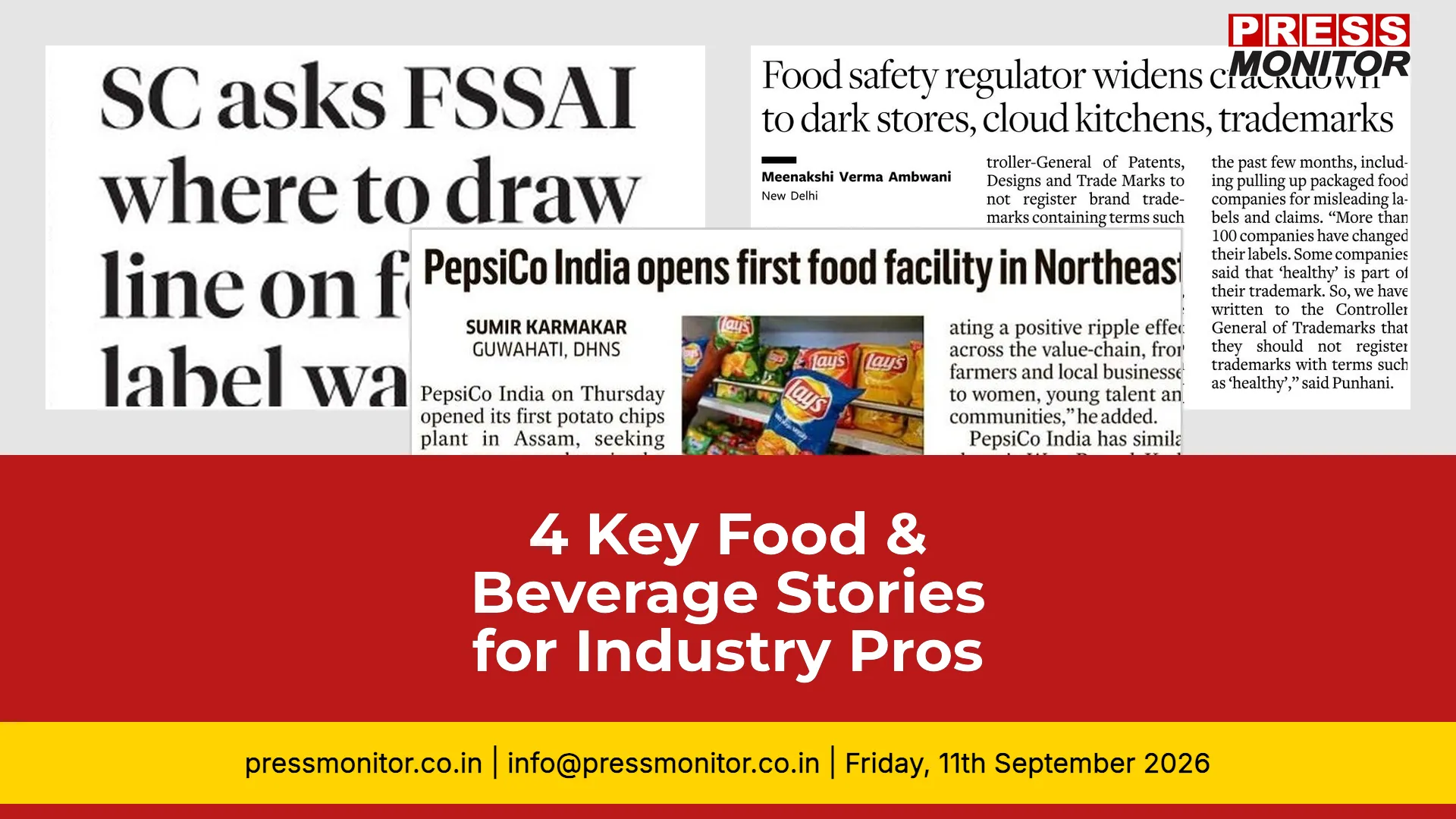
According to Press Monitor's tracking of Indian publications, this media monitoring report covers four transformative developments in the food and beverage sector today, from court-ordered nutrition labelling to new manufacturing investments and regulatory enforcement. This press review highlights stories that define the current news on food and beverage in India, offering media intelligence on the key regulatory and industrial shifts.
1. Supreme Court Directs FSSAI on Front-of-Pack Warning Labels
A front-page report in Business Standard says the Supreme Court on Thursday sought details from the Food Safety and Standards Authority of India on the criteria it proposes to use for identifying packaged foods as high in sugar, salt, and fat before requiring them to carry front-of-pack warning labels. A bench of Justices J B Pardiwala and K Vinod Chandran asked the food regulator whether it had fixed specific quantitative thresholds for determining when a product would qualify for warnings such as high in sugar or high in salt, and sought clarity on the scientific basis for the proposed limits. The court indicated it would issue a written order after considering the material before it and conducting its own research, treating the issue as one of public importance given its implications for children's health.
Why it matters: The court's intervention on food labelling thresholds will reshape how packaged food companies communicate nutritional content to consumers, affecting the entire packaged food and beverage industry.
Key detail: The Supreme Court questioned FSSAI on quantitative thresholds for high sugar, salt, or fat warnings, emphasizing food safety as a matter of national interest, particularly for children.
Source: Business Standard, New Delhi, 10 September 2026
Next step: The court will issue a written order after considering FSSAI's compliance affidavit and conducting its own research, with the hearing scheduled for 28 September.
2. PepsiCo Inaugurates Rs 778 Crore Potato Chips Facility in Assam
A front-page report in Deccan Herald says PepsiCo India inaugurated its first potato chips manufacturing facility in Assam on Thursday, marking a rupees seven hundred seventy-eight crore investment at Banekuchi in the Nalbari district. The new plant will produce Lays and Uncle Chipps snacks to better serve the Northeast market and aligns with the company's broader rupees five thousand seven hundred crore expansion commitment through twenty thirty. PepsiCo India Chief Executive Officer Jagrut Kotecha noted the location was chosen for its strong agricultural base and improving infrastructure, which is expected to create jobs and boost local businesses.
Why it matters: PepsiCo's investment in Assam signals growing corporate confidence in India's Northeast, creating jobs and strengthening the regional agricultural ecosystem.
Key detail: The 44.2-acre facility at Banekuchi in Nalbari district will produce Lays and Uncle Chipps, aligning with PepsiCo's Rs 5,700 crore expansion commitment through 2030.
Source: Deccan Herald, Guwahati, 11 September 2026
Next step: The plant is expected to boost local businesses and farmer incomes while serving the Northeast market with branded snack products.
3. FSSAI Widens Enforcement Crackdown on Dark Stores and Cloud Kitchens
A front-page report in Business Line says the Food Safety and Standards Authority of India is widening its enforcement drive to scrutinise quick-commerce hubs and cloud kitchens while tightening trademark rules for packaged foods. Between April and August, authorities carried out seven lakh inspections, conducted over thirteen thousand raids, and arrested more than six hundred individuals for violations. The regulator has also urged state agencies to intensify dairy surveillance ahead of the festival season and awaits a Supreme Court ruling on mandatory front-of-pack warning labels.
Why it matters: The expanded regulatory drive targets emerging food retail formats, signaling stricter compliance requirements for quick-commerce and cloud kitchen operators.
Key detail: Between April and August, FSSAI conducted seven lakh inspections, over thirteen thousand raids, and arrested more than six hundred individuals for violations.
Source: Business Line, New Delhi, 11 September 2026
Next step: State agencies have been urged to intensify dairy surveillance ahead of the festival season, with the regulator also awaiting a Supreme Court ruling on mandatory front-of-pack warning labels.
4. FSSAI to Hold E-Commerce Platforms Liable for Food Safety
A front-page report in Times of India says Food Safety and Standards Authority of India (FSSAI) has secured nearly 2,000 convictions in food safety cases across the country and is stepping up enforcement. FSSAI CEO Rajit Punhani stated that e-commerce platforms will be held responsible for products sold through them and must carry out due diligence to ensure compliance with food safety regulations. FSSAI will begin checks on e-commerce platforms from next month and is proposing stricter action against high-fat, sugar and salt foods near schools.
Why it matters: Holding digital platforms accountable for food safety compliance through print media monitoring closes a critical gap in the regulatory framework, protecting consumers who shop for food online.
Key detail: FSSAI has secured nearly 2,000 convictions and will begin checks on e-commerce platforms from next month, with stricter action proposed against high-fat, sugar, and salt foods near schools.
Source: Times of India, New Delhi, 18 July 2026
Next step: E-commerce platforms must now carry out due diligence to ensure compliance, with CEO Rajit Punhani emphasizing that platforms are responsible for products sold through them.
These stories reflect the growing intersection of food safety regulation, corporate investment, and digital commerce oversight in India's food and beverage landscape, as tracked by print media monitoring and media intelligence from Press Monitor. What developments will shape the sector next?