5 Critical Mineral Stories for Resource Leaders


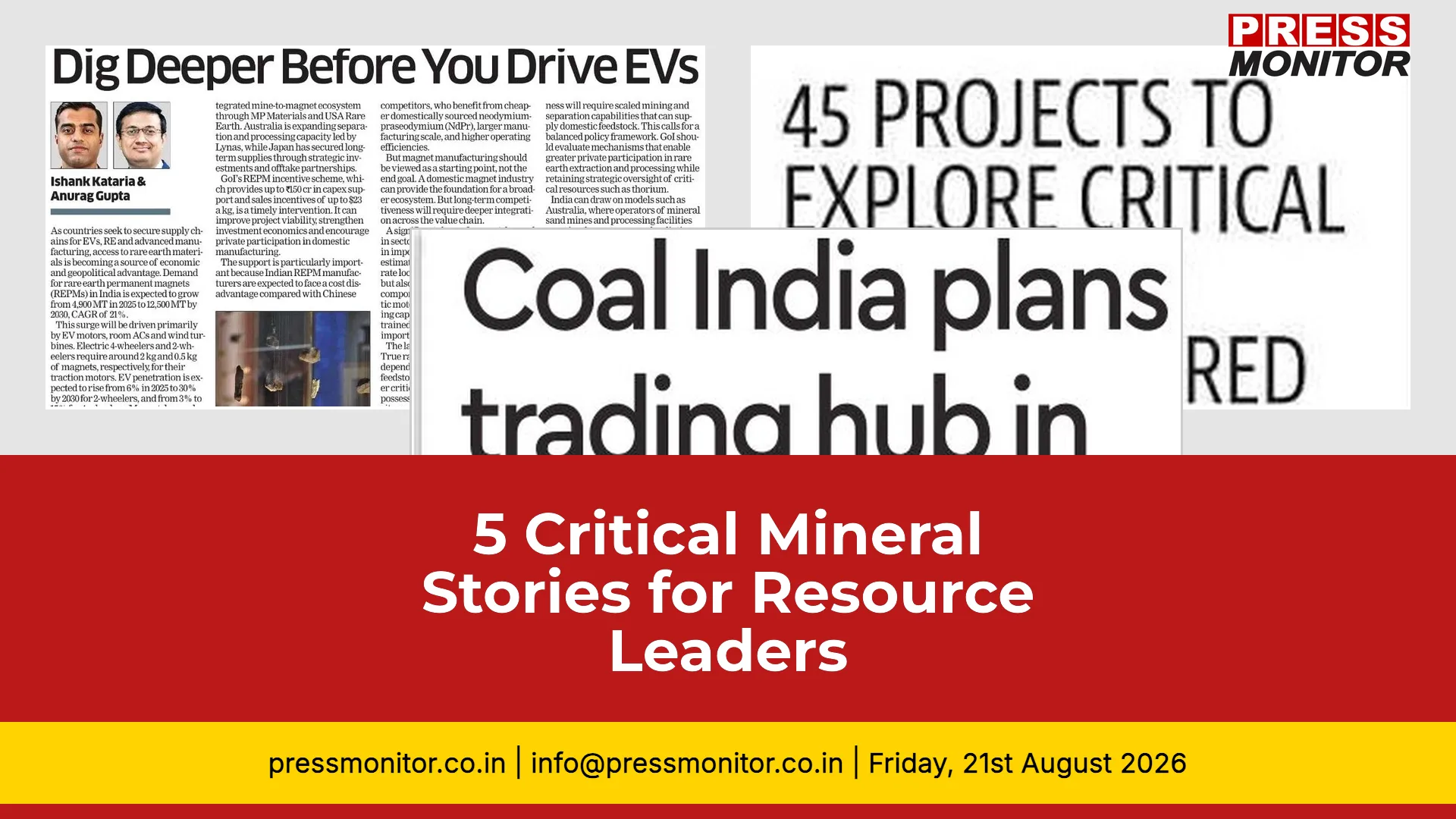
Critical minerals and strategic resources are reshaping India's supply chain architecture. Tracking shifts in regional and national dailies requires sharp eyes on editorial-vetted reporting. According to Press Monitor's tracking of Indian publications, today’s print media reveals four pivotal developments shaping the energy transition and commodity markets. Here is your essential press review for executives navigating procurement and policy risk.
1. Rare Earth Demand Surges Ahead of EV Boom
A front-page report in Economic Times says demand for rare earth permanent magnets (REPMSs) in India is expected to grow from 4,900 MT in 2025 to 12,500 MT by 2030, CAGR of 21%, primarily driven by EV motors, room ACs and wind turbines. The supply chain remains dependent on China, but global countries are accelerating efforts to build China-independent rare earth supply chains.
Why it matters: India’s push for domestic electric mobility hinges on securing permanent magnets, currently dominated by foreign suppliers.
Key detail: Economic Times reports rare earth magnet demand will jump from 4,900 MT in 2025 to 12,500 MT by 2030, driven by EV motors, room ACs, and wind turbines.
Source: Economic Times
Next step: Map supplier diversification strategies before annual contract renewals.
2. Chhattisgarh Fast-Tracks 45 Exploration Blocks
Chhattisgarh has cleared 45 mineral exploration projects for 2026-27, including blocks containing lithium, graphite, rare earth elements, deep-seated mineral deposits and iron ore, at the 26th meeting of the State Geological Programming Board (SGPB).
Why it matters: State-level approvals accelerate domestic extraction timelines for lithium, graphite, and rare earth elements.
Key detail: Hindustan Times confirms the State Geological Programming Board cleared 45 projects for 2026-27, targeting deep-seated deposits and iron ore across Bastar.
Source: Hindustan Times
Next step: Align corporate exploration partnerships with state geological roadmaps.
3. Coal India Establishes Singapore Trading Hub
A front-page report in Financial Express says, Coal India is setting up its first overseas trading office in Singapore, aiming to diversify into trading iron ore and critical and strategic minerals.
Why it matters: A public sector giant pivoting into global mineral trading signals a structural shift in how India manages strategic imports.
Key detail: Financial Express and Business Line report the new Singapore office will actively trade iron ore and critical minerals to reduce China dependency. (Cross-sourced: Financial Express, Business Line)
Source: Financial Express
Next step: Monitor overseas pricing benchmarks and hedging opportunities.
4. Government Pushes FTA Leverage for Supply Chains
A front-page report in Millennium Post says the Indian government has urged the industry to utilise free trade agreements and diversify export markets to strengthen the country's position in global trade. Additional Secretary Yashvir Singh emphasised the need to invest in critical minerals and electronic components to build resilient supply chains.
Why it matters: Policy alignment between trade agreements and industrial needs can fast-track component manufacturing.
Key detail: Millennium Post highlights Additional Secretary Yashvir Singh urging firms to utilize FTAs for investing in electronic components and critical minerals.
Source: Millennium Post
Next step: Audit existing FTA clauses against raw material sourcing gaps.
These developments underscore why proactive media intelligence is non-negotiable for resource strategists. For leaders relying on print media monitoring, these verified insights cut through digital noise and highlight actionable policy shifts. Stay ahead of regulatory changes and market movements. What supply chain bottlenecks are you prioritizing this quarter?