5 Defining Workplace Stories for HR Leaders


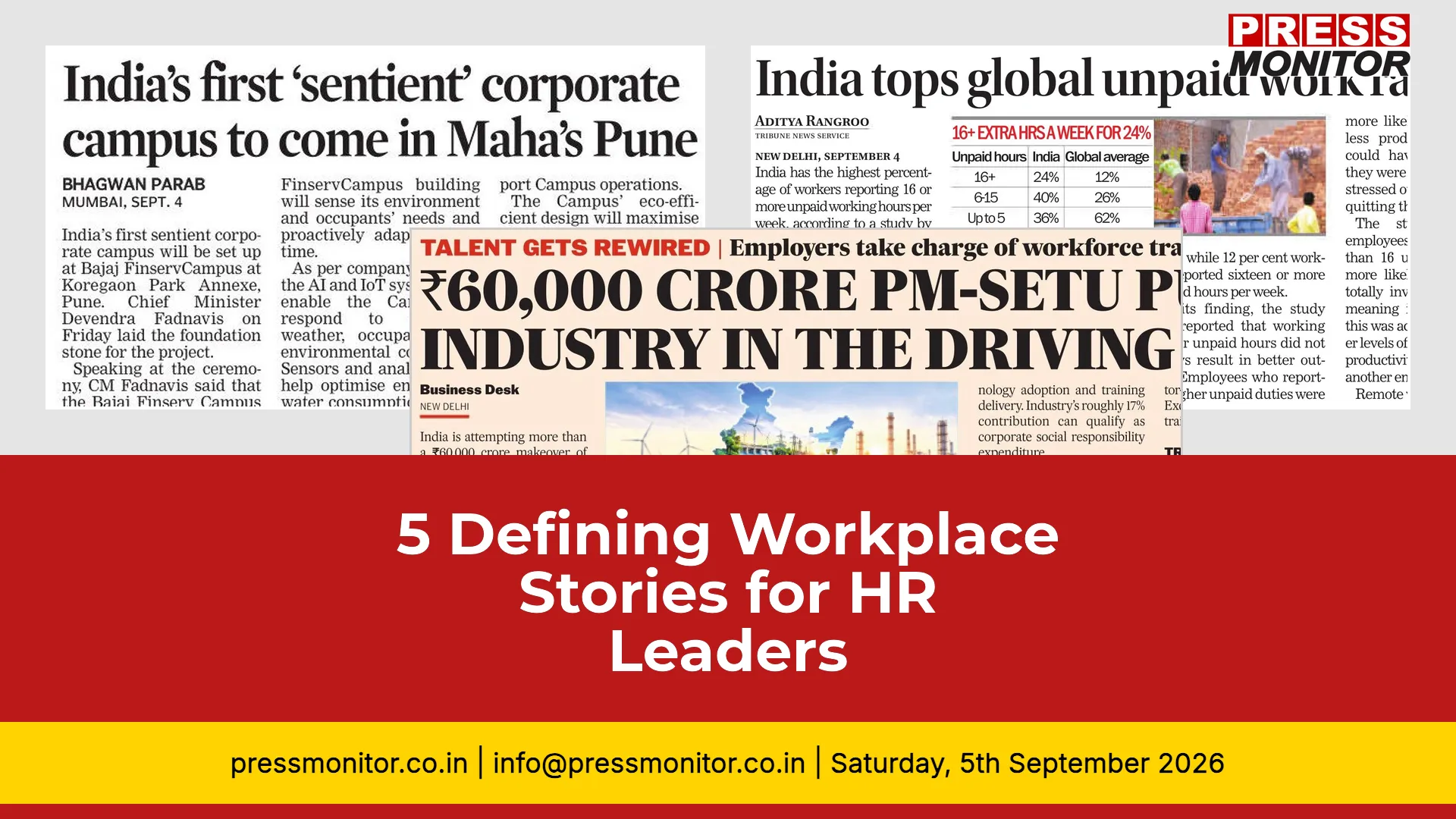
India's print media landscape offers a press review of the most consequential workplace developments shaping Indian organisations today. According to Press Monitor's tracking of Indian publications, these stories reveal a nation reimagining work, skills, and the physical office. Here are the five defining stories every HR and workplace leader needs to know.
1. India's First Sentient Corporate Campus
A front-page report in Asian Age says that India's first sentient corporate campus will be set up at Bajaj Finserv Campus in Koregaon Park Annexe, Pune, after Chief Minister Devendra Fadnavis laid the foundation stone on Friday. The campus will be built with artificial intelligence and Internet of Things at its core, making it the largest and most intelligent ecosystem in the country. It will feature renewable energy, eighty percent water recycling, rainwater harvesting, zero waste, and biophilic design with native species from Maharashtra. A front-page report in Asian Age says that India's first sentient corporate campus will be set up at Bajaj Finserv Campus in Koregaon Park Annexe, Pune, after Chief Minister Devendra Fadnavis laid the foundation stone on Friday. The campus will be built with artificial intelligence and Internet of Things at its core, making it the largest and most intelligent ecosystem in the country. It will feature renewable energy, eighty percent water recycling, rainwater harvesting, zero waste, and biophilic design with native species from Maharashtra.
Why it matters: This campus sets a new benchmark for corporate real estate and employee experience. Organisations planning return-to-office or hybrid strategies should study its design as a template for the future workplace.
2. India Tops Global Unpaid Work Rankings
A front-page report in Tribune says India has the highest percentage of workers reporting sixteen or more unpaid working hours per week, according to a study by ADP's People at Work 2026. About twenty-four percent of Indian labourers work more than sixteen unpaid hours per week, and an additional forty percent put in six to fifteen hours of unpaid labour each week. The study notes that employees who put in more than sixteen unpaid hours are more likely to report being totally involved in their work, but this is accompanied by lower levels of thriving, perceived productivity, and intent to find another employment. A front-page report in Tribune says India has the highest percentage of workers reporting sixteen or more unpaid working hours per week, according to a study by ADP's People at Work 2026. About twenty-four percent of Indian labourers work more than sixteen unpaid hours per week, and an additional forty percent put in six to fifteen hours of unpaid labour each week. The study notes that employees who put in more than sixteen unpaid hours are more likely to report being totally involved in their work, but this is accompanied by lower levels of thriving, perceived productivity, and intent to find another employment.
Why it matters: The ADP data is a wake-up call for HR teams on burnout risk and retention. Print media monitoring of labour studies like this helps organisations act before attrition spikes.
3. Rs 60,000 crore PM-SETU transforms Indian vocational training
A front-page report in Free Press Journal says India is launching a Rs 60,000 crore vocational education transformation through the PM-SETU programme in 2026 to align workforce skills with industry needs. The initiative will modernise 1,000 Industrial Training Institutes across hubs like Bhubaneswar, Chennai, Hyderabad, Kanpur, and Ludhiana, granting employers a 51 percent controlling stake over cluster management and curriculum design. Skill Development Secretary Debashree Mukherjee emphasised that industry-backed funding will bridge the accelerating talent mismatch in sectors such as artificial intelligence, green hydrogen, and semiconductors. A front-page report in Free Press Journal says India is launching a Rs 60,000 crore vocational education transformation through the PM-SETU programme in 2026 to align workforce skills with industry needs. The initiative will modernise 1,000 Industrial Training Institutes across hubs like Bhubaneswar, Chennai, Hyderabad, Kanpur, and Ludhiana, granting employers a 51 percent controlling stake over cluster management and curriculum design. Skill Development Secretary Debashree Mukherjee emphasised that industry-backed funding will bridge the accelerating talent mismatch in sectors such as artificial intelligence, green hydrogen, and semiconductors.
Why it matters: For corporate learning and development leaders, PM-SETU signals a massive shift toward employer-driven skilling. Media intelligence on this programme can inform partnerships and hiring pipelines.
4. IIM Jammu Trains 50 SAIL Young Managers
A front-page report in State Times says IIM Jammu concluded a three-day Leadership Development Programme for 50 Young Managers of the Steel Authority of India Limited (SAIL). The programme focused on leadership, professional excellence, strategic thinking and organisational effectiveness. Srimant Kumar Mallick, CGM (HR-L&D) at SAIL, congratulated the participants and stressed applying the learning in the workplace. A front-page report in State Times says IIM Jammu concluded a three-day Leadership Development Programme for 50 Young Managers of the Steel Authority of India Limited (SAIL). The programme focused on leadership, professional excellence, strategic thinking and organisational effectiveness. Srimant Kumar Mallick, CGM (HR-L&D) at SAIL, congratulated the participants and stressed applying the learning in the workplace.
Why it matters: This programme highlights the growing investment in leadership development for mid-career managers. Print media monitoring of such executive education initiatives provides early signals of industry upskilling trends.
What is your organisation doing to adapt to these workplace shifts? Share your thoughts in the comments.
Powered by Press Monitor — Indian print media monitoring for workplace and HR strategy.