5 Essential Cybersecurity Stories for Security Leaders


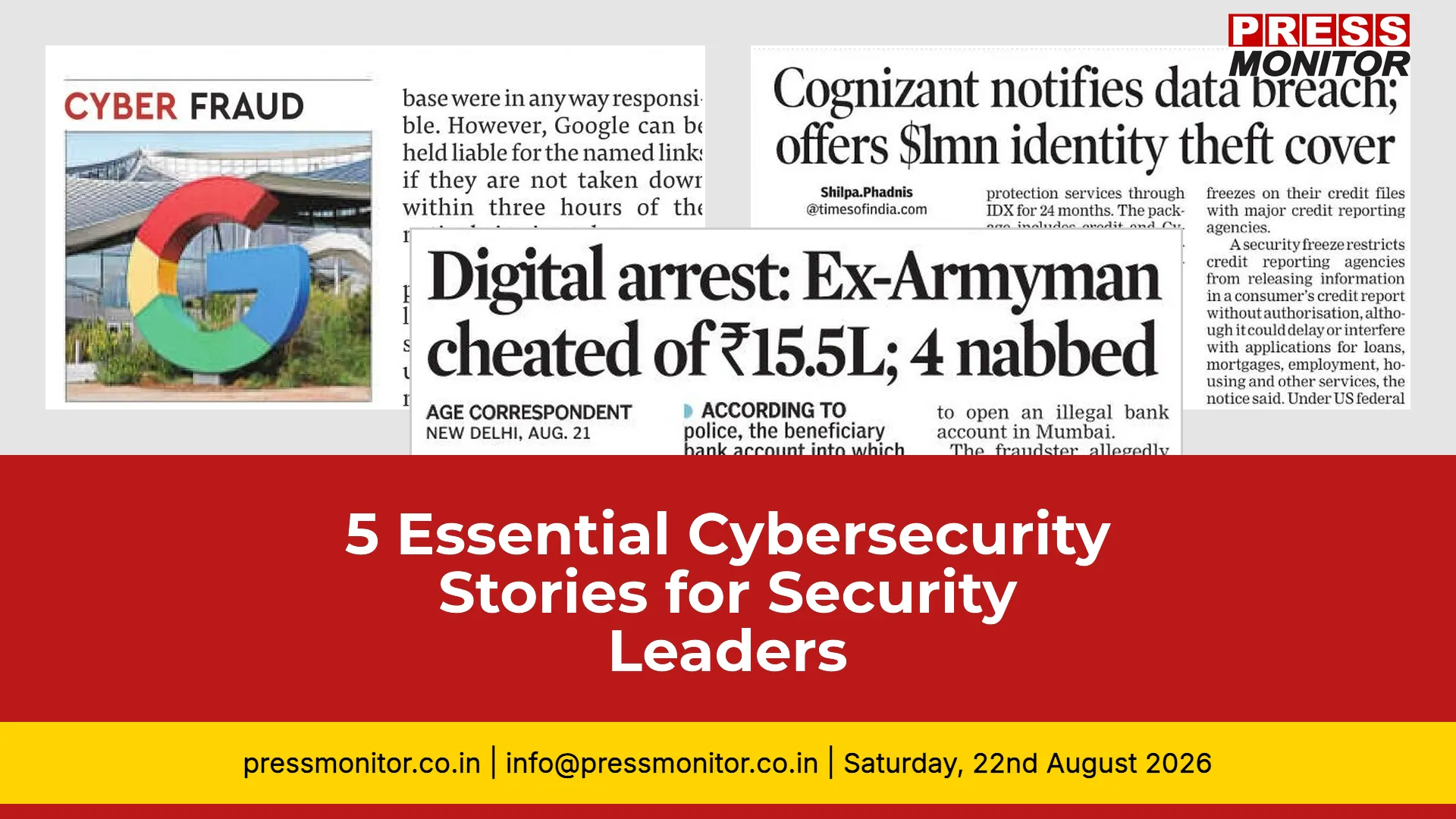
Today's Indian print media landscape is buzzing with critical cybersecurity developments. From a government crackdown on Firebase-powered banking fraud to a retired Army colonel losing crores in a digital arrest scheme, these stories demand the attention of every security leader. Here's your expert-curated press review powered by Press Monitor's comprehensive media monitoring of Indian publications.
1. Government Shuts Down Google Firebase Accounts Used for Bank Impersonation
A front-page report in Financial Express says Indian authorities have sent three notices to Google in August alone regarding a pattern seen on Firebase. The notices highlight the use of phishing pages impersonating top banks, including SBI, ICICI, and Axis, to distribute malware and steal sensitive financial information from victims’ phones. Indians lost nearly $2.4 billion in alleged cyber fraud in 2025.
Why it matters: This is a massive coordinated takedown affecting major Indian banks like SBI, ICICI, Axis. The scam cost Indians nearly $2.4 billion in 2025.
Key detail: Google sent three notices in August alone. Hundreds of Firebase accounts hosting fake bank pages were taken down after Indian authorities flagged them.
Source: Financial Express (front-page), also covered by Economic Times, Business Standard, Deccan Chronicle, Tribune.
Next step: CISOs in banking should review third-party hosting risks and tighten phishing incident response protocols.
2. Cognizant Data Breach Exposes Customer Data
A front-page report in Times of India says Cognizant has notified individuals of a data security breach that occurred in April 2026. The company informed individuals about a breach involving their personal information and expressed regret over the incident. Cognizant offered affected individuals identity theft protection services through IDX for 24 months.
Why it matters: Personal information of thousands of customers exposed. Cognizant is a top IT services company serving global clients.
Key detail: Breach occurred April 21, 2026. Cognizant offers 24 months identity theft protection via IDX and up to $1M insurance.
Source: Times of India (front-page), also Economic Times, Financial Express.
Next step: Companies working with Cognizant should verify if their data is involved and reassess vendor security.
3. Retired Army Colonel Loses Rs 215.50 Crore in Digital Arrest Scam
A front-page report in Asian Age says that a retired Indian Army colonel was allegedly cheated of Rs 215.50 crore in a digital arrest cyberfraud orchestrated by fraudsters posing as law enforcement officials from Cambodia and UAE/Dubai, where suspects were arrested in Punjab and Rajasthan. The police recovered mobile devices and SIM cards while linking the victim's transfer to a bank account tied to 17 NCRP complaints. The scam involved forged legal documents and sustained psychological manipulation after victim contacted on April 15 under false pretenses about Maharashtra police orders.
Why it matters: Highlights the sophistication of 'digital arrest' frauds targeting high-net-worth individuals and defence personnel.
Key detail: Fraudsters posed as law enforcement from Cambodia and Dubai. Suspects arrested in Punjab and Rajasthan. Victim's account linked to 17 other NCRP complaints.
Source: Asian Age (front-page), also The Pioneer.
Next step: CISOs should educate executive teams about digital arrest tactics and verify emergency calls through official channels.
4. HDFC Bank Warns Customers About 'Boss Scam'
A front-page report in Business Line says HDFC Bank, Indias leading private sector bank, advises customers to remain vigilant against Boss Scam (impersonation of a business leader/senior company executive). In the Boss Scam, fraudsters impersonate senior leaders and trusted colleagues on social messaging apps to trick employees into making payments or sharing sensitive information.
Why it matters: Impersonation of senior executives on messaging apps is increasingly common in corporate phishing.
Key detail: Fraudsters trick employees into making payments or sharing sensitive info by posing as the CEO or trusted colleague.
Source: Business Line (front-page).
Next step: Implement strict verification protocols for payment requests initiated over chat or email.
5. UPI Scam Cluster in Vijayawada: One Tap Empties Four Accounts
A front-page report in The Pioneer says Four people went to the Patamata Police station in Vijayawada on the same day to report cybercrimes. In every case, their bank accounts were emptied within minutes of them using their phones.
Why it matters: Demonstrates how quickly funds can be siphoned after a single malicious tap on a phone.
Key detail: Four separate victims reported their bank accounts emptied within minutes of using their phones. Likely linked to malware or SIM swap.
Source: The Pioneer (front-page).
Next step: Encourage users to avoid clicking unknown links and enable transaction alerts.
Closing thought: Which of these threats keeps you up at night? Share your thoughts in the comments.
Tracked by Press Monitor — your daily source for media intelligence on what matters most.