5 Essential Human Resources Stories for HR Leaders


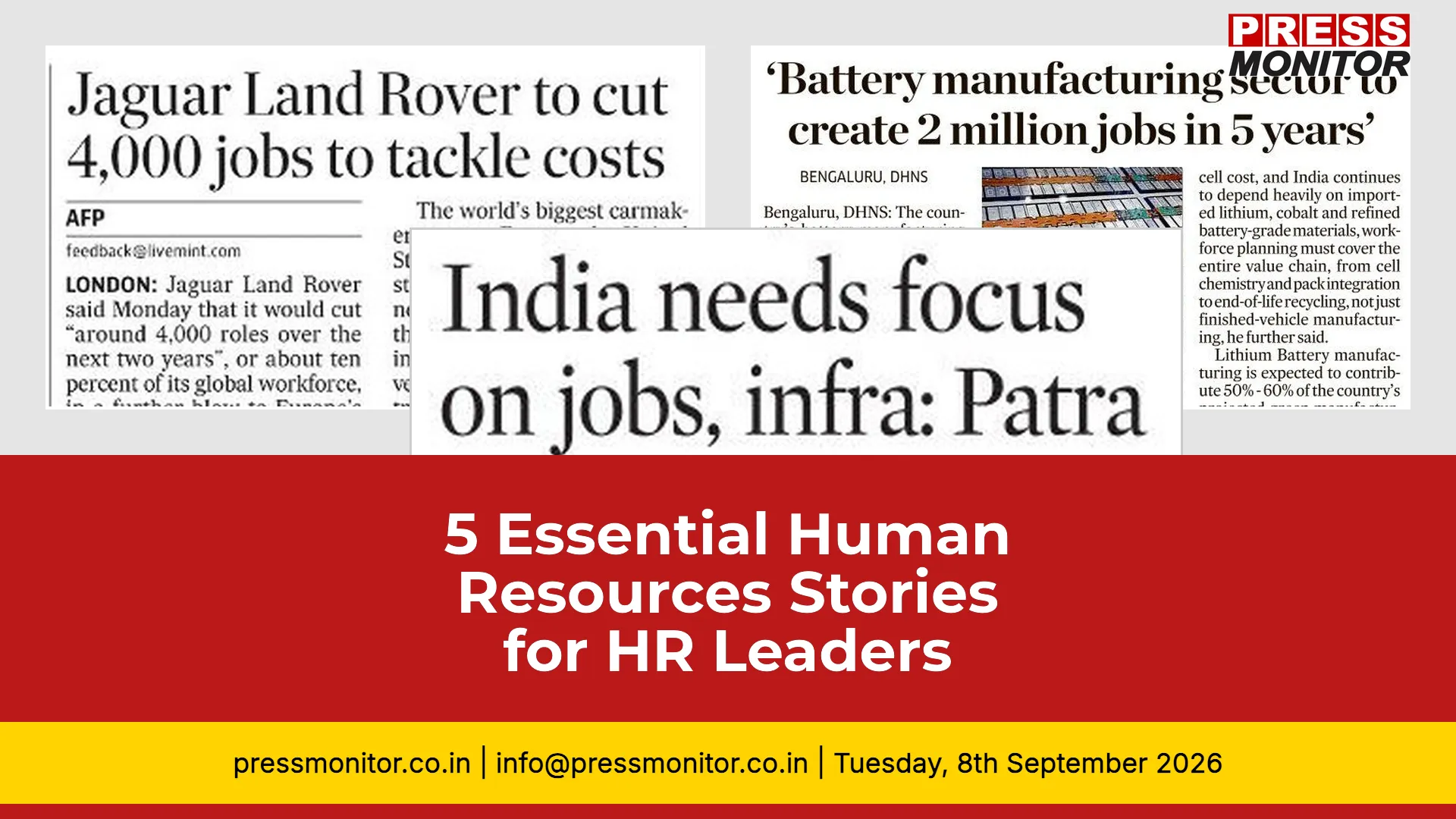
According to Press Monitor's tracking of Indian publications, this press review delivers five essential human resources stories shaping workforce strategy and news on human resources across India and the globe. From major layoffs at Jaguar Land Rover and Samsung India to a hiring rebound and battery sector job boom, these developments demand immediate attention from HR leaders. media monitoring of Indian print publications reveals how labour markets, talent management, and workplace policy are evolving in real time, offering media intelligence that digital-only feeds cannot match.
1. Jaguar Land Rover Cuts 4,000 Jobs Globally
A front-page report in Hindustan Times says Jaguar Land Rover announced Monday that it would cut around 4,000 roles over the next two years, representing about ten percent of its global workforce, as a further blow to Europe’s automobile industry. The voluntary redundancy scheme was revealed just days after German car giant Volkswagen announced 50,000 new job cuts, and follows months of turmoil caused by a cyberattack on the British luxury carmaker and US President Donald Trump’s sector-wide tariffs. JLR’s chief executive PB Balaji stated the company targets cost savings of 17 billion rupees, while the automotive industry faces significant challenges from technological change, intense competition from Chinese manufacturers, and the shift toward electric vehicles. JLR's voluntary redundancy scheme, announced days after Volkswagen's 50,000-job cut, targets 10% of its global workforce. CEO PB Balaji cited US tariffs, a cyberattack, and competition from Chinese manufacturers. The move draws criticism from UK political leaders and signals deeper restructuring in European auto. Why it matters: Workforce reductions at a major automotive employer ripple across the global talent market. Key detail: 34,000 employees remain based in the United Kingdom. Source: Hindustan Times. Next step: Assess how automotive sector layoffs may affect your talent pipeline and retention risk.
2. India Battery Sector to Create 2 Million Jobs
A front-page report in Deccan Herald says India's battery manufacturing sector is projected to generate 1.5 to 2 million jobs by 2030, with hiring growing 25 to 30 percent year-on-year. Under the PLI Scheme for Advanced Chemistry Cells, the Government of India has committed Rs 18,100 crore to develop 50 GWh of domestic manufacturing capacity. The sector is also building a full industrial ecosystem across Gujarat, Karnataka, Haryana, and Telangana. India's battery manufacturing is projected to generate 1.5 to 2 million jobs by 2030, with the PLI Scheme committing Rs 18,100 crore for 50 GWh of domestic capacity. This represents a massive opportunity for HR teams in scaling talent pipelines across Gujarat, Karnataka, Haryana, and Telangana. Why it matters: A new industrial ecosystem means surge hiring and reskilling demands. Key detail: Hiring growing 25 to 30 percent year-on-year in the battery sector. Source: Deccan Herald. Next step: Begin mapping battery manufacturing hubs for potential recruitment and partnership opportunities.
3. RBI Deputy Governor Charts India's Economic Course
A front-page report in Deccan Chronicle says that Reserve Bank of India deputy governor Michael Patra stated at a Mumbai conference on 7 September that India’s trajectory toward becoming the world’s largest economy hinges on leveraging its demographic dividend and implementing structural reforms. He highlighted that the country has averaged seven point seven per cent growth since the financial year twenty twenty two and currently stands as the second-largest contributor to global economic expansion. Patra emphasised that addressing employment, manufacturing, infrastructure, and women’s labour force participation remains critical to unlocking this potential. RBI Deputy Governor Michael Patra stressed that India's path to becoming the world's largest economy depends on demographic dividends and structural reforms, particularly in employment and women's labour force participation. HR leaders must align workforce strategies with these macro trends. Why it matters: Economic policy directly shapes hiring, compensation, and workforce planning. Key detail: India has averaged 7.7 percent growth since FY22 and is the second-largest contributor to global growth. Source: Deccan Chronicle. Next step: Review your workforce plan against India's structural reform priorities and demographic opportunities.
4. Samsung India Axes Staff as Sales Dip
A front-page report in Economic Times says Samsung India has been issuing termination letters daily to employees in the home appliance and television businesses without notice periods, offering three months' salary plus one month's pay per year of service as severance. Smartphone staff remain unaffected for now, with the company expecting a sales rebound during Diwali to improve overall financial performance. The challenges include a nearly ten percent rupee decline through fiscal 26, a slip to third place in the domestic smartphone market, and difficulties expanding in the high-value air-conditioner business. Samsung India Electronics is issuing daily termination letters in its TV and home appliance units, with up to 25% of the sales and marketing workforce at risk. The company offers three months' salary plus one month per year of service as severance, while smartphone staff remain unaffected for now. Why it matters: Tech sector layoffs signal broader restructuring in India's electronics manufacturing. Key detail: A nearly ten percent rupee decline through fiscal 26 and a slip to third place in the domestic smartphone market. Source: Economic Times. Next step: Monitor consumer electronics sector volatility for workforce planning adjustments.
5. India Tops Global Hiring League
A front-page report in Economic Times says India's hiring sentiment rose six percentage points quarter-on-quarter and eleven percentage points year-on-year in July 2026, putting the country at the top of the global hiring league table with an outlook 25 percentage points above the global average. Sandeep Gulati, managing director of ManpowerGroup India and Middle East, said employers across India are reshaping workforces with greater intent, placing a stronger emphasis on capability building than on headcount growth alone, while 69% of employers planning to add staff cite changing roles and skills driven by advancing technology. India's hiring sentiment rose six percentage points quarter-on-quarter and eleven percentage points year-on-year in July 2026, putting the country at the top of the global hiring league table with an outlook 25 percentage points above the global average. 69% of employers planning to add staff cite changing roles and skills driven by advancing technology. Why it matters: A rebounding hiring market means talent competition will intensify. Key detail: ManpowerGroup data shows India as the most optimistic labour market among all markets surveyed globally. Source: Economic Times. Next step: Strengthen employer branding and capability-building programs to attract top talent in a tightening market.
As these stories illustrate, print media monitoring provides the editorial depth that digital-only feeds miss. Which workforce trend will most impact your organisation in the next quarter?
