5 Essential Immigration Stories for Policy Leaders


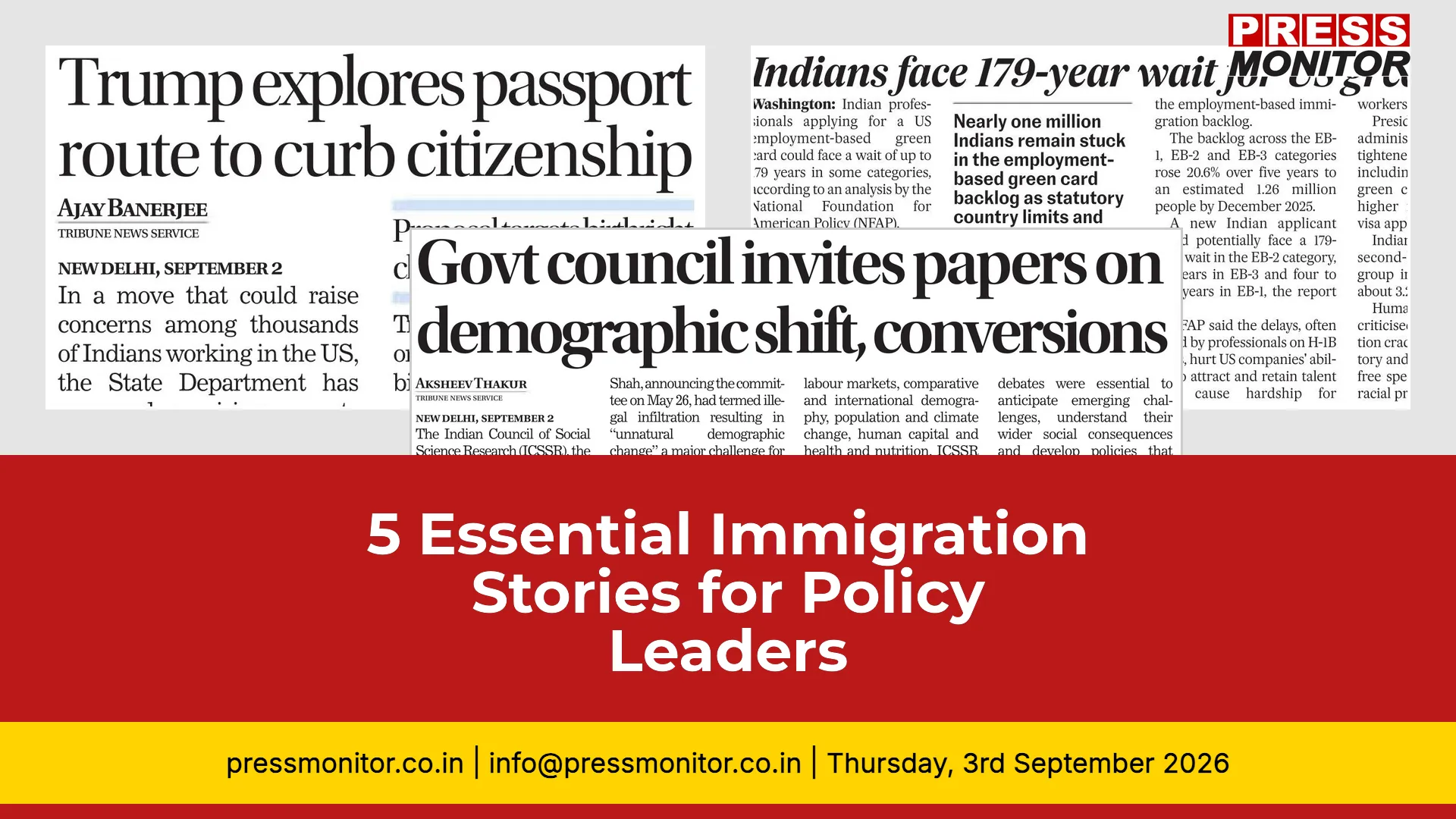
According to Press Monitor's tracking of Indian publications, this media monitoring report covers five essential stories shaping the immigration and migration landscape today. From a US citizenship proposal that could redefine passport rules for millions to a green card backlog stretching 179 years, these developments demand immediate attention from every stakeholder in migration policy.
1. US Citizenship Passport Proposal
A move that could raise concerns among thousands of Indians working in the US, the State Department has proposed requiring parents applying for passports for their children to provide proof of their own citizenship or immigration status. The proposal is a formal follow-up to President Donald Trump’s August 6 executive order aimed at restricting birthright citizenship.
Why it matters: This proposal could fundamentally alter how citizenship is transmitted to children born on US soil, affecting thousands of Indian professionals and their families.
Key detail: The State Department has proposed requiring parents applying for passports for their children to provide proof of their own citizenship or immigration status, formalizing President Trump's August 6 executive order on birthright citizenship. Cross-referenced across Times of India and Tribune — tracked from two independent sources.
Source: Tribune, Times of India
Next step: Monitor State Department implementation timelines and potential legal challenges.
2. 179-Year US Green Card Wait
A front-page report in Free Press Journal says Indian professionals applying for US employment-based green cards could face a wait of up to 179 years in the EB-2 category, according to an analysis by the National Foundation for American Policy. The study of US Citizenship and Immigration Services data found nearly 10 lakh Indians stuck in the green card backlog as of December 2025, with the backlog across the EB-1, EB-2 and EB-3 categories rising 20.6% over five years to an estimated 12.6 lakh people. New Indian applicants could wait 179 years in EB-2, 38 years in EB-3 and four to five years in EB-1, as US law caps employment-based green cards at 140,000 annually with no more than 7% for any single country.
Why it matters: The EB-2 category backlog means Indian professionals may wait generations for permanent residency, creating severe retention risks for employers.
Key detail: Nearly 10 lakh Indians stuck in the green card backlog as of December 2025; the backlog across EB-1, EB-2, and EB-3 categories has risen 20.6% over five years to an estimated 12.6 lakh people. New Indian applicants could wait 179 years in EB-2, 38 years in EB-3, and four to five years in EB-1.
Source: Free Press Journal, National Foundation for American Policy analysis
Next step: HR and talent mobility teams should engage with industry associations on visa reform advocacy.
3. Govt Council Invites Papers on Demographic Shift
A front-page report in Tribune says the Indian Council of Social Science Research has invited original research papers for a special issue examining India’s changing demographic profile. Eighteen themes listed for the elicited papers include cross-border migration, religious conversions and national security.
Why it matters: The government's call for research on cross-border migration and religious conversions signals a proactive approach to understanding demographic change.
Key detail: The Indian Council of Social Science Research has listed eighteen themes for the special issue, including cross-border migration, religious conversions, and national security.
Source: Tribune, AKSHEEV THAKUR
Next step: Research institutions and think tanks should submit papers ahead of the deadline.
4. Jaipur Airport Detains Dubai Passenger
A front-page report in First India says a passenger arriving from Dubai was detained at Jaipur Airport after a lookout notice was found pending against him. Immigration officials intercepted the man during checks after he landed on an Air India Express flight. He was handed over to police for further action and verification.
Why it matters: This incident highlights the effectiveness of India's border control mechanisms at entry points and the importance of lookout notice systems.
Key detail: A passenger arriving from Dubai on an Air India Express flight was detained at Jaipur Airport after a pending lookout notice was identified during immigration checks.
Source: First India, Jaipur
Next step: Aviation security teams should review lookout notice protocols and inter-agency coordination.
5. SC Allows Boy's Return to Dad in Canada
A front-page report in Hindustan Times says the Supreme Court has allowed a boy to be returned to his father in Canada after six years, dismissing the mother’s appeal against a Delhi High Court order directing the child’s repatriation.
Why it matters: The Supreme Court's ruling sets a precedent for cross-border child custody cases involving immigration status, with implications for international family law.
Key detail: The Supreme Court dismissed the mother's appeal against a Delhi High Court order directing the child's repatriation to his father in Canada after six years.
Source: Hindustan Times, SHRUTI KAKKAR
Next step: International family law practitioners should consult on cross-border custody and immigration implications.
What does this news on immigration mean for your organization's compliance and planning? This print media monitoring review, powered by Press Monitor's tracking of Indian publications, delivers the media intelligence you need to stay ahead.