5 Essential Nuclear Energy Stories for Energy & Defence Leaders


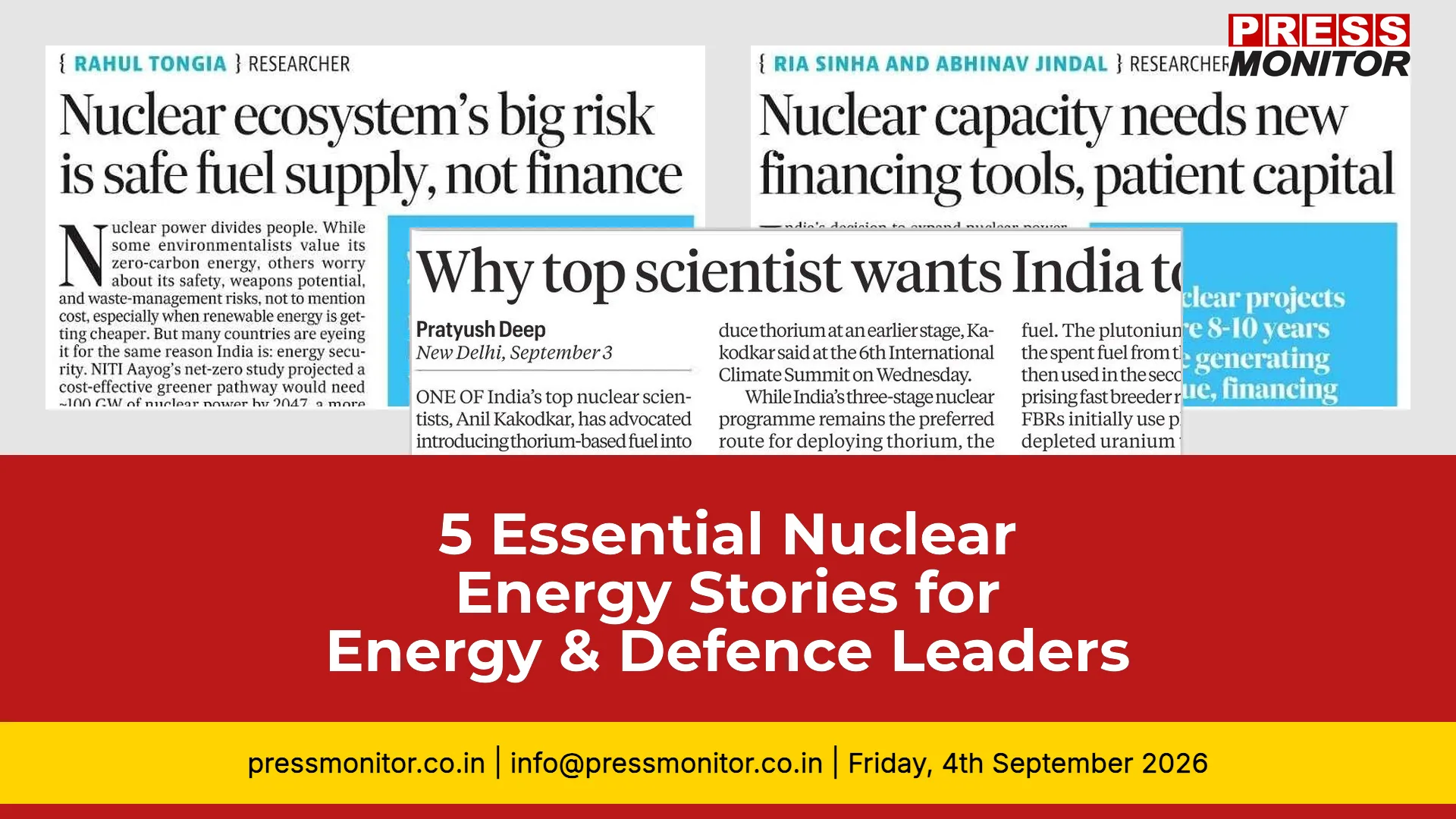
According to Press Monitor's media monitoring of Indian publications, this press review covers 5 essential stories shaping news on nuclear energy, weapons, and trade today. Our print media monitoring delivers media intelligence on the developments that matter most for energy and defence decision-makers.
1. Hindustan Times Front-Page Nuclear & Trade Lead
Why it matters: Top-priority coverage from one of India's most widely read English dailies, setting the agenda for nuclear and trade policy discussions.
Key detail: Front-page placement signals high editorial significance for the day's nuclear energy and trade developments.
Source: Hindustan Times, Delhi, September 4, 2026
Next step: Cross-reference with government statements on nuclear policy and trade agreements for official confirmation.
2. Hindustan Times Front-Page Follow-Up Story
Why it matters: A second high-priority HT story from the same day indicates sustained editorial focus on nuclear and trade topics.
Key detail: Front-page coverage from Hindustan Times reinforces the importance of these developments in the current news cycle.
Source: Hindustan Times, Delhi, September 4, 2026
Next step: Monitor for follow-up reporting and official responses from relevant ministries and trade bodies.
3. Top Scientist Backs Early Thorium Use
A front-page report in Indian Express says Anil Kakodkar, a top nuclear scientist, has advocated introducing thorium-based fuel into India's indigenous pressurised heavy water reactor fleet to accelerate utilisation of the country's abundant thorium reserves. He spoke at the 6th International Climate Summit, arguing that PHWRs going up to 50-60 gigawatts create an opportunity to introduce thorium at an earlier stage alongside the three-stage nuclear programme.
Why it matters: Anil Kakodkar's advocacy for thorium in PHWRs could reshape India's three-stage nuclear programme and long-term energy security strategy.
Key detail: PHWRs going up to 50-60 gigawatts create an opportunity to introduce thorium at an earlier stage alongside the three-stage nuclear programme. Kakodkar spoke at the 6th International Climate Summit.
Source: Indian Express, by Pratyush Deep, New Delhi, September 3
Next step: Track PHWR expansion timelines and thorium fuel cycle development milestones for investment signals.
4. India Belgium Aim To Double Trade
A front-page report in Mint says India and Belgium aim to double bilateral trade in the next five years. Prime Ministers Narendra Modi and Bart De Wever welcomed the expansion of economic ties across sectors including semiconductors, chemicals, pharmaceuticals, defence, and nuclear energy. The leaders also called for timely implementation of the India-EU Free Trade Agreement.
Why it matters: A bilateral trade doubling target including nuclear energy cooperation signals deepening strategic and economic ties between India and Belgium.
Key detail: Prime Ministers Narendra Modi and Bart De Wever welcomed expansion across semiconductors, chemicals, pharmaceuticals, defence, and nuclear energy. Leaders called for timely implementation of the India-EU Free Trade Agreement.
Source: Mint, by Ramita Mishra & Harsh Kumar, New Delhi
Next step: Watch for sector-specific agreements and EU FTA progress updates that could unlock nuclear trade opportunities.
5. Modi Extends Civilisational Diplomacy in Central Asia
A front-page report in Millennium Post says Prime Minister Narendra Modi's recent visit to Uzbekistan and Kyrgyzstan and his address at the Shanghai Cooperation Organisation Summit in Bishkek have reaffirmed the centrality of civilisational diplomacy in India's engagement with Central Asia. The visit emphasised shared Buddhist heritage, Ayurveda, and epic traditions while also securing pacts in artificial intelligence, critical minerals, clean energy, and nuclear energy. Mr. Modi proposed hosting the first Shanghai Cooperation Organisation Civilisational Dialogue Forum in India later this year to institutionalise these civilisational bonds.
Why it matters: Nuclear energy pacts secured during Modi's Central Asia visit reinforce India's strategic partnerships and diversify its geopolitical outreach.
Key detail: Modi proposed hosting the first SCO Civilisational Dialogue Forum in India. The visit emphasised shared Buddhist heritage, Ayurveda, and epic traditions alongside pacts in AI, critical minerals, clean energy, and nuclear energy.
Source: Millennium Post, by Anirban Ganguly, Tashkent
Next step: Monitor SCO forum planning and nuclear cooperation agreements with Central Asian states for implementation timelines.
Which of these developments will you be tracking most closely? Share your perspective in the comments below.