5 Essential Nuclear Energy Stories for Energy Leaders


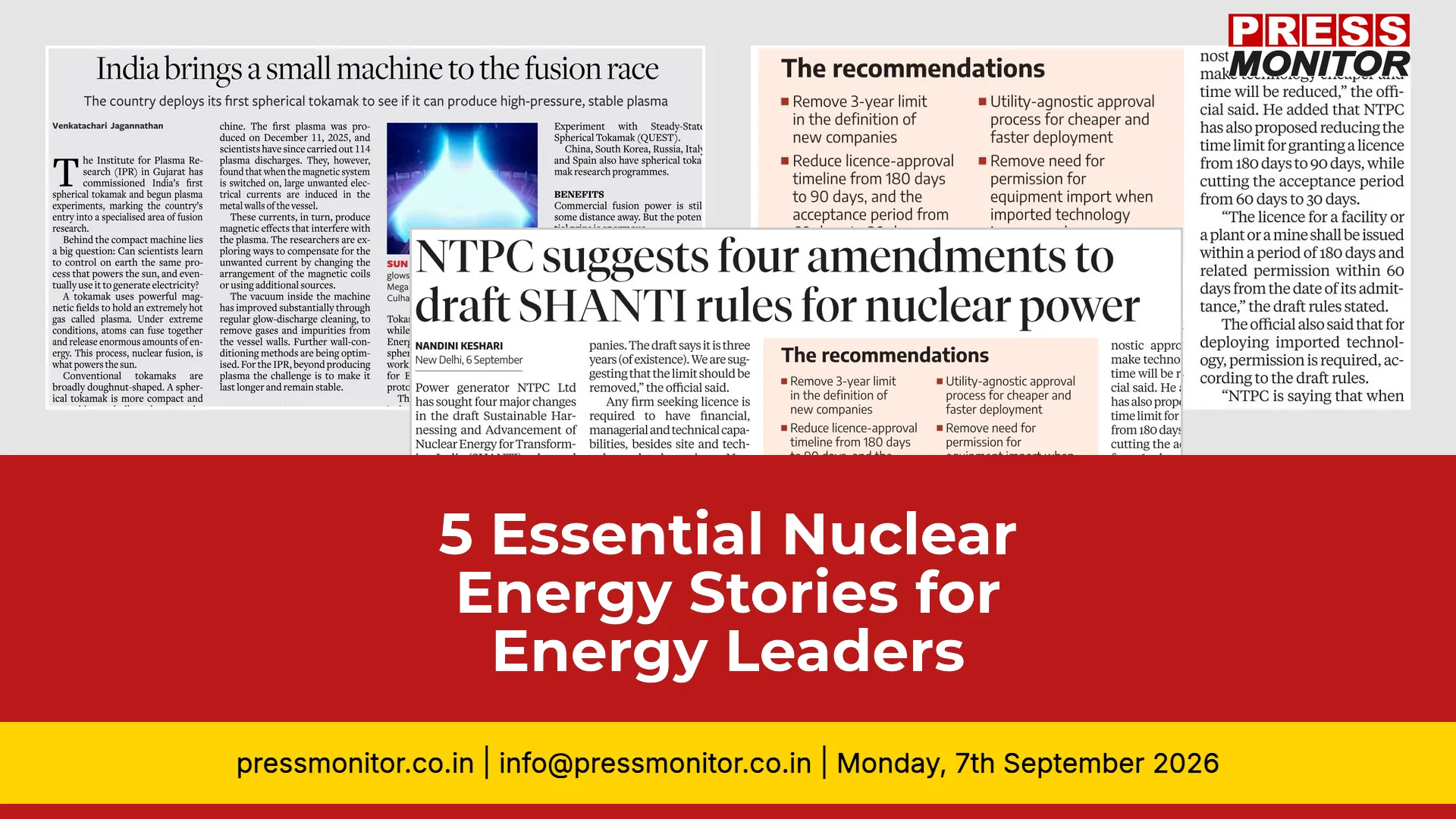
According to Press Monitor's tracking of Indian publications, here are 5 essential news on nuclear energy stories shaping India's atomic future today. This press review draws on print media monitoring across national and regional dailies to deliver media intelligence on the developments that matter most.
1. India Deploys First Spherical Tokamak
A front-page report in Business Line says the Institute for Plasma Research in Gujarat has commissioned India's first spherical tokamak and begun plasma experiments. The country has entered a specialised area of fusion research, with the first plasma produced on December 11, 2025. Scientists have carried out 114 plasma discharges and are exploring ways to address unwanted electrical currents induced in the vessel walls. India has entered the global fusion research arena. The Institute for Plasma Research in Gujarat commissioned the country's first spherical tokamak and produced its first plasma on December 11, 2025. Scientists have carried out 114 plasma discharges and are exploring ways to address unwanted electrical currents induced in the vessel walls. Why it matters: Fusion energy could redefine India's long-term power strategy and position the country as a compact fusion leader. Key detail: 114 plasma discharges completed since commissioning. Source: Business Line, by Venkatachari Jagannathan, Gujarat, 11 December 2025. Next step: Track IPR Gujarat's publication timeline for peer-reviewed results. Tag @IPRGujarat in comments.
2. NTPC Nuclear Joint Venture Ashvini 2400 MW Project
A front-page report in Business Standard says Nigam Limited (Ashvini), a joint venture between NTPC and Nuclear Power Corporation of India Limited (NPCIL), is establishing a 2,400 MW nuclear power project called Mahi Banswara Rajasthan Atomic Power Project (MBRAPP) in Banswara district, Rajasthan, with initial testing of the first 700 MW unit expected by FY33. The report also says NTPC has proposed a utility-agnostic approval process and licence time reductions under the draft SHANTI Rules, 2026, which seek to open the nuclear power sector to private and foreign participation. Nigam Limited (Ashvini), the joint venture between NTPC and Nuclear Power Corporation of India Limited, is establishing a 2,400 MW nuclear power project — the Mahi Banswara Rajasthan Atomic Power Project (MBRAPP) — in Banswara district, Rajasthan. Initial testing of the first 700 MW unit is expected by FY33. Why it matters: This is one of India's largest proposed nuclear installations and a model for public-private partnership in atomic energy. Key detail: 2,400 MW capacity; first 700 MW unit testing by FY33. Source: Business Standard. Next step: Monitor DAE approval milestones for the first unit. Tag @NTPC in comments.
3. NTPC Proposes Four Amendments to SHANTI Rules
A front-page report in Business Standard says NTPC has submitted four major changes to the draft Sustainable Harnessing and Advancement of Nuclear Energy for Transforming India rules, targeting the removal of the 3‑year limit for new companies, a utility‑agnostic approval process, shortened licensing timelines, and exemption from import permission for equipment once the design is approved. The proposals were sent to the Department of Atomic Energy in New Delhi and aim to facilitate private participation and faster deployment of nuclear power projects such as the Mahi Banswara Rajasthan Atomic Power Project. NTPC has submitted four major changes to the draft Sustainable Harnessing and Advancement of Nuclear Energy for Transforming India rules. The proposals target removal of the 3-year limit for new companies, a utility-agnostic approval process, shortened licensing timelines, and exemption from import permission for equipment once the design is approved. The proposals were sent to the Department of Atomic Energy in New Delhi. Why it matters: These amendments could open the nuclear power sector to private and foreign participation at unprecedented speed. Key detail: 4 amendments covering licensing, approvals, and import rules. Source: Business Standard, by NANDINI KESHARI, New Delhi, 6 September. Next step: Watch for DAE's response and stakeholder consultations. Tag @DAE in comments.
4. Twenty Five Nations Back Nuclear Shipping
A front-page report in Mint says roughly twenty five nations agreed to plan nuclear-powered merchant ships at a recent International Atomic Energy Agency summit in Washington. The initiative seeks to speed up ocean freight and drastically cut maritime carbon emissions, but analysts warn excluding China from drafting the rules will sabotage progress and fuel a new geopolitical arms race. Roughly twenty five nations agreed to plan nuclear-powered merchant ships at a recent International Atomic Energy Agency summit in Washington. The initiative seeks to speed up ocean freight and drastically cut maritime carbon emissions, but analysts warn that excluding China from drafting the rules will sabotage progress and fuel a new geopolitical arms race. Why it matters: Nuclear maritime propulsion could reshape global trade routes and energy logistics. Key detail: 25 nations at IAEA summit; China exclusion risk flagged. Source: Mint, by David Fickling. Next step: Follow IAEA working group formations for shipping protocol drafts. Tag @IAEA in comments.
5. Economic Times — Nuclear Sector Coverage
Economic Times published a front-page report on nuclear sector developments in Delhi on 7 September 2026. Tracked by Press Monitor as part of comprehensive print media monitoring across India's business daily landscape. Why it matters: Economic Times coverage signals corporate and policy attention to nuclear energy developments. Key detail: Front-page placement in India's leading business daily. Source: Economic Times, Delhi. Next step: Cross-reference with NTPC and DAE announcements for full context.
What do you think — will India's nuclear ambitions accelerate in the next fiscal year? Share your perspective in the comments.