5 Essential Nuclear Energy Stories for Indian Readers


India's nuclear landscape spans geopolitics, clean energy investment, and domestic infrastructure expansion. This press review, grounded in media monitoring and print media monitoring of Indian publications, delivers a news on nuclear energy briefing powered by media intelligence that matters for policymakers, investors, and industry leaders. According to Press Monitor's tracking of Indian publications, here are the five essential stories shaping the nuclear discourse today.
1. Iran Referred to UN Security Council by IAEA
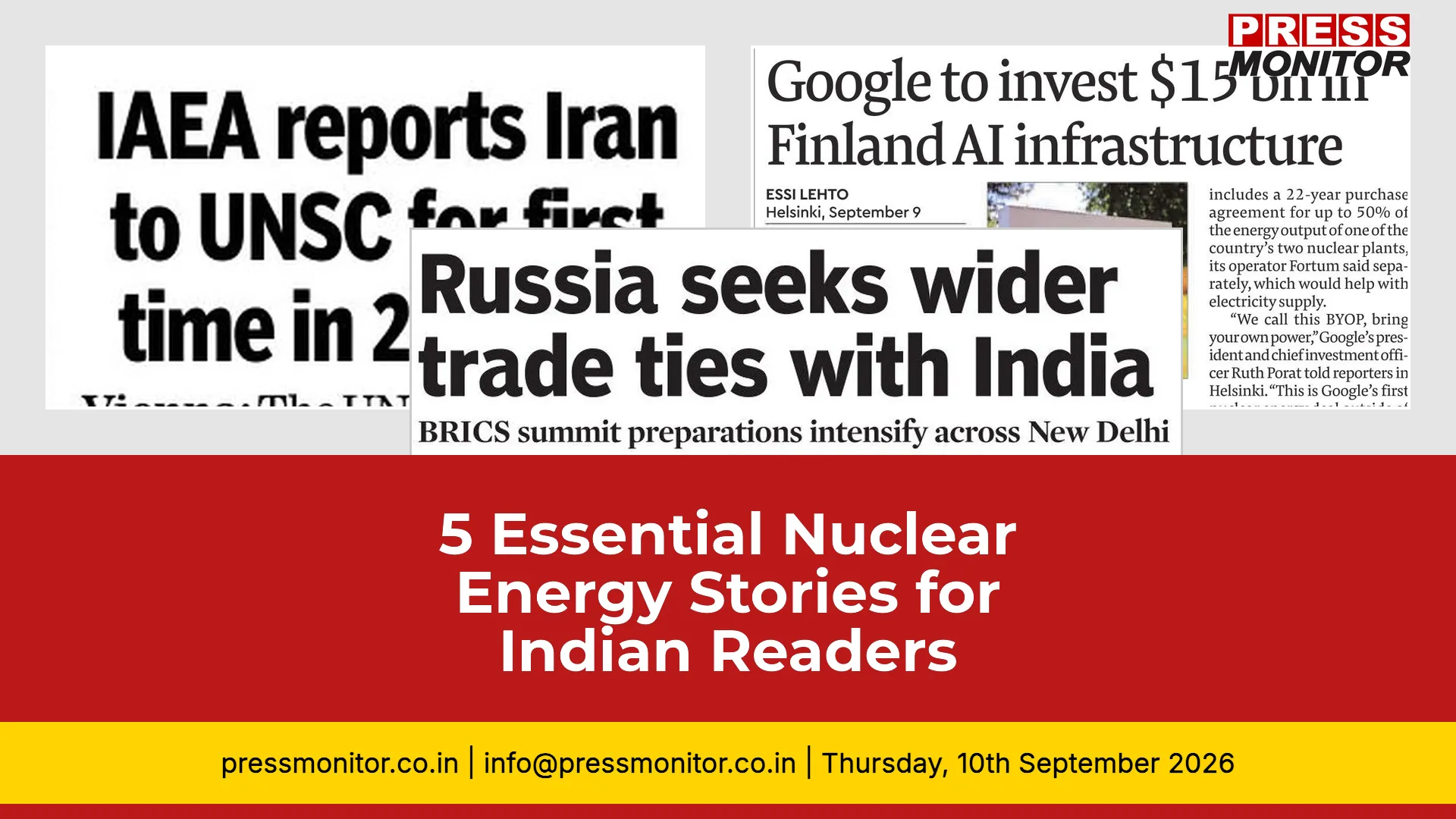
A front-page report in Times of India says the UN atomic watchdog's board reported Iran to the UNSC for the first time in 20 years for failing to cooperate in a probe into uranium traces detected at undeclared sites in Iran. Twenty-three countries on the IAEA's 35-member board voted for the resolution at IAEA headquarters in Vienna, while China, Russia and Niger opposed it, and eight countries abstained. The resolution was put forward by the US, Britain, France and Germany, as Western officials suspect the uranium traces could provide evidence that Iran had a secret nuclear weapons programme until 2003, though Iran says it is not pursuing nuclear weapons. The IAEA board referred Iran to the UNSC for the first time in twenty years over uranium traces at undeclared sites. Twenty-three countries voted in favour, with China, Russia, and Niger opposing. Western officials suspect the traces could indicate a secret nuclear weapons programme until 2003. Iran has warned of retaliation. This escalation marks a pivotal moment in global non-proliferation efforts and will test the resolve of the international community.
Why it matters: The referral could reshape diplomatic alliances and tighten nuclear sanctions on Iran.
Key detail: First UNSC referral in 20 years; 23-1 vote with 8 abstentions.
Source: Tracked by Press Monitor from Times of India, Morning Standard, and Indian Express.
Next step: Watch for Iran's formal response and any UNSC procedural moves.
2. Google Invests €13 Billion in Finland AI and Nuclear Energy
A front-page report in Financial Express says Alphabet's Google will invest at least 13 billion euros in AI infrastructure in Finland over the next two years, involving three new data centres in the north. The deal includes a 22-year agreement to purchase up to 50% of the energy output of one of Finland's nuclear plants, which Google's president and chief investment officer Ruth Porat described as bring your own power. This marks Google's first nuclear energy deal outside the United States and reflects a push for colder climates with stable grids to host energy-intensive data centres while meeting climate goals. Alphabet's Google will invest at least €13 billion in AI infrastructure in Finland, including a 22-year agreement to purchase up to 50% of the energy output from one of Finland's nuclear plants. Ruth Porat called the deal a cornerstone of Google's Finland strategy. This marks Google's first nuclear energy agreement outside the United States.
Why it matters: The deal signals a new model for tech companies sourcing clean nuclear power for energy-intensive data centres.
Key detail: €13 billion investment, 22-year nuclear power purchase agreement, three new data centres planned.
Source: Tracked by Press Monitor from Financial Express, Business Standard, and First India.
Next step: Monitor Finland's nuclear capacity expansion and Google's broader clean energy roadmap.
3. Russia Expands India Cooperation at Innoprom India
A front-page report in Deccan Chronicle says Moscow-based companies showcased products at the first Innoprom.India exhibition in New Delhi, seeking to expand economic and high-technology cooperation with India. The exhibition features Russian technologies in industrial equipment, transport, nuclear energy, space, and artificial intelligence, including a model nuclear power plant and aircraft models. The outreach comes ahead of the 18th BRICS Leaders' Summit in New Delhi on September 9, 2026, where Prime Minister Narendra Modi will welcome leaders including Vladimir Putin and Xi Jinping. Moscow-based companies showcased advanced technologies at the first Innoprom.India exhibition in New Delhi, including nuclear energy, AI, aerospace, and industrial machinery. The outreach comes ahead of the 18th BRICS Leaders' Summit where PM Modi will welcome President Putin and President Xi Jinping.
Why it matters: Russia is positioning itself as a strategic technology partner for India beyond traditional defence ties.
Key detail: First Innoprom.India exhibition; nuclear energy and AI among showcased sectors.
Source: Tracked by Press Monitor from Deccan Chronicle.
Next step: Track outcomes of the BRICS summit for Indo-Russian technology cooperation.
4. North Korea Builds New Yongbyon Uranium Enrichment Facility
A front-page report in The Hindu says North Korea has built a new uranium enrichment facility at its Yongbyon nuclear complex and started operating an expanded annex at its Kangson enrichment site, according to the IAEA, which said the developments violate UN Security Council resolutions. North Korea has built a new uranium enrichment facility at its Yongbyon nuclear complex and started operating an expanded annex at its Kangson enrichment site, according to the IAEA. The developments violate UN Security Council resolutions.
Why it matters: The expansion signals North Korea's continued advancement of its nuclear weapons programme despite international sanctions.
Key detail: New enrichment facility at Yongbyon; expanded Kangson annex operational.
Source: Tracked by Press Monitor from The Hindu.
Next step: Watch for IAEA follow-up reports and any UNSC emergency consultations.
5. Maharashtra Signs Rs 79,000 Crore Nuclear Power MoUs
A front-page report in Free Press Journal says Maharashtra has signed two Memorandums of Understanding with Torrent Power Ltd and JSW Energy Ltd for nuclear power projects with a combined capacity of 4,200 MW and an estimated investment of Rs 79,000 crore. The projects are expected to generate around 11,700 direct and indirect employment opportunities. Chief Minister Devendra Fadnavis said nuclear energy would be crucial for meeting baseload requirements. Maharashtra signed two MoUs with Torrent Power Ltd and JSW Energy Ltd for nuclear power projects with a combined capacity of 4,200 MW and an estimated investment of Rs 79,000 crore. The projects are expected to generate around 11,700 direct and indirect employment opportunities. CM Devendra Fadnavis said nuclear energy is crucial for meeting baseload requirements.
Why it matters: This investment underscores India's push to expand nuclear capacity as part of its clean energy and baseload power strategy.
Key detail: 4,200 MW capacity, Rs 79,000 crore investment, 11,700 jobs expected.
Source: Tracked by Press Monitor from Free Press Journal.
Next step: Follow project timelines and state-level regulatory approvals for the nuclear plants.
These five stories illustrate the interconnected nature of nuclear energy — from geopolitical tensions to clean energy investment and domestic infrastructure. As print media monitoring continues to track these developments, Press Monitor remains your trusted source for verified, editorial-vetted nuclear news from across India's diverse print landscape. Which nuclear development will you be watching next?