5 Essential Robotics & Automation Stories for Industry Leaders


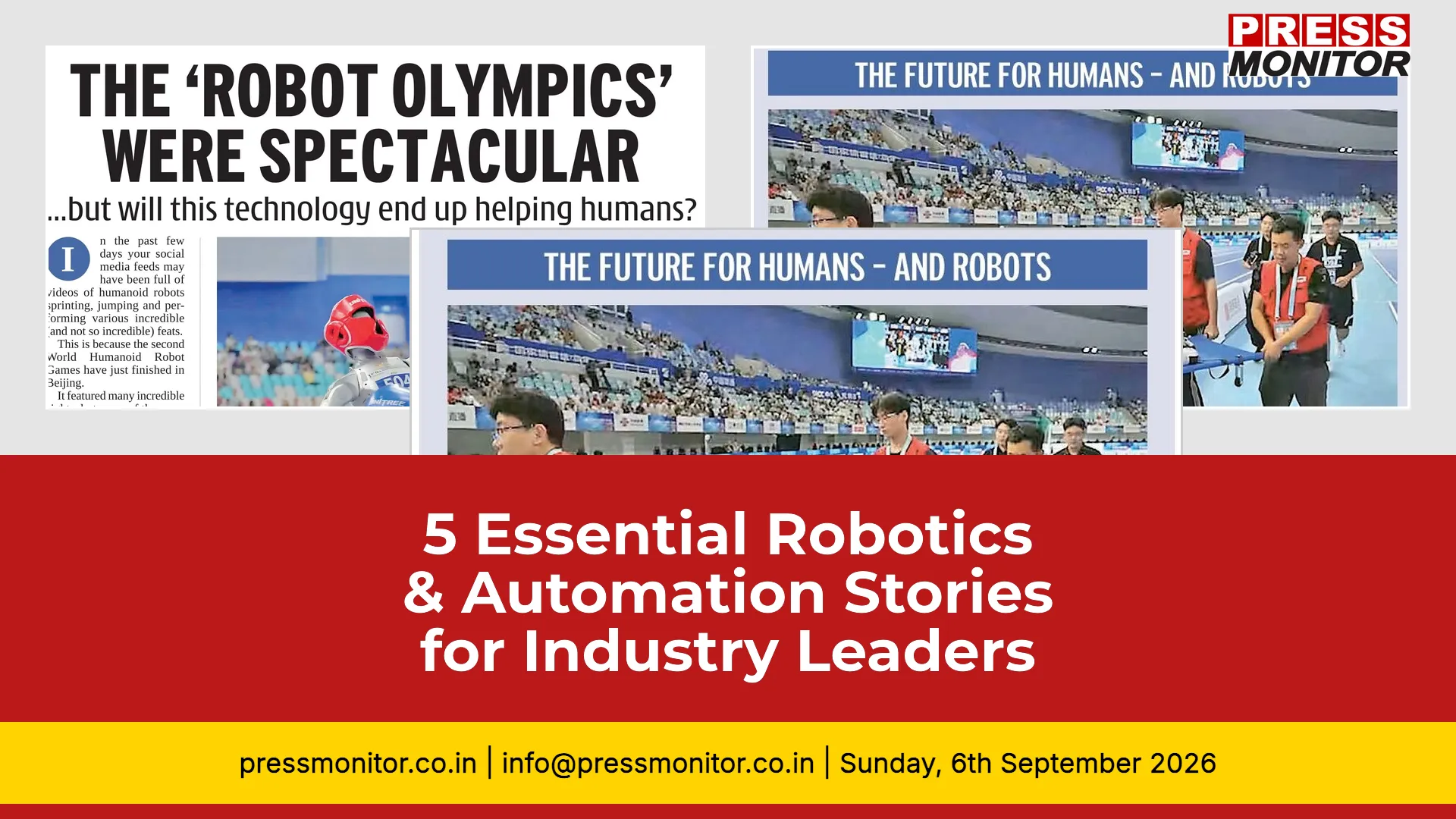
According to Press Monitor's tracking of Indian publications, the Robotics & Automation sector is transforming industries at a pace that demands rigorous media monitoring. This press review delivers media intelligence on the most consequential news on Robotics & Automation from today's Indian print landscape. From humanoid robot Olympics in Beijing to consumer robots selling out, these stories define the trajectory of automation in 2026 — and they are tracked exclusively through print media monitoring of India's most influential newspapers.
1. 2000 Robots Compete in Beijing Games
A front-page report in First India says the second World Humanoid Robot Games have just finished in Beijing, featuring more than 2000 robots competing in 50 events. Half of the events are direct copies of the human Olympics and Paralympics, while the other events include book sorting, garden management, bricklaying and tweezer bean picking. The report notes that two robots beat Usain Bolt’s world record of 9.58 seconds in the 100 metre sprint, clocking 9.39 seconds.
Why it matters: The World Humanoid Robot Games signal that human-machine competition has moved from theory to spectacle. Two robots have already beaten Usain Bolt's 9.58-second world record in the 100-metre sprint, clocking 9.39 seconds across 50 events.
Key detail: Half the events mirror the human Olympics and Paralympics; the rest include book sorting, garden management, bricklaying, and tweezer bean picking.
Source: First India, Jaipur, front page, 6 September 2026.
Next step: Watch for how these performance benchmarks influence Indian robotics startups and manufacturing automation roadmaps.
2. Humanoid Robots Rise
A front-page report in First India says that competitions for humanoid robots are proving useful to technology companies, with sports demonstrations showing what robots can do when everything goes right and real‑world contests exposing failures. The report notes that despite huge investment, humanoid robots are still far from common household use, but experts predict they will soon assist with tasks such as unloading trucks, stocking shelves, working in hazardous settings, helping elderly independence and even emptying dishwashers.
Why it matters: Robotics competitions are proving their value to technology companies, revealing what robots can do when everything goes right — and where they fail in real-world conditions.
Key detail: Experts predict humanoid robots will soon assist with unloading trucks, stocking shelves, working in hazardous settings, helping elderly independence, and even emptying dishwashers.
Source: First India, Jaipur, front page, 6 September 2026.
Next step: Identify which Indian industries are best positioned for early humanoid robot adoption.
3. Humanoid Robots Still Far from Home Use
A front-page report in First India says that robotics competitions demonstrate both the capabilities and limitations of humanoid robots. While spectacular sports demonstrations show robots when everything goes right, real-world task competitions reveal the vast gap before humanoids can assist in homes. Massive investment sums suggest the day may be closer than we think, but tasks like making tea or cleaning litter trays remain science fiction.
Why it matters: The gap between spectacular sports demonstrations and practical household assistance remains wide, and investors need to understand why.
Key detail: Despite massive investment, making tea or cleaning litter trays remain science fiction. Real-world task competitions expose the vast distance before humanoids can assist in homes.
Source: First India, Jaipur, front page, 6 September 2026.
Next step: Separate the hype cycle from realistic timelines for consumer robotics deployment.
4. Humanoid Robots Face Dishwasher Challenge
A front-page report in First India says humanoid robots struggle with dishwasher tasks that humans find routine. The Conversation explains that robots must sense objects, judge lighting, plan actions and manipulate items such as plates, teaspoons, pots and pans. No specific date, location or named people are provided.
Why it matters: Everyday tasks like loading a dishwasher require advanced perception, judgment, and fine motor control — the exact capabilities where humanoid robots still struggle.
Key detail: Robots must sense objects, judge lighting, plan actions, and manipulate items such as plates, teaspoons, pots, and pans. No specific date, location, or named individuals are provided in the source.
Source: The Conversation, as reported in First India, Jaipur, 6 September 2026.
Next step: Research labs and manufacturers should prioritise fine motor skill development and computer vision improvements.
5. Microduck Robot Sells 10,000 Units
A front-page report in Financial Express says Microduck, a programmable personal robot from Pollen Robotics, the French subsidiary of Hugging Face, has sold more than 10,000 units since its launch, generating more than 4 million dollars at a 399 dollar unit price, and new orders are now facing delivery delays beyond the original Christmas 2026 estimate.
Why it matters: Consumer robotics is reaching a commercial inflection point, with demand outstripping supply for the first time.
Key detail: Microduck, a programmable personal robot from Pollen Robotics (the French subsidiary of Hugging Face), has sold more than 10,000 units since launch, generating over 4 million dollars at a 399-dollar unit price. New orders now face delivery delays beyond the original Christmas 2026 estimate.
Source: Financial Express, Delhi, front page, 6 September 2026.
Next step: Monitor supply chain constraints as consumer robotics demand accelerates across global markets.
Closing question: Which of these robotics developments will reshape Indian industry first — and is your organisation ready for the shift?