5 Essential Robotics & Automation Stories for Tech Leaders


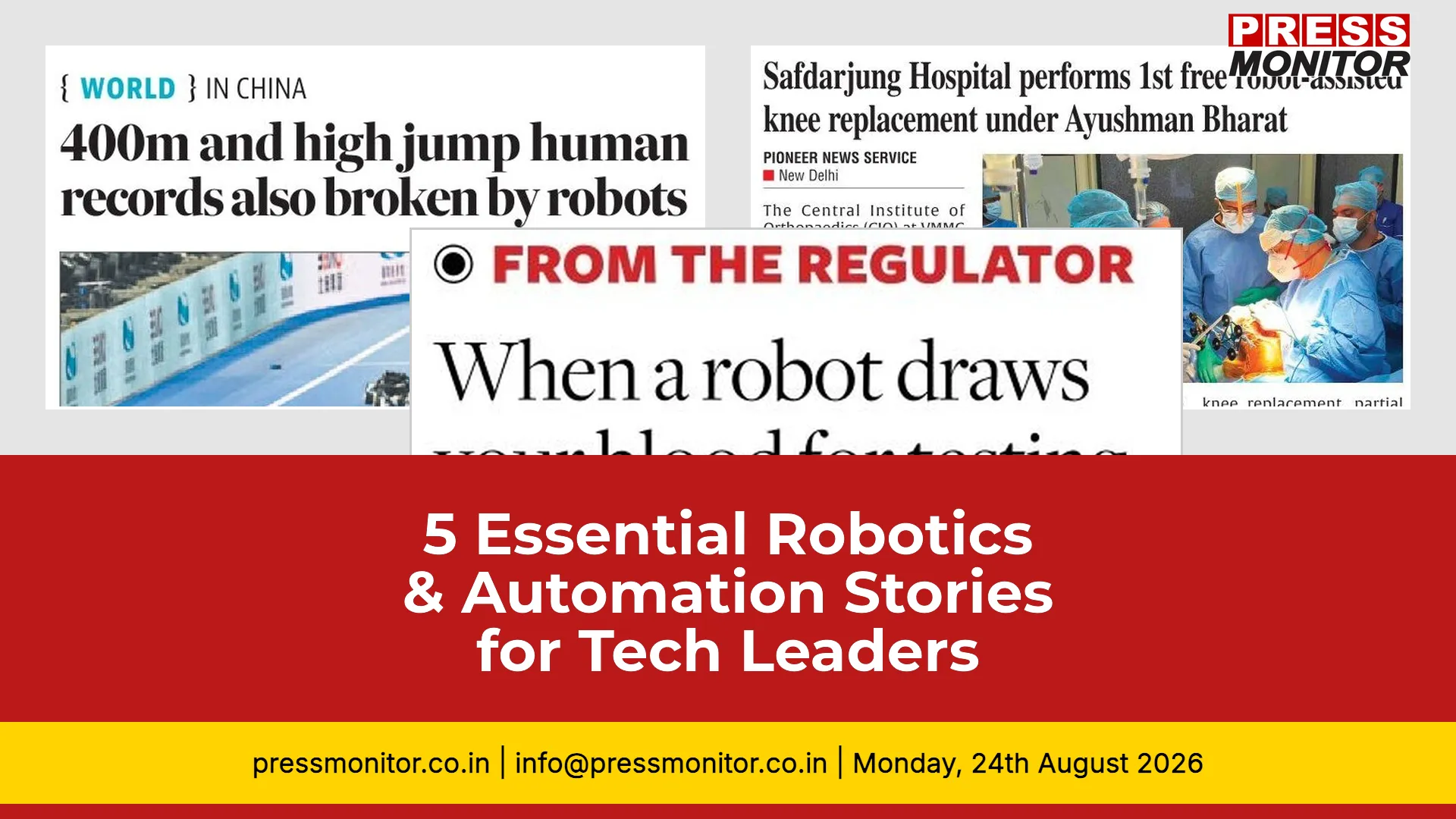
The world of robotics and automation is moving at breakneck speed. From humanoid robots shattering world records in Beijing to a first-of-its-kind autonomous blood-drawing robot approved by the FDA, here are the top 5 stories tracked by print media monitoring across Indian publications, according to Press Monitor's tracking of Indian publications.
1. Humanoid Robots Break Human Athletics Records at Beijing Games
A front-page report in Hindustan Times says that robots have broken two more human records at the World Humanoid Robot Games in Beijing. The same robot that broke Usain Bolt's 100m best a day earlier shattered the 400m world record by nearly five seconds. In a standing high jump, a robot was able to reach 2.88m, surpassing the human high jump record of 2.45m.
Why it matters: This marks a pivotal moment in robotics, demonstrating that humanoid machines can outperform humans in physical tasks, with implications for industrial and service automation.
Key detail: At the World Humanoid Robot Games, robots Tiangong Ultra and Lightning shattered Usain Bolt's 100m record (9.39s), broke the 400m record by nearly five seconds, and achieved a 2.88m high jump. The event featured 51 competitions including football, boxing, and Tai Chi.
Source: Covered by 9 Indian newspapers including Hindustan Times, The Hindu, Mint, and Business Standard.
Next step: Track how these advancements influence warehouse automation and logistics with print media monitoring.
2. India's First Free Robot-Assisted Knee Replacement at Safdarjung Hospital
A front-page report in The Pioneer says the Central Institute of Orthopaedics at VMMC and Safdarjung Hospital has successfully performed its first robotic-assisted total knee replacement on a 75-year-old economically disadvantaged beneficiary at no cost under the Ayushman Bharat scheme. The procedure was led by Dr Sumit Sural and the hospital confirmed the platform is now upgradable for further procedures.
Why it matters: This procedure, performed under Ayushman Bharat, makes advanced robotic surgery accessible to economically disadvantaged patients, setting a precedent for public healthcare robotics.
Key detail: Dr. Sumit Sural led the surgery on a 75-year-old patient at no cost. The robotic platform is now upgradable for future procedures.
Source: The Pioneer and The Hans India.
Next step: Monitor the expansion of robotic surgery in government hospitals with media intelligence.
3. FDA Approves First Autonomous Blood-Drawing Robot Aletta
A front-page report in Business Line says the FDA has authorized Aletta, the first stand-alone robotic device designed to draw blood from patients' arms without direct operator intervention. This robot must be supervised by trained phlebotomists overseeing up to three devices, aiming to address a national staff shortage. Authorized for outpatient use in adults, Aletta combines near-infrared imaging and Doppler ultrasound to safely conduct blood draws while ensuring no unsafe veins are selected. Clinical data supports its effectiveness comparable to human phlebotomists, granted via the De Novo pathway due to its novel nature for low- to moderate-risk procedures.
Why it matters: Addressing the phlebotomist shortage in the US, Aletta can autonomously draw blood using near-infrared and Doppler ultrasound, supervised by a human operator.
Key detail: The De Novo clearance allows outpatient use for adults. Clinical data shows effectiveness comparable to human phlebotomists.
Source: Business Line, citing FDA.
Next step: Watch for similar regulatory approvals for medical robots in India.
4. Deeptech Funds Expand into Robotics, Space, and Semiconductors
“Selon Economic Times,” Growing interest in deeptech is prompting more sector-focused venture capital funds to widen their horizons and invest in areas such as robotics, space, advanced manufacturing, semiconductors, and energy. Across specialist investors such as Omnivore, Ankur Capital, Avaana Capital, Aavishkaar Capital, and Incubate Fund Asia India, a larger share of investments since 2024 has gone into businesses beyond the sectors they are traditionally associated with. For instance, Agri-focused venture firm Omnivore is in advanced discussions to invest in Hyderabad-based industrial robotics startup Perceptyne, recently signing a term sheet to raise $10 million from Premji Invest.
Why it matters: Specialist VC firms like Omnivore, Ankur Capital, and Avaana Capital are investing beyond their traditional sectors, with robotics startup Perceptyne in Hyderabad raising $10 million from Premji Invest.
Key detail: This trend signals growing investor confidence in India's deeptech ecosystem, particularly industrial robotics.
Source: Economic Times.
Next step: Use press review to track emerging deeptech startups in your sector.
5. Elon Musk Predicts End of Money as AI and Robotics Create Abundance
A front-page report in Free Press Journal says Elon Musk proposes that money could eventually cease to matter as abundance driven by AI and robotics destroys traditional pricing. The piece explores how technological deflation in intelligence and labour might reduce bureaucracy and the economic cost of friction.
Why it matters: Musk's vision of technological deflation raises questions about the future of work and economic value in an automated world.
Key detail: The proposal suggests that as AI and robotics drive down costs, traditional pricing models may become obsolete.
Source: Free Press Journal.
Next step: Stay informed on policy debates around automation and universal basic income.
Closing: Which of these stories will impact your industry most? Let us know in the comments. For daily curated intelligence from Indian print media, you're already in the right place.