5 Essential Semiconductors Stories for Tech Executives


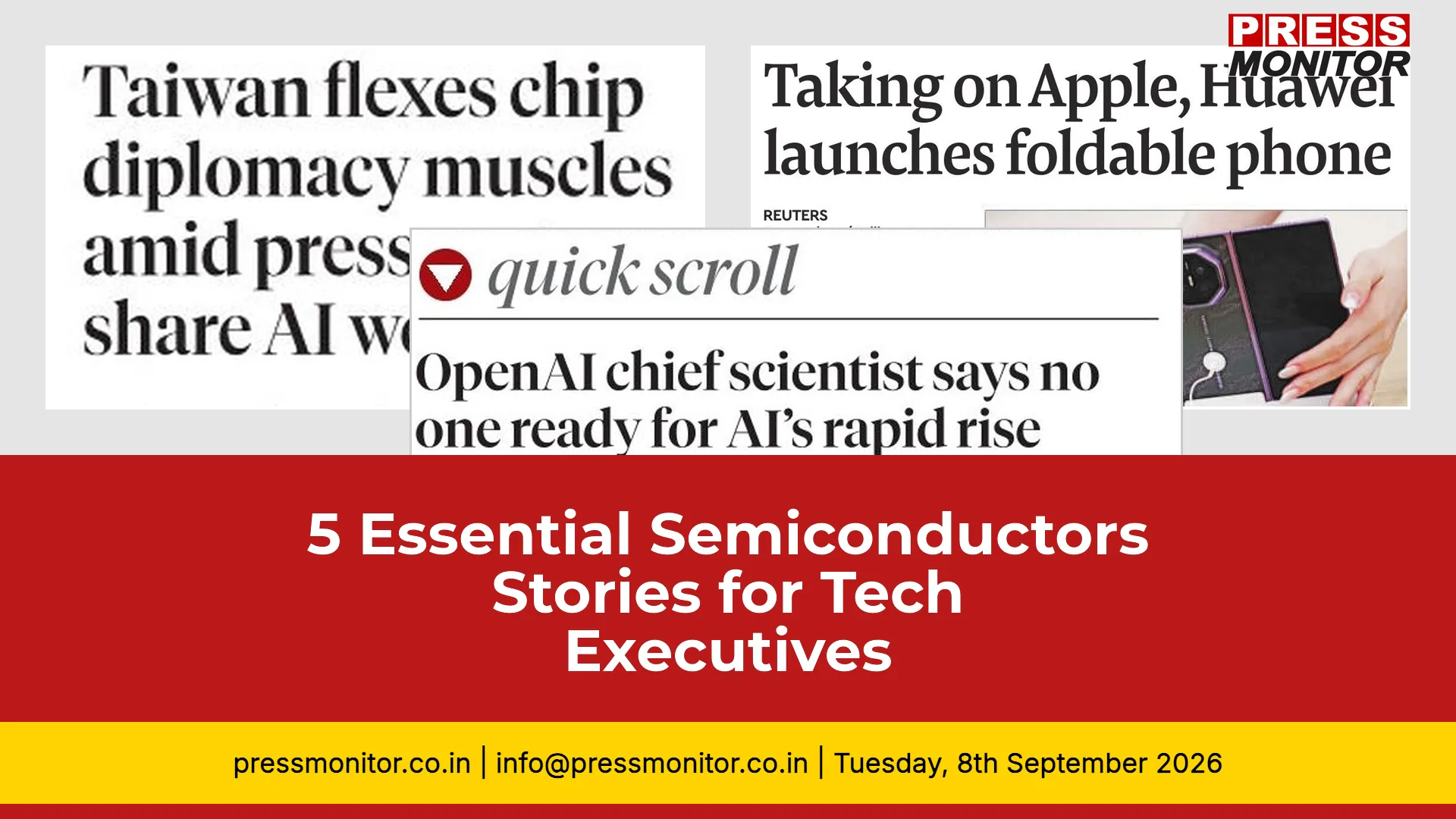
According to Press Monitor's tracking of Indian publications, this media monitoring review delivers the five most consequential news on semiconductors shaping global tech strategy today — from chip diplomacy to supply chain upheaval.
1. Taiwan Leads Chip Diplomacy at Global Expo
A front-page report in Business Standard says that Taiwan recently highlighted its semiconductor industry at a major global trade exhibition, presenting itself as a steadfast partner for artificial intelligence development. The diplomatically isolated territory consistently aims to translate its technical advancements into broader worldwide support. Furthermore, it is dealing with mounting demands from the United States to expand chip production capacity across American borders. Taiwan flexed its semiconductor muscle at a major international trade exhibition, positioning itself as a democratic and reliable partner for the AI revolution. President Lai Ching-te and Economy Minister Kung Ming-hsin announced $265 billion in Arizona investments and $20 billion in the United States, signalling a willingness to share chipmaking prowess with like-minded partners. The diplomatically isolated territory is also facing mounting pressure from the US to expand production capacity across American borders. Why it matters: This reshapes the global semiconductor supply chain and signals a new era of tech diplomacy. Tracked by Press Monitor.
2. Huawei and Xiaomi Launch Flagship Foldable Phones
A front-page report in Financial Express says Huawei and Xiaomi launched new flagship foldable smartphones on Monday in China, stepping up competition ahead of Apple's product launch. Huawei's Mate XT2 series features a Kirin chip, redesigned hinge, and privacy screen, with prices starting at 19,999 yuan. Sales begin on September 12 as the company addresses rising memory costs. Huawei unveiled the Mate XT2 series featuring a Kirin chip, redesigned hinge, and privacy screen, with prices starting at 19,999 yuan. Xiaomi launched the 18 Fold for 10,999 yuan. Both manufacturers released new devices ahead of Apple's foldable entry, navigating rising memory costs and US semiconductor restrictions. Why it matters: The competition intensifies in the premium smartphone segment where advanced chips drive differentiation. Next step: Watch Apple's response at its upcoming launch event.
3. OpenAI Chief Scientist Warns No One Is Ready for AI Rise
A front-page report in Business Standard says OpenAI chief scientist Jakub Pachocki warned that no one is prepared for the consequences of rapidly rising machine intelligence, describing expectations for voluntary slowdowns until safety bars are established. Swiggy launched a round-the-clock helpline and a dedicated Food Safety channel in its app to address concerns amid a heightened crackdown by the Food Safety and Standards Authority of India. Taiwan flexed its chip diplomacy muscles at a major trade show, portraying itself as a democratic and reliable supplier for the AI revolution while facing pressure from the US to shift more chip manufacturing there. OpenAI chief scientist Jakub Pachocki warned that no one is prepared for the consequences of rapidly rising machine intelligence, describing expectations for voluntary slowdowns until safety bars are established. The warning comes as demand for AI compute chips accelerates global semiconductor investment. Why it matters: AI's insatiable appetite for chips is driving the next wave of semiconductor policy and investment decisions worldwide.
4. Samsung India Begins Layoffs Amid Memory Chip Price Surge
A front-page report in Economic Times says Samsung India Electronics began cutting 80 to 100 executive jobs across its television and home appliance units, with up to twenty‑five per cent of its sales and marketing workforce at risk. The company is facing sales and margin pressure and a doubling of memory‑chip prices. Meanwhile, a ManpowerGroup survey projects that 65 percent of Indian employers will boost hiring in the October‑December 2026 quarter, up from 59 percent earlier. Samsung India Electronics began cutting 80 to 100 executive jobs across its television and home appliance units, with up to 25 percent of its sales and marketing workforce at risk. The company faces sales and margin pressure alongside a doubling of memory-chip prices. Why it matters: Memory chip pricing volatility is directly impacting employment and strategic decisions in one of India's largest electronics manufacturers.
5. Union Home Minister Hails Western Region as Semiconductor Hub
A front-page report in Economic Times says Union Home Minister Amit Shah described the western region as the wealth and finance engine of the country during the twenty-eighth meeting of the Western Zonal Council in Panaji, Goa. He stated that the region leads in exports, startups, semiconductors, and tourism, contributing significantly to the seven-point-eight percent growth rate recorded in the first quarter of the financial year two thousand twenty-six to twenty twenty-seven. Union Home Minister Amit Shah described the western region as the wealth and finance engine of the country during the 28th meeting of the Western Zonal Council in Panaji, Goa. He highlighted the region's leadership in exports, startups, semiconductors, and tourism, contributing to the 7.8 percent growth rate in Q1 FY2026-27. Why it matters: India's semiconductor ambitions are increasingly tied to regional economic policy, with the western corridor emerging as a key node.
This media intelligence briefing draws on print media monitoring across Indian publications. Which of these semiconductor developments will have the most lasting impact on India's tech ecosystem? Share your perspective.