5 Essential Workplace Stories for Professionals


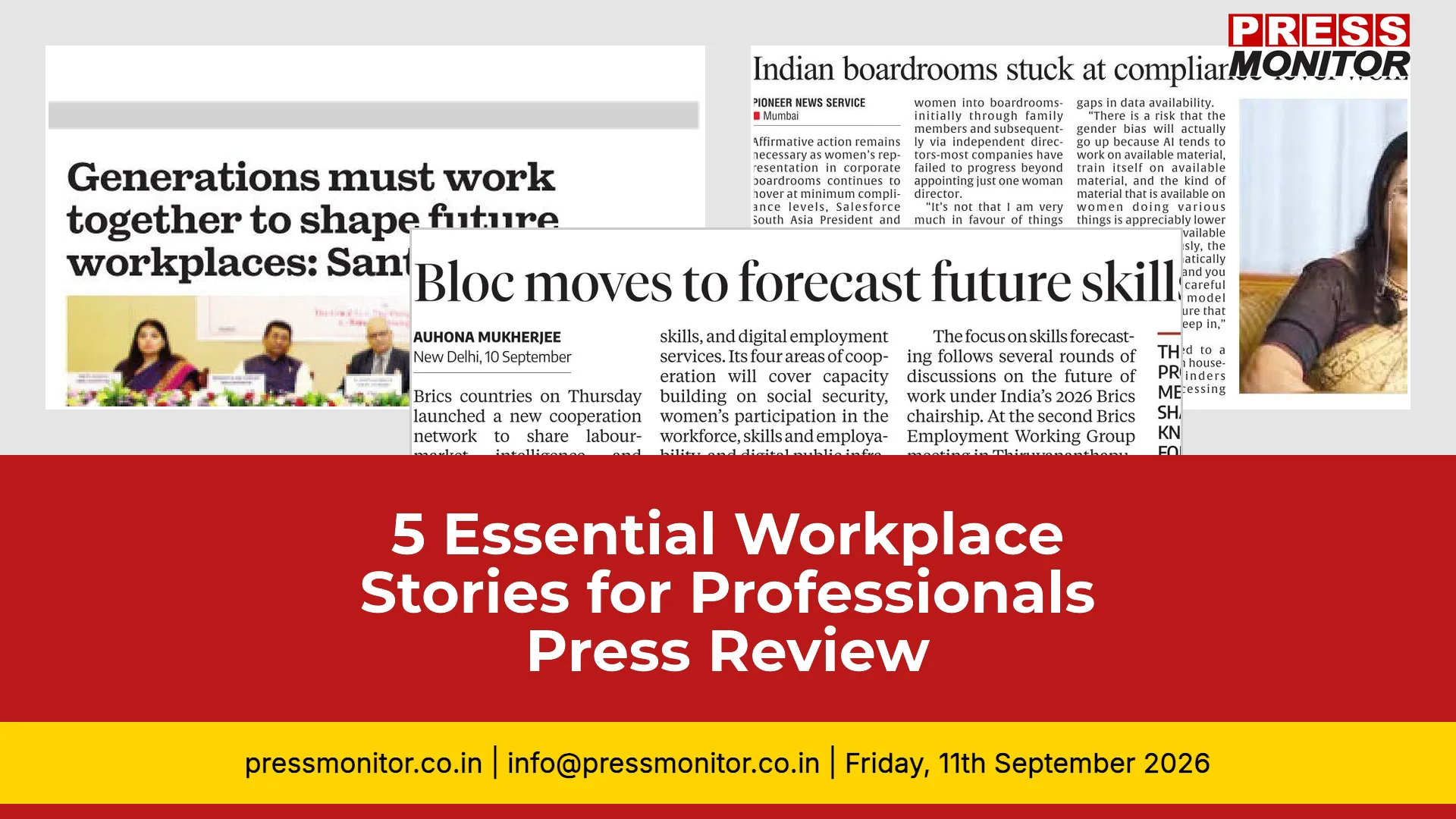
This press review covers the top news on workplace trends, drawing on media monitoring of Indian print publications. From intergenerational leadership to boardroom gender parity and global skills forecasting, these stories reflect the power of press review and media intelligence through print media monitoring across India's diverse newspaper landscape.
1. Dr Santosh Bhave on Intergenerational Leadership
A front-page report in Free Press Journal says veteran human resources professional Dr Santosh Bhave urges organisations to foster intergenerational collaboration rather than viewing Generation Z and older workers as competitors. He highlighted the need for leadership to shift towards coaching, listening, and open trust during his address at the National Institute of Personnel Management lecture in Mumbai. Meanwhile, Northeastern and Western railways announced extended festival train services, recognised staff for operational vigilance, and reported August freight loading growth.
Dr Santosh Bhave, veteran human resources professional, challenged organisations to move beyond viewing Gen Z and older employees as competing generations. His address at the 34th Late Shri Naval Tata Memorial Lecture, organised by the National Institute of Personnel Management in Mumbai, called for inclusive workplaces where people across age groups can learn and succeed together. Why it matters: As younger generations reshape the workforce, leadership culture must evolve to harness cross-generational talent. Key detail: Bhave stressed the need to rethink leadership and workplace culture for cross-age learning and collaboration. Source: Free Press Journal, Mumbai, 2 September 2026. Next step: Organisations should audit their culture policies for generational inclusivity. Tag Dr Santosh Bhave in the comments — what does intergenerational leadership look like in your workplace?
2. Arundhati Bhattacharya Urges Boardroom Gender Parity
A front-page report in The Pioneer says that Salesforce South Asia President Arundhati Bhattacharya has called for affirmative action to improve women's representation in Indian corporate boardrooms, which remain at minimum compliance levels. Speaking at the Global Fintech Fest 2026 in Mumbai on Thursday, she warned that rapid adoption of artificial intelligence risks deepening existing gender biases due to gaps in data availability. She also highlighted the digital divide in households and called for policy interventions to ensure women can participate equally in the changing technological landscape.
Salesforce South Asia President Arundhati Bhattacharya has called for affirmative action to improve women's representation in Indian corporate boardrooms, which remain at minimum compliance levels. Speaking at the Global Fintech Fest 2026 in Mumbai, she warned that rapid adoption of artificial intelligence risks deepening existing gender biases due to gaps in data availability. Why it matters: Gender parity in leadership is not just an equity issue — it is a business imperative for AI-ready organisations. Key detail: Bhattacharya highlighted the digital divide in households and called for policy interventions to ensure women can participate equally in the changing technological landscape. Source: The Pioneer, Delhi, 18 July 2026. Next step: Companies must embed gender parity metrics into board governance frameworks. Tag Arundhati Bhattacharya if you believe boardroom diversity drives innovation.
3. Brics Launches CONNECT Network for Future Skills
A front-page report in Business Standard says Brics countries launched Brics CONNECT, a cooperation network to forecast future skills and share labour‑market intelligence. The network, unveiled in New Delhi on 10 September 2026, will cover capacity building on social security, women’s workforce participation, skills and employability, and digital public infrastructure. Meetings in Hyderabad and Thiruvananthapuram earlier in the year focused on AI, gig workers and traditional knowledge, underscoring the group’s commitment to a future‑ready workforce.
Brics countries launched Brics CONNECT, a cooperation network to forecast future skills and share labour-market intelligence. Unveiled in New Delhi on 10 September 2026, the network will cover capacity building on social security, women's workforce participation, skills and employability, and digital public infrastructure. Why it matters: Coordinated workforce planning across Brics nations signals a new era of skills forecasting that Indian organisations must prepare for. Key detail: Earlier meetings in Hyderabad and Thiruvananthapuram focused on AI, gig workers, and traditional knowledge. Source: Business Standard, New Delhi, 10 September 2026. Next step: Indian firms should align talent strategies with Brics skills forecasting priorities.
4. BDA Abandons Rs 10 Crore Relocation Plan
A front-page report in Deccan Herald says the Bangalore Development Authority has abandoned its proposal to distribute staff across three municipal transport complexes, deciding instead to secure a single temporary headquarters during the planned redevelopment of its Kumara Park West office. The initial relocation scheme carried an estimated cost of around Rs 10 crore for interior modifications, though state government approval for the demolition remains pending amid heritage preservation debates. Officials maintain that final architectural plans are still in preliminary stages.
The Bangalore Development Authority has abandoned its proposal to distribute staff across three municipal transport complexes, deciding instead to secure a single temporary headquarters during the planned redevelopment of its Kumara Park West office. Why it matters: Urban infrastructure decisions directly affect workplace environments and city-level economic planning. Key detail: The abandoned scheme carried an estimated cost of around Rs 10 crore for interior modifications, while state government approval for demolition remains pending amid heritage preservation debates. Source: Deccan Herald, Bangaluru. Next step: City planners must balance redevelopment with heritage conservation.
5. CUJ Hosts Online Guest Lecture on Career Building
A front-page report in State Times says the Training and Placement Office of the Central University of Jammu organised an online guest lecture for BTech students on building future careers. The session was delivered by Pavan Kulkarni of Qualeomm, who discussed industry expectations, interview readiness, and professional growth. Students gained practical insights into workplace expectations and the mindset required to succeed in the technology sector.
The Training and Placement Office of the Central University of Jammu organised an online guest lecture for BTech students on building future careers, delivered by Pavan Kulkarni of Qualeomm. Why it matters: Bridging the gap between academia and industry is critical for student employability and workplace readiness. Key detail: Students gained practical insights into industry expectations, interview readiness, and professional growth. Source: State Times, Jammu. Next step: Universities should expand industry-partnered career sessions. What workplace trend from today's stories will most impact your organisation? Share your thoughts below.